SEO for landscapers and lawn care companies, planned around the seasons
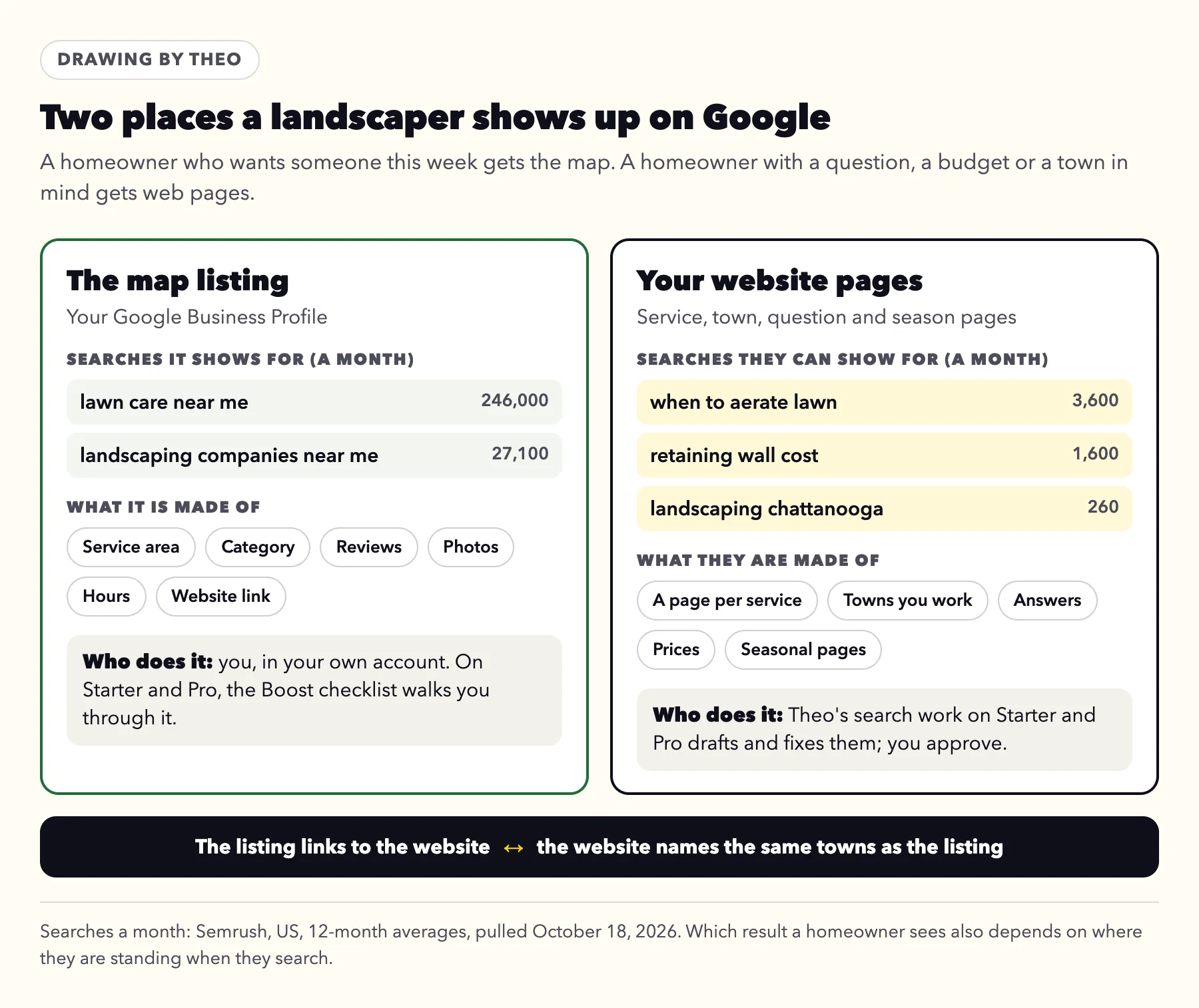
Homeowners find a landscaper two ways on Google: on the map when they want someone this week, and through web pages when they have a question, a budget or a town in mind. On Starter and Pro, Theo's search work handles the web pages. Below is what it did on a lawn care site Theo built: the searches it picked, the pages it wrote and the note it left.
Your first build is on Theo: see the site before you decide
SEO for landscapers is two jobs. The first is the map listing: a Google Business Profile with your service area, photos and a steady run of reviews, which is what a homeowner sees after typing "lawn care near me". The second is the website, which answers what homeowners search for the rest of the time: a page for each service, a page for each town you work in regularly, plain answers to questions like when to aerate, and seasonal pages that go up before the season does. On Starter and Pro, Theo takes on the website job. It researches the searches in your towns, drafts pages and posts and fixes technical problems. On every plan, connecting Google also submits your sitemap. Drafts wait in your Growth tab until you approve them, unless you turn on auto-publish, and the Boost checklist takes you through the Business Profile and your other listings. The work runs on a site Theo builds and hosts, and the first draft of that site costs nothing.
In Theo's audit of 6,861 small business websites, 36 percent of the 440 home services and trades sites with search data got an estimated zero visitors a month from Google search, and 56 percent got fewer than ten. The sample is the sites whose owners ran Theo's free audit. See the research.
On a lawn care site Theo built
Three runs on a lawn care site, and what each one did
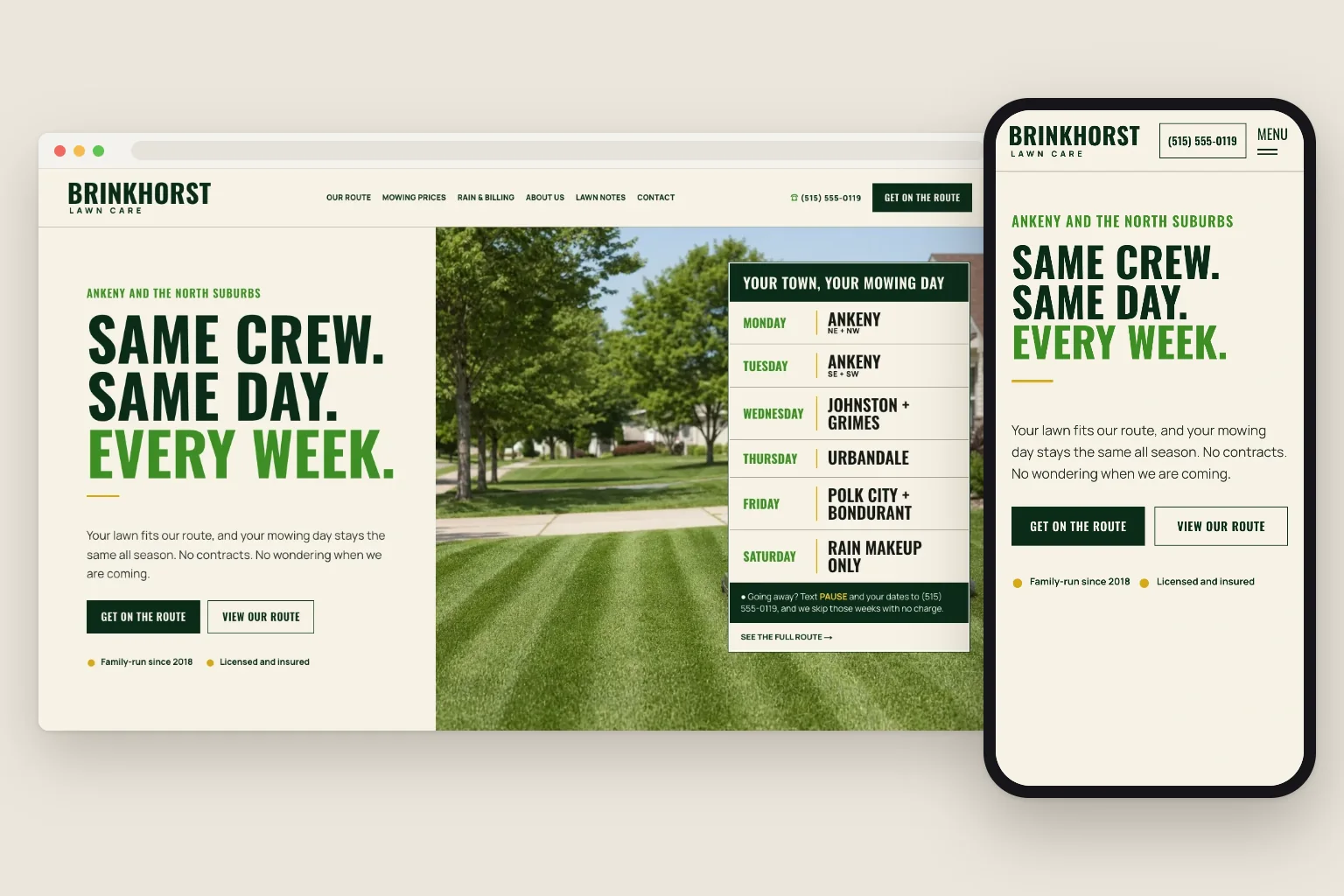
Brinkhorst Lawn Care, a site built by Theo, is a lawn care business with a weekly mowing route in Ankeny and the towns north of Des Moines, Iowa. On October 19, 2026, Theo's Growth Engine, the search work on Starter and Pro, ran on it three times: once to write a blog post, once to write a page, and once to check the whole site. Each piece of work waited in the Growth tab until it was published from there. On a lawn care company's own site these jobs are spread across the weeks, not done in one sitting.
The runs worked from Semrush data and a direct check of the live site. On your own site, the work starts once your domain points at it and Google is connected.
The searches it chose
Before writing, each run looked up searches in Semrush for the US: how many people type each one in an average month, and keyword difficulty, Semrush's 0 to 100 score for how hard a search is to win. Here is what the two writing runs picked.
The post run compared five lawn questions, the national "when to aerate lawn" among them at 3,600 searches a month, and picked the Iowa version, which its note calls a strong, locally relevant opportunity. The page run looked up seven Ankeny searches; Semrush had a monthly figure for two, "lawn care ankeny ia" (70 a month, difficulty 37) and "core aeration ankeny ia", and the run built the page around core aeration, a service already on Brinkhorst's site.
What it wrote
A seasonal post, a town service page and a section to hold more
Each writing run drafts one piece, checks it on phone, laptop and desktop screens, and links it from the pages around it. These are the pages the runs added, as they open on the live site.
Built by TheoBrinkhorst Lawn CareThe Iowa aeration guide, on a laptop.See the live site
01
A seasonal question, answered for Iowa
When to Aerate Your Lawn in Iowa is a post of about 2,000 words. It opens with April and September as the windows for cool-season lawns, citing Iowa State University Extension, then covers the signs of packed soil, how to judge the day by the ground, where overseeding fits, a homeowner checklist and four common questions.
Where a reader needs a next step, it links to Brinkhorst's aeration, cleanup, mowing-price and contact pages.
Built by TheoBrinkhorst Lawn CareThe new town service page: what core aeration solves, and its price box.See the live site
02
One service, one town
Core Aeration in Ankeny, IA is a page of about 1,200 words for homeowners in that town. It says what aeration fixes and when it will not help, why September is the main season with spring as a second window, when to add overseeding, the price range by lot size and how to get the yard ready, then answers four questions homeowners ask before booking.
The Core Aeration card on the homepage now links straight to it.
Built by TheoBrinkhorst Lawn CareLawn Notes, the new section, with Lawn Timing as its first topic.See the live site
03
A section for the next seasonal answers
The post opened Lawn Notes, a section with its own place in the main menu, and a Lawn Timing topic page inside it. Later posts about the lawn calendar have a home there, and no empty topic shows in the meantime.
All three new addresses went into the site's sitemap with the post.
What it linked and checked
The writing runs linked each new page into the site as they went. The third run, SEO repair, wrote nothing new: it went through every public page and found nothing that needed changing.
What it did
Where
Why it helps
Linked the new pages in
Lawn Notes in the main menu, the homepage's Core Aeration card to the Ankeny page, and the post to the aeration, cleanup, mowing-price and contact pages
Homeowners and Google reach each new page from pages they already use.
Added the new addresses to the sitemap
The post, Lawn Notes, Lawn Timing and the Ankeny page
The sitemap is the list Google reads to find a site's pages.
Labeled the pages for search engines
Question and breadcrumb markup on the post and the Ankeny page, and service markup on the Ankeny page
Structured data spells out the questions, the trail of pages and the service in a form search engines read directly.
Checked the rest
Every public page: titles, descriptions, preferred addresses, links, the sitemap and the instructions for search engines
Every page passed, so the run left the site alone.
Left alone on purpose
Rewrites of existing pages, and redirects
With no Search Console or visitor data yet, nothing showed that a page needed rewriting or that an old address needed a redirect.
Your Growth tab
The note from the Ankeny run
Every run ends with a note in the Activity list of your Growth tab: what it looked at, what it changed and why. Here are excerpts from the note the Ankeny page run left, as Theo wrote it.
On Starter and Pro, a weekly email also counts what was added, such as new posts, updates and pages.
Pricing
What it costs, in full
The ongoing search work is part of Starter and Pro. Basic is the site and hosting on its own. Starter is free for the first 30 days.
Plan
Per month
Ongoing search work
Chat credits
Best for
Basic
$29.99
Not included
1,500 a month
Owners who just want their site live and easy to update.
StarterFree for 30 days
$69.99
Included, uses no credits
4,500 a month
Owners who want the site handled without heavy publishing volume.
Pro
$129.99
Included, uses no credits
7,000 a month
Owners who want more capacity, more publishing, and more room to experiment.
No contract, cancel anytime, and you own the site and its content. The pricing page lists what each plan includes and how chat credits work.
Which landscaping searches a website can win, and which go to the map
Landscaping searches come in three kinds, and each is won by something different. "Near me" searches are by far the biggest, and Google answers them with a map of nearby Business Profiles first. Questions and cost searches are smaller, and local companies' own pages answer a good share of them. Town searches are smaller again, and mostly go to companies based in that town.
The table pairs real searches with what tends to win them. The numbers are Semrush's for the US, pulled October 18, 2026; difficulty is its 0 to 100 score. For the last column we checked each of the top 10 US results Semrush lists for the search, opening the pages to confirm, and counted the ones that belong to small local landscaping, lawn or hardscape companies.
Search
Searches a month
Difficulty
What wins it
Who ranks today (October 18, 2026)
lawn care near me
246,000
57
Your Business Profile: service area, category, reviews
A map of nearby Business Profiles at the top; below it, mostly national chains, directories and booking sites
when to aerate lawn
3,600
4
A question post
4 of 10 are local lawn care companies' own posts
retaining wall cost
1,600
14
A cost page on a hardscape site
3 of 10 are local landscaping or paver companies
how much does lawn mowing cost
390
32
Your own prices page, for homeowners in your towns
None of 10: booking sites, forums, cost guides and a mower maker
how much does landscape design cost
320
5
A process or cost page on a design-build site
About half are local landscape design companies
landscaping chattanooga
260
16
The homepage of a company based in Chattanooga
7 of 10 are Chattanooga companies' homepages
lawn care des moines
390
53
A lawn company based in the area, mostly with its homepage
6 of 10 are local lawn companies: five homepages and one Des Moines area page, in seventh place
retaining wall contractors pittsburgh
170
19
A walls page on a local hardscape site
7 of 10 results are Pittsburgh-area companies' pages, two of them retaining wall pages
Drawing by Theo. Searches a month are Semrush's US averages, pulled October 18, 2026.
What the table means for your own pages
A "near me" search goes to the map, so the website's part there is to back the listing up: the same business name, the same towns and a page for each service the listing names. The searches a website can take on by itself are the questions, the costs and the services in a named town.
Town searches need care. A company based in the town usually holds the top spots with its homepage. A town page can earn a place for a town you work in regularly: in the October 18 check, one lawn company's Des Moines area page was seventh for "lawn care des moines". A single town page does not carry a whole metro, though. Difficulty does not follow size either: "when to aerate lawn" gets 3,600 searches a month at a difficulty of 4, while "how much does lawn mowing cost" gets 390 at 32.
That is why the research step on Starter and Pro goes for searches a site can realistically win, like "core aeration ankeny ia" in the run above, before it reaches for the biggest number.
When homeowners search for each landscaping job
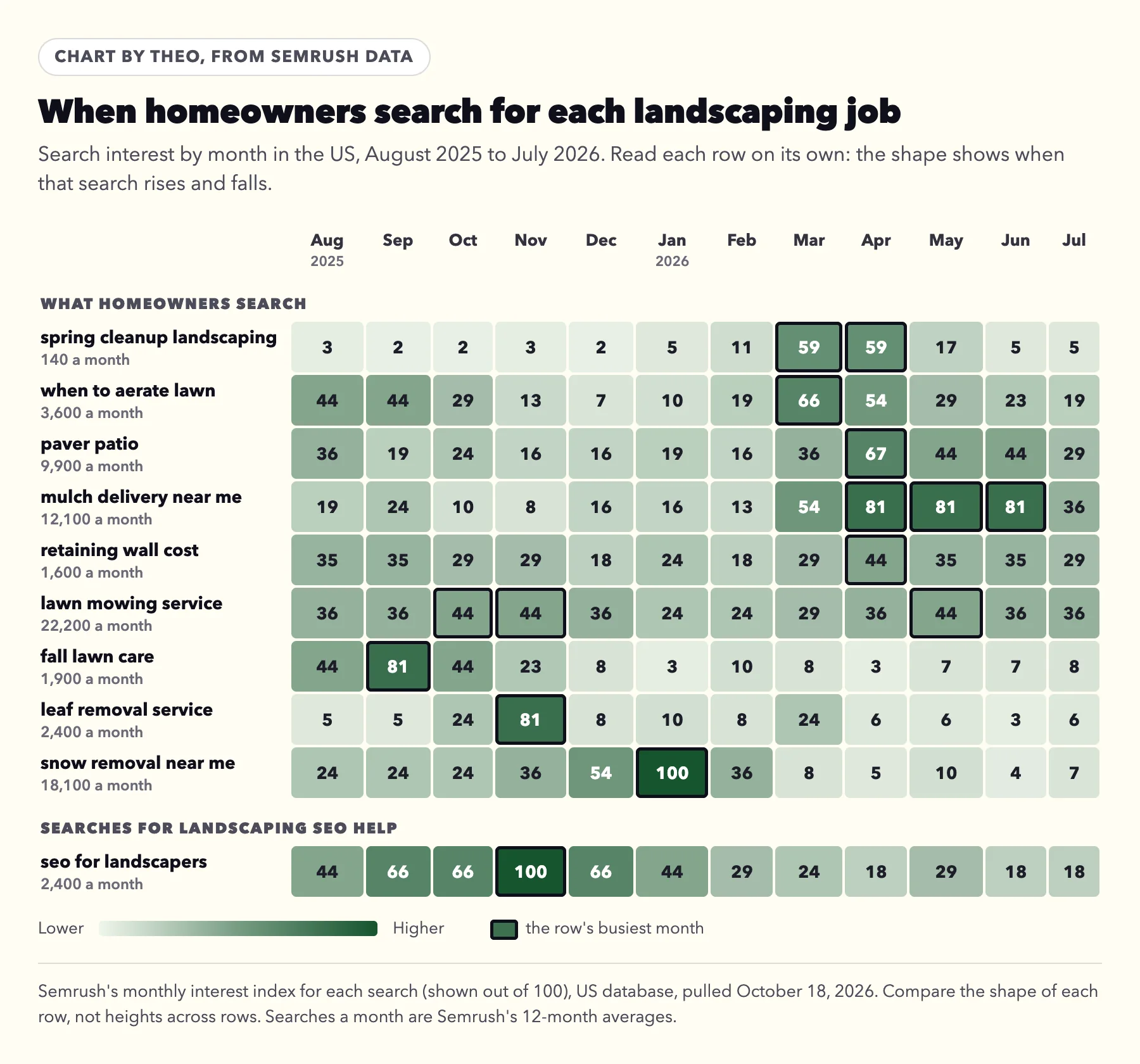
Landscaping searches rise and fall with the seasons, and the pattern is sharp enough to plan around. In Semrush's US data for August 2025 to July 2026, spring cleanup searches stayed low until March, leaf removal climbed in October and peaked in November, and snow removal peaked in January. "When to aerate lawn" rises twice: in March and April, and again in August and September.
The chart below has one more row worth a look. Searches for "seo for landscapers" peak in November, in the slow months, which is also the right time to start: the pages written then have the winter to settle in before spring.
Google needs time to find and place a new page, so a seasonal page does the most good when it is on the site well before its searches climb. Working back from the chart below:
By January: spring cleanup, spring aeration and the mulch page.
By February: paver patio, retaining wall and drainage pages, ahead of their April high.
By July: fall lawn care, fall aeration and overseeding, and leaf removal.
By October: snow removal, if you plow.
Semrush's monthly interest index for each search, US, August 2025 to July 2026, pulled October 18, 2026. Compare the shape of each row, not heights across rows.
Pages that bring in searches, by kind of landscaping business
Each kind of landscaping company has its own searches to aim for. The table pairs a few of them, with Semrush's US numbers, with the page on your site that answers each. What those pages should say and show is on the page about landscaping website design; this page is about getting them found.
Kind of business
Searches to aim for (searches a month, difficulty)
The page that answers them
Mowing route
weekly lawn mowing (170, 27); lawn care ankeny ia (70, 37)
A mowing page with what a visit includes and how you price it, and a page for each town on the route
Lawn treatment
aeration and overseeding (1,900, 22); lawn aeration cost (1,000, 10); fall lawn care (1,900, 24)
A program page with the rounds and prices, and one post for each seasonal question
A process page with the design fee, a plants page true to your area, and project stories that state the price
Hardscape
french drain cost (1,900, 11); how much does a paver patio cost (210, 15)
A walls and drainage page with price ranges, a patio page that says what moves the price, and before-and-after pairs
Mowing routes: where you go and what it costs
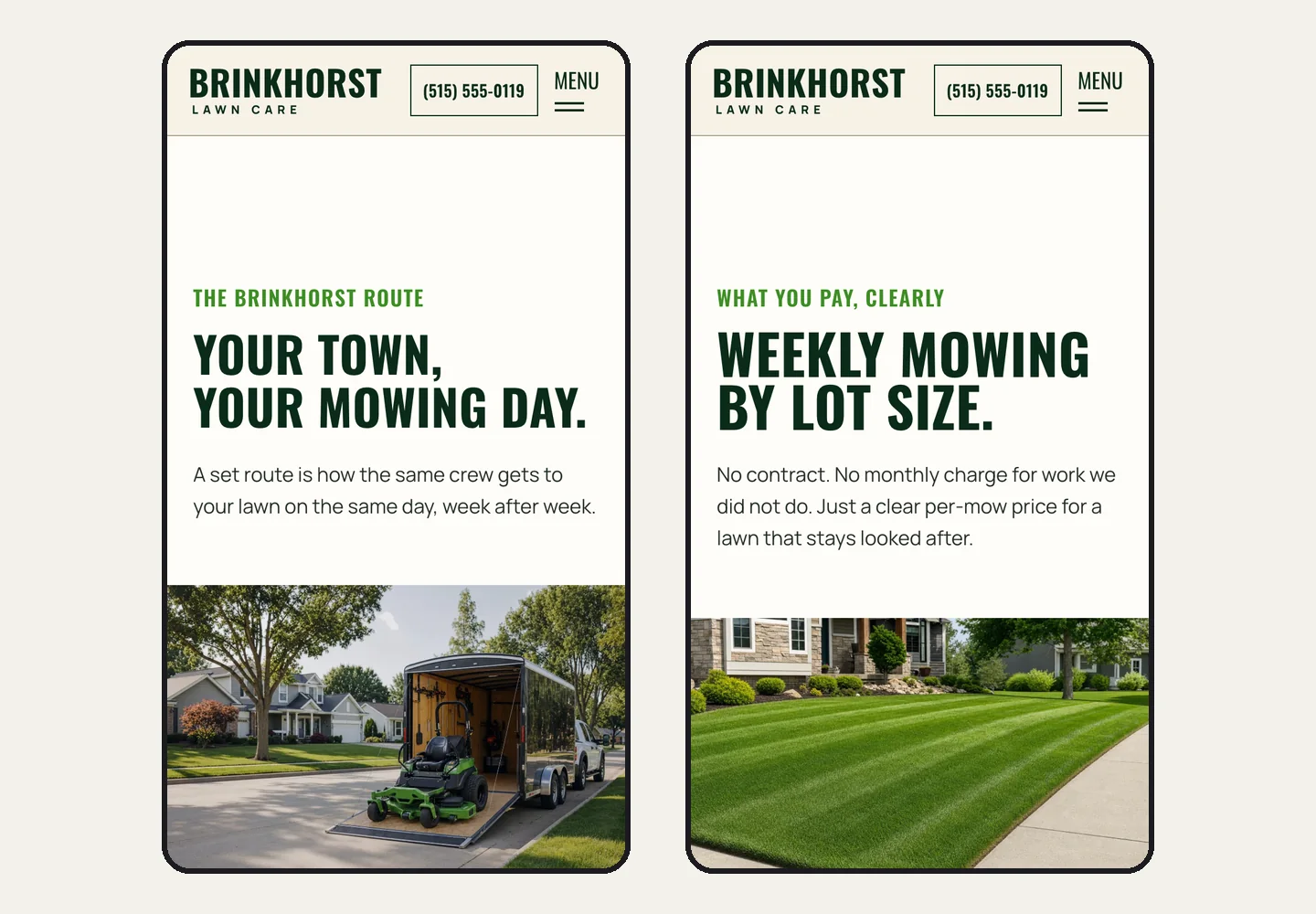
A homeowner shopping for mowing checks two things before anything else: whether you come to their street, and what a mow costs. Brinkhorst answers each on its own page, the route page by town and mowing day, the prices page by lot size. New writing links back to them: the run's aeration post sends readers to the prices page.
Built by TheoBrinkhorst Lawn Care's route page and prices page on a phone. See the live site
Lawn treatment: one question, one post
Treatment programs sell one season at a time, and homeowners often look up a round before they book it, which makes treatment the natural home for question posts. The run above shows the split: the post answers when to aerate for any Iowa homeowner, and the Ankeny page offers the service to one town. Plain answers like these are also the kind AI answers can quote; the guide to showing up in AI Overviews explains how that works.
Built by TheoThe run's post on a phone, and the town service page at its price box, as they read on October 21, 2026. See the live site
Design-build: the price and the plants
A design-build customer often reads for a while before calling, and cost is a common first search: "landscape design cost" alone gets 720 searches a month. Larkhollow Landscape Design, a Chattanooga site Theo built, answers it on a project story that puts the project total, plan included, right under the headline. Its plants page does the same for the other early question, what will grow in shade, on a slope and around deer.
Built by TheoLarkhollow's project story opens with its total cost. See the live site
Hardscape: walls, drainage and photos that line up
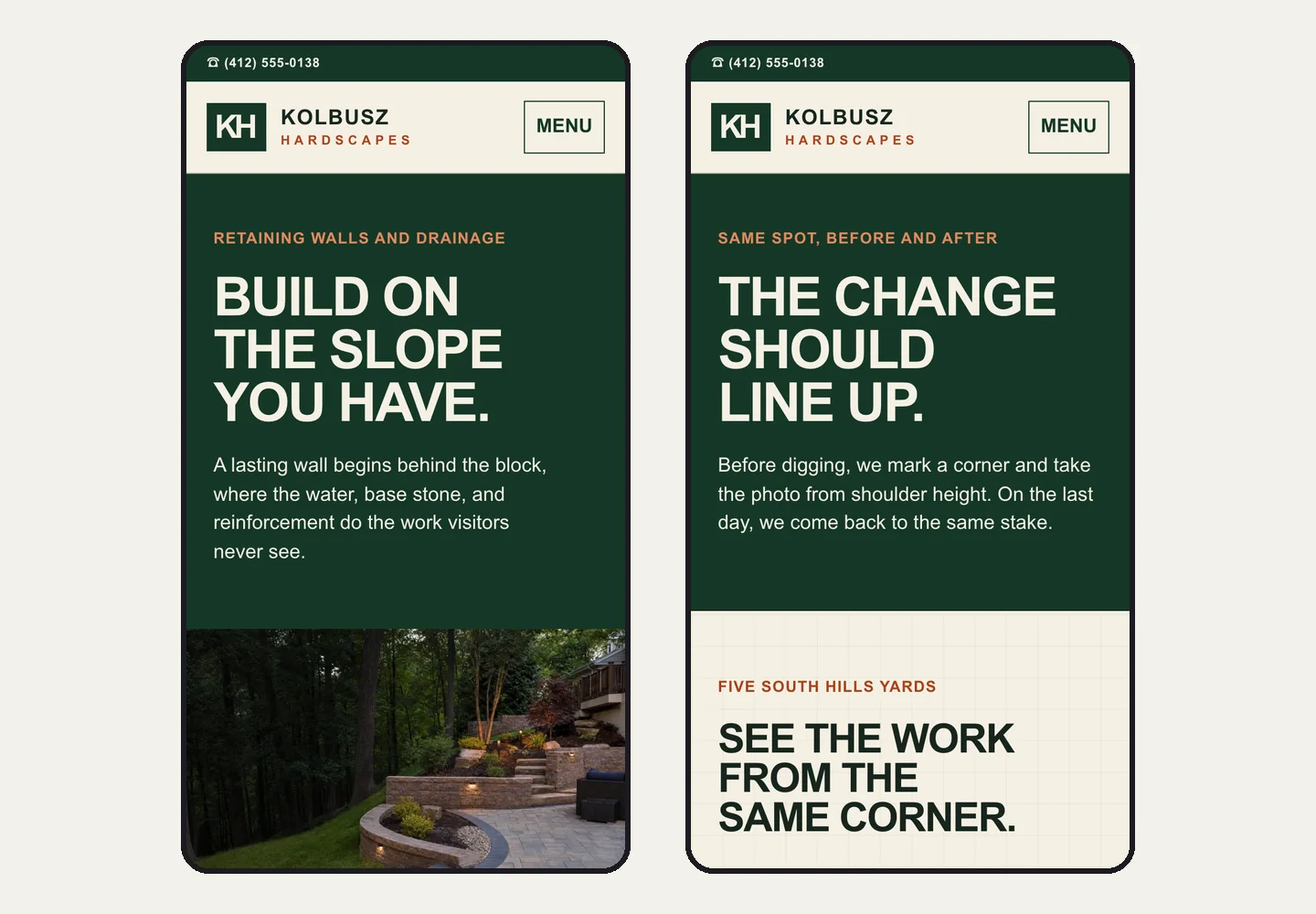
Hardscape searches often pair the job with a place, like "retaining wall contractors pittsburgh", and in October 2026 two of the top results for that one were local companies' retaining wall pages. Kolbusz Hardscapes, a South Hills site Theo built, gives walls and drainage a page of their own and shows before-and-after pairs shot from the same corner, the proof a homeowner pricing a wall wants to see.
Built by TheoKolbusz Hardscapes' walls page and before-and-after page on a phone. See the live site
Your Google Business Profile when you work at the customer's yard
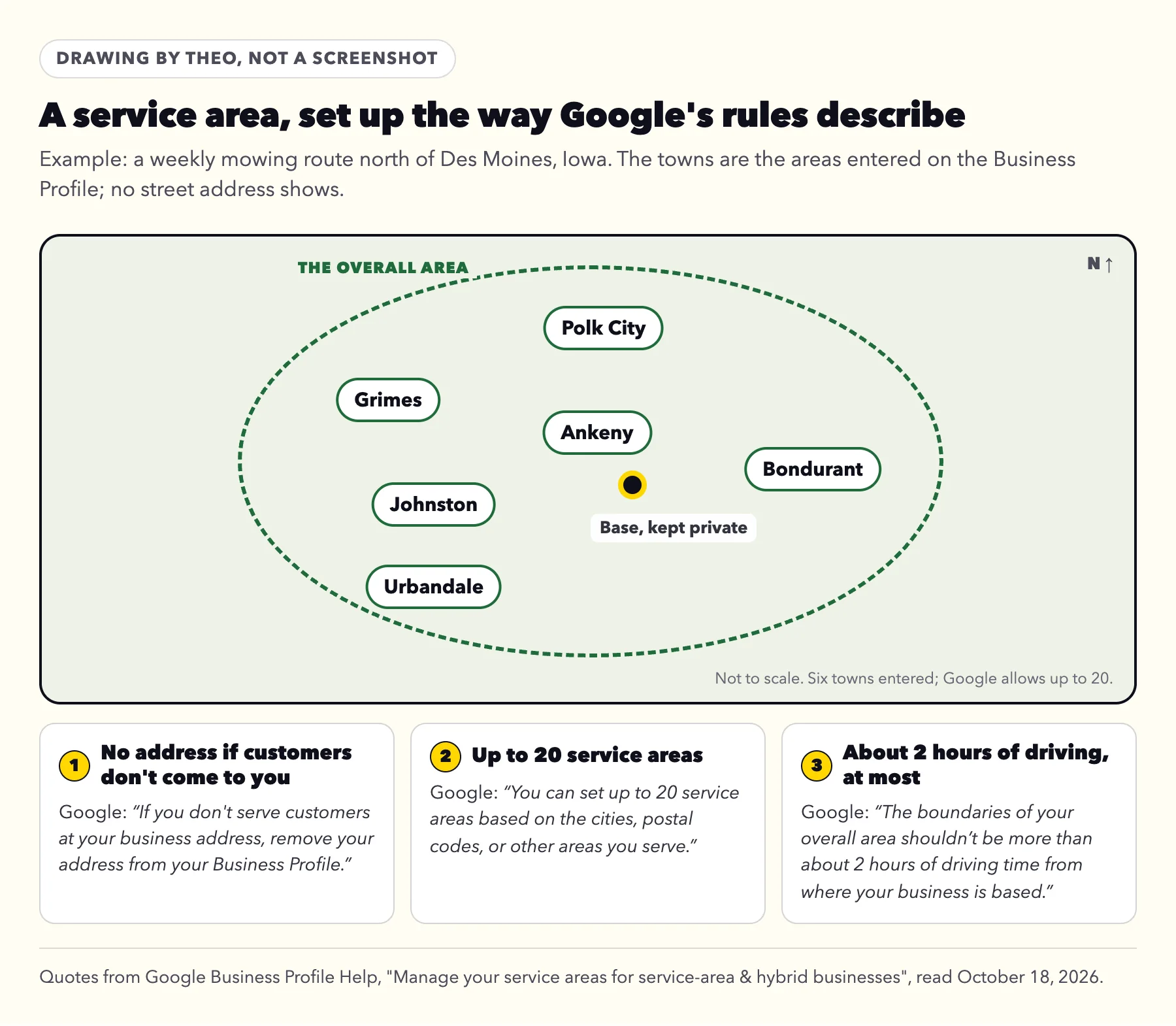
Most landscapers do their work at the customer's house, and Google's rules for that case are specific. Google's rule is that a business customers do not visit takes its address off the profile. These lines are from Google's help on service areas and on representing your business, read on October 18, 2026.
The address. "If you don't serve customers at your business address, remove your address from your Business Profile."
The towns. "You can set up to 20 service areas based on the cities, postal codes, or other areas you serve."
The reach. "The boundaries of your overall area shouldn’t be more than about 2 hours of driving time from where your business is based."
The name. "Your name should reflect your business’s real-world name, as used consistently on your storefront, website, stationery, and as known to customers." Towns and services belong in the service area and the categories, not in the name.
The categories. "Use as few categories as possible to describe your overall core business from the provided list." Start with the one that names your main work.
Setting the service area, step by step
Open your Business Profile and select Edit profile, then Location.
Next to Service area, select Edit.
Pick a suggested area or type a town or ZIP code, once for each place you work regularly.
Select Save.
If customers never come to you, select Edit next to Business location, turn off Show business address to customers, and select Save.
A drawing, not a screenshot. Steps and quotes from Google Business Profile Help, read October 18 and 19, 2026.
Photos and reviews, job by job
Photos and reviews keep a listing current. Add pictures of finished yards as the season goes, and ask every customer for a review the same way once the job is done; Theo's free Google review link generator makes the link to send. Answer reviews as they come in, the unhappy ones included, with help from the post on responding to negative Google reviews. If Google asks you to verify the listing with a video, the video verification guide walks through it.
Which Google account is which
Is this for connecting the website to the Google maps business listing or... the Google Ads account or something else entirely?
One owner wrote, 2026
It is an easy mix-up, because three Google products touch a landscaping business and each does a different job. The full version of this table, with Google Analytics and the code Google asks you to add when you verify a site, is in the Google site verification guide.
Google product
What it does for a landscaper
Who sets it up on Theo
Google Business Profile
The map listing: service area, hours, reviews and photos
You, in your own account, with the Boost checklist on Starter and Pro
Search Console
Shows how Google sees your website: which pages are indexed and which searches bring clicks
Theo, after you select Connect Google once your domain is live (Analytics is set up the same way)
Google Ads and Local Services Ads
Paid listings at the top of the results, billed by Google
Not part of the search work; set up on its own if you want ads
Your part through the mowing season, and Theo's
You do not have to write anything. Theo researches, drafts and fixes, and your part is short, most of it done once.
Once: point your domain at the site and select Connect Google, so Theo can set up Search Console and Analytics. The search work starts after that, so it pays to do it early in Starter's free 30 days.
Most weeks: open the Growth tab and approve what is waiting, or turn on auto-publish and let drafts go live on their own. On Starter and Pro, a weekly email lists what was added.
When the work changes: tell Theo in plain words about a new service, a new town on the route or a job you are dropping for the season, and drag photos of finished yards into the chat as you take them.
After every job: ask for the review.
When Google emails you: a Search Console email about pages that are not indexed means Google is crawling the site. On Starter and Pro, the search work's SEO repair reads those reports and fixes what it finds, from redirects to sitemap issues. The Search Console guide explains each reason in plain words.
How long landscaping SEO takes
Search traffic builds over months, not weeks. Google's own guidance on hiring an SEO puts the payoff at four months to a year. Google Search Central gives that range in its video How to hire an SEO, and its SEO Starter Guide puts it this way: "Some changes might take effect in a few hours, others could take several months."
The first sign to watch is impressions in Search Console, which mean Google has indexed a new page and is showing it in results. Clicks follow as pages climb. If some pages wait a while to be indexed, the guide to Discovered - currently not indexed explains that status.
A landscaper has a second clock to watch: the season. A fall cleanup page published in October is late for this year's leaves, while one published in July has the summer to settle in.
What you can check is the work, all season long: every page, post and fix in the Growth tab, and the clicks and impressions Google reports in your Analytics tab.
Before you hire anyone for landscaping SEO
Google keeps a page for owners weighing outside help, Do you need an SEO?, last updated June 5, 2026. Two of its lines are worth keeping by the phone: "If they guarantee you that their changes will give you first place in search results, find someone else." And: "Ultimately, you are responsible for the actions of any companies you hire."
Some pitches arrive with a screenshot from a third-party SEO tool. Google's advice on those is to "check their recommendations against official guidance from Google Search" before changing anything, and Search Console is Google's own free report on your site. One of those pitch emails, read line by line, is in the guide to whether SEO is worth it for a small business, along with what to ask before you pay anyone.
If you already have a landscaping website
Theo's search work runs on a site Theo builds and hosts, because the system that drafts a page is the one that publishes it, links it, fixes it and submits the sitemap. Paste your current site's address and Theo rebuilds it as a starting draft in the same look, and you correct it in the chat. Your old site stays up until your domain points at the new one.
A move does not mean starting over with Google. Once Search Console is connected, the search work on Starter and Pro redirects the old addresses that still get search traffic to the matching new pages, and on any plan, Theo adds any other redirect you ask for in chat. The post on redesigning a website without losing SEO covers the rest of a move.
If you quote and schedule in Jobber or Housecall Pro, the estimate buttons on the new site can open your request form there; the Jobber page shows how. The site itself, from the route board to the project stories, is covered on landscaping website design. The same search work for any business is on small business SEO services, and the runs on a roofing site are on SEO for roofers.
FAQ
Questions landscapers ask about SEO
How much does SEO for a landscaping company cost on Theo?
The search work comes with two plans: Starter, at $69.99 a month with the first 30 days free, and Pro, at $129.99 a month. Each price covers the website, its hosting and the ongoing search work, with no separate build fee. Basic covers the site and hosting without the search work.
How long until my landscaping site shows up on Google?
A new page first has to be found and indexed, and the first sign of that is impressions in Search Console. Clicks come later, as pages climb. Search traffic builds over months, not weeks. Google's own guidance on hiring an SEO puts the payoff at four months to a year, which is why a page for next spring is best written this winter.
Who owns the website and the pages Theo writes?
Your business does: every page and post, your photos and your words. Theo hosts the site for you, and on Pro you can also copy its code through read-only access on GitHub. A domain you bought elsewhere stays registered where it is.
Can I cancel?
Yes, whenever you like; there is no contract term to wait out. Your cancellation confirmation gives the last day of the plan, and the site stays live until then. Save any page text and job photos you want before that day.
Does Theo set up my Google Business Profile?
No. You make the changes in your own Business Profile, so the listing stays yours. On Starter and Pro, the Boost checklist takes you through it step by step, along with Facebook, Apple Business Connect, Bing Places, Yelp and other listings homeowners check. If customers never come to your shop, Google's help says to remove your address and enter your service area instead.
Is a town page the same as a service area on my Business Profile?
No, they do different jobs. The service area is a setting on your Business Profile that tells Google where you work, so the map listing can show for homeowners there; Google allows up to 20 areas. A town page is a page on your website for a homeowner who types the town into the search, such as core aeration in Ankeny. Write one only for a town you work in regularly, with something true about its lawns and yards.
Will this help me show up in ChatGPT and Google's AI answers, or is that an add-on?
It is not an add-on. Starter and Pro include work toward being cited in AI search tools, including ChatGPT and Google's AI Overviews, as part of the same search work. Those tools choose their own sources, and what helps is a page that answers one homeowner question plainly, like the Iowa aeration post above.
Can Theo do SEO on the landscaping website I already have?
Not on another platform. Theo does the search work on a site it builds and hosts, since the same system writes each page, publishes it and keeps it in order. Give Theo your current site's address and it rebuilds the site as a starting draft in the same look, which you correct in the chat. Your old site stays live until your domain points at the new one, and once Search Console is connected, SEO repair on Starter and Pro redirects old addresses that still get search traffic to their new pages; on any plan you can ask for a redirect in chat.