Contractor SEO: the searches your customers type, and the pages that answer them
Homeowners and property managers find a contractor on Google in two places: the map, and the pages that answer what they type before they call. Below are real searches with real numbers, and the pages Theo's search work wrote on two contractor sites it built, a basement finisher and a commercial build-out crew.
Your first build is on Theo: see the site before you decide
SEO for contractors is the work that puts your company in front of homeowners and property managers when they search for the job you do in the towns you work in. It has two halves. Searches for the job itself, with or without "near me", such as deck builders, basement finishing or tenant improvement contractor, mostly open with Google's map, where your Business Profile and reviews decide who shows. Searches about a cost or a decision, such as cost to finish a basement or composite vs wood deck, open with pages, and a page on your own site can answer them. On Starter and Pro, Theo does the website half: it picks searches your site has a fair chance with, drafts the pages and posts and fixes what it finds. On every plan, connecting Google also submits your sitemap, and Google rereads it on its own, so each new page you publish is on the list it checks. Nothing goes live until you approve it in your Growth tab, unless you turn on auto-publish. On Starter and Pro, the Boost checklist walks you through the map half, in your own accounts. Expect months, not weeks.
In Theo's audit of 6,861 small business websites, 36 percent of the 440 home services and trades sites with search data got an estimated zero visitors a month from Google search, and 56 percent got fewer than ten. The sample is the sites whose owners ran Theo's free audit. See the research.
Rochester and Tucson, built by Theo
A basement finisher and a commercial crew: what each run chose, wrote and checked
Kjelstad Basements and Quintanar Commercial Builders, both sites built by Theo, are a basement finisher in Rochester, Minnesota, and a build-out crew in Tucson, Arizona. On October 19, 2026, the Growth Engine, the search work in Starter and Pro, ran three times on each: once for a post, once for a page, and once to check the whole site. Every piece was published from the Growth tab.
Each post or page run writes one piece. On your own site the runs keep coming on a schedule, week after week.
Four pieces, and the search behind each
Before writing, each run looks up what people type and how many strong pages already answer it, then picks a search the site has a fair chance with. One post answers a planning question that Semrush had no figures for. The numbers are the ones the engine stored from Semrush: searches a month in the US, October 2026, and difficulty, Semrush's score from 0 to 100, where lower means fewer strong pages compete. A difficulty of 0 means Semrush has no data, not that the search is easy.
The town searches are small. Semrush has no difficulty data for them, and the person who types one wants that job done in that town.
Written by the runs
Two posts and two pages, one of each per site
Each run drafted one piece, linked it from pages visitors already use and added it to the sitemap. The post runs also opened a section to hold posts: Advice on Kjelstad and Field Notes on Quintanar.
Built by TheoKjelstad BasementsThe humidity post, first screen on a laptop.See the live site
01
A question homeowners ask before they call
What Humidity Should My Basement Be? is a post of about 2,000 words. It opens with the answer, 30 to 50 percent relative humidity, the range the U.S. Environmental Protection Agency gives, then covers the Minnesota Department of Health's lower winter range, how to tell damp air from water coming in, and when a reading means it is time for a moisture check.
It links to the moisture check, egress, finished-basement and process pages, and it ends with a button to book a free walk-through.
Built by TheoKjelstad BasementsThe Rochester page, with the city above the headline.See the live site
02
A service page for one city
Basement Remodeling in Rochester, MN runs about 1,200 words for homeowners ready to plan a whole basement. It starts with the first walk-through, then covers drainage, permits, the rooms people build downstairs and the order of the job, and answers buyers' questions, with structured data that marks it as a service page with an FAQ.
The home page now links to it from the finished-basements section.
Built by TheoQuintanar Commercial BuildersThe Tucson page, first screen on a laptop.See the live site
03
Commercial remodeling for a business that stays open
Commercial Remodeling in Tucson, AZ is about 1,400 words for owners and property managers changing a space they cannot close. It covers phased work, night and weekend schedules, protecting customers, staff and the site, landlord requirements and what to bring to a bid walk-through, and it leans on the site's own project stories as proof.
The home page links to it from the services area.
Built by TheoQuintanar Commercial BuildersThe planning guide, with Field Notes now in the menu.See the live site
04
A planning guide for the months before a bid
How to Plan Commercial Remodeling While Staying Open is a guide of about 1,900 words on phases, customer access, permits and inspections, utility shutoffs, after-hours work and the opening plan. Its permit advice sends readers to the City of Tucson's commercial permit guidance.
Field Notes, the section it opened, now sits in the main menu.
Seven pages that point Google to themselves, plus new links and sitemap entries
The page and post runs linked each new piece in and added it to the sitemap. The third run on each site wrote nothing new: it went through every public page, the sitemap, the instructions for search engines and the redirects, and changed only what needed changing.
What it did
Where
Why it helps
Pointed seven pages at their own address
Quintanar: Projects, Property Managers, Request a Bid, About, Contact, Privacy and Terms
Each of those pages names itself as its preferred address, its canonical tag, which is what lets a page show in Google as itself.
Left the basement site as it was
Kjelstad: every public page, the sitemap, the search engine instructions and the redirects
Everything opened and matched, so the run changed nothing rather than edit a page for the sake of it.
Linked each new page in
Kjelstad: Advice in the menu and footer, and the home page's finished-basements section. Quintanar: Field Notes in the main menu, and the home page's services area.
Visitors and Google reach the new pages from pages they already use.
Added the new pages to the sitemap
Both sites
Google reads the sitemap to find pages it has not seen yet.
Waited for search data
Rewrites of existing pages, on both sites
Rewrites wait until Search Console shows which existing page needs the work.
Growth tab note, October 19
The Rochester page run, in its own words
After a run, a note lands in the Activity list on your Growth tab, in plain words, with links to every page it touched. Below are excerpts from the note the Rochester page run left.
None of it is live until you publish it from the Growth tab, unless you have switched on auto-publish. On Starter and Pro, a weekly email also counts the new posts, pages and updates.
Pricing
What it costs, in full
The ongoing search work is part of Starter and Pro. Basic is the site and hosting on its own. Starter is free for the first 30 days.
Plan
Per month
Ongoing search work
Chat credits
Best for
Basic
$29.99
Not included
1,500 a month
Owners who just want their site live and easy to update.
StarterFree for 30 days
$69.99
Included, uses no credits
4,500 a month
Owners who want the site handled without heavy publishing volume.
Pro
$129.99
Included, uses no credits
7,000 a month
Owners who want more capacity, more publishing, and more room to experiment.
No contract, cancel anytime, and you own the site and its content. The pricing page lists what each plan includes and how chat credits work.
What contractors' customers search for, and who shows up now
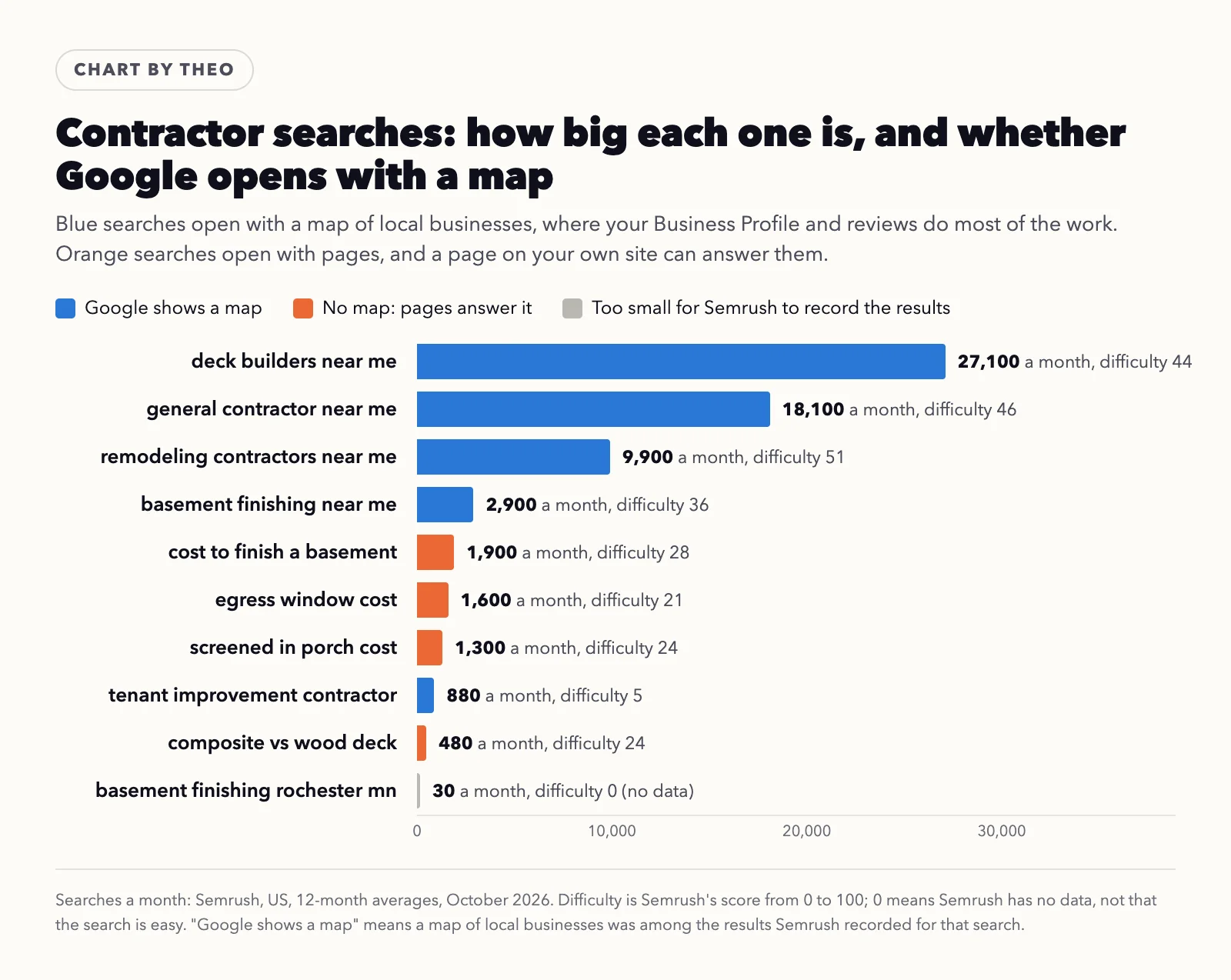
Homeowners rarely type a company's name. They type the job, often with "near me", or they type the cost or the choice in front of them. Google answers those two kinds of search in different ways, and that decides where your effort goes. The table below has ten real searches from the work this page covers: how often each is typed, how hard it is, whether Google opens with a map, and who fills the first ten results today.
The pattern is plain. Searches for the job itself open with a map of nearby businesses, so the Business Profile does most of that work. Of the ten searches in the table, the "near me" ones are typed most. The plain job search can be bigger still: Semrush estimates about 14,800 US searches a month for "basement finishing" against 2,900 for "basement finishing near me" (October 2026). For decks it runs the other way, about 9,900 for "deck builders" against 27,100 for "deck builders near me". On October 19, 2026, Semrush showed Google's map in the first spot for both plain searches too. Cost and comparison searches are smaller and open with no map. Forums, stores, makers and cost sites hold most of their first ten results, and a contractor's page that answers the question in full belongs in that list.
Commercial work follows the same split, with a different buyer. Semrush estimates about 880 US searches a month for "tenant improvement contractor" (October 2026) and rates it 5 of 100. Google shows a map for it as well, and commercial contractors' own service pages fill most of its first ten results. Town searches are the smallest of all: Semrush estimates about 30 US searches a month for "basement finishing rochester mn" (October 2026), too few for it to record what the results look like.
Search
Searches a month (US, Semrush, October 2026)
Difficulty
Google shows a map
Who shows up now
A page built to answer it
deck builders near me
27,100
44
Yes
Deck builders' own sites (6 of the first 10), directories and review sites (3), and a decking maker's find-a-builder page
None needed first: the map answers it, so a complete Business Profile and steady reviews come before any page
general contractor near me
18,100
46
Yes
Directories, review and lead sites (6 of 10) and contractors' own sites (4)
The map again: your Business Profile and reviews
remodeling contractors near me
9,900
51
Yes
Directories and lead sites (8 of 10), a video and one contractor's site
The map again: your Business Profile and reviews
basement finishing near me
2,900
36
Yes
Basement companies' own sites (5 of 10), directories (2), forum threads (2) and a video
Your Business Profile first, backed by a page about the one job, like Kjelstad's Finished Basements page. A page Theo built to answer it.
cost to finish a basement
1,900
28
No
A forum thread and a DIY video, two contractors' cost guides, and cost, finance, store and product sites
Kjelstad's process page, which gives a price per finished square foot. A page Theo built to answer it.
egress window cost
1,600
21
No
Forum threads and DIY blogs, egress window companies, a home store and a cost site
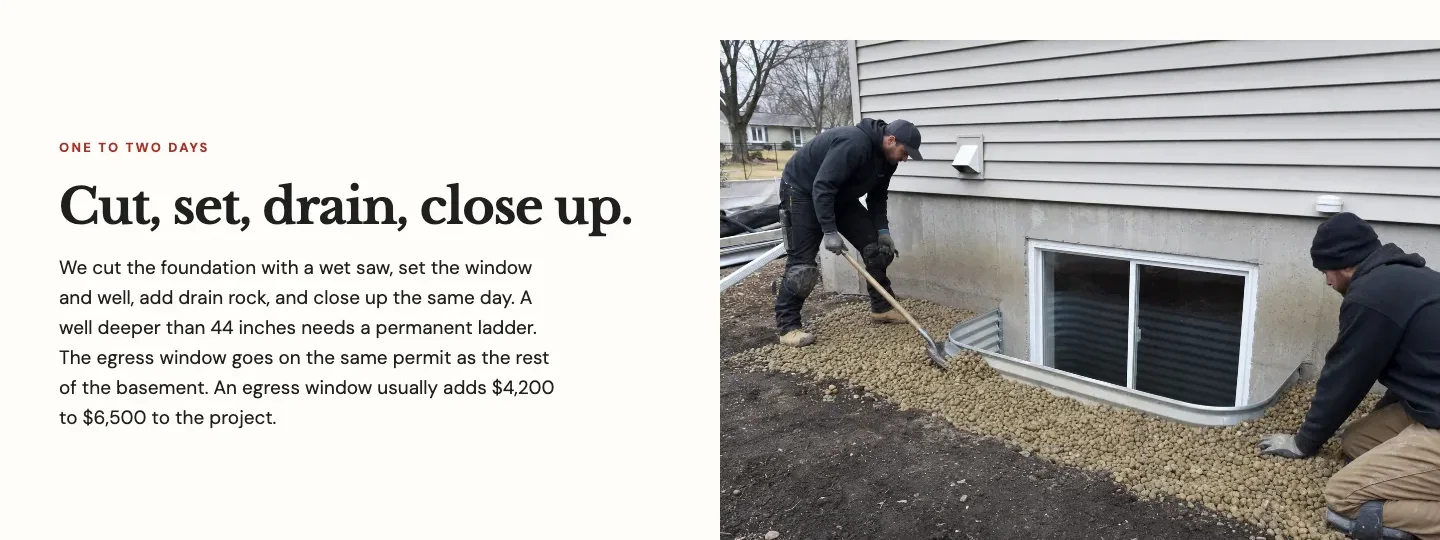
Kjelstad's egress page gives its own price range right after the size rules. A page Theo built to answer it.
screened in porch cost
1,300
24
No
Builders' cost guides (4 of 10), forum threads, a DIY blog, home and magazine sites and a video
A cost page with your installed price range and what moves it
tenant improvement contractor
880
5
Yes
Commercial contractors' own service pages (7 of 10), a directory and a marketplace guide
Quintanar's page run looked up the Tucson version, found no recorded searches for it, and wrote the Tucson commercial remodeling page instead.
composite vs wood deck
480
24
No
Decking makers and stores (8 of 10), a forum thread and an insurer
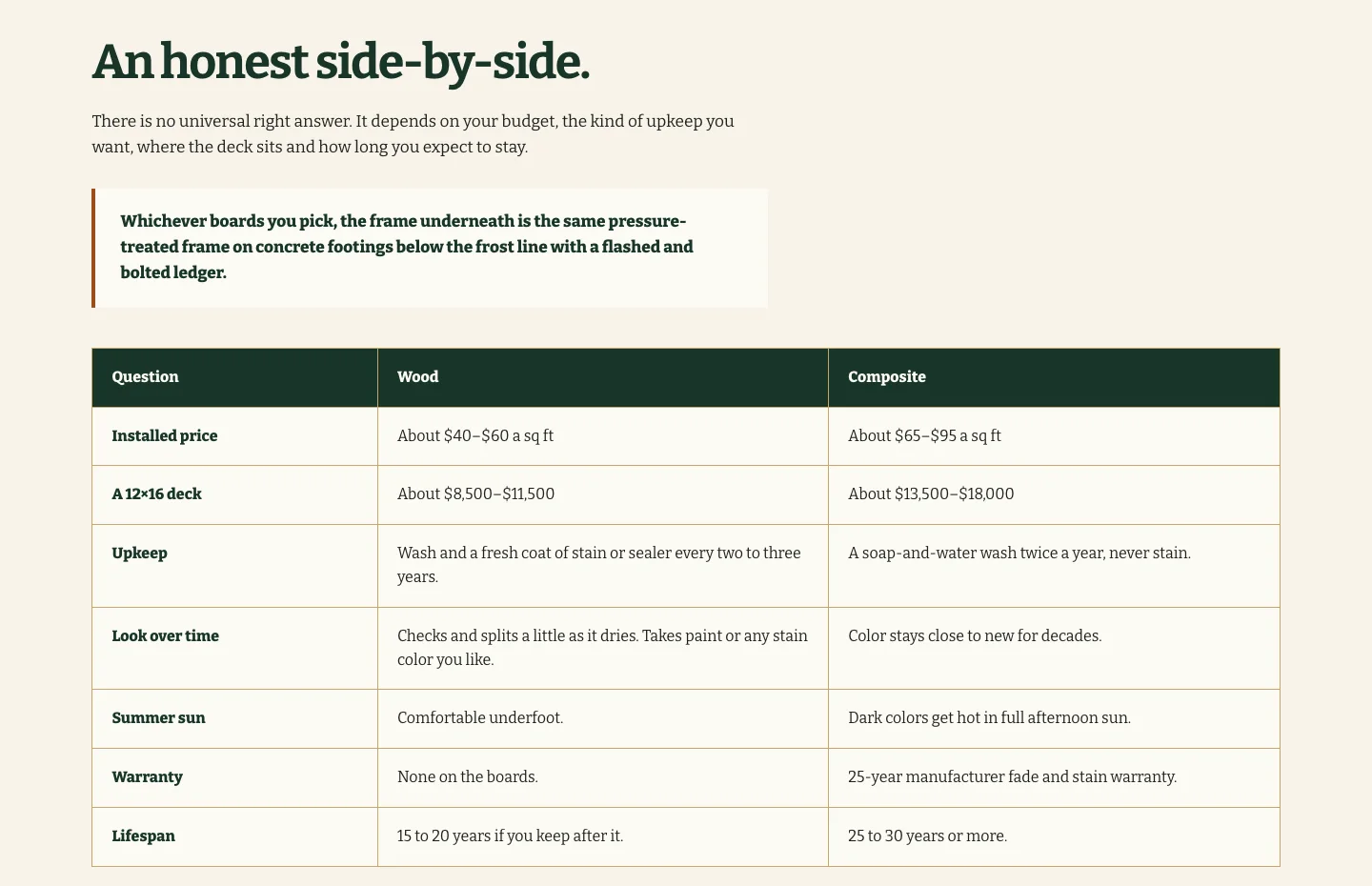
Ledgerwood's Wood or Composite page, with installed prices side by side. A page Theo built to answer it.
basement finishing rochester mn
30
No data
Not recorded
Too few searches for Semrush to record the results
Chart by Theo from Semrush US data, October 2026. The four near-me searches and tenant improvement contractor open with a map; the cost and comparison searches are answered by pages. Volumes are 12-month averages, and deck and porch searches swing with the seasons.
Remodeler, specialty builder or commercial crew: the pages each one needs
Whether you remodel, build decks or run a general contracting company, SEO comes down to one page for each kind of search. For most contractors that means a page for each kind of job, a page for each decision customers struggle with, and a page for each town where you have real work to show. Which of those matters most changes with the kind of contractor you are.
Kind of contractor
What customers type
The page that answers it
What to put on it
Remodeler or general contractor
The room, the job and the town: kitchen remodel, bathroom remodel, home addition cost
A page per room or job, then a page per town where you have finished work
Photos captioned with the town and the scope, a price range or what moves the price, and the weeks a job takes
Square footage, weeks, night and weekend work, insurance certificates and bonding
A page for every decision, not only every job
Comparison searches can be where a small contractor's page has the most room. For "composite vs wood deck", eight of the first ten results come from decking makers and stores, and none from a local builder. Put the choice side by side, with the installed price, the upkeep and the lifespan, and say plainly when each option makes sense.
Built by TheoLedgerwood Deck & Porch, Roanoke, Virginia: a page built to answer "composite vs wood deck", with the installed price per square foot for each.
Cost pages that give a number
People search the cost of a job long before they call anyone. A page that gives your real range, and says what moves it, answers that search and sorts out the calls you would not win anyway. Where the price depends on what is behind the wall, say what drives it and how your written estimate works.
Built by TheoKjelstad Basements, Rochester, Minnesota: right after the size rules, the egress page gives its own price range.
Town pages only where you have work to show
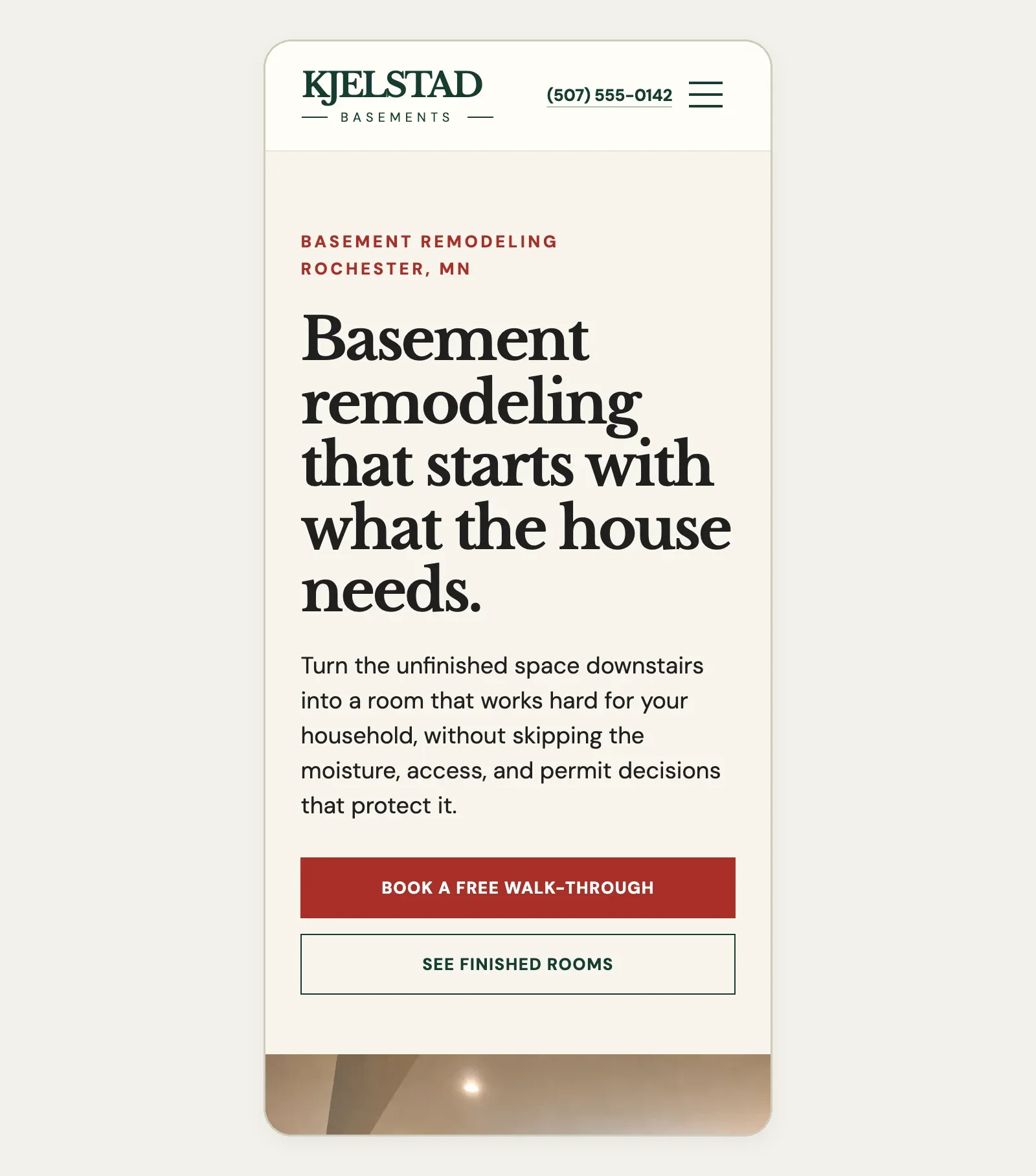
One page for each town you take work in, filled with jobs finished there, does more than a page per zip code with the name swapped. How many to build and what goes on each is covered on the page about contractor website design. A town page also has to work on a phone, since that is where most people tap the number.
Built by TheoThe Rochester page the run wrote, on a phone: the number in the header, the city above the headline and the walk-through button up top.
Commercial work: the project is the page
Construction SEO for a commercial crew works on the project, not the room. The buyer is a business owner or a property manager, and the search is the project: a tenant build-out, an office renovation, a storefront. Give each kind of project its own page, then add project pages named by town with the square footage and the weeks. The sale also takes longer than a homeowner's, so count bid requests as the early sign that the pages are working, not only signed jobs.
The map half: Business Profile and reviews for a contractor who comes to the job
Local SEO for contractors starts with the map. For "near me" searches and plain job searches like "deck builders", it comes first, and it is filled from Business Profiles, not websites. Google's help page on improving your local ranking, checked October 18, 2026, opens its explanation with this line: "Local results are mainly based on relevance, distance, and popularity." The same page says reviews count, and that there is no way to pay Google for a better spot on the map.
Most contractors work at the customer's house, which changes how the profile is set up. Google's service area help page, checked the same day, says a business that does not serve customers at its own address should take that address off the profile, and that a service area can list up to 20 places within about 2 hours of driving.
Set the towns you drive to as your service area, and take the shop address off the profile if customers never come there.
Pick the main category that best describes your company as a whole, as specific as Google's list allows, such as Deck builder rather than Contractor. Add only a few extra categories, not one for every service you offer. Google's category help page, checked October 19, 2026, sets out both rules.
Post photos of finished jobs every few weeks, the same ones you put on the site's job pages.
Ask every customer for a review the day the job closes, the same way each time. The free Google review link generator makes a link they can tap.
Claim your free listing on the directories that show up for your job and town. On the four "near me" searches in the table above, directories and review sites hold 2 to 8 of the first ten results (Semrush, US, pulled October 19, 2026).
Ask the makers, suppliers and trade groups you already work with to list you. If you install a maker's product, ask to be on its find-a-builder page: for "deck builders near me", a decking maker's builder finder is among the first ten results. Ask your supplier about its installer list, and your local builders or remodelers association about its member directory, with a link to your site on each.
Keep the company name, phone number and service area the same on the profile, the website and every other listing.
Who does this part
On Starter and Pro, the Boost checklist walks you through your Business Profile and the other listings, such as Facebook, Apple Business Connect, Bing Places and Yelp, one at a time. You make each change in your own account, so every listing stays in your name. If your office runs on Jobber, the site's request button can point at your Jobber request form; see Theo and Jobber.
What contractor SEO costs, side by side
Most SEO sold to contractors is a monthly agency retainer, often quoted only after a call.
Doing it yourself
An SEO agency on a retainer
Theo Starter
Theo Pro
Monthly cost
Your evenings, plus any tools you pay for
A monthly retainer, usually quoted after a call
$69.99 a month, free for the first 30 days, with the site and hosting included
$129.99 a month, with the site and hosting included
Who picks the searches
You
The agency
Theo, and the run note in your Growth tab says what it looked up and why
Theo, the same way
Who writes the pages
You
The agency, or you supply the words
Theo drafts them, and you approve them in the Growth tab
Theo, with more pages and posts each week
Who fixes the site
You, or whoever built it
Depends on who hosts and edits the site
Theo, on its scheduled repair runs
Theo, the same way
Business Profile and reviews
You
Ask whether it is included
You make the changes, guided by the Boost checklist
You make the changes, guided by the Boost checklist
Who owns the site, the domain and the profile
You
Depends on the contract, ask
You own the pages, words and photos, and a domain bought in Theo is registered to you
The same, plus read-only access to the site code on GitHub
Contract
None
Ask about the minimum term before signing
Month to month, cancel any month
Month to month, cancel any month
Will the work pay for itself?
Work it through with your own average job and margin. The guide Is SEO worth it for a small business? lays out the break-even math step by step: how many extra jobs a month cover the cost.
Months, not weeks: the timeline for contractor SEO
Search traffic builds over months, not weeks. Google's own guidance on hiring an SEO puts the payoff at four months to a year. Maile Ohye gives that range in Google Search Central's video How to hire an SEO.
The first sign is impressions in Search Console, Google's free report for site owners: your new pages showing up in results, before anyone clicks. Clicks come after that, then calls, estimate requests and bid requests. For a commercial crew, count the bid requests, because a signed build-out comes later.
The setup is the quick part. Connecting your domain usually lands within a few hours, and signing in with Google is one step. The ranking is the slow part, and your Growth tab shows every page and fix along the way.
Before you sign with a contractor SEO company
SEO offers reach contracting companies by phone, email and text. Google's page Do you need an SEO?, checked October 18, 2026, gives the plainest test of them in one line: "No one can guarantee a #1 ranking on Google." It adds a warning every owner should read twice: "Ultimately, you are responsible for the actions of any companies you hire," so a shortcut taken on your site lands on you.
Read what a guarantee measures. An offer of results in 90 days, guaranteed, can count as little as a few more keywords on a report. Ask exactly what it counts, and what happens if it misses.
Get ownership in writing. The website, the domain and the Google Business Profile should all be in your company's name, with you as the owner of the profile, before anyone starts.
Ask to see every change. Google suggests asking an SEO, "Will you share with me all the changes you make to my site". Ask to see the pages and fixes from the last month, each with a link.
Turn down bulk links. Google warns against SEOs who talk about link popularity schemes. Say no to anyone who sells links by the hundred.
Search your main job and your town, such as deck builder and the town's name. Note whether you appear on the map, in the pages under it, or nowhere on the first screen.
Open your Business Profile and look at the service area, the hours, and the dates of your newest photo and newest review.
For what a phone cannot show, such as an estimate of how much traffic your site gets from Google search, run the free audit. It needs no login.
Moving a contractor website you already have
Theo's search work runs on a site Theo builds and hosts, because the system that drafts a page also publishes it, links it in and lists it in the sitemap, with no web person in between. Paste your current site's address and Theo rebuilds it as a starting draft in the same look, which you then adjust by typing in chat. Your old site keeps taking calls until your domain points at the new one.
Once Search Console is connected, an old address that still gets search traffic is forwarded to its matching new page with a permanent (301) redirect, as part of SEO repair on Starter and Pro. On any plan, you can also ask Theo in chat to forward an old address, and the forward works as soon as Theo adds it. The page on what happens to rankings when you move a website walks through that step.
Your part after that is short: approve drafts when you have a minute, drag in job photos with the town they came from, and ask every customer for a review. The site itself, with job pages, project galleries and an estimate form, is on the page about contractor website design. Roofers, plumbers and landscapers have pages of their own, and the same work for any local business is on small business SEO services.
FAQ
Questions contractors ask about SEO
How much does SEO for a contractor cost on Theo?
Starter is $69.99 a month, free for the first 30 days, and Pro is $129.99 a month. Both plans include the website, the hosting and the search work, so there is no build fee and no separate retainer. Basic is the site and hosting without the search work.
How long until my contracting company shows up on Google?
The first sign is impressions in Search Console once a page is indexed, meaning Google is showing it to searchers. Clicks come after that. Search traffic builds over months, not weeks. Google's own guidance on hiring an SEO puts the payoff at four months to a year.
Who owns the website, the domain and the Business Profile?
You do. The pages, words and job photos on the site belong to your company, and a domain bought inside Theo is registered to you. Your Google Business Profile stays in your own Google account, because you make the changes there yourself. Theo hosts the site, and Pro adds read-only access to its code on GitHub.
Can I cancel?
Yes, in any month, and there is no contract term. When you cancel, the confirmation shows the day the subscription ends, and the site stays up through that day. Save the text and job photos you want to keep before then.
Can Theo do SEO on the contractor website I already have?
Yes, after Theo rebuilds it, since the search work runs on the sites Theo builds and hosts. Paste your current address and Theo rebuilds it as a starting draft in the same look, which you adjust in chat. Your current site keeps running until your domain is pointed at the new one. Once Search Console is connected, SEO repair on Starter and Pro redirects old addresses that still get search traffic to the matching new pages, and on any plan you can ask for a redirect in chat.
Is SEO or Google Ads better for a contractor?
They do different jobs. Ads appear the day you pay and stop the day you stop. Pages that rank keep bringing visits with no cost per click, but they take months to get there. Some contractors use both: ads for a busy season and pages for the long run. Theo does the search work, so the pages keep working between seasons.
Will this help my company show up in ChatGPT and Google's AI answers?
It is part of the same plans, not an add-on. Starter and Pro work toward citations in AI search tools, including ChatGPT and Google AI Overviews, with the same pages and plain answers that serve Google search.
What do I have to do myself?
Not much, and most of it once. Connect your domain and sign in with Google so Theo can set up Analytics and Search Console. Then read the drafts in your Growth tab when you have a minute, or switch on auto-publish. Send job photos by dragging them into the chat with the town they came from, keep your Business Profile current with the Boost checklist, and ask every customer for a review.