Restaurant SEO services, with the website included and the work in plain view
Restaurant SEO is the ongoing work that gets a restaurant found by people deciding where to eat tonight, where to hold a rehearsal dinner, or who should cater Thursday's office lunch. On Theo, Starter is $69.99 a month, free for the first 30 days, and covers the website, its hosting and that search work. The work runs on a site Theo builds and hosts, rebuilt from your current site if you have one. Further down, a restaurant site Theo built shows what three runs of the work produced, with links to open each page.
Your first build is on Theo: see the site before you decide
Restaurant SEO services cover two jobs. The first is your Google listing, the one on the map, which answers most "near me" searches from your category, your hours, your photos, your reviews and how close the guest is standing. The second is your website, which answers the searches people plan ahead: a private room for 20, office lunch catering in your town, a birthday cake by Saturday, Thanksgiving dinner, a gluten-free menu. The website job is Theo's on Starter and Pro. It finds what diners in your town type before they book, writes the pages and posts that answer them, and keeps the site quick and in good order. On every plan, connecting Google also submits your sitemap, which Google rereads on its own, so every menu, room or holiday page you publish is on its list. New drafts sit in your Growth tab until you publish them, or go live by themselves once you turn on auto-publish. For the listing, the Boost checklist walks you through each change, and you make it in your own account.
In Theo's audit of 6,861 small business websites, 37 percent of the 329 food, hospitality and events sites with search data got an estimated zero visitors a month from Google search, and 50 percent got fewer than ten. The sample is the sites whose owners ran Theo's free audit. See the research.
On a restaurant site Theo built
Three runs on a restaurant site with two locations
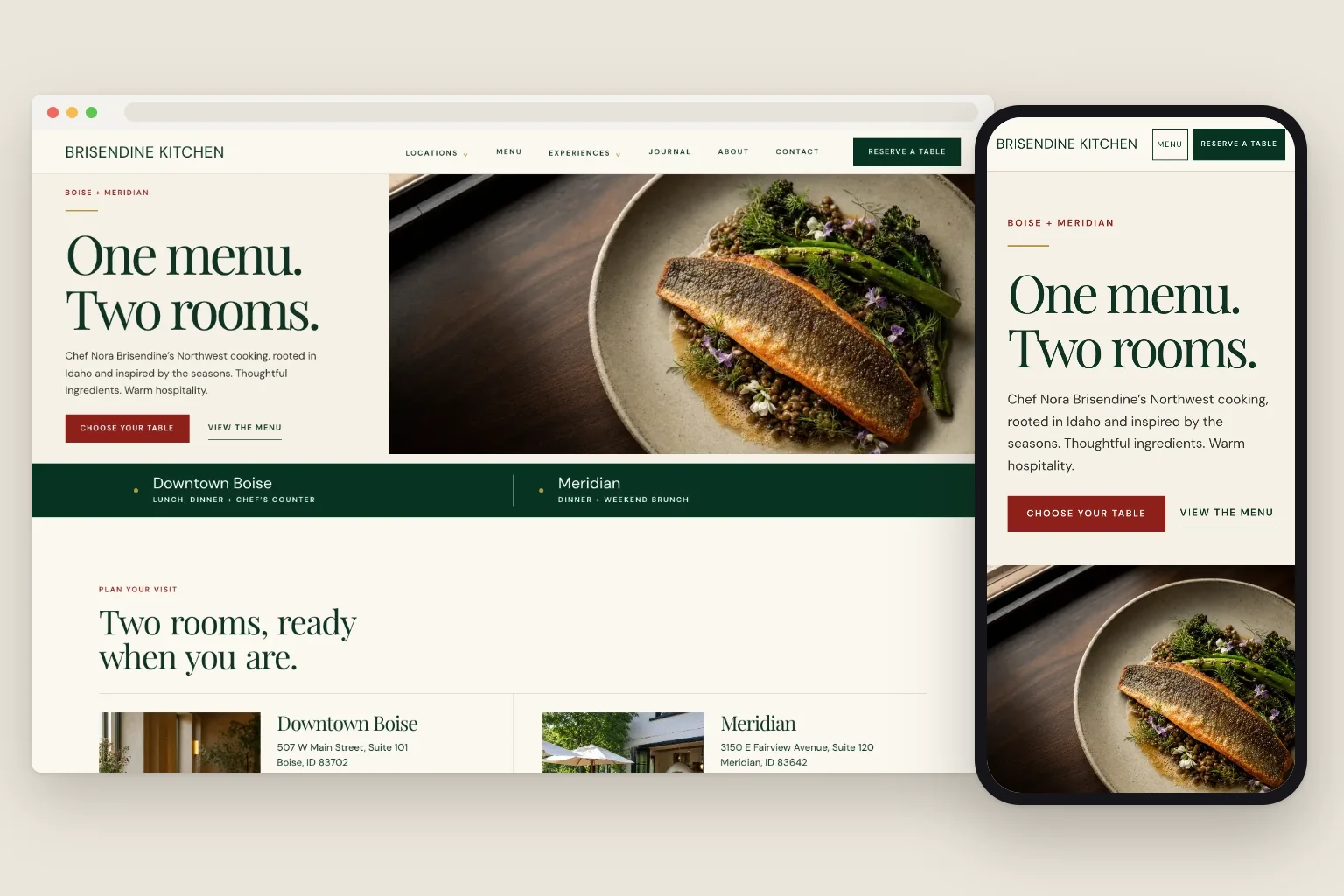
Brisendine Kitchen, a restaurant site built by Theo, is a chef-owned restaurant with one dining room in Downtown Boise and a second in Meridian, Idaho. Theo's Growth Engine, the search work that comes with Starter and Pro, took three turns on it on October 19, 2026: one wrote a post, one wrote a page, and one checked the whole site. Nothing went live until it was published from the Growth tab. On a restaurant's own site, the same kinds of jobs arrive a few at a time through each week, not three in one day.
The searches it chose
Before writing, both runs looked up how often each search is typed and how crowded it already is. Below are Semrush's US-wide figures as the engine saved them on October 19, 2026: average searches a month, and difficulty, Semrush's 0 to 100 rating, where a lower number means fewer strong pages stand in the way.
Semrush had no difficulty score for "private dining boise", which means too little data to score it, not that the search is easy. The page run checked about a dozen Boise group-dining searches first, such as "rehearsal dinner Boise" and "corporate dinner Boise", and this was the only one with monthly searches on record. The post run weighed brunch searches in Boise too, then picked a question about a dish the Meridian brunch already serves.
What it wrote
A page, a post and a new Journal, live on the site
Both writing runs looked over their drafts at phone, laptop and desktop widths before handing them over, and each one linked its work from pages guests already visit. Here is what they added, shown as each page opens on the live site.
Built by TheoBrisendine KitchenThe top of the new page, on a laptop.See the live site
01
A private dining page for planners in Boise
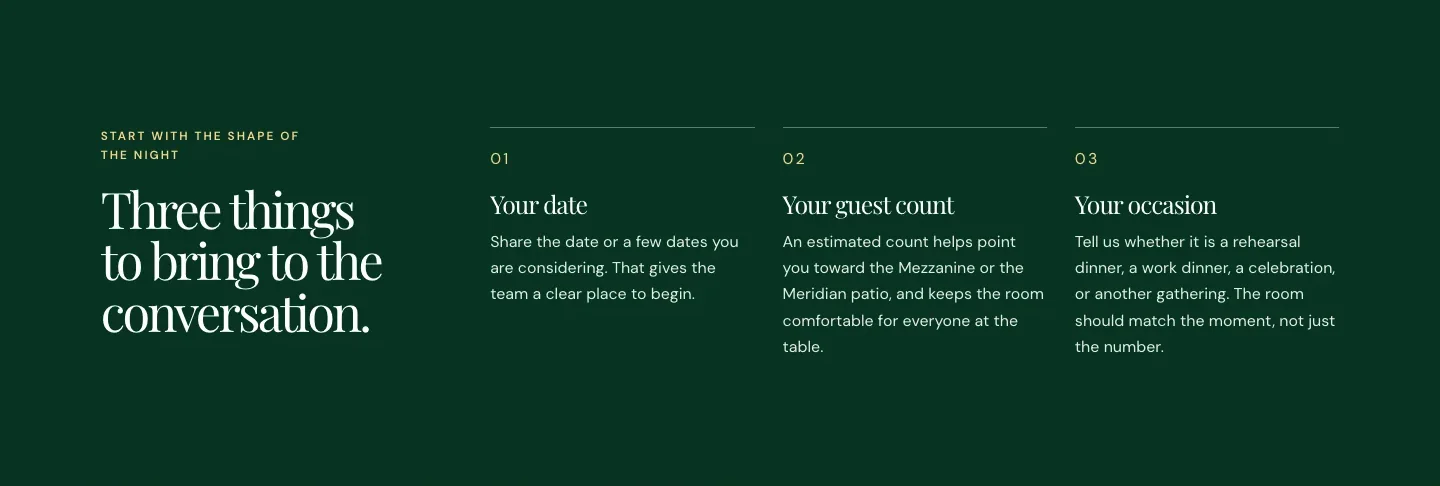
Private Dining in Boise runs to about 1,200 words for someone booking a group dinner. It sets the two settings side by side, the Mezzanine downtown for up to 24 seated guests and the Meridian patio buyout for up to 50 from May through September, then asks for three things to start the conversation: a date, a rough guest count and the occasion.
It answers four planner questions and ends with one button to ask about private dining. The restaurant's original private dining page now links to it.
Built by TheoBrisendine KitchenThe new post as it opens, filed under Brunch notes.See the live site
02
A question about a dish, answered in full
What Is a Dutch Baby? The Puffy Oven Pancake Explained is a post of about 1,800 words. It says what the dish is, why it rises in the oven and settles at the table, where the name comes from, how it differs from a Dutch pancake and a Yorkshire pudding, and what to expect when one arrives.
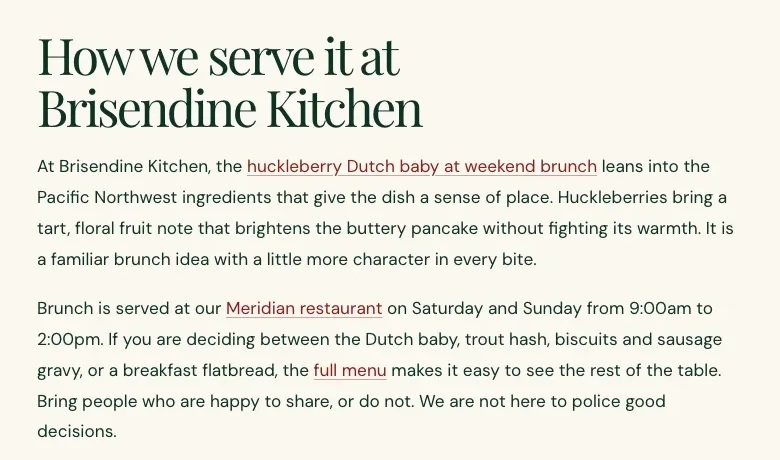
Before its closing questions, it turns to the huckleberry Dutch baby at Meridian's weekend brunch, with links to the brunch page, the Meridian page and the menu, so a reader who came for the answer can find a table.
Built by TheoBrisendine KitchenThe Journal page, with Brunch notes as its first collection.See the live site
03
A Journal for the posts still to come
The same run opened the Journal, a new section in the menu and the footer, with a first category, Brunch notes. Later posts get a home there, under headings guests can browse.
The Journal page and the Brunch notes page went into the site's sitemap along with the post, so search engines can find all three.
What it linked, checked and left alone
Links to the new page and post went in on the same day they were written. The site check, the third run, produced no new page. It went through the whole site, found nothing to change, and its note said exactly that.
What it did
Where
Why it matters
Linked the new pages in
Journal in the main menu and the footer, and a link from the original private dining page to the Boise page
Guests click through to each new page from pages they already visit, and Google follows the same links.
Sitemap entries for the new pages
All four new addresses
The sitemap is the list search engines read to find the pages on a site.
Checked the whole site
All 17 pages in the sitemap, the sitemap itself, the instructions for search engines, and each page's preferred address
Every page loaded, and each page it checked pointed to its own address, so nothing was changed.
Left alone on purpose
Rewrites of existing pages
A rewrite waits until search data shows which page needs one.
From the Growth tab
The note after the private dining run
Every run leaves a short write-up in the Activity list on your Growth tab, covering what it read, what it changed, the reasons, and links to the pages. Below are two parts of the write-up from the private dining run, word for word.
You publish each page from the Growth tab, or switch on auto-publish and let pages go live on their own. A weekly email adds up the new pages, posts and updates.
Pricing
What it costs, in full
The ongoing search work is part of Starter and Pro. Basic is the site and hosting on its own. Starter is free for the first 30 days.
Plan
Per month
Ongoing search work
Chat credits
Best for
Basic
$29.99
Not included
1,500 a month
Owners who just want their site live and easy to update.
StarterFree for 30 days
$69.99
Included, uses no credits
4,500 a month
Owners who want the site handled without heavy publishing volume.
Pro
$129.99
Included, uses no credits
7,000 a month
Owners who want more capacity, more publishing, and more room to experiment.
No contract, cancel anytime, and you own the site and its content. The pricing page lists what each plan includes and how chat credits work.
Is SEO worth it for your restaurant?
Much of what brings a guest through the door happens on the map: your listing, your reviews, your photos and how far away you are. Google's own page for owners weighing SEO help says, "If you run a small local business, you can probably do much of the work yourself." A complete listing, a steady flow of reviews and a menu typed onto your site already cover a lot of what a "near me" search needs.
Paying for SEO work earns its keep on the searches a listing cannot answer alone, the ones people plan ahead: a room for a rehearsal dinner, catering for an office, a cake by the weekend, a holiday meal. The table sorts restaurants by what their guests look for.
Your place
What its guests search for
Where that is won
What it needs
A neighborhood spot that fills from regulars and walk-ins
Your name, "near me", tonight's hours
Mostly your Google listing and its reviews
A complete listing and the menu on your site as text.
A room for private parties, rehearsal dinners or work dinners
Private dining, private room, rehearsal dinner, each with your town
A page on your site about the room
The search work. These are booked weeks ahead, for a whole table at once.
A kitchen that caters offices or parties
Catering, party trays, office lunch catering, with your town
A page for each kind of order
The search work, with a page for each kind of order you take.
A bakery that takes cake orders
Custom cakes, birthday cakes, wedding cakes
Pages with sizes, servings and notice
The search work.
A bar with live music or events
Live music near me, happy hour near me
The map first, then an events page
The listing first, plus a calendar page for the nights you host.
A place that is busiest on holidays
Thanksgiving dinner, Easter brunch, Mother's Day brunch
An occasion page that is live weeks ahead
The search work, started well before the season.
A new opening or a second location
Your name with the new neighborhood, plus "near me"
A listing and a page for each location
Both: a listing per location, and pages that tell Google the new room exists.
What decides how much work it takes
Three things. The first is your town: the same phrase may bring up a handful of local places in a small town and dozens of strong pages in a big city, so search your own town's version of each phrase before you pay anyone. The second is how far ahead your guests plan, because planned searches are the ones a page can win. The third is whether the details guests need are on your site as text already: the menu with prices, the size of each room, the order deadlines. A menu posted only as a photo gives Google little to read. A PDF with real text in it can be indexed, but a menu typed onto the page serves Google and a guest on a phone better.
Social media posts and paid ads are a different tool. They reach people who follow you, or people who see an ad while you pay for it. A page answers the planner who searches next month, and it stays on your site after an ad budget runs out. Plenty of restaurants use both.
Guests rarely type a restaurant's name while they are still choosing. They type what they want and where: brunch, a private room, catering, a cake, gluten-free. The table shows a sample of those searches with Semrush's figures for the whole US, averaged over 12 months and checked October 19, 2026. A restaurant competes only in its own town, so your share of each figure is a small slice. Difficulty runs from 0 to 100; the lower it is, the fewer strong pages compete.
The broad searches open with the map, so your listing does most of the work there. The longer ones, made days or weeks ahead, are where a page on your site gets its chance, and most of them score under 30.
What guests type
Searches a month (US)
Difficulty
Mostly won by
What answers it
restaurants near me
16,600,000
55
Your Google listing
The listing, backed by your hours and a menu typed out on your site
pizza near me
6,120,000
33
Your Google listing
The listing, plus a page that names the towns you deliver to
brunch near me
823,000
22
Your Google listing
The listing, plus a brunch page with the days, hours and dishes
happy hour near me
450,000
24
Your Google listing
The listing, plus a page with the days and times
live music near me
165,000
44
Your Google listing
The listing, plus a calendar with each night's start time and any cover
catering near me
90,500
28
The listing and a page
A catering page listing the dishes, the headcount each order serves, the lead time and the towns you deliver to
dog friendly restaurants near me
40,500
27
The listing and a page
A visit page that says where dogs are welcome
gluten free restaurants near me
33,100
19
The listing and a page
The menu as text, with a gluten-free mark the kitchen can stand behind
custom cakes near me
22,200
33
A page on your site
A cake page with sizes, servings, prices and the notice each cake needs
kid friendly restaurants near me
14,800
12
The listing and a page
A kids' menu on the menu page, and a line about high chairs
outdoor seating restaurants near me
9,900
21
The listing and a page
A patio line on the visit page, with the months it is open
restaurants with private rooms near me
5,400
15
A page on your site
A private dining page: each room, how many it seats, who answers
party trays near me
2,900
33
A page on your site
A big orders page with tray sizes and how many each feeds
private dining near me
2,400
17
A page on your site
The same private dining page
office lunch catering
1,900
20
A page on your site
An office catering page with the order-by time and the minimum
rehearsal dinner restaurants near me
590
11
A page on your site
A private dining page that names rehearsal dinners
Private rooms and rehearsal dinners
A planner booking a rehearsal dinner compares several places for the same date. The page that gets the inquiry names each room, how many it seats, the months it is open, any minimum, and who answers and how fast. The page the Growth Engine wrote for Brisendine Kitchen keeps the first step small: a date, a rough count and the occasion.
Built by TheoThree things to bring to the conversation, on the private dining page the run wrote for Brisendine Kitchen: the kind of detail a planner searching for private dining near them looks for.
Catering and office lunches
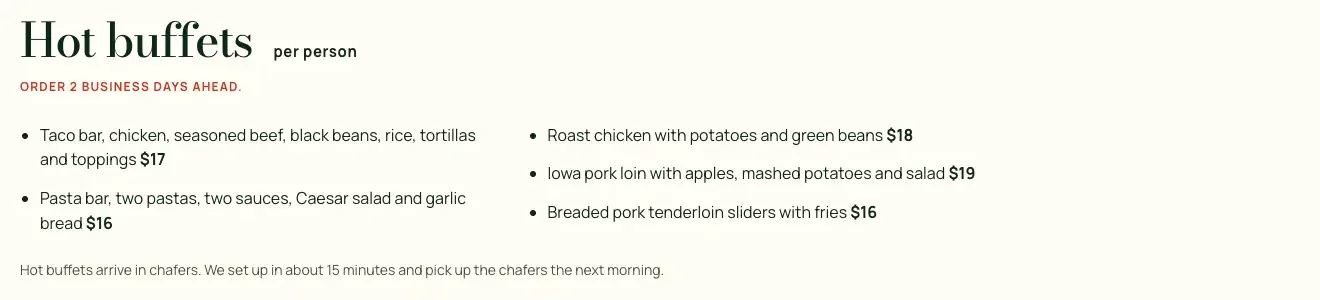
An office manager searching for lunch catering wants three facts before she picks up the phone: the price per person, how far ahead to order and whether you deliver to her building. Print the order-by time under each heading, put the minimum where she will see it, and name every town you deliver to.
Built by TheoKelderhouse Kitchen's catering menu puts the order-by time and a price per person under each heading, the facts behind a search like "office lunch catering".
Cakes and big orders
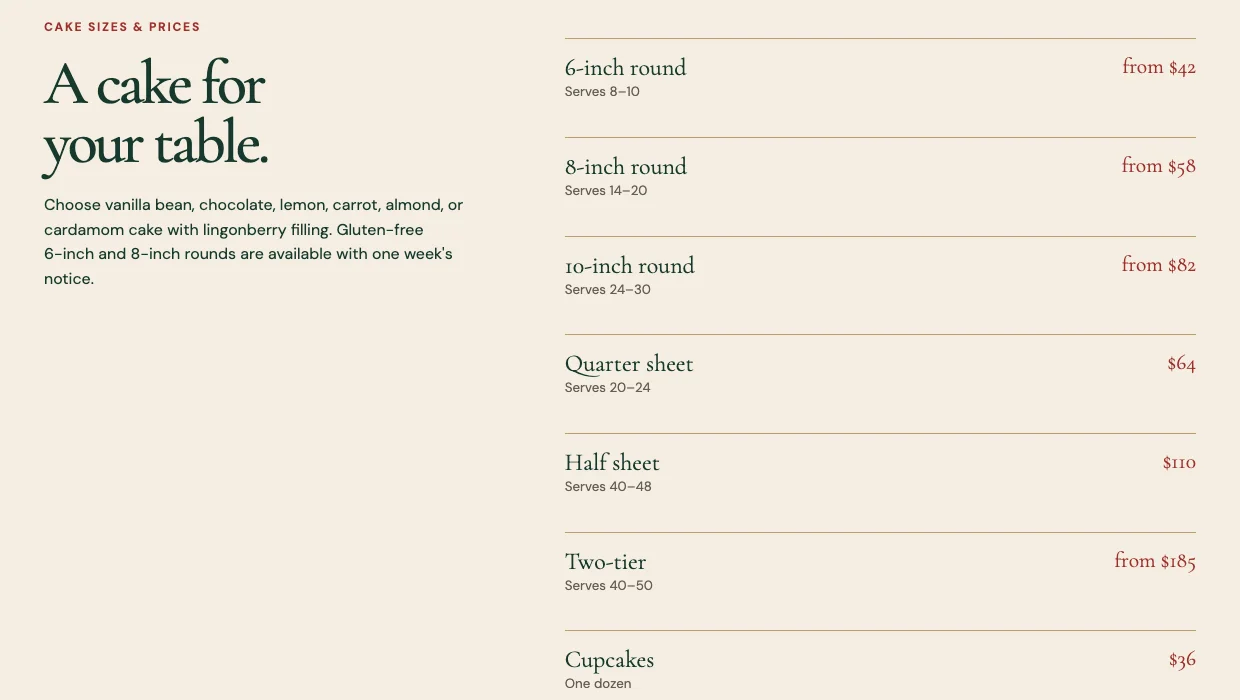
Cake searches come with a deadline attached. A page that lists each size, how many it serves, what it costs and how much notice it needs answers the question before the phone rings. The same goes for party trays and family packs: give the size, the headcount it feeds and the day to order by.
Built by TheoKvalheim Bakery lists every size with its servings and a starting price, and says gluten-free rounds need a week's notice.
Dishes and dietary needs
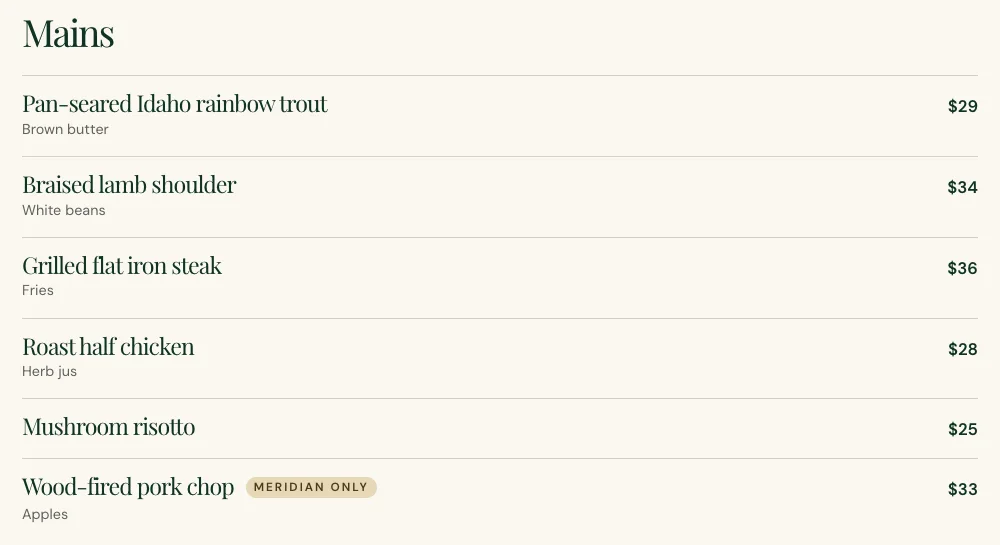
A menu typed onto the page, with a price on every line, lets Google match a search for a dish or a dietary need to your restaurant. A photo of the menu gives Google far less to work with than typed text. A PDF with real text in it is on Google's list of file types it can index, but it sits apart from your menu page and is hard to read on a phone, so type the menu onto the page itself. The typed menu can reach your listing too. Google's menu editor help, read October 19, 2026, says: "Google may transcribe menu data from your business website so that it appears accurately on your Business Profile." Mark dishes gluten-free or vegetarian only where the kitchen can stand behind the mark, and keep the allergy line near the top.
Built by TheoBrisendine Kitchen's mains as text: every dish with its price, most with a short note, and a tag on the one dish only the Meridian kitchen cooks.
Questions about what you serve
Some searches are questions: what a dish is, how it is made, what a cuisine means. They come from people who are curious rather than hungry yet, and a post that answers one properly can end at your table. The Dutch baby post the run wrote does that, closing on the brunch where the dish is served.
Built by TheoHow the Dutch baby post ends: the dish as Brisendine serves it, with links to weekend brunch, the Meridian page and the menu.
What a restaurant is up against on a town search
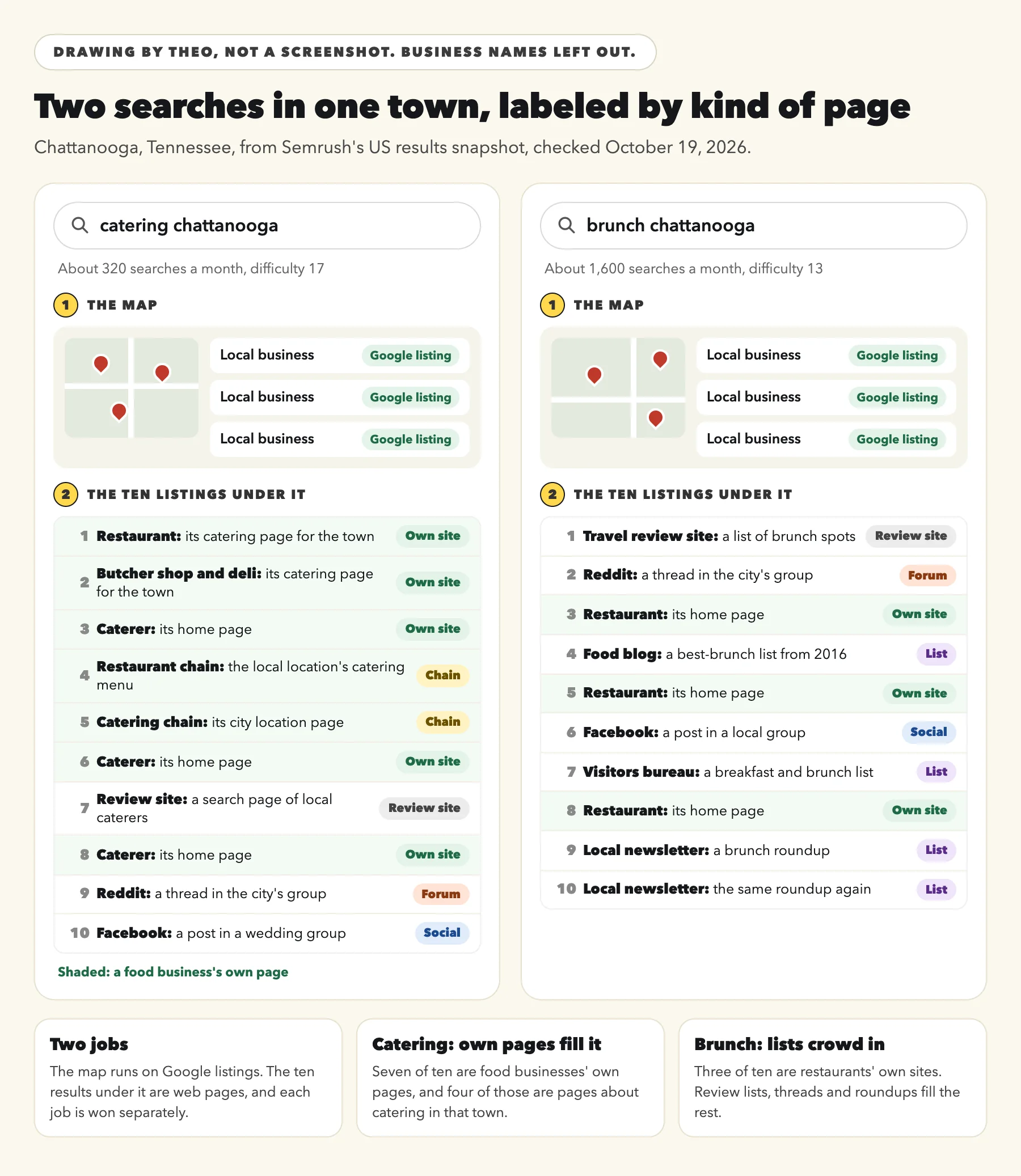
A national figure hides what one town looks like. For two searches in Chattanooga, Tennessee, Semrush's US snapshot on October 19, 2026 showed the map of local places first, then ten listings. Chattanooga was picked to show ordinary local results.
For "catering chattanooga", about 320 searches a month at a difficulty of 17, seven of the ten listings were food businesses' own pages. Four were pages about catering in that town: one on a restaurant's site, one on a butcher shop's, and two that chains run for their Chattanooga locations. The rest were a review site's list, a city forum thread and a Facebook group post.
For "brunch chattanooga", about 1,600 a month at 13, the listings leaned the other way: lists from a travel review site, the visitors bureau, a local newsletter and a food blog, plus a forum thread and a Facebook post, with three restaurants' own sites among them.
The lesson is that broad searches about where to eat are decided on the map and on other people's lists, so your listing and your reviews come first. Searches about a specific order or event are where a page on your own site can take a place among the listings. The order is Google's to set.
A labeled drawing of two Chattanooga searches as Semrush's US snapshot showed them on October 19, 2026, with business names left out. It is not a screenshot, and results change from day to day and phone to phone.
When holiday searches come, and when the page has to be ready
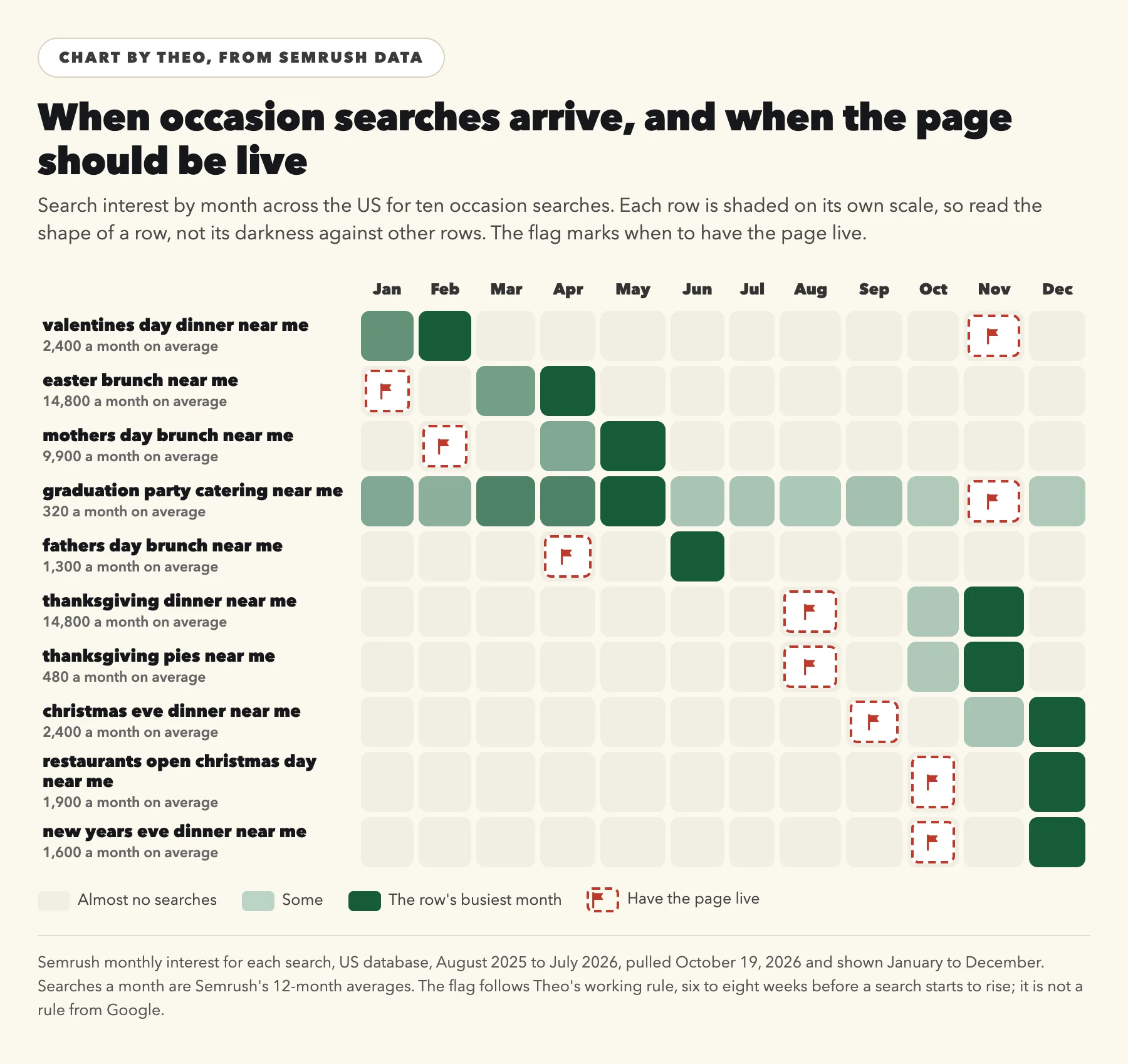
Holiday searches arrive all at once. Semrush puts "thanksgiving dinner near me" at about 14,800 searches a month on a 12-month average, and most of them come in November, starting in October. Easter brunch peaks in March and April, Mother's Day brunch in April and May, and Christmas Eve and New Year's Eve dinners in December.
A new page takes time to be found. Search Console can list it as Discovered - currently not indexed for a while before Google shows it, so an occasion page belongs on your site well before its season. Theo's working rule is six to eight weeks before the searches start to rise; it is a habit, not a Google rule. Once a holiday page is up, keep it, update the date and the menu each year, and let it build a history.
On Starter and Pro, the search work can draft occasion pages like these for your review. Tell Theo in the chat what you are serving, the seatings and the price, and the page can carry what guests look for.
Search (US)
Searches a month
When it comes
Have the page live by
valentines day dinner near me
2,400
January and February
Mid-November
easter brunch near me
14,800
March and April
Mid-January
mothers day brunch near me
9,900
April and May
Mid-February
graduation party catering near me
320
Builds from January, highest in May
Mid-November
fathers day brunch near me
1,300
June
Mid-April
thanksgiving dinner near me
14,800
October and November
Mid-August
thanksgiving pies near me
480
October and November
Mid-August
christmas eve dinner near me
2,400
November and December
Mid-September
restaurants open christmas day near me
1,900
December
Mid-October
new years eve dinner near me
1,600
December
Mid-October
When each occasion search arrives across the US, from Semrush's monthly figures for August 2025 to July 2026, with a flag where Theo's working rule says the page should be live.
Your restaurant's Google listing
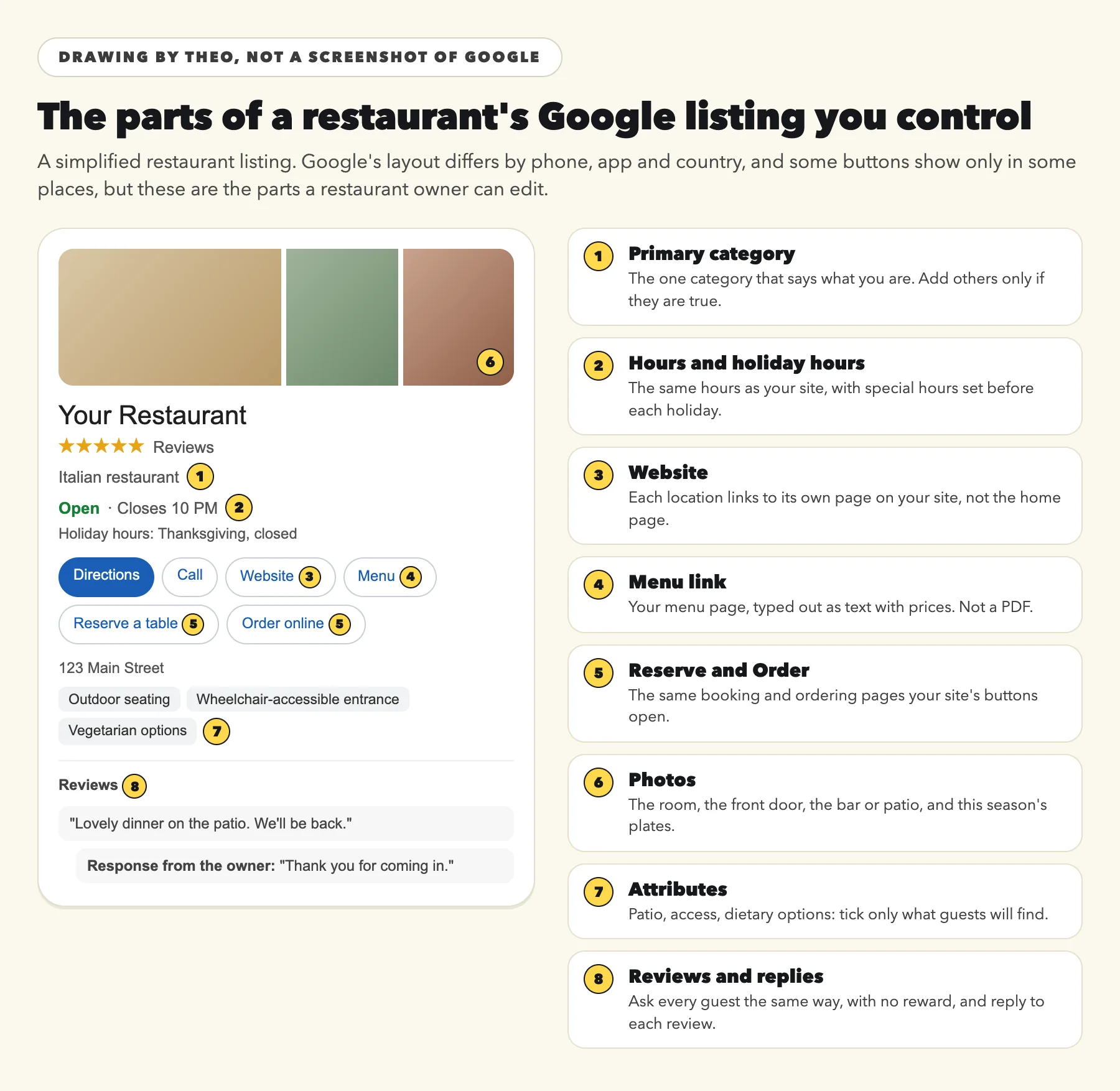
For the two Chattanooga searches drawn above, catering and brunch with the town's name, Semrush's US snapshot on October 19, 2026 showed a map of local places before the web listings. That map runs on your Google Business Profile, a free listing that is separate from your site. Google's help page on local ranking, read the same day, says: "Local results are mainly based on relevance, distance, and popularity." Further down, the page's heading calls that third factor prominence, which it explains as "how well-known a business is." It adds, "More reviews and positive ratings can help your business's local ranking." The same page is plain about money: "There's no way to request or pay for a better local ranking on Google."
These are the parts of the listing a restaurant controls:
The primary category. Pick the one that says what you are, such as Italian restaurant, bakery or caterer, and add others only if they are true.
Hours, and holiday hours. Keep the hours you actually open, and set special hours the week before each holiday, on the same day you change them on your site.
The menu link. Point it at your menu page, the one typed out as text, not a PDF. Google's menu editor help says menu changes made in the editor can take 24 to 48 hours to show on Maps and Search.
Reserve and Order links. Make them open the same booking and ordering pages your site's buttons open. Google's ordering help lets you add your own ordering link and mark a provider as preferred, and it notes that providers who say they have an authorized relationship with your business are listed automatically.
Photos. The room, the bar or patio, the front door from across the street, and this season's plates.
Attributes. Outdoor seating, a wheelchair-accessible entrance, vegetarian options: tick only what guests will find when they arrive.
One listing for each location, each linking to that location's own page on your site rather than the home page.
Review replies. Answer every review, the hard ones too, briefly and calmly. For sample replies, see the post on responding to negative Google reviews.
Edits that wait. Google reviews changes to a verified profile, and its help page on edits says they "usually take up to 10 minutes to review, but sometimes it can take up to 30 days." An edit can come back as Not approved. Google's appeals page, read October 19, 2026, lists a rejected edit to your name, category, address, phone or website among the decisions you can appeal. Outside the UK and the European Economic Area, those appeals go through Google's contact form.
A labeled drawing of a restaurant listing, not a screenshot of Google. The layout changes by phone and country, and some buttons appear only in some places.
Reviews: ask every guest the same way, never for a reward
Google's contribution policy for Maps says businesses may not offer incentives "such as payment, discounts, free goods and/or services" for a review, and may not "selectively solicit positive reviews from customers". A free dessert for a five-star review breaks both rules. The same policy says businesses should not pressure guests to write reviews while they are still on the premises, so a card to take home works better than a tablet passed across the table.
Ask every guest the same way: a line on the check, a card with a QR code, a word at the door. The free Google review link generator makes a link that opens the review box, and a QR code to print.
Where Theo fits with your listing
On Starter and Pro, the Boost checklist takes you through Google Business Profile, Apple Business Connect, Bing Places, Yelp, Facebook and more, one listing at a time, and you make each change in your own account, so every listing stays in your name. Theo keeps the site side in step: type "closed the Monday after Easter" in the chat, publish, and set the same special hours on the listing that day.
If the Google products blur together, the site verification guide sorts out which one is which, and why Search Console is not your listing.
Advice you will read about restaurant SEO, checked against Google
Here are four claims restaurant owners often hear, each set against Google's own pages, read October 19, 2026. A cold email that scores your restaurant on AI searches is a sales pitch; the guide Is SEO worth it? reads one line by line.
The claim
What Google's own pages say
What to do
An Order button that opens an outside ordering site lowers your ranking.
Google has not said this. Its local ranking help names relevance, distance and prominence, and nothing about where an order is paid. Google's own listing shows ordering links to outside providers and lets you add your own.
Keep the menu as text on your own site, and point the Order button at the tool your kitchen already uses. See how the buttons are set up.
Offer a free dessert or a discount for a review.
Google's Maps policy rules out incentives such as payment, discounts and free goods for any review, and asking only the guests you expect to be happy.
Ask every guest the same way, with nothing attached.
Put star ratings from your own testimonials on your site so they show in search.
Since September 2019, Google has not shown review stars in search for a business's reviews of itself on its own site. Its announcement: "Self-serving reviews are no longer displayed for businesses and organizations."
Quote a few real reviews as text, and link to your Google reviews.
We can put your restaurant on page one, guaranteed.
Google's page Do you need an SEO? says: "If they guarantee you that their changes will give you first place in search results, find someone else." For the map, Google says no one can pay for a better local ranking.
Ask what will be done each month, and to see the pages and fixes from the month before.
What restaurant SEO covers, and who does it
The work splits between the site, which Theo handles, and the listing and the reviews, which stay with you. The table shows each part and who does it on Theo.
The work
What it means for a restaurant
On Theo
Research
Finding what guests near you type before they choose: brunch, private rooms, catering, cakes, holidays, a dish on your menu.
Theo's job on Starter and Pro.
Pages for planned visits
A page for each room, each kind of order, each location and each occasion you take bookings for.
Theo drafts them, and you publish them.
Posts that answer questions
What a dish is, what a cuisine means, whether the patio is heated in October.
Theo drafts them, and you publish them.
The menu as text
Every dish and price on the page, with dietary marks the kitchen can stand behind.
Part of every Theo site. You send changes in the chat.
Technical fixes and speed
Redirects, preferred page addresses and the sitemap kept in order, and a photo-heavy site kept quick on a phone.
Theo, on Starter and Pro. SEO repair handles the redirects, preferred addresses and sitemap.
Getting new pages found
Giving Google your sitemap through Search Console, its free tool for site owners, so the pages you add are on the list Google rereads.
Every plan, once you connect Google. On Starter and Pro, SEO repair also fixes sitemap issues.
AI answer tools
Work toward being cited by ChatGPT and Google AI Overviews, which read the same public pages. More in the guide to showing up in AI Overviews.
Included in Starter and Pro, not an add-on.
Your Google listing and other listings
Category, hours, holiday hours, menu link, Reserve and Order links, photos, attributes.
You make the changes, and the Boost checklist guides you.
Reviews
Asking every guest the same way, and replying to all of them.
You ask. The free review link tool helps.
Reporting
Each week's new pages and fixes, and what Google says about your site.
The Growth and Analytics tabs whenever you look, and an email each week that sums it up.
What restaurant SEO services cost
On Theo, restaurant SEO services come with the website. Starter is $69.99 a month and free for the first 30 days. Pro is $129.99 a month and drafts more pages and posts each week. Both include the site, its hosting, the search work and the Boost checklist, with no build fee. There is no fee on orders either, because every booking and order finishes in the tool behind your button.
Menu and hours changes you type into the chat use chat credits, and the search work uses none: 4,500 chat credits a month come with Starter and 7,000 with Pro. A Starter or Pro restaurant can also pay for one of the optional directory submission packages offered in the Boost checklist.
For comparison, one restaurant SEO agency sells three packages on its restaurant SEO page, as of October 2026, each with its own number of pieces of content a month, and none of the three lists a website or hosting. Restaurant website platforms that build online ordering into the site charge their own monthly plans, and some add a fee to each order. On Theo, the site, its hosting and the search work come in one plan with no fee on orders, and the Boost checklist walks you through your listings.
Your part, and Theo's part
The search work is built for an owner who would rather be on the floor than at a keyboard. What it needs from you is small, and most of it can wait until after the lunch rush.
Once, at the start: connect your domain, and when it is active, click Connect Google and sign in one time. Theo then sets up Search Console in your own Google account, or uses a property you already have, along with Google Analytics. The search work waits for these steps, so get them done early in Starter's free 30 days.
When drafts arrive: open the Growth tab, read each one, and publish what you like; auto-publish can take that step for you.
When the menu or the hours change: type the change in the chat, and make the same change on your Google listing that day.
Before each holiday: set holiday hours in both places, and tell Theo what you are serving so the occasion page can say so.
Whenever you have them: drag new photos of the plates and the room into the chat.
At every table: ask for a review the same way, with no reward attached.
How long restaurant SEO takes
Search traffic builds over months, not weeks. Google's own guidance on hiring an SEO puts the payoff at four months to a year. The range comes from How to hire an SEO, a video Google made for owners choosing outside help.
The first progress shows up in Search Console. It counts impressions, the times your new pages appeared in results, which tells you they are indexed. Visits from those results come later, as the pages work their way up. Timing matters more for a restaurant than for most businesses: a Thanksgiving page published in November is late, so occasion pages belong on the site a season ahead.
If you are moving from an old site, Google can keep showing the old pages for a while, until it has followed the redirects to the new ones. The Page with redirect guide explains what Search Console shows during that stretch.
Buy My Lunch is a school lunch ordering service and a Theo customer. Google search sent it 929 clicks in the 90 days to September 27, 2026, up from 131 in the 90 days before.
Before you hire anyone for restaurant SEO
Restaurants hear from SEO sellers often, and some ordering and reservation companies sell SEO as an extra. Google's page Do you need an SEO?, last updated June 5, 2026, lists warnings for owners. These matter most to a restaurant:
Promises of first place. Google says: "If they guarantee you that their changes will give you first place in search results, find someone else." The map works the same way, since Google says no one can pay for a better local ranking.
Link schemes. If a seller talks about buying links for your restaurant or "submitting your site to thousands of search engines", walk away. Google's page names "link popularity schemes" as a reason to avoid an SEO.
Seeing every change. Among the questions Google suggests putting to an SEO is "Will you share with me all the changes you make to my site". Ask for last month's published pages and fixes, one by one.
Responsibility. In Google's words, "Ultimately, you are responsible for the actions of any companies you hire". A shortcut taken on your site is yours to live with.
Ownership. Keep the domain, the website and your Google listing in your own name, and add anyone you hire to the listing as a manager, not an owner.
If you already have a restaurant website
Theo does the search work on a site it builds and hosts itself. Writing a page, putting it live and repairing it later all happen inside that one system. Paste in your restaurant's current web address and Theo rebuilds that site as a first draft, carrying over your menu, rooms and look, which you then adjust by typing in the chat. Your old site stays up for guests until your domain is pointed at the new one, and once Search Console is connected, SEO repair on Starter and Pro redirects old addresses that still get search traffic to their new matching pages; on any plan you can ask for a redirect in chat.
Starter costs $69.99 a month after a free first 30 days, and Pro costs $129.99 a month; the search work is part of both. Either plan covers the website and its hosting too, with no build fee and nothing taken from your orders. Basic is the site and hosting without the search work.
How long does restaurant SEO take?
Search traffic builds over months, not weeks. Google's own guidance on hiring an SEO puts the payoff at four months to a year. Pages for holidays and events need to be live weeks before their searches start, so begin well ahead of the season you care about most.
Who owns the website and the pages Theo writes?
Your restaurant does: the pages, the menu text and your photos. A domain bought inside Theo is registered in your name. Theo hosts everything, and Pro also opens the code behind your restaurant's site on GitHub, read-only.
Can I cancel?
Yes. You can cancel any time, and there is no contract to sit out. When you cancel, the confirmation gives the last day of the subscription, and the site, the menu and the Reserve and Order buttons stay up until that day. Before that day, keep a copy of your menu text and any photos you want.
Can Theo do SEO on the site I already have?
No. The search work needs a restaurant site that Theo builds and hosts, so the old site is not where it happens. Theo rebuilds your site from its current address as a starting draft, menu and rooms included, and you fine-tune it in the chat. Until your domain points at the new site, guests still see the old one.
Does an Order button that opens an outside ordering site hurt my Google ranking?
Google has not said so. Its local ranking help names relevance, distance and prominence, and says nothing about where an order is paid, and Google's own listings carry ordering links to outside providers. What matters is that your menu sits on your own site as text, and that the button opens the tool your kitchen already uses.
Is showing up in ChatGPT and Google AI Overviews an add-on?
No. Starter and Pro already include work toward being cited by ChatGPT, Google AI Overviews and similar tools. Those tools read the same public pages, so your menu, hours, prices and room details belong on your site as text.
Will Theo get my restaurant into the map for "restaurants near me"?
The map runs on your Google listing, your reviews and how far the guest is from you, and Google says there is no way to request or pay for a better local ranking. The Boost checklist walks you through each change to your listing, which you make in your own account, and the pages Theo writes give Google more to match on your site.