SEO for HVAC companies: the right searches, published before the weather turns
HVAC SEO is the ongoing work that brings homeowners to your website when the furnace quits, the AC blows warm or a new system is being priced, in the towns your trucks cover. Theo does that work on Starter and Pro. Below is what it did on a Lancaster County heating and cooling site Theo built, with every new page there to open.
Your first build is on Theo: see the site before you decide
HVAC SEO happens in two places. Near-me searches such as "furnace repair near me" open with a map of nearby companies, and that map runs on your Google Business Profile and its reviews. Nearly everything else is won by pages on your own website: one for each service and each town you cover, plain answers to what homeowners type when a system acts up, and seasonal pages that are live before the weather turns. On Starter and Pro, Theo takes the website side. It picks searches a young site has a real chance at, drafts the pages and posts, and fixes technical problems. Each draft waits in your Growth tab until you approve it, unless you switch on auto-publish, and the Boost checklist walks you through the Business Profile and your other listings. On every plan, connecting Google also submits your sitemap so Google can find each new page. All of it happens on a site Theo builds and hosts, starting with a free first draft. On Theo the search work comes with Starter at $69.99 a month, free for the first 30 days.
In Theo's audit of 6,861 small business websites, 36 percent of the 440 home services and trades sites with search data got an estimated zero visitors a month from Google search, and 56 percent got fewer than ten. The sample is the sites whose owners ran Theo's free audit. See the research.
On a heating and cooling site Theo built
What the search work did on Aukamp Heating & Cooling's site
Aukamp Heating & Cooling is a heating and cooling site built by Theo, set in Lancaster County, Pennsylvania, as a family shop that drives to Lancaster, Lititz, Millersville, Ephrata, Strasburg and Mount Joy. On October 19, 2026, Theo's Growth Engine, the search work in Starter and Pro, ran on it four times with one job each: a homeowner question post, a page for one service in one town, a reference page of statistics, and a pass that checks the whole site and fixes what it finds. Every piece waited in the Growth tab and was published from there. On your own site, the same jobs are spread across the weeks.
The two searches it picked
Before writing, the post run and the no-heat page run each looked up what homeowners type and how hard each search is to win. The numbers are Semrush's US estimates as the engine saved them on October 19, 2026: searches in an average month, and keyword difficulty, a 0 to 100 score where a lower number means fewer strong pages stand in the way.
The post run pulled 60 furnace filter searches, checked the difficulty of five and chose the question about how often; the easier question of which way the filter's arrow points (difficulty 9) is answered inside the post. The statistics page was built as a reference for other sites to cite, not for one search.
What it wrote
A filter post, a no-heat page and a page of statistics
Each writing run drafts one piece of work, checks it at phone, laptop and wide desktop sizes, and links it from the pages around it. Here is each page as it looks on the live site.
Built by TheoAukamp Heating & CoolingPartway down the new post: the schedule by filter thickness.See the live site
01
A homeowner question, answered with a schedule
How Often Should You Change Your Furnace Filter? runs about 1,700 words. It opens with the answer, a monthly look and a new 1-inch filter every one to three months for most homes, then gives a schedule by filter thickness, a 60-second monthly check, four things that shorten the schedule, two mistakes to avoid, how to pick a replacement and how to change it safely. It ends with four common questions and cites ENERGY STAR and the EPA along the way.
It links to the maintenance plan, the safe checks, the heating and cooling pages and the booking page. It also opened a Home Comfort section, with its own place in the main menu and a topic page ready for the next posts.
Built by TheoAukamp Heating & CoolingThe new no-heat page, as it opens on a laptop.See the live site
02
A no-heat page for one service in one town
Emergency Furnace Repair in Lancaster, PA runs about 1,250 words for the homeowner with a cold house. It starts with when to leave the house (a gas smell or a carbon monoxide alarm), then five safe checks, what the visit looks like, the after-hours trip charge stated before anyone drives over, the towns served, repair or replace, and four questions.
The Heating page now links to it, so a visitor can reach it from the homepage through Heating.
Built by TheoAukamp Heating & CoolingThe six figures on the statistics page, each checked against the EIA's own pages on October 19, 2026.See the live site
03
A reference page built to be quoted
U.S. Home Heating & Cooling Statistics gathers six national figures from the U.S. Energy Information Administration, such as the 52 percent of a household's yearly energy that went to heating and air conditioning in 2020, then adds how Pennsylvania homes heat. Each figure carries its data year and names its source.
It closes with a method note, a source list and a citation ready to copy. A link in the footer of every page leads to it.
What it added and linked
The writing runs linked each new page in as they went. The fourth run, SEO repair, wrote nothing new: it checked 15 public pages and the files search engines read, and named the homepage's preferred address.
What it did
Where
Why it helps
Named the homepage's preferred address (a canonical tag)
The homepage, through the site's shared settings
Search engines get one version of the homepage to treat as the main result, instead of splitting it between look-alike addresses.
Linked the new pages in
Home Comfort in the main menu, the Heating page to the no-heat page, the footer to the statistics page, and the post to the maintenance, heating, cooling and booking pages
A homeowner, or Google, can get to each new page from a page they already visit.
Listed the new addresses in the sitemap
The post, the two Home Comfort pages, the no-heat page and the statistics page
The sitemap is the list of pages a site gives search engines, so each new page is on the list Google checks.
Labeled the new pages for search engines
Blog post, breadcrumb and question markup on the post; service and question markup on the no-heat page; dataset markup on the statistics page
This markup spells out what each page is in a form search engines read directly.
Checked the rest
15 public pages, each for loading, a title, a description and a preferred address, plus the sitemap and the instructions for search engines
All of it passed, so nothing else changed.
Left alone on purpose
Rewrites of existing pages
Rewrites wait for Search Console data to show a page falling short, so the run rewrote nothing.
Your Growth tab
The note from the no-heat page run
After every run, a short note lands in the Activity list of your Growth tab, saying what the run looked at, what it changed and why. These three parts come from the Lancaster no-heat page run, word for word.
Each piece sits in the Growth tab as a draft until you publish it there, or until you turn on auto-publish. A weekly email also counts the new posts, updates and pages.
Pricing
What it costs, in full
The ongoing search work is part of Starter and Pro. Basic is the site and hosting on its own. Starter is free for the first 30 days.
Plan
Per month
Ongoing search work
Chat credits
Best for
Basic
$29.99
Not included
1,500 a month
Owners who just want their site live and easy to update.
StarterFree for 30 days
$69.99
Included, uses no credits
4,500 a month
Owners who want the site handled without heavy publishing volume.
Pro
$129.99
Included, uses no credits
7,000 a month
Owners who want more capacity, more publishing, and more room to experiment.
No contract, cancel anytime, and you own the site and its content. The pricing page lists what each plan includes and how chat credits work.
Which HVAC searches your website can win, and which the map decides
Not every HVAC search is open to a website. The biggest ones, such as "ac repair near me", open with a map of nearby companies above the ordinary results, and that map is filled from Google Business Profiles. A website has its chance on narrower searches: a town and a service, a homeowner's question, a price, a maintenance plan. The table sorts a sample of them by what usually wins each one and who it reaches.
The figures are Semrush's US estimates, pulled October 19, 2026: average searches a month over the past year, and keyword difficulty from 0 to 100. Your own towns see a small share of each national number.
Search
Searches a month (US)
Difficulty
What usually wins it
Who it reaches
ac repair near me
201,000
50
The map: your Business Profile and its reviews
People nearby, ready to call
furnace repair near me
165,000
21
The map, with a furnace repair page behind it
People nearby, ready to call
hvac company near me
49,500
46
The map
People nearby, ready to call
hvac lancaster pa
480
43
The map first, then town and service pages in the results below it
People in that town, ready to call
heat pump installation lancaster pa
170
4
The map first, then a heat pump page for the town
People in that town, ready to call
ac repair lancaster pa
140
8
The map first, then an AC repair page for the town
People in that town, ready to call
heat pump vs furnace
6,600
26
A side-by-side post
Homeowners everywhere, a few near you, plus a chance at AI answers
how long does a furnace last
3,600
17
A post that answers the question
Homeowners everywhere, a few near you, plus a chance at AI answers
ac blowing warm air
2,900
1
A post that answers the question
Homeowners everywhere, a few near you, plus a chance at AI answers
why is my furnace blowing cold air
1,900
20
A post that answers the question
Homeowners everywhere, a few near you, plus a chance at AI answers
mini split installation cost
5,400
27
Mostly forum and Facebook threads, with two installers' price pages, each for one town
Homeowners pricing a job, everywhere and near you
furnace tune up cost
1,900
7
A tune-up page with the price
Homeowners pricing a visit, everywhere and near you
hvac maintenance plan
2,400
15
A maintenance plan page
Homeowners weighing a plan, everywhere and near you
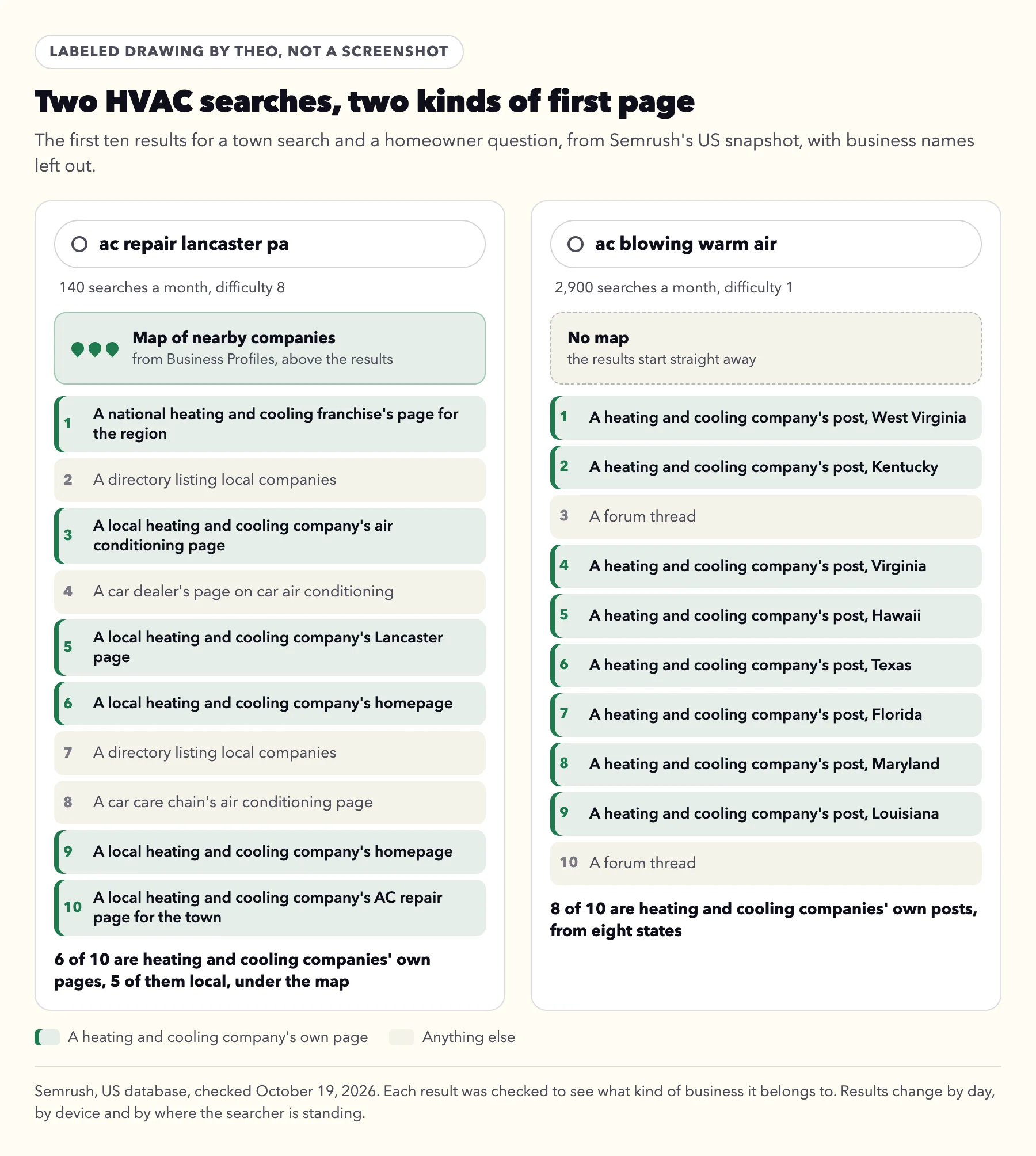
A labeled drawing of Semrush's US snapshot for each search, checked October 19, 2026, with business names left out. It is not a screenshot, and results shift with the day, the device and where the searcher is.
Town searches: the map comes first
Add a town to a search and it shrinks to a few hundred searches a month or fewer, but the people typing it are close by and ready to call. Google still opens with the map, and town and service pages come in the results below it. For "ac repair lancaster pa", six of the ten results under the map were heating and cooling companies' own pages, five of them local, and three of those five were built around air conditioning in Lancaster. Two more were car repair pages about car air conditioning, which is a good reason for a town page to say plainly that it is about the house.
Question searches: open to a page from anywhere
Questions work another way. The search "ac blowing warm air" sounds urgent, yet Google treats it as a question: no map at all, and eight of the ten results were heating and cooling companies' own posts, from eight different states. A question post reaches homeowners everywhere, a few of them near you, and a clear answer is the kind of page AI answers can cite. It is also a search where a small company's post sits beside other small companies' posts rather than national brands.
That is why the search work looks at difficulty as well as volume, and why it leans toward searches a young site has a real chance at.
When to publish: HVAC searches follow the weather
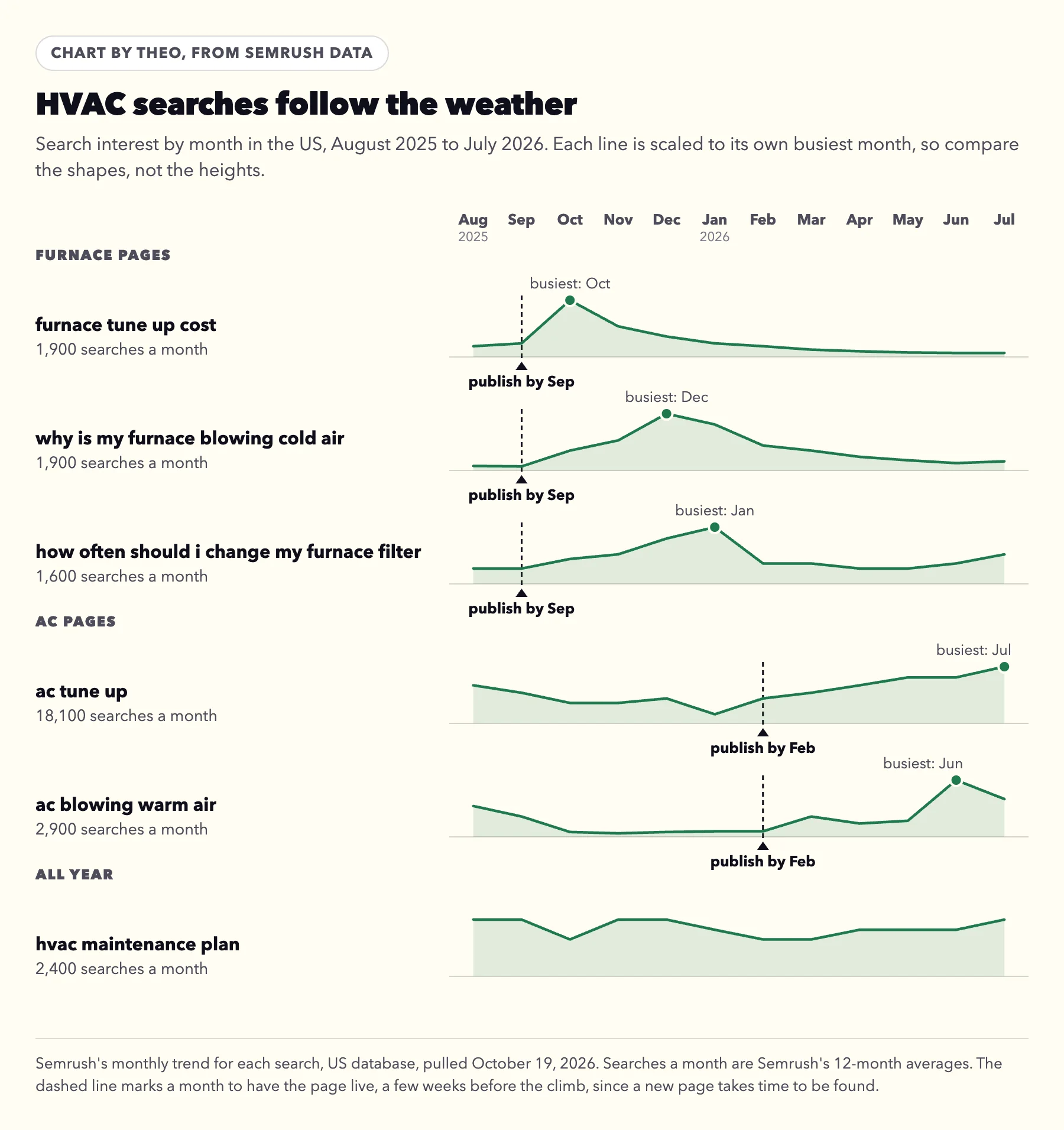
Heating and cooling searches rise and fall with the seasons, and a page has to be live before the rise, because Google can take weeks to find a new page and start showing it. The chart traces six searches across a year.
Furnace pages by September. Searches for "furnace tune up cost" peak in October and fall to under a tenth of that peak by summer. "Why is my furnace blowing cold air" builds through the fall to a December peak, and the furnace filter question peaks in January.
AC pages by late winter. Searches for "ac tune up" climb from February to a peak in July, and "ac blowing warm air" jumps in June.
Plan pages any month. Searches for "hvac maintenance plan" never fall more than about a third below their busiest month.
A chart by Theo from Semrush's monthly trend for six searches, US, August 2025 to July 2026, pulled October 19, 2026. Each line is scaled to its own busiest month, and the searches-a-month figures are 12-month averages, so a given month can run well above or below them.
Getting a seasonal page up on time
The search work drafts pages on its own schedule. If you want a particular page ready for a season, such as a fall tune-up page with this year's price, you can also ask for it in the chat in plain words. Pages you ask for in chat use chat credits; the search work's own pages never do.
The pages an HVAC website needs, shown on sites Theo built
Each kind of search in the table needs its own kind of page. These matter most for a heating and cooling company, with examples from sites Theo built.
A no-heat and no-cooling page
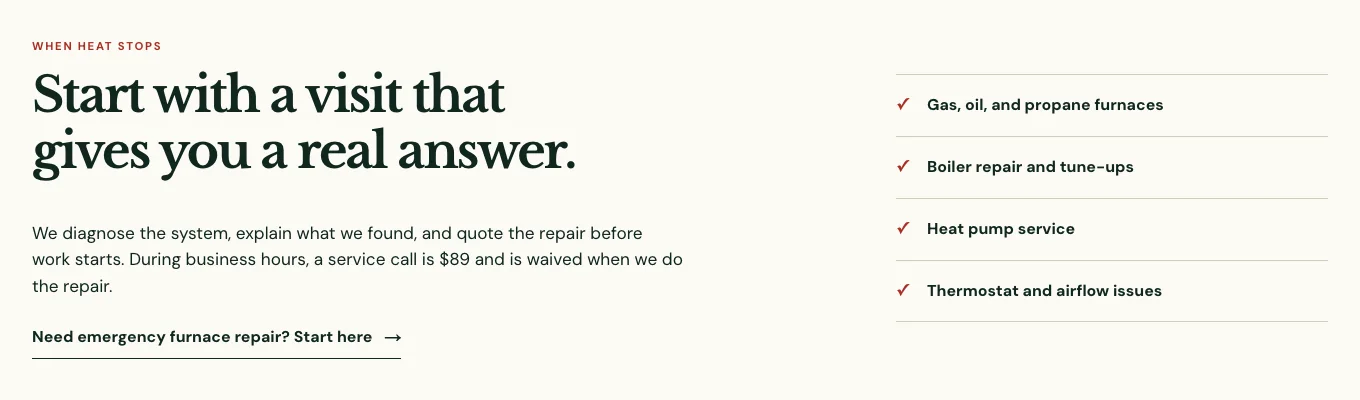
Someone with a cold house wants three answers: whether to leave, what to try, and who will pick up. Aukamp's new page opens with the phone number, puts the gas and carbon monoxide warnings right under it, then lists five checks a homeowner can safely make.
Built by TheoFurther down the no-heat page the run wrote: five checks to try before calling, in order.
Service pages, linked where people already look
A page for each job you sell, from furnace and boiler repair to heat pumps, mini-splits and replacement, lets Google match each search to the right page. A new page also needs a way in. When the run added the no-heat page, it put a link on the Heating page, where a homeowner with a furnace problem already goes.
Built by TheoThe link the run added to Aukamp's Heating page.
Price pages for the planning searches
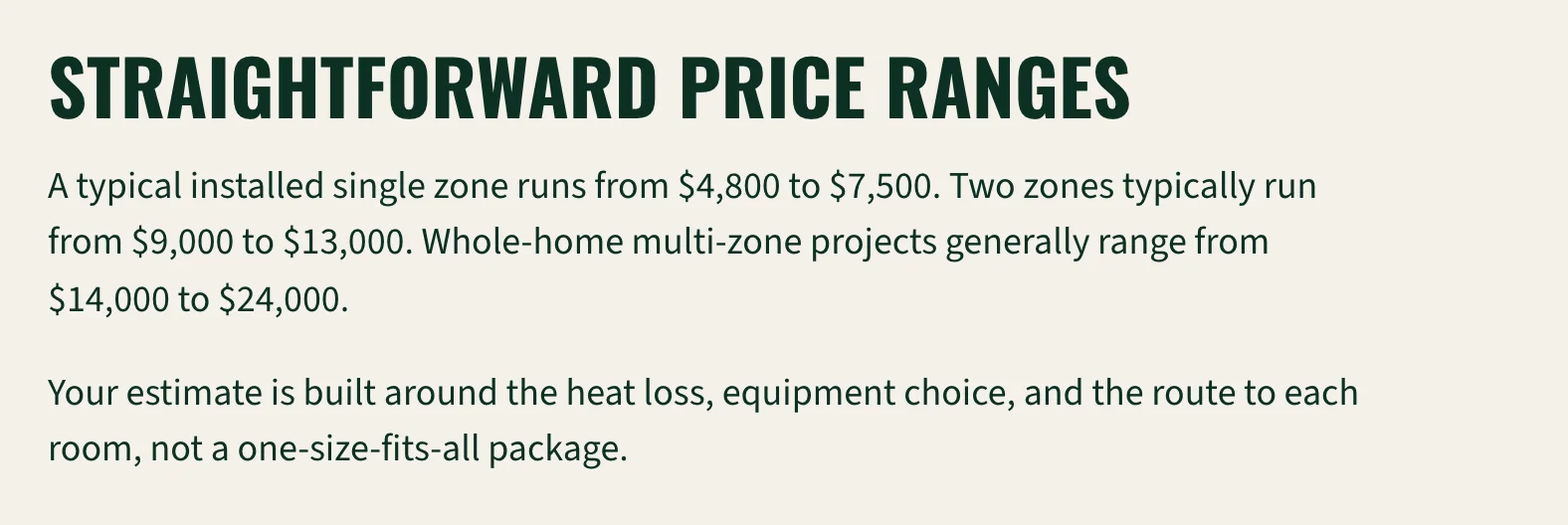
Searches with cost in them come from homeowners who are planning, and a page that shows a range answers what they typed. For "mini split installation cost", Semrush's US top ten on October 19, 2026 was mostly forum and Facebook threads, and the two installers in it each had a price page for one town. Vellacott Heat Pumps, a cold-climate heat pump site built by Theo, gives its ductless page installed price ranges by the number of zones and says what moves the price.
Built by TheoVellacott's ductless page puts its price ranges in plain numbers.
Town pages, a plan page and proof
Town pages for the places you drive to most, each with something true about that town: how far it is, the houses and systems you see there, any trip charge. Swapping the town name into the same page tells a homeowner nothing new.
A maintenance plan page with the price, the visits and what members get, for the plan searches that run all year.
Proof where the decision happens: your license, EPA 608 certification for refrigerant work, insurance, photos of your own techs and trucks, and reviews.
Links you already have a right to: the dealer locator of each equipment brand you install, your trade association's member directory and your local chamber of commerce. Make sure each listing shows your current website address. No SEO needs to sell you these.
Your Google Business Profile does the map's work
The map above a near-me search comes from Google Business Profiles, which are free and separate from your website. Google's help page on local results, read October 19, 2026, says they are "mainly based on relevance, distance, and popularity," and that more reviews and positive ratings "can help your business’s local ranking." The same page says there is no way to "request or pay for a better local ranking."
For a heating and cooling company, these parts of the profile matter most:
One main category that says what the business is, such as HVAC contractor, and as few others as possible. Google's guidelines for Business Profiles, read October 19, 2026, ask owners to "Choose the fewest number of categories it takes to describe your overall core business."
The hours your office is open. The same guidelines ask for your "regular customer-facing hours of operation," and any More hours you add for a service should be "a subset of your primary hours." If a person answers no-heat calls on evenings and Sundays, say so in the business description, the same way the website says it.
A service area instead of a street address if customers never come to your shop.
Services listed one by one, such as furnace repair, AC repair, heat pump installation and maintenance plans, so the profile and your pages say the same thing.
You do, with help. On Starter and Pro, the Boost checklist takes you through the Business Profile, then Apple Business Connect, Bing Places, Yelp, Facebook and more, one step at a time. Each change is made in your own account, so every listing stays yours.
Your part each week, and Theo's
Most of your share is setup. After that, the table shows who does what.
When
You
Theo
Once, early in Starter's free 30 days
Point your domain at the site and sign in with Google
Sets up Google Analytics and Search Console and submits your sitemap, then switches the search work on
Each week
Read the drafts in your Growth tab and publish them, or turn on auto-publish
Researches searches, drafts pages and posts, and fixes technical problems
When something changes
Tell Theo in the chat about a new service, town or hours, and drag in photos of techs, trucks and installs
Makes the change on the site
After every job
Ask for a Google review the same way each time
The free review link generator makes the link and a QR code
How long HVAC SEO takes
Search traffic builds over months, not weeks. Google's own guidance on hiring an SEO puts the payoff at four months to a year. That line comes from Google Search Central's video How to hire an SEO. Google's SEO Starter Guide, read October 19, 2026, adds: "Some changes might take effect in a few hours, others could take several months."
Expect the first signs on the small searches: town and service searches and homeowner questions start showing impressions in Search Console, which means Google is listing the new pages. Clicks come after that. Broad searches such as "hvac company near me" are decided mostly by the map, and a young website rarely reaches page one for them within six months unless other sites link to it.
What you can watch is the work: every page, post and fix in your Growth tab, and Google's clicks and impressions in your Analytics tab.
What HVAC SEO costs, next to an HVAC marketing agency
On Theo, the search work comes with Starter, $69.99 a month and free for the first 30 days, and with Pro, $129.99 a month, which adds more weekly pages and posts. Both prices cover the website and its hosting, and there is no fee to build the site. The pricing page lists everything in each plan.
HVAC SEO from an agency is usually sold as a monthly retainer, and some agencies add a one-time setup fee.
Owners who search for an HVAC marketing agency (about 2,900 searches a month in the US, Semrush estimates as of October 19, 2026) mostly find agencies that sell ads and social media alongside SEO. Theo builds the site and does the search work.
An HVAC SEO or marketing agency
Theo Starter
Theo Pro
Monthly price
A monthly retainer, or a quote after a call
$69.99, free for the first 30 days
$129.99
Setup fee
Some charge one
None, and the first build is free
None
The website
Ask whether it is included
Included, with hosting
Included, with hosting
Who writes the pages
The agency, or you supply the words
Drafted by Theo, approved by you in the Growth tab
Theo, with more pages and posts each week
Contract
Ask about the minimum term
Month to month
Month to month
What you see
Ask for a list of each month's changes
Every page, post and fix in the Growth tab, plus a weekly email
The same, with read-only access to the site's code
Other costs on Theo
Three things can cost extra: top-up chat credits if you ask for more changes than your plan's credits cover, a domain if you buy one through Theo, and the optional paid directory submission packages in the Boost checklist. For a quick check in your own numbers, divide $69.99 by what you keep from one tune-up or repair call; that is how many extra calls a month Starter needs to pay for itself. To see whether the plan pays for itself, the guide Is SEO worth it for a small business? works through the math with your own job size and margin.
Before you hire anyone for HVAC SEO
HVAC owners get SEO pitches by phone, email and text all year. Google's page for owners weighing outside help, Do you need an SEO?, was updated on June 5, 2026, with new advice on judging an SEO's tools and recommendations. These points from it, read again on October 19, 2026, settle most pitches.
A promise of first place. If an SEO guarantees their changes will put you in "first place in search results," Google's advice is to find someone else.
A free audit that needs your login. Google says to "only grant read access to Search Console" at that stage, never write access.
Link schemes, or a link back to them. In Google's words: "You should never have to link to an SEO." Google also says: "Avoid SEOs that talk about link popularity schemes or submitting your site to thousands of search engines."
Changes you never see. Google reminds owners that they are responsible for "the actions of any companies you hire," so ask for a list of every change, with links.
An email out of nowhere. Google tells owners to be wary of SEO firms and agencies that "email you out of the blue."
The email that says you are invisible to AI
One pitch arrives often enough to name: an email asking whether you are in AI searches, with screenshots from a paid SEO tool showing an AI visibility score of zero and a list of lost backlinks. Two lines from Google's page answer it. Third-party SEO tools "don't have access to Google's internal ranking data," so the score is the tool's guess, not Google's. And for advice on AI answers, often sold as AEO or GEO, Google asks whether it is "aligned with Google Search's official guidance on optimizing for generative AI features," which is Google's own page on generative AI search.
Work toward citations in AI search tools such as ChatGPT and Google AI Overviews is already part of Starter and Pro. The guide to showing up in AI Overviews explains what those tools look for, and a pitch email taken apart line by line is in how to tell a good SEO offer from a bad one.
Moving an HVAC website you already have
Theo's search work runs on a site Theo builds and hosts, so the system that writes a page can also publish it, link it and fix it. Send Theo the address of your current site and it drafts a new one from it, with your services, towns and look, which you shape in the chat. The old site stays up until your domain points at the new one.
Once Search Console is connected, SEO repair on Starter and Pro forwards old addresses that still get search traffic to their matching new pages, and on any plan Theo adds a forward you ask for in chat. Google may then send an email headed "New reasons preventing your pages from being indexed". After an HVAC site moves, that list is mostly the old addresses forwarding to their new pages and the http and www versions forwarding to the main address. That is good news: Google is crawling the move. On Starter and Pro, Theo's SEO repair runs pull those reports from Search Console, check the site directly and fix what needs it. The guide to Search Console's emails reads that email line by line.
Starter is $69.99 a month and free for the first 30 days, and Pro is $129.99 a month with more pages and posts each week. Either plan covers the website, its hosting and the search work, and there is no charge to build the site. Possible extras are top-up chat credits, a domain bought through Theo and the optional paid directory submission packages in the Boost checklist. Basic is the site and hosting without the search work.
How long does HVAC SEO take to work?
Search traffic builds over months, not weeks. Google's own guidance on hiring an SEO puts the payoff at four months to a year. Expect impressions in Search Console for town and question searches first, then clicks, and plan seasonal pages a few weeks before the weather turns.
Who owns the website and the pages Theo writes?
Your company does. The pages, the words and your photos belong to you, and a domain bought inside Theo is registered in your name. Theo hosts it, and on Pro you can also read the site's code on GitHub.
Is there a contract, and can I cancel?
There is no term to sign. Cancel in any month: the confirmation shows the date your subscription ends, and the site stays live until that date. Copy any text and photos you want to keep before then.
Can Theo do SEO on the site I already have?
No, the old site stays as it is: Theo's search work happens on a site Theo builds and hosts. Send Theo the address of your current site and it drafts a new one from it, keeping your services, towns and look. Until your domain is pointed at the new site, the old one stays up.
Can Theo put my company in the map for "ac repair near me"?
The map runs on your Google Business Profile, which stays in your own Google account. On Starter and Pro, the Boost checklist walks you through the profile and your other listings one step at a time, and steady reviews do much of the work. Google says there is no way to "request or pay for a better local ranking."
Is showing up in ChatGPT and Google's AI answers an add-on?
No. Work toward citations in AI search tools, including ChatGPT and Google AI Overviews, is part of Starter and Pro. There is no extra charge for it.
Does Theo run Google Ads or Local Services Ads?
No. Theo builds the site and does the search work, and ads stay with you or whoever runs them now. If you book jobs in ServiceTitan, Housecall Pro or Jobber, the site links to your booking page.