Insurance agency SEO: the searches open to a local agency, and the pages that answer them
Insurance agency SEO is the work that puts an agency's own website in front of people looking for coverage in the towns it writes in. It covers the map listing that answers 'near me', a page for each line and town, and plain answers to the questions clients raise at renewal. On Theo, the search work on the website and the Boost checklist for the map listing come with Starter and Pro, for agents and brokers alike. This page sorts an agency's searches by who can realistically win them, with the numbers, then shows what the work did on an agency site Theo built.
Your first build is on Theo: see the site before you decide
SEO for an insurance agency comes down to picking the right searches. The biggest ones, such as 'cheap car insurance' or 'home insurance quote', belong to national carriers and comparison sites, so a local agency should leave them alone. Searches like 'insurance agent near me' are answered on the map, which makes your Google Business Profile the main tool there. What stays open to a local agency is its own towns and the coverage questions clients ask, such as how much umbrella insurance a family needs. On Starter and Pro, Theo researches those searches, drafts the pages and posts and fixes technical problems on the site. On every plan, connecting Google also submits your sitemap through Search Console, so Google can find each new page. Nothing goes live until someone at your agency publishes it from the Growth tab, unless you switch on auto-publish. On Starter and Pro, the Boost checklist takes you through your Business Profile and the other listings, step by step. The work runs on a site Theo builds and hosts, and the first draft of that site is free.
In Theo's audit of 6,861 small business websites, 53 percent of the 532 professional services sites with search data got an estimated zero visitors a month from Google search, and 74 percent got fewer than ten. The sample is the sites whose owners ran Theo's free audit. See the research.
On an agency site Theo built
What the search work did on an insurance agency site
Kettlehaus Insurance, a site built by Theo, is a family-owned home and auto agency in Wausau, Wisconsin. On October 19, 2026, Theo's Growth Engine, the search work on Starter and Pro, ran on it four times, one job per run. Auto-publish was off, so each batch of work waited in the Growth tab until it was published from there.
On an agency's own site, the same jobs arrive one at a time over the weeks, on its plan's schedule.
The searches it chose
Before writing anything, the engine looked up what people type and how many strong pages already compete. The figures come from Semrush, a search data service, for the US: average searches a month, and keyword difficulty on a scale of 0 to 100, where a lower score means less competition. For the town page it looked up four Wausau searches before picking one.
The Wisconsin statistics page had no single search behind it. Its job is to be a sourced reference that writers and other sites can quote and link to. Numbers as the engine stored them on October 19, 2026.
What it wrote
Three new pages on the Kettlehaus site
Each of the three page runs drafted one page, checked it on phone and desktop screens and linked it from the pages next to it. Here are the three pages, as they open on the live site.
Built by TheoKettlehaus InsuranceThe new umbrella guide, as it opens on a laptop.See the live site
01
A coverage question, answered in plain words
What is umbrella insurance coverage, and who should consider it? runs to about 1,200 words. It explains how an umbrella policy sits above home and auto liability limits, works through a simple example, says what umbrella coverage usually leaves out and lists the household changes worth a second look, such as a new teen driver or a boat.
It points readers to Wisconsin's insurance regulator and the National Association of Insurance Commissioners. The same run opened a Guides section with an Insurance basics category and added Guides to the main menu.
Built by TheoKettlehaus InsuranceThe new Wausau auto page, partway down: why one policy should fit how a household drives, and what the agency reviews.See the live site
02
One line of insurance in the home town
Auto insurance in Wausau, WI carries about 1,200 words for Wausau drivers. It covers what the agency checks in an auto policy, when a policy is worth another look, what to bring for a quote and how the comparison works, then answers local questions, such as how a deer strike is usually handled.
The Home + auto page now links to it, so a visitor reading about household coverage can reach the Wausau page in one click.
Built by TheoKettlehaus InsuranceThe six figures on the statistics page, each one linked to its source.See the live site
03
Wisconsin figures with their sources
Wisconsin auto insurance statistics: 2026 sets out six dated figures, from the 2024 crash totals in the state's crash report to the 25/50/10 minimum liability limits, and links each one to its public source.
It closes with how the figures were chosen and a citation a writer can copy, and the Wausau auto page links to it.
What it linked and checked
Each new page was linked into the site: the Wausau page from the existing Home + auto page, the statistics page from the new Wausau page, and the umbrella guide from a new Guides section that the main menu now links to. The fourth run was the search health check: it read the site's public pages and changed nothing.
What it did
Where
Why it helps
Linked each new page in
Guides in the main menu, then the new Guides and Insurance basics pages, for the umbrella guide; the Home + auto page for the Wausau page; and the Wausau page for the statistics page
People and Google can reach each new page from one they already know.
Added the new pages to the sitemap
The guide, the Guides and Insurance basics pages, the Wausau page and the statistics page
The sitemap is the list of pages a site hands to search engines.
Checked the whole site
Titles, descriptions, preferred addresses and main headings on the public pages, the sitemap, the instructions for search engines and all 17 internal addresses the site links to
The run changed nothing on this pass; its note lists what it read.
Left alone on purpose
Rewrites of the agency's existing pages
The run's note says this pass found no evidence that a page needed one.
Your Growth tab
The note waiting after each run
After every run, Theo leaves a note in the Activity list of your Growth tab that says what it read, what it changed and why, with links to the pages. Below are three parts of the note from the Wausau run, word for word.
An agency that reviews its marketing before anything goes out can keep auto-publish off, as it was here, and publish each page from the Growth tab once it reads right. A weekly email also counts what was added.
Pricing
What it costs, in full
The ongoing search work is part of Starter and Pro. Basic is the site and hosting on its own. Starter is free for the first 30 days.
Plan
Per month
Ongoing search work
Chat credits
Best for
Basic
$29.99
Not included
1,500 a month
Owners who just want their site live and easy to update.
StarterFree for 30 days
$69.99
Included, uses no credits
4,500 a month
Owners who want the site handled without heavy publishing volume.
Pro
$129.99
Included, uses no credits
7,000 a month
Owners who want more capacity, more publishing, and more room to experiment.
No contract, cancel anytime, and you own the site and its content. The pricing page lists what each plan includes and how chat credits work.
Check first: is your agency's site on Google at all?
Before any of this, make sure Google has the site. Search for site: followed by your domain, such as site:youragency.com. If the answer surprises you, one of these is usually the reason.
What you see
The usual reason
What to do
Your address does not open the new site in a browser
The site is not published yet, or the domain does not point at it
Publish, then point the domain. Theo walks you through that step.
The site opens in a browser, but Google lists nothing
Google has not found the site yet
Connect Search Console. On every plan, Theo then submits your sitemap.
Google still shows the old site
Google has not revisited since the move
This settles as Google crawls the new pages, and Search Console shows the progress.
Your name comes up, but not your coverage pages
There is no page yet for that search, or it is new
Which insurance searches are open to a local agency
Type "car insurance" or "home insurance quote" into Google and you will rarely find a local agency on the first page. Those searches belong to national carriers and comparison sites with large budgets. Search is still open to a small agency, but only in certain places, and the numbers show where.
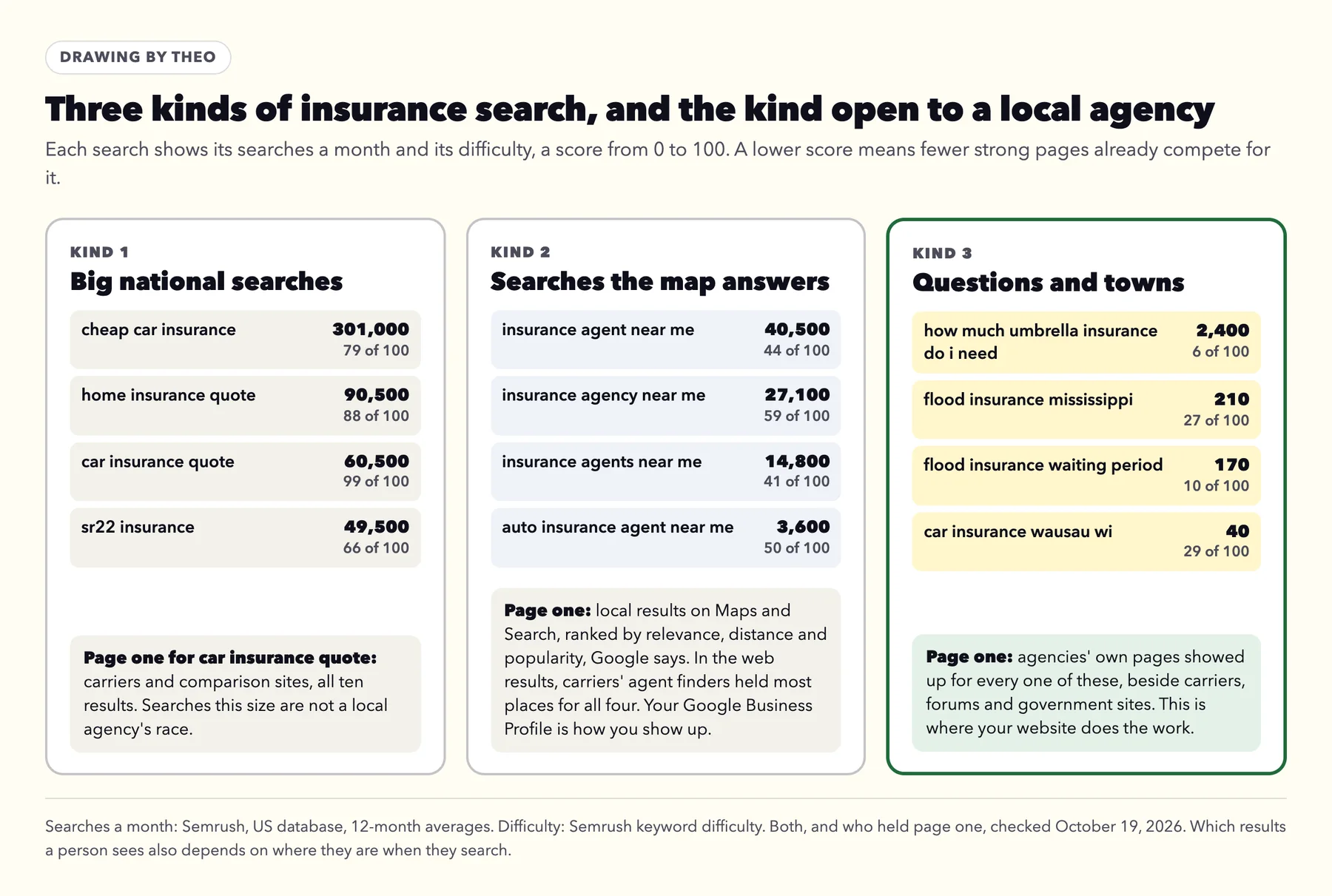
Semrush estimates how many people in the US type each search in a month and scores how hard it is to reach page one, from 0 to 100. Sorted by who held page one on October 19, 2026, the searches around an agency fall into three kinds.
A drawing by Theo. Searches a month and difficulty from Semrush, US, checked October 19, 2026.
Big national searches: leave them to the carriers
The largest insurance searches run to tens or hundreds of thousands a month, with difficulty scores high on the scale. For "car insurance quote", every one of the ten results on page one was a carrier or a comparison site. That list belongs to carriers and comparison sites, and an agency's time is better spent where agencies already appear.
Some questions are taken too. "Why did my home insurance go up", at 320 searches a month, sounds like one a local agent could answer, yet page one held carriers, two state insurance departments, a news site, a forum thread and a video. Look at page one before you write.
Near me searches: the map decides
"Insurance agent near me" gets about 40,500 searches a month. Google says local results on Maps and Search are "mainly based on relevance, distance, and popularity," and that distance "refers to how far each business is from the customer who's searching." That is your Google Business Profile's job, covered further down. In the ordinary web results for it and for "insurance agency near me", Semrush's US check found mostly carriers' agent finders.
Medicare is the exception: for "medicare agent near me", about 2,900 searches a month at a difficulty of 10, page one held Medicare agent directories, a federal help page and guides, beside three agencies' own pages. So a Medicare agency's own page for its area has room there.
Volumes here are 12-month averages, and some move a lot. "Insurance agency near me" has run at about half its 12-month high in Semrush's most recent months.
Coverage questions and your towns: where agencies show up
These searches are smaller, but agencies' own pages already hold places on page one, so a careful page has room. The questions also tend to beat a town name on volume: far more people ask how much umbrella coverage they need than search for car insurance in a small town like Wausau.
Search
Searches a month
Difficulty
Who was on page one, October 19, 2026
how much umbrella insurance do i need
2,400
6 of 100
Posts by four local and regional agencies, beside forum threads and an insurance company
flood insurance mississippi
210
27 of 100
A local agency's guide and another agency's town page, beside FEMA, state offices and insurance companies
flood insurance waiting period
170
10 of 100
Agencies' own pages, beside FEMA, FloodSmart, state sites and a flood insurer
car insurance wausau wi
40
29 of 100
Four local agencies' home pages and a regional agency's office page
Your towns: what page one shows for a small-town search
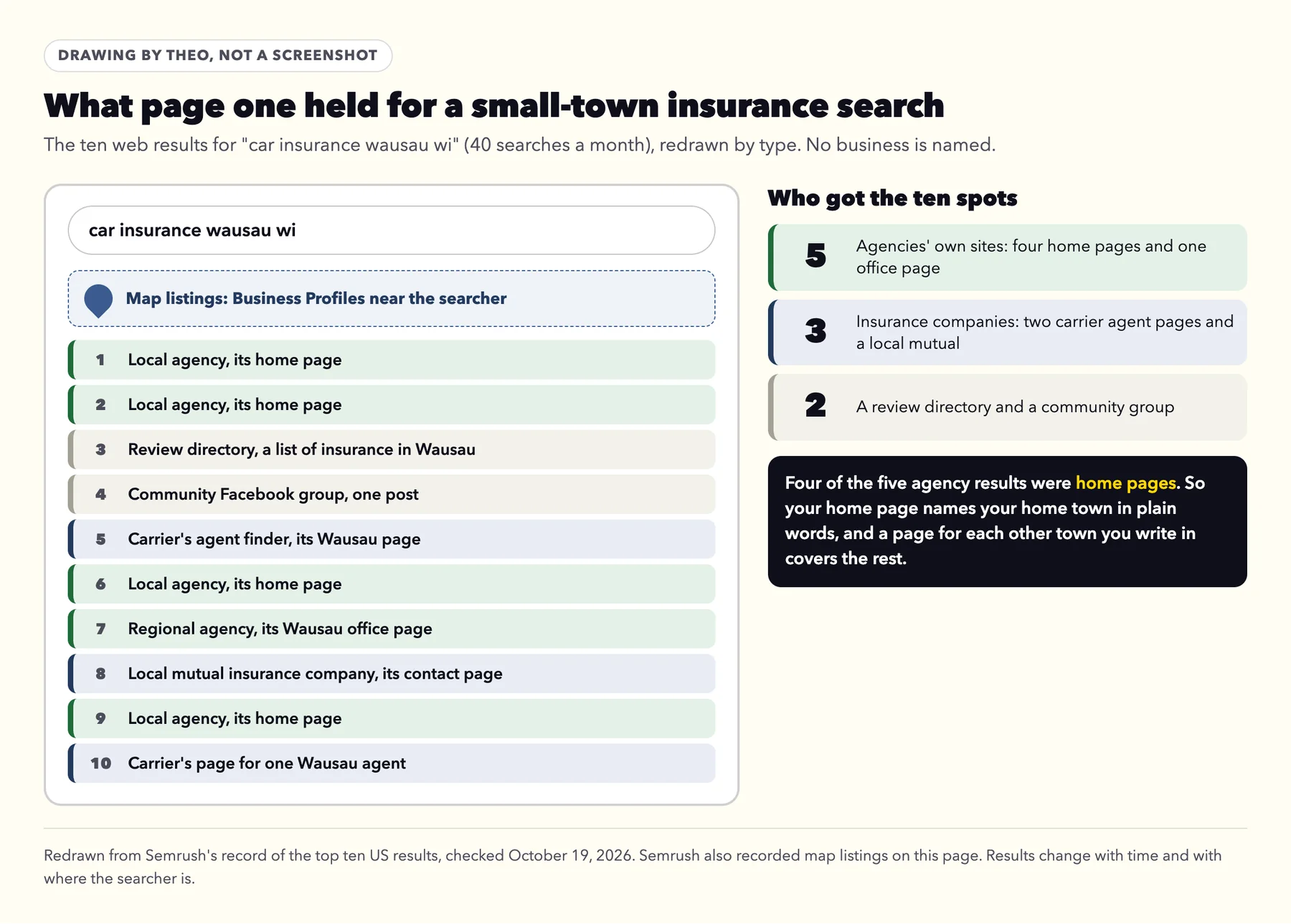
Town searches are small. "Car insurance wausau wi" gets about 40 searches a month. They still count, because the person typing one is close to asking for a quote, and agencies' own sites take half the places. Here is page one for that search on October 19, 2026, redrawn by type.
A drawing by Theo from Semrush's record of the top ten US results, checked October 19, 2026. No business is named.
What that means for your site
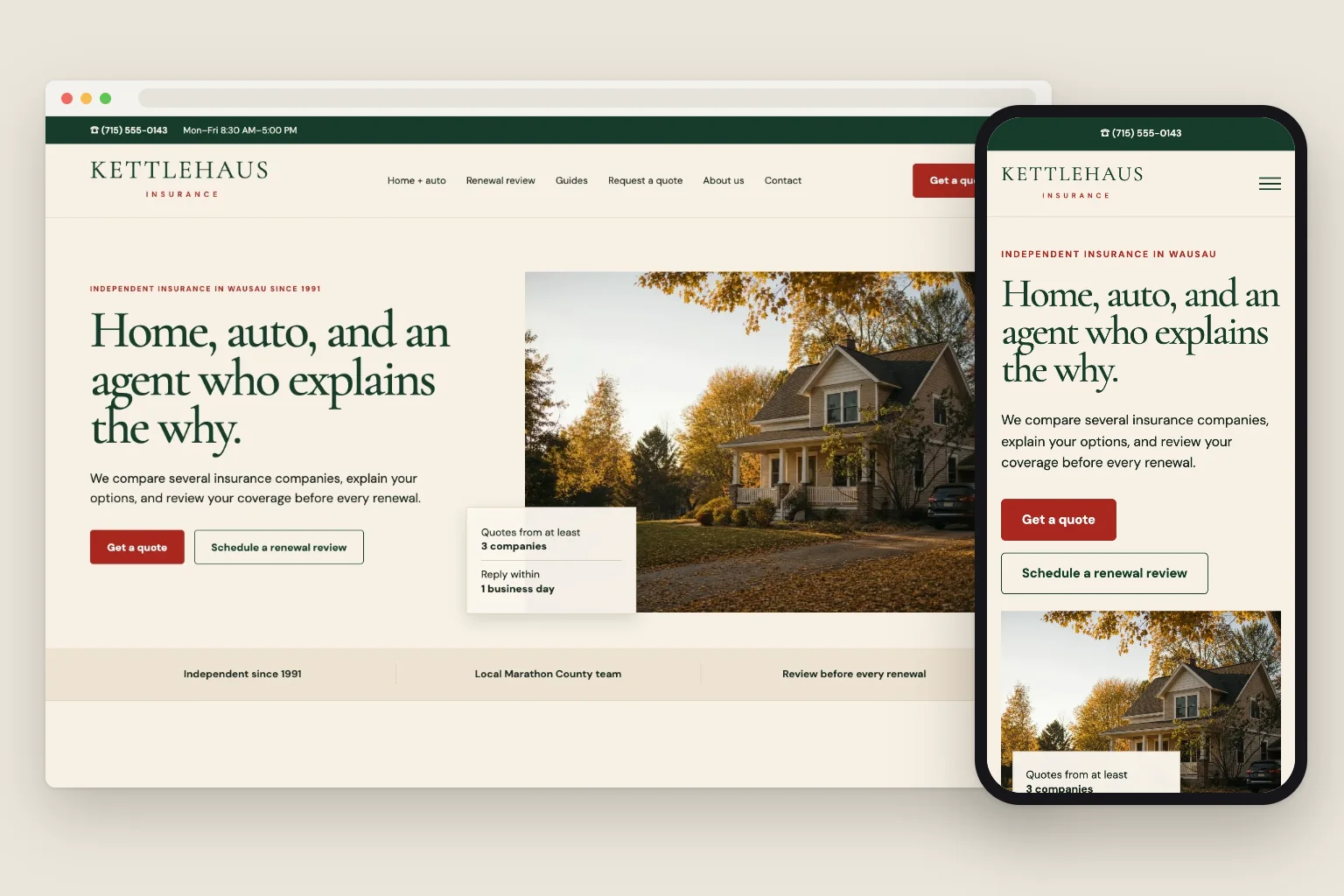
Your home page names your home town. Four of the five agency results were home pages. Say near the top which lines you write and where, the way the Kettlehaus home page titles itself "Independent Insurance in Wausau, WI."
Each other town you write in gets a page. One page per town, written about that town, not the home page copied with a new name.
A line can get its own page in your home town. The Wausau auto page above is one, written for a search with clear quote intent.
Keep the map listing and the site in step. The same name, address, phone and hours on both.
The pages that answer agency searches
Each page below answers a different kind of search. How to build each one, from the quote form to the claims page, is on the page about insurance agency website design. Here, each kind is paired with the searches it is for.
Question pages for what clients ask at renewal
A client wondering about an umbrella policy, or how soon a new flood policy starts, types the question the way they would ask it. A page that answers it in the first lines, then explains the details, is the kind of page agencies already hold places with on page one for these questions, and one a client forwards to a spouse.
Ask your producers and customer service staff which questions come up every renewal season. That list is the plan. The pages explain coverage in general terms; anything about one client's own policy stays in the conversation with that client.
Pages for one kind of client
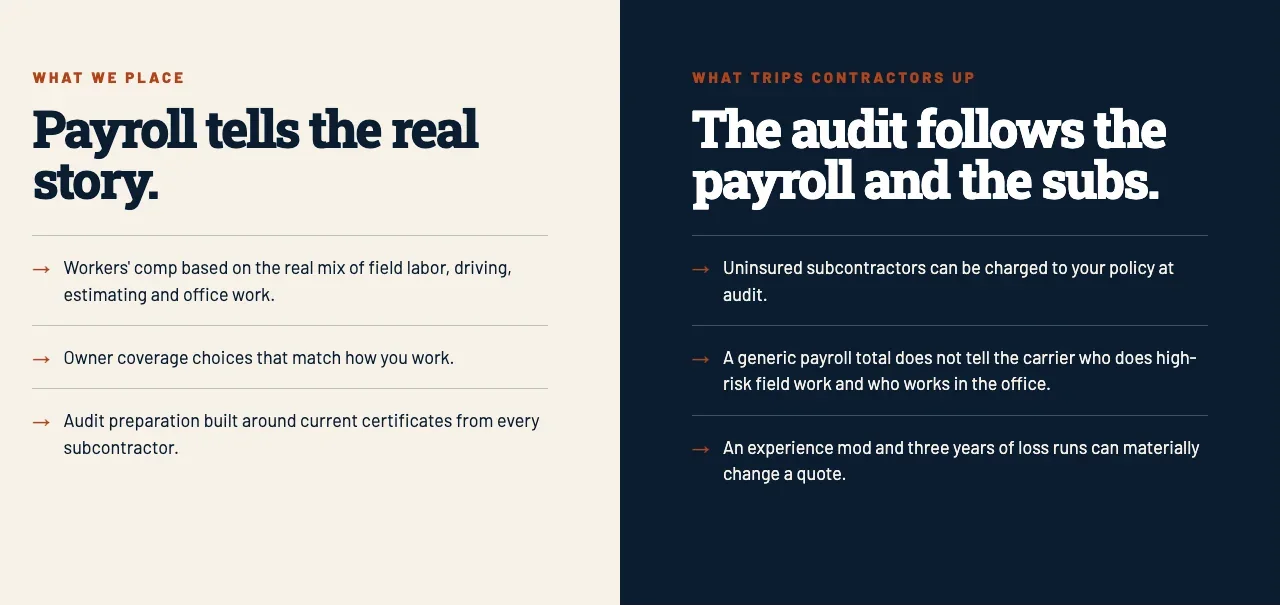
Contractors, landlords, small employers and new parents each search in their own words. "Certificate of insurance contractor" (140 a month, Semrush US, October 19, 2026) and "do i need workers comp for 1099 employees" (170 a month) are contractor searches. Brunvald Insurance, a contractors-only agency site built by Theo, writes its workers' comp page around the payroll audit, in a section it labels What trips contractors up.
Built by TheoBrunvald Insurance's workers' comp page explains what drives the premium and what comes up at audit. See the live page.
Pages for a moment in a client's life
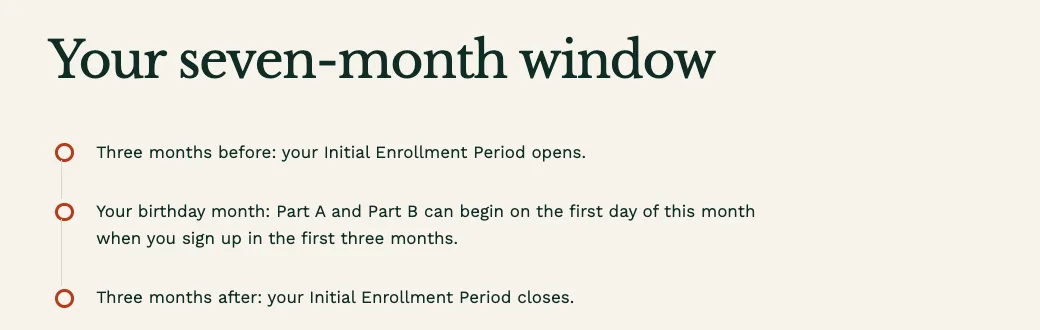
Turning 65, a first teen driver, a new baby or a first home each set off a run of searches. "Turning 65 medicare checklist" gets about 90 a month at a difficulty of 10 (Semrush US, October 19, 2026). Hallendine Medicare Advisors, a Medicare agency site built by Theo, gives turning 65 a page of its own and opens with the dates.
Built by TheoThe Turning 65 page sets out the seven-month sign-up window that Medicare.gov describes. See the live page.
Your Google Business Profile and the near me searches
Owners often mix up three Google products, all reached with one Google sign-in. The Business Profile is your listing on Maps and in local results. Search Console is Google's free report on how your website does in search, and it is what Theo connects to submit your sitemap. Google Ads is paid advertising, separate from both.
For the map, the profile does most of the work. Google's own help pages, read on October 19, 2026, set a few rules that matter to agencies.
One profile per office. Google says, "Do not create more than one page for each location of your business." An agency with three offices has three profiles, each at its own address.
A lone agent at a branded office. When one agent is the only public-facing person at an office carrying a company's brand, Google says it is best to share one profile with the organization, named "[brand/company]: [practitioner name]".
Categories. Google asks owners to "use as few categories as possible" and to pick ones "as specific as possible, but representative of your main business."
Reviews. Ask every client the same way and answer every review. Google's review policy bars offering "payment, discounts, free goods and/or services" for a review, and bars asking only the clients you expect to be happy. A gift for a review can also run into your state's insurance rules; the insurance website design page says what to check.
Links and reviews count. Google says prominence, how well-known a business is, also draws on "info like how many websites link to your business and how many reviews you have."
Who does the profile on Theo
You do, in your own Google account, so the listing stays in the agency's name. On Starter and Pro, the Boost checklist walks you through the profile and the other listings people check, such as Apple Business Connect, Bing Places, Yelp and Facebook, so the details match your site. For replies to reviews, how to respond to negative Google reviews has sample wording.
Google product
What it is for
Who sets it up on Theo
Business Profile
Your listing on Maps and in local results
You, with the Boost checklist on Starter and Pro
Search Console
How your website does in Google search, and where the sitemap goes
Theo, after you sign in with Google once
Google Ads
Paid ads above or below the results
Not part of the search work
Captive agents: your carrier's page may already be on page one
In the Wausau search above, two of the ten results were carrier pages for local agents: one carrier's agent finder for the town, and another carrier's page for a single agent. If you are a captive agent, your carrier may give you a page like that, and it may already show up for your town.
A site of your own can add what that template cannot, such as answers to the questions your clients ask and a page for each nearby town you write in. Whether you may run one, and what it may say, is your carrier's call, so ask before you build and keep the answer on file. For an independent agency, these carrier pages are part of what a town search puts you beside.
How long insurance agency SEO takes, and when to publish before a season
Search traffic builds over months, not weeks. Google's own guidance on hiring an SEO puts the payoff at four months to a year. Google Search Central gives that range in its video How to hire an SEO.
An earlier sign comes before any calls. Once Google indexes a new page, Search Console starts counting impressions, the number of times the page appeared in results. How to get Google to index a site explains each step, including why a page Google has found can wait before it is added.
Insurance runs on dates, so that lead time decides when a page should go up. So put seasonal pages up months ahead, not the week a season opens. The dates below count back four months, the short end of Google's range for search work to pay off.
February, for a page on flood coverage and its waiting period
Your busiest renewal month
Whenever most of your book renews
Four months before it, for a page on what to review at renewal
Turning 65
A seven-month window around each person's 65th birthday month
Any time; these searches come all year
Built by TheoHallendine Medicare Advisors' Fall Review page gives the enrollment dates in its first lines. See the live page.
Who approves each page before it goes live
Insurance pages mention carriers, coverage terms and sometimes Medicare plans, so many agencies have someone read marketing before it goes out. The search work fits that. Every page Theo drafts waits in the Growth tab until someone at the agency publishes it. Auto-publish is a switch the owner turns on, and an agency with a review step can leave it off. The four Kettlehaus runs above went that way: auto-publish off, and each batch published from the Growth tab.
Carrier logos, license lines and the notice that agents who sell Medicare plans for more than one company must show on their websites are covered on the insurance website design page, so they are not repeated here.
Pages drafted with AI: what Google says
The Growth Engine drafts with AI, and a person at the agency decides what goes live. Google's guidance on generative AI content, last updated October 1, 2026, says these tools "can be particularly useful when researching a topic, and to add structure to original content." It also warns against using them "to generate many pages without adding value for users."
So the test is the page, not the tool. A page that answers a client's question correctly, with the agency's own towns and details, is the kind Google describes. Google's guidance is short and worth a read.
What the search work covers, and who does each part
Set this next to any proposal you are weighing. It lists each job in insurance agency SEO and who does it when the site is on Theo.
The job
What it means for an agency
Who does it on Theo
Search research
Finding the coverage questions and town searches people type, with monthly numbers, and setting aside the ones carriers own
Theo, on Starter and Pro
Question pages and guides
Plain answers to what clients ask at renewal, such as umbrella limits or flood waiting periods
Theo drafts; your agency approves
Line and town pages
A page for a line in a town you write in, like auto insurance in Wausau
Theo drafts; your agency approves
Reference pages
Sourced state figures other sites can cite, kept current
Theo drafts; your agency approves
Site health
Titles, descriptions, preferred addresses, links, the sitemap and the instructions for search engines, checked on a schedule
Theo, on Starter and Pro
Getting pages found
The sitemap submitted through Search Console, so Google can find each new page
Theo, once you sign in with Google
Business Profile and listings
Category, hours, photos, and the same name, address and phone everywhere
You, in your own accounts, with the Boost checklist
Reviews
Asking every client the same way and answering each review, with no gifts in return
You and your staff
Carrier and state rules
Approval for named products and logos, license lines and the Medicare notice, for agents who sell plans for more than one company
You, your carriers and whoever reviews your marketing
Reporting
Each new page, post and fix, plus the search clicks and impressions Google counts
The Growth tab, the Analytics tab and a weekly email
Before you hire anyone for insurance SEO
Agency owners hear from SEO firms, website platforms and insurance wholesalers all year. The offers tend to come in a few shapes.
A monthly retainer, with the price given only after a sales call.
A website platform that sells the search work as a separate monthly service.
Coverage pages from a shared library, the same words other agencies' sites carry.
A free website from a wholesaler, offered once you contract with it.
Two lines from Google settle most pitches. Its Business Profile help says, "There's no way to request or pay for a better local ranking on Google." Its page on hiring help says, "If they guarantee you that their changes will give you first place in search results, find someone else." Then ask these, of anyone, Theo included.
Which searches will you go after, and which do you expect carriers to keep? On Theo: each run note says what it looked at and why, like the Wausau note above.
Who approves a page before it goes live? On Theo: someone at your agency, from the Growth tab, unless you switch on auto-publish.
Can we see Search Console ourselves? On Theo: yes. It is set up in your own Google account when you sign in with Google.
What does it cost each month, and is there a term? On Theo: Starter is $69.99 a month after a free 30 days and Pro is $129.99 a month, with no term contract.
What happens to the pages if we stop? On Theo: they are yours, and the site stays live to the end of the paid period.
Why the search work runs on a site Theo builds
The system that drafts a page also publishes it, links it from the pages around it and keeps the sitemap current, so nothing waits on a separate web person. That is why the search work runs on a site Theo builds and hosts. If your agency is on an insurance website platform today, paste its address and Theo rebuilds it as a draft in the look your clients know. The current site keeps answering clients until your domain points at the new one.
After a move, Google sometimes emails a list of addresses it is not indexing, often marked "Page with redirect". That is expected: those are addresses that forward to the pages you keep, such as the http and www versions of your address and any old addresses forwarded to their new pages, and the email shows Google is reading the site. On Starter and Pro, Theo's SEO repair reads those reports and handles what they list. The Page with redirect guide walks through it, and what happens to rankings when you move a website covers the rest of a move.
How much does SEO for an insurance agency cost on Theo?
Insurance agency SEO on Theo comes with two plans. Starter is $69.99 a month and free for the first 30 days. Pro is $129.99 a month and adds more new pages and posts each week. Both include the agency's website and hosting, with no build fee and no contract term. Basic covers the site and hosting without the search work.
How long until my agency shows up on Google?
Search traffic builds over months, not weeks. Google's own guidance on hiring an SEO puts the payoff at four months to a year. The first sign comes sooner: once Google indexes a new page, Search Console starts counting the times it appears in results. Calls and quote requests come later.
Who owns the pages, and can I cancel?
The agency owns them. The pages, the words and your photos are yours, and Pro adds read-only access to the site's code on GitHub. You can cancel any month, with no term contract. The confirmation shows the date the plan ends, and the site stays live until then, so save the text and images you want before that date.
Can Theo do SEO on the site I already have?
Not on a site hosted somewhere else. The search work runs on a site Theo builds and hosts, so it can publish, link and fix each page itself. Paste your current site's address and Theo rebuilds it as a starting draft in the look clients know, which you refine in chat. Your current site stays live until your domain points at the new one. It works the same for agents and brokers moving off an insurance website platform.
Does 'insurance agent near me' come from my website or my Google Business Profile?
Mostly the profile. Google says local results are mainly based on relevance, distance and popularity, and distance means how far the agency is from the person searching. The website still matters: it backs up the profile and is what shows for coverage questions and town searches. On Starter and Pro, the Boost checklist walks you through the profile in your own account.
I'm a captive agent. Can Theo do the search work for my own site?
Yes, if your carrier lets you run a site of your own, so ask first. Your carrier's page for you may already show up for your town, the way two carrier pages did in the Wausau search on this page. Your own site can add answers to your clients' questions and a page for each town you write in. What the site may say is set by your carrier agreement.
Will this help my agency show up in ChatGPT and Google's AI answers, or is that extra?
It is part of the same search work on Starter and Pro, not an add-on. Google says a page has to be indexed and able to show a snippet before its AI features can link to it, so getting pages indexed comes first. Google also says no special optimizations are needed to appear in AI Overviews or AI Mode.
Who checks the coverage pages before they go live?
Your agency does. Every draft waits in the Growth tab until someone publishes it, and auto-publish stays off unless you switch it on. If a carrier or a compliance reviewer must see a page first, leave it off and publish each page once it has been approved.