SEO for accountants, CPA firms and bookkeepers: which searches bring clients, and when
Accounting SEO is the work that puts your firm in front of people who have no referral to go on: someone holding an IRS letter, an owner whose books are a year behind, a family that needs a tax preparer by April. On Theo, Starter and Pro include it. This page shows the searches that matter for an accounting practice, the months people make them, and the pages Theo's Growth Engine wrote on a tax resolution site Theo built.
Your first build is on Theo: see the site before you decide
SEO for accountants is the steady work of making your firm the page Google shows when someone without a referral looks for help. It rests on four things: a page for each service you offer and each kind of client you take; plain answers to the questions people type before they hire, such as what an IRS notice means or what catch-up bookkeeping costs; a complete Google Business Profile that keeps gathering reviews; and a site that opens fast on a phone. Timing matters a great deal for a tax practice. In Semrush's US data for August 2025 to July 2026, searches for a tax preparer ran about four times higher from February to April than in August, and search traffic to new pages builds over months, so pages meant for the spring need to be up well before it. Theo takes on the website side with Starter and Pro. It researches what people search, drafts pages and posts, fixes technical issues and speeds up the site. On every plan, connecting Google also submits your sitemap, and Google rereads it on its own, so each new page is on the list it checks. Nothing it drafts goes live until you approve it in the Growth tab, unless you turn on auto-publish.
In Theo's audit of 6,861 small business websites, 53 percent of the 532 professional services sites with search data got an estimated zero visitors a month from Google search, and 74 percent got fewer than ten. The sample is the sites whose owners ran Theo's free audit. See the research.
On a tax resolution site Theo built
What the search work did on a tax firm's site
Tullberry Tax Resolution, a site built by Theo, is a tax resolution firm of Enrolled Agents in Tulsa, Oklahoma. On October 19, 2026, Theo's Growth Engine ran on it three times, one job per run: a post, a service page and a repair pass. Each piece was published from the Growth tab. On a firm's own site, the same jobs are spread over weeks.
The searches it chose
Each writing run first looked up what people type and how hard each search would be to win. The figures are Semrush's US estimates as the engine stored them that day: average searches a month, and keyword difficulty on a scale of 0 to 100, where a lower score means fewer strong pages already compete. The engine favors a search a small site can win over the largest number.
Before it picked the service page, the run checked four Tulsa searches. Semrush returned zero for "tax resolution tulsa", 20 a month for "tax relief tulsa" and no figures for the other two. "irs payment plan help" scored 62 on difficulty. It chose "irs wage garnishment help", at 260 a month and 13.
What it wrote
A post, a service page and a new Guides section
Each run drafts one piece of work, checks it at phone, laptop and desktop sizes, and links it from the pages around it. These pictures come from the live site after the last publish.
Built by TheoTullberry Tax ResolutionThe CP504 post, at the size a laptop shows it.See the live site
01
A post about one IRS notice
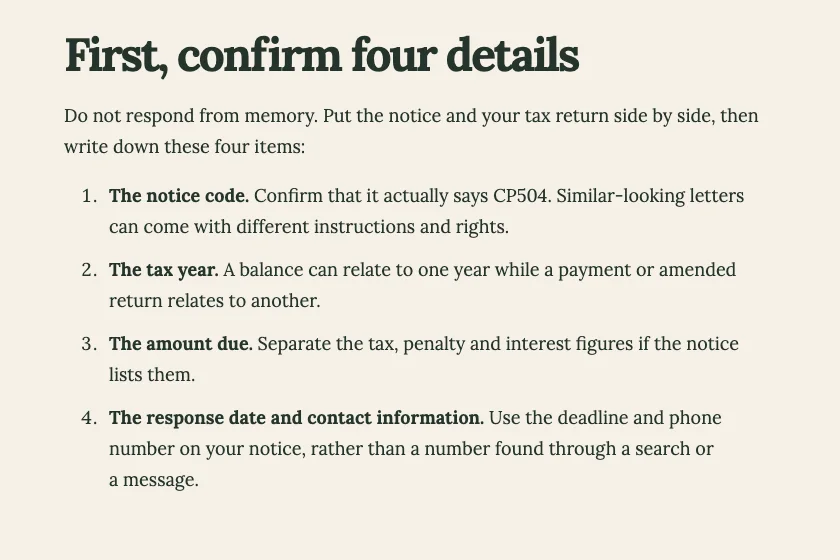
IRS Notice CP504: What It Means and What to Do Next runs about 1,400 words. It starts with what the notice is, which the IRS calls a Notice of Intent to Levy, then lists the four details to confirm before replying, explains how CP504 differs from the later final notice that carries the right to a hearing, gives a response for each situation, and ends with three questions and answers.
It links on to the firm's payment plan, unfiled returns, Enrolled Agent and contact pages, so a reader who understands the letter can take the next step.
Built by TheoTullberry Tax ResolutionIts What to do today list, written for someone who just got a levy notice.See the live site
02
A service page for people whose pay is being taken
IRS Wage Garnishment Help is a service page of about 1,300 words. It covers what to gather today, four paths worth reviewing, what an employer can and cannot decide, the firm's four steps, and common questions, with a free letter review button at the top and the bottom.
The homepage's list of services now links to it, and it links on to payment plans, unfiled returns and the IRS letter guide.
Built by TheoTullberry Tax ResolutionThe IRS Notices category, with the CP504 post listed first.See the live site
03
A Guides section with room to grow
Tax Guides and its first category, IRS Notices, are short pages that lead into the posts. The run added Guides to the main menu and showed only the category that has a post in it, so no visitor lands on an empty shelf.
Its note suggests another IRS notice topic for a later run, which would sit in the same category.
What it added and linked
The new pages were linked into the site as they were written. The third run wrote nothing new: it checked the live site and gave every public page a preferred address.
What it did
Where
Why it helps
Gave every public page a preferred address (a canonical tag)
14 pages, including the homepage, the IRS letter guide, fees, payment plans, audits, the new Guides pages and the policy pages; the wage garnishment page already had one, and the run checked it
Each page now tells Google which address to keep in results, so signals are not split between two versions of it.
Linked the new pages in
Guides in the main menu, which leads to the new IRS Notices page and the CP504 post; the wage garnishment page in the homepage's list of services; and links from the CP504 post on to the payment plan, unfiled returns, Enrolled Agent and contact pages
Readers reach each new page from the menu or the homepage, and the post sends them on to the next step.
Checked the rest
The sitemap and the instructions for search engines
Both were reachable and listed the public pages, so neither needed a change.
Left alone on purpose
Rewrites of existing pages, and redirects
There was no search data yet to show which page to improve, and no old address needed a redirect.
Your Growth tab
The note each run leaves for you
After every run, a short note appears in the Activity list of the Growth tab: what Theo looked at, what it changed and why, with links to the pages. Below are excerpts from the note the wage garnishment run left.
On a firm's own site, each draft sits in the Growth tab until someone at the firm publishes it, unless auto-publish is on. Each week an email also counts the new posts, updates and pages.
Pricing
What it costs, in full
The ongoing search work is part of Starter and Pro. Basic is the site and hosting on its own. Starter is free for the first 30 days.
Plan
Per month
Ongoing search work
Chat credits
Best for
Basic
$29.99
Not included
1,500 a month
Owners who just want their site live and easy to update.
StarterFree for 30 days
$69.99
Included, uses no credits
4,500 a month
Owners who want the site handled without heavy publishing volume.
Pro
$129.99
Included, uses no credits
7,000 a month
Owners who want more capacity, more publishing, and more room to experiment.
No contract, cancel anytime, and you own the site and its content. The pricing page lists what each plan includes and how chat credits work.
What people search before they hire an accountant
When I search for keywords relating to my site I'm not being seen.
One owner wrote
Plenty of owners feel that way at the start. Search brings the clients who arrive without a referral: people who just moved to town, owners who outgrew a box of receipts, anyone who opened an envelope from the IRS this morning. They type three kinds of searches, and each kind is won in its own way.
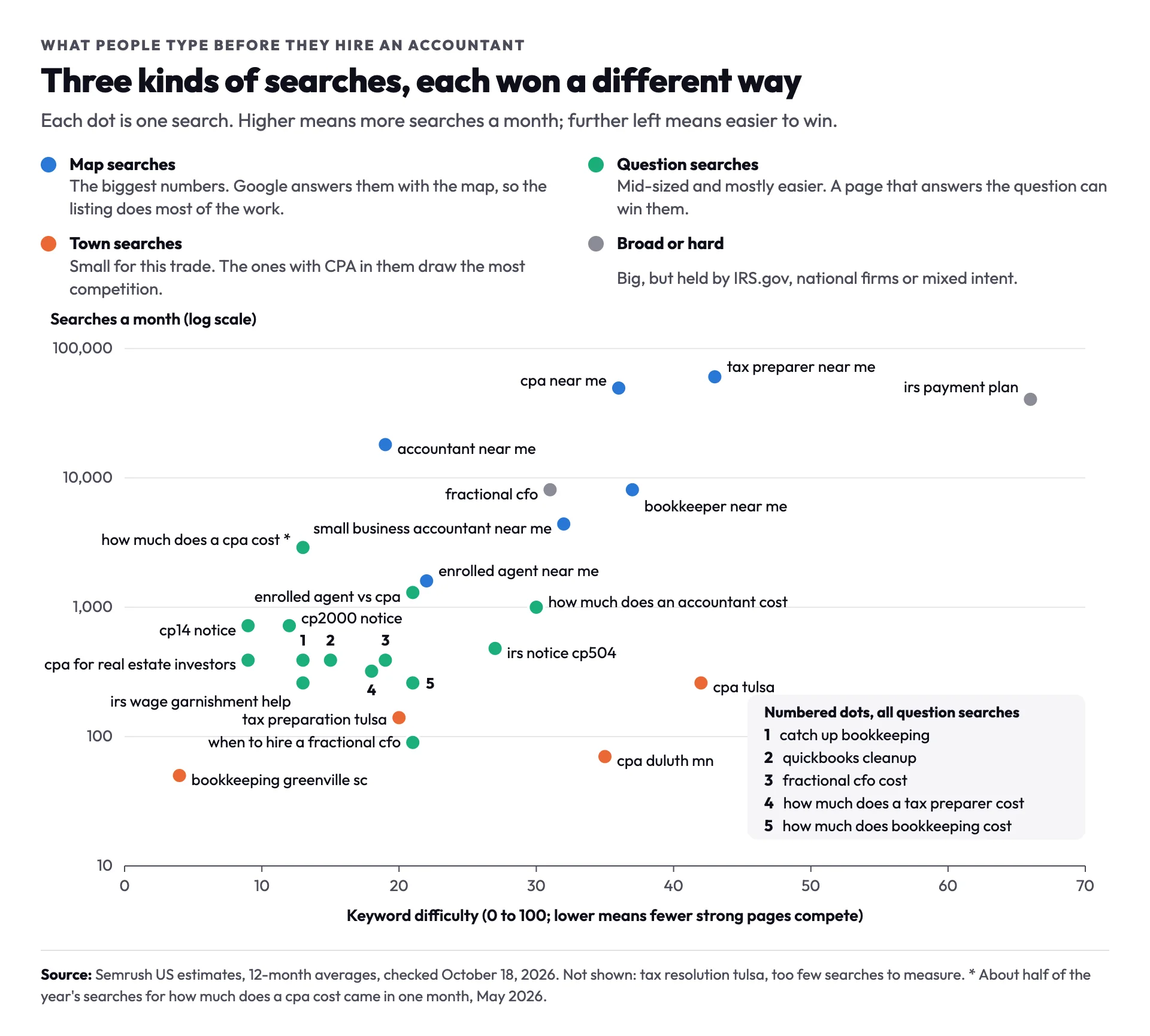
Map searches, such as "tax preparer near me", are by far the largest. Google answers them with the map, so your Business Profile and reviews carry most of the weight, and the website backs them up. Town searches, such as "cpa tulsa", name a place. For accountants they are small, and the ones with CPA in them draw the stiffest competition. Question searches name a problem: what a CP2000 letter means, what catch-up bookkeeping costs, when to hire a fractional CFO. They are bigger than the town searches and mostly easier to win, which is why the search work leans on question pages for this trade.
A question page can also reach past your town. The IRS puts it this way: "Enrolled agents, like attorneys and certified public accountants (CPAs), have unlimited practice rights." It goes on: "This means they are unrestricted as to which taxpayers they can represent" (IRS, Enrolled Agent information, last reviewed January 29, 2026). A bookkeeper who works online can serve clients anywhere too. A CPA license, though, is issued by a state board of accountancy, and each board has its own rules for serving clients in other states, so check yours before you write for readers elsewhere.
One rule shapes the tables below. The title CPA belongs to people licensed by a state board, and to firms the board permits to use it, so only a licensed CPA or CPA firm should claim it on a page. NASBA lists every state board. The built by Theo pages in the tables come from three sites: Tullberry Tax Resolution, a tax resolution firm; Vellenby Bookkeeping, a bookkeeping practice; and Thornquill CFO Advisory, a fractional CFO firm. None of them is a CPA firm, so no search for a CPA is matched to them. The one CPA row that has a page, enrolled agent vs cpa, is answered by Tullberry's page on its own credential.
Each dot is one search, from Semrush's US estimates checked October 18, 2026. Drawn for this page.
Map searches: won by the listing
For these, the website's job is to back up the listing with this season's hours, whether you are taking new clients, and the same services your profile names. Tullberry's Enrolled Agent page is the kind of page that supports a search like "enrolled agent near me", because it says what the credential is and links to the IRS lookup.
Search
Searches a month
Difficulty
What wins it
tax preparer near me
60,500
43
The map listing, with this season's hours on the site
cpa near me
49,500
36
The map listing, for a licensed CPA firm only
accountant near me
18,100
19
The map listing
bookkeeper near me
8,100
37
The map listing, if you meet clients in person, at your office or theirs
small business accountant near me
4,400
32
The listing, plus a page for each kind of business client
enrolled agent near me
1,600
22
The listing, plus a page that explains the credential
Town searches: small for this trade
A town page names the place and the work you do there. For accountants the numbers are modest, and Tullberry's own run shows it. Semrush had figures for two of the four Tulsa searches it checked, at zero and 20 a month, and none for the other two. The run wrote a page about an IRS problem instead.
Search
Searches a month
Difficulty
What wins it
cpa tulsa
260
42
A page naming the town and the work done there, for a licensed CPA firm
tax preparation tulsa
140
20
A town page for a tax preparer
cpa duluth mn
70
35
A town page, for a licensed CPA firm
bookkeeping greenville sc
50
4
A town page; few firms compete for it
tax resolution tulsa
Too few to measure
No data
Checked by the Tullberry run, then passed over
Question searches: won by a page that answers
This is where a small firm's site can earn a place. Each search names a problem, and a page that answers it plainly can be found by someone who has never heard of the firm.
One figure needs a note. Semrush puts "how much does a cpa cost" at 2,900 searches a month, but about half of the year's searches came in one month, May 2026, so the table uses the steadier "how much does an accountant cost" instead.
Search
Searches a month
Difficulty
Page that answers it
Built by Theo
how much does an accountant cost
1,000
30
A fees page with starting prices
-
how much does a tax preparer cost
320
18
A fees page with starting prices
-
enrolled agent vs cpa
1,300
21
A page that explains the credential in plain words
A page for that kind of client, for a licensed CPA firm
-
Built by TheoThornquill CFO Advisory answers fractional cfo cost with two monthly levels and what each includes. See the live page
Broad or hard: leave them for later
Two searches show why the engine does not chase the biggest number. "irs payment plan" draws about 40,500 searches a month at a difficulty of 66, the hardest score in this set, so Tullberry's payment plans page is there for visitors who already found the firm rather than to compete for that search. "fractional cfo", at 8,100 a month and 31, mixes people researching the role, people looking for work and firms selling it; "fractional cfo cost", at 390 and 19, is closer to what a buyer types.
When people search for an accountant, month by month
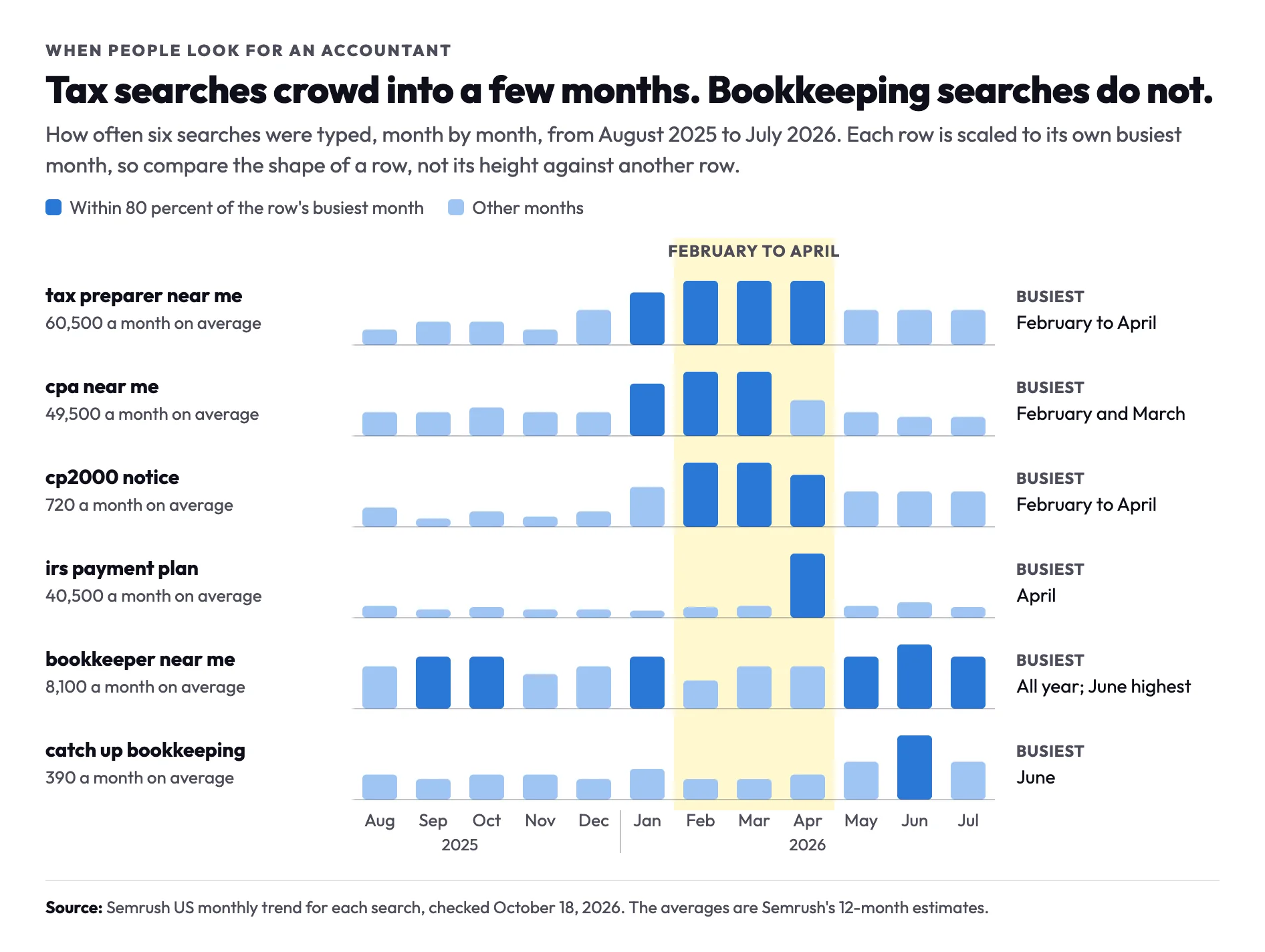
Tax searches bunch up. Semrush's monthly figures for August 2025 to July 2026 show "tax preparer near me" running about four times higher from February to April than in August or November, and "cpa near me" busiest in February and March. Searches for "cp2000 notice", the letter the IRS sends when income reported by employers or banks does not match a return, were busiest from February to April. Searches for "irs payment plan" jumped in April and nowhere else.
Bookkeeping searches keep a steadier pace. Searches for "bookkeeper near me" stayed busy all year and were highest in June 2026, and "catch up bookkeeping" also peaked in June, after the filing deadline. So a bookkeeping page or an IRS letter page can go up in any month and still meet its readers, while a page meant for next spring's tax searches needs to be live months before February to have time to be found.
Firms look for SEO help on a calendar of their own. Across the main phrasings, searches for SEO help for accountants ran highest between August and January in the same twelve months. Whenever you start, count back from February.
Semrush US monthly trend for each search, checked October 18, 2026. Each row is scaled to its own busiest month. Drawn for this page.
What a page that answers a client's question looks like
A page written in the firm's own words, about a problem its clients bring in, gives Google a reason to show it. Three habits make the difference, and the sites Theo built show each one.
Answer the letter in the reader's hand
Someone holding an IRS notice wants to know what it is and what to do this week. Tullberry's CP504 post, written by the Growth Engine, starts with what the notice is and then lists four things to check before replying. It also explains how CP504 differs from the later final notice that comes with the right to a hearing, a line the IRS draws in its Collection Due Process FAQ. Every tax statement on a page like this should rest on an IRS page you can link, and you approve each draft before it goes live.
Built by TheoTullberry's CP504 post sets out what to confirm before anyone replies. See the live page
Put a starting price where people can see it
Cost questions run all year, and a page with real starting prices can answer them. Vellenby Bookkeeping prices catch-up work by the month behind and gives a worked example, so an owner can guess the bill before calling. If you practice before the IRS, Circular 230 governs how fees are advertised: 31 CFR 10.30(b) allows fixed fees, hourly rates and fee ranges to be published, and holds you to a published fee for at least 30 calendar days.
Built by TheoVellenby's catch-up page explains how the price is set and gives one worked example. See the live page
Your own article, not a shared one
Some website vendors place the same tax article on many firms' sites. When Google keeps another site's copy, yours can show up in Search Console under the label "Duplicate, Google chose different canonical than user", which has a guide of its own. A page that answers your own clients' question has no copy to lose to. The accounting website design page covers what to do with a vendor's newsletter.
What SEO for an accounting firm covers, and who does each part
Part of the work happens on the website, and part of it only the firm can do. The table splits it for an accounting practice.
The work
What it means for an accounting firm
Who does it
Research
Finding what people type before they hire: services, letters, costs and towns, with Semrush's numbers for each.
Theo, on Starter and Pro.
Service pages
A page each for returns, bookkeeping, payroll, IRS representation, advisory or whatever the firm sells.
Theo drafts; you approve.
Client-type pages
A page for each kind of client you take, such as contractors, landlords or nonprofits.
Theo drafts; you approve.
Question posts
Answers about the letters, deadlines and costs people ask about.
Theo drafts; you approve.
Titles and descriptions
The lines Google shows for each page, written for the search that page answers.
Theo, on Starter and Pro.
Technical fixes and speed
Preferred addresses, sitemap problems and slow pages, fixed on the site itself.
Theo, on Starter and Pro.
Getting pages into Google
Submitting the sitemap through Search Console, which lists every new page for Google.
Theo, once Google is connected.
Season lines
Hours, the cutoff for new returns and the extension date, changed as the year turns.
You, with one chat message each.
Business Profile and listings
The map listing, Apple Business Connect, Bing Places, Yelp and Facebook.
You, with the Boost checklist.
Credential listings
The IRS preparer directory and your state board's license lookup.
You; the site links to them.
Reviews
Asking once the work is delivered, and answering without revealing client details.
You.
Reporting
New pages and fixes on the firm's site, and the searches Google counts.
Theo's weekly email, with drafts in Growth and search activity in Analytics.
The listings people check before they call an accountant
Before a stranger hands over a Social Security number, they check you out. On the four biggest searches in the map table above, from "tax preparer near me" at 60,500 a month to "bookkeeper near me" at 8,100, Google put the map above the first regular result when Semrush checked its US results on October 19, 2026. So the listing is often the first thing a stranger sees, and some go on to look up a credential. Each listing below is free, and each one needs the firm to keep it current.
A bookkeeper who works from home and meets clients in person, at home or at their offices, has one more choice; under Google's eligibility rules, a practice that only works online cannot have a listing. Google's help page on service areas says: "If you don't serve customers at your business address, remove your address from your Business Profile." You can then list up to 20 service areas, which Google says "shouldn't be more than about 2 hours of driving time from where your business is based" (Google Business Profile Help, read October 18, 2026).
Listing
What a prospect sees
What to keep right
Google Business Profile
Your place on the map, hours, reviews and photos.
The main category, this season's hours and the services you list. Google asks you to "Choose categories that are as specific as possible, but representative of your main business", and to pick ones that complete the statement "This business IS a" (Guidelines for representing your business on Google, read October 19, 2026). Only a licensed CPA firm should pick a category that names CPAs. On Starter and Pro, the Boost checklist walks you through it.
Apple Business Connect and Bing Places
The same details in Apple Maps and Bing.
The same name, address and phone as on Google.
IRS Directory of Federal Tax Return Preparers with Credentials and Select Qualifications
Your name and credential. It lists Enrolled Agents, CPAs, attorneys, Enrolled Retirement Plan Agents, Enrolled Actuaries and Annual Filing Season Program participants who hold an active PTIN.
If you are missing, the IRS says to check that your credential is self-reported in your online PTIN account, where the opt-out setting also lives. Changes can take up to four weeks (IRS directory FAQ, last reviewed May 6, 2026).
State board license lookup, or CPAverify
Whether a CPA's license is active, and in which state.
Link to it from your about page, so a prospect can check in one tap.
Answering reviews without giving away client details
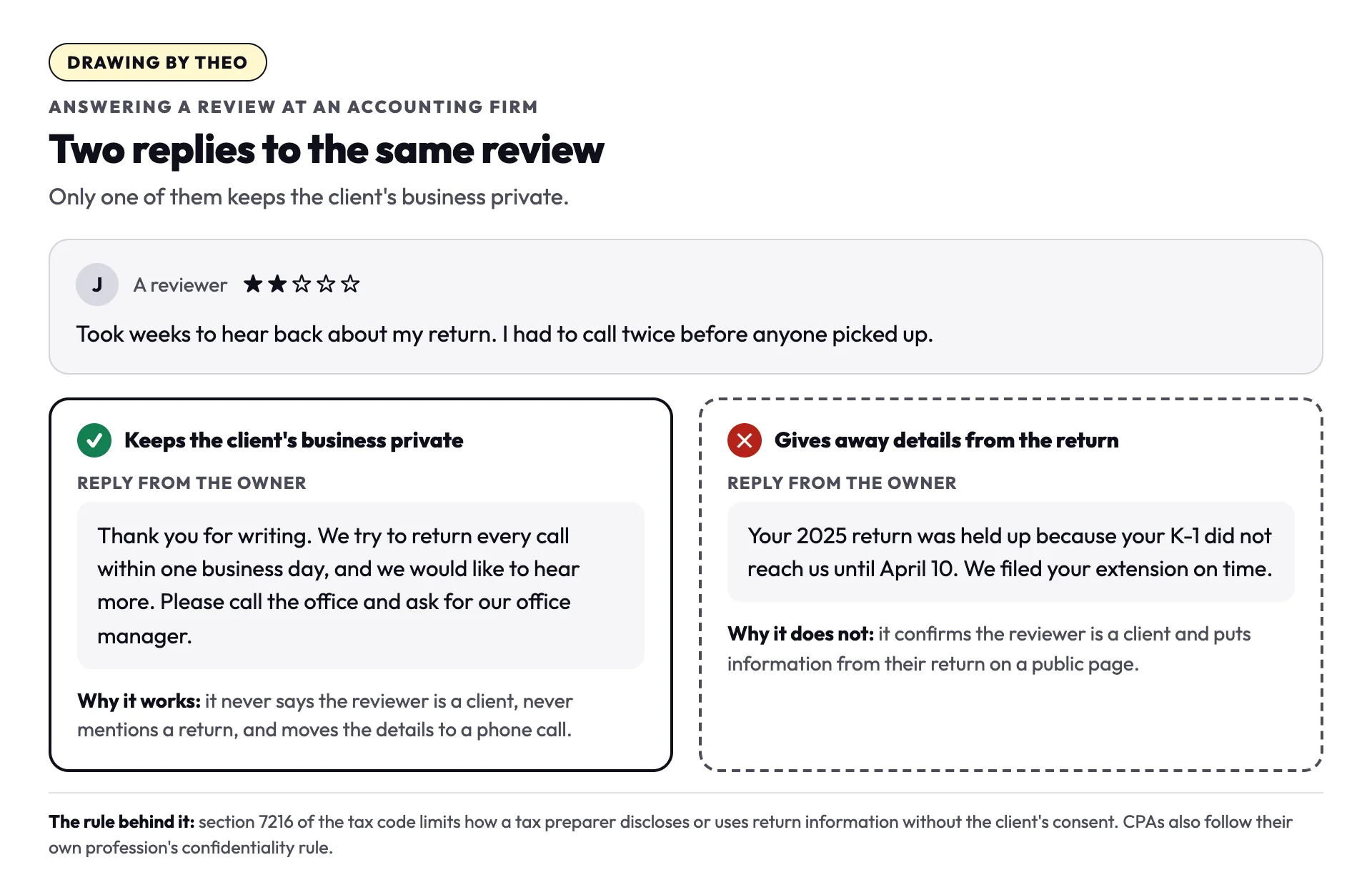
Reviews help the map listing, and accountants answer them under a rule most trades do not have. Section 7216 of the tax code limits how a tax preparer discloses or uses a client's return information without consent (IRS Section 7216 information center, last reviewed September 7, 2026). A reply that confirms someone is a client, or mentions their return, can cross that line. Thank the reviewer, invite them to call, and keep the details off the page. CPAs also answer to their profession's confidentiality rule and to their state board.
Ask for reviews once the work is delivered, and in May rather than the week of April 15, when clients have time to write. How to respond to negative Google reviews has more sample replies, and the free review link generator turns the request into one tap.
Drawing by Theo: two replies to the same review, and why only one keeps the client's business private.
Your part around the filing calendar, and Theo's
Your part is small, and most of it fits around the filing calendar.
Once: point the firm's domain at the new site and click Connect Google, which lets Theo set up Analytics and Search Console for the firm. The search work begins only after that, so get it done early in Starter's 30 free days. The steps are in how to get your website on Google.
Each week: read the drafts waiting in your Growth tab, the way you would read your own engagement letter, against section 10.30 of Circular 230 if you practice before the IRS and your state board's advertising rules if you hold a CPA license. Approve each one or ask for a change in chat. Auto-publish exists, but a firm that has to review its advertising may prefer to keep approving.
When clients ask something new: tell Theo in chat. The question three clients asked this week is often what strangers are typing too.
As the season turns: change the hours, the cutoff for new returns and the extension date with one chat message each.
After each engagement: ask for a Google review, the same way every time.
How long SEO takes for an accounting firm
Search traffic builds over months, not weeks. Google's own guidance on hiring an SEO puts the payoff at four months to a year. That line comes from Google's video How to hire an SEO. Google's SEO Starter Guide (last updated December 10, 2025) adds: "Some changes might take effect in a few hours, others could take several months." It suggests you "wait a few weeks to assess" whether a change helped.
For a tax practice, that means working back from the season. Pages meant for February's searches should be live months ahead, so fall is a reasonable time to start and summer is better. A bookkeeping or IRS letter page can start in any month. The first sign of progress is impressions in Search Console, meaning your pages are appearing in results, often far down, before anyone clicks. Even new pages on theo.site wait their turn, as the guide to Discovered - currently not indexed shows with our own Search Console.
Anyone who quotes you a date should be ready for a question Google itself suggests asking: "What kind of results do you expect to see, and in what timeframe?" On Theo, what you see is the work: each page and fix in your Growth tab, and a weekly email that counts what was added.
Before you sign with an accounting SEO company
Accounting firms hear from SEO sellers all year, and the pitches come in a few familiar shapes. Google's page Do you need an SEO? (last updated June 5, 2026) speaks to most of them. The full list of questions, with an annotated sales email, is in Is SEO worth it for a small business?
One point is Theo's advice rather than Google's: keep the website, its pages and the domain in the firm's name, so leaving never means starting over.
What you hear
What to ask
What Google's page says
A 12-month agreement you cannot leave early
What happens to the pages, the domain and the client portal links if we leave in month 13?
Nothing about contracts. Keeping the site and the domain in your name is Theo's advice.
An email out of the blue saying your firm does not show up in AI searches
Which Google documentation backs that advice?
"Be wary of SEO firms and web consultants or agencies that email you out of the blue." On AI advice, it asks whether it is "aligned with Google Search's official guidance on optimizing for generative AI features".
First place on Google, guaranteed
Nothing. Move on.
"If they guarantee you that their changes will give you first place in search results, find someone else."
Send us your Search Console login for a free audit
Can you work from read access?
"only grant read access to Search Console (at this stage, don't grant them write access)."
We handle the site, so you never need to see the changes
Can I have a list of every change made last month, with links?
"If an SEO has FTP access to your server, they should be willing to explain all the changes they are making to your site." It also says: "Ultimately, you are responsible for the actions of any companies you hire."
If you already have an accounting website
The search work runs on a site Theo builds and hosts: the same system drafts a page, publishes it, keeps it current and submits the sitemap. If your firm has a site now, paste its address and Theo rebuilds it as a first draft that keeps the look clients know. The old site keeps serving clients until your domain points at the new one, so clients never land on a missing page. Once Search Console is connected, SEO repair on Starter and Pro redirects old addresses that still get search traffic to their new pages, and on any plan you can ask for a redirect in chat.
How much does SEO for an accounting firm cost on Theo?
The search work comes with Starter, $69.99 a month and free for the first 30 days, and with Pro, $129.99 a month. Both include building and hosting the site, with no separate build fee. Basic is the site and hosting without the search work. Beyond the plan, a firm might pay for top-up chat credits, a domain bought through Theo, or the optional paid directory submission packages in the Boost checklist.
How long before my firm's new pages show up in Google?
Google's SEO Starter Guide says: "Some changes might take effect in a few hours, others could take several months." Search traffic builds over months, not weeks. Google's own guidance on hiring an SEO puts the payoff at four months to a year, so pages aimed at February's tax searches belong online by the summer or fall before.
Who owns the pages, and can I cancel?
Your firm owns every page and post on the site, with its words and photos. Theo hosts the site, and on Pro you can also read its code on GitHub. There is no contract term: cancel whenever you like, and the confirmation gives the date the subscription ends. The site stays up until that day, so copy the text and photos you want to keep before then.
Can Theo do SEO on the site I already have?
Not on the old site itself. The work runs on a site Theo builds and hosts. Paste your current address and Theo rebuilds it as a starting draft in the same style, which you adjust in chat. Your old site keeps serving clients until your domain points at the new one, and your portal and payment links come across as buttons.
Will SEO help my firm show up for CPA near me?
Near me searches are answered mostly by Google's map, which weighs your Business Profile, your reviews and how close the searcher is. The Boost checklist on Starter and Pro walks you through the profile, and service pages on your site give Google more to go on. Only a licensed CPA firm should aim for that search at all.
Can search bring my firm clients from outside my town?
Yes, for some kinds of work. Question searches, such as what a CP2000 notice means, come from everywhere. The IRS says Enrolled Agents, like attorneys and CPAs, have unlimited practice rights and can represent any taxpayer. Bookkeepers who work online are not tied to one town either. A CPA should check the state board's rules before taking clients who live in another state.
Who checks that the pages follow the advertising rules for CPAs and Enrolled Agents?
You do. Theo drafts the pages but does not review them against Circular 230, state board or professional rules. Every draft waits in your Growth tab until you approve it, so you can read each one against section 10.30 of Circular 230 or your board's advertising rules first. Leave auto-publish off if your firm must sign off on everything it publishes.
Does the work cover ChatGPT and Google's AI answers?
Yes, as part of Starter and Pro, not as an extra. The work writes pages that answer questions plainly and aims for citations in ChatGPT and Google AI Overviews.