SEO for electricians starts with what homeowners type into Google
SEO for electricians is the steady work that puts your website in front of a homeowner searching for a breaker that keeps tripping, a surge protector, a panel upgrade price or an electrician in the next town over. On Theo, it comes with Starter and Pro. Below are those searches with Semrush's numbers, and the four jobs Theo's search work did on an electrician site it built, each linked to the live page.
Your first build is on Theo: see the site before you decide
Electrician SEO has two halves. The map half is your Google Business Profile: for the near-me searches, Google usually shows map listings above the websites, so the profile needs your real service area, the right category, photos of real jobs and a steady run of reviews. The website half is everything else: a page for each job you want more of, a page for each town your van goes to, plain answers to the questions homeowners search before they call, such as why a breaker keeps tripping or what a panel upgrade costs, and a site that opens fast on a phone. On Starter and Pro, Theo does the website half for you. It looks up what people search and how hard each search is to win, drafts the pages and posts, and fixes what holds the site back in search. On every plan, connecting Google also submits your sitemap. Drafts wait in your Growth tab for your yes, unless you turn on auto-publish. For the map half, the Boost checklist takes you through your Business Profile and the other listings one at a time. All of it runs on a site Theo builds and hosts, starting from a free first draft.
In Theo's audit of 6,861 small business websites, 36 percent of the 440 home services and trades sites with search data got an estimated zero visitors a month from Google search, and 56 percent got fewer than ten. The sample is the sites whose owners ran Theo's free audit. See the research.
On an electrician site Theo built
Four runs of the search work on Wendroth Electric
Wendroth Electric is an electrician site built by Theo for a one-person residential shop in Fort Collins, Colorado, that also covers Loveland, Windsor, Wellington, Timnath and Laporte. On October 19, 2026, the Growth Engine, the search work in Starter and Pro, ran on it four times with one job per run: a homeowner post, a service page, a page of statistics and a repair pass over the whole site. Each batch of work was published from the Growth tab.
On your own site those jobs are spread across the weeks.
The searches it chose
The post run and the service-page run each began by looking up what homeowners type and how many strong pages already answer it. The statistics run started from the U.S. Energy Information Administration's survey of American homes instead. The figures are Semrush's for the whole US, as the engine stored them on October 19, 2026: average searches a month over the last 12 months, and keyword difficulty, a score from 0 to 100 where lower means fewer strong pages compete. The post run also lined up four more troubleshooting searches for later posts.
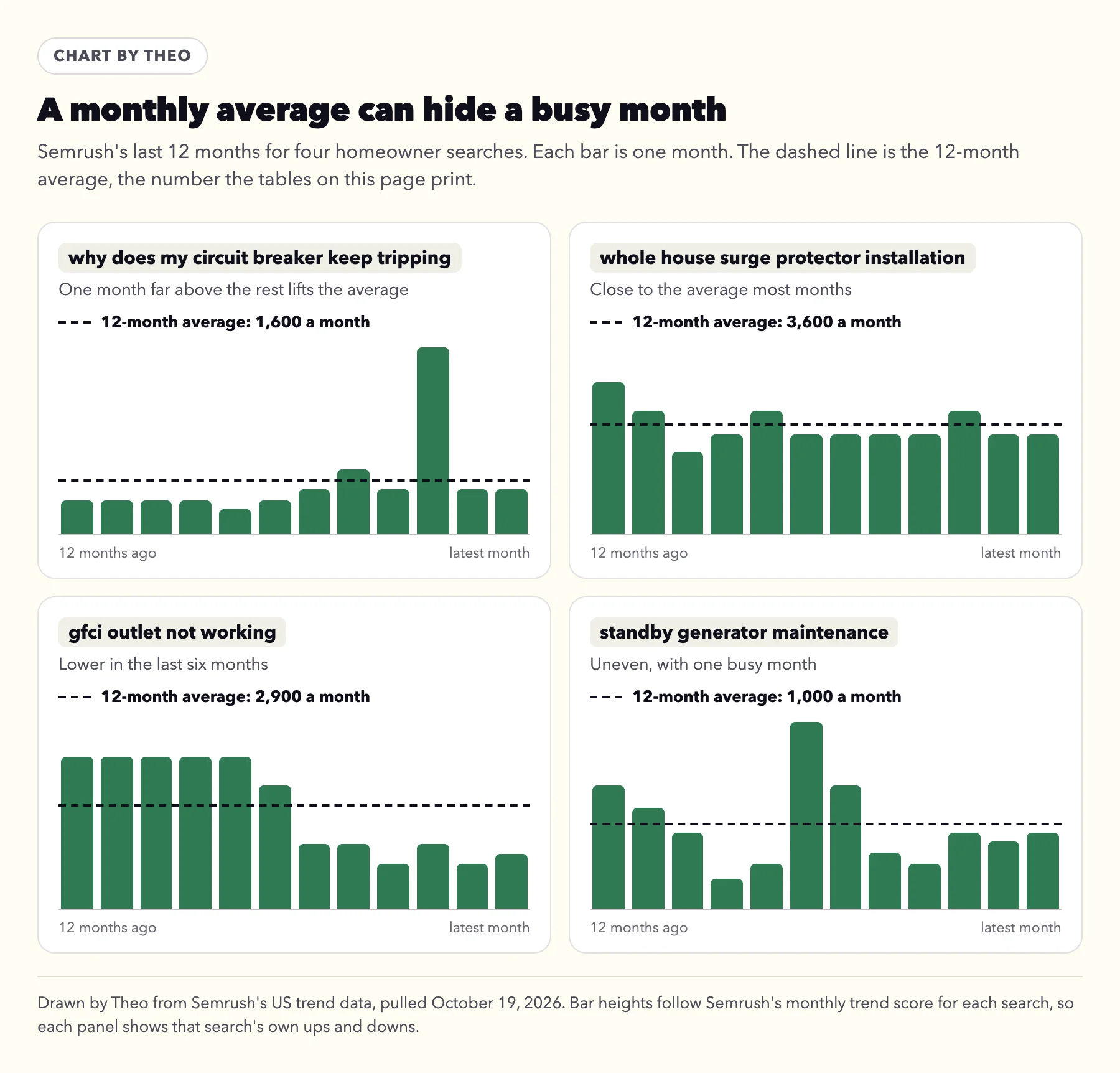
Both searches it used are for work the shop already sells, and the statistics page was built as a reference other sites can cite rather than for one search. One honest note on the first number: Semrush's trend for it shows one month far above the rest, so most months see fewer than 1,600 searches. The chart further down shows it.
What it wrote
What the three writing runs added
Each writing run drafted one piece of work and linked it into the pages around it. Here is each new page as it looks on the live site.
Built by TheoWendroth ElectricThe top of the post: the homeowner's question as the headline, and what the post covers in two lines.See the live site
01
A homeowner's breaker question, answered with one safe check
Why Does My Circuit Breaker Keep Tripping? runs about 2,200 words. It reads a trip three ways: an overloaded circuit, one appliance or cord that sets it off, and a breaker that trips right away. Then it gives one safe check in four steps, what not to do, and what to write down before calling.
It ends with four common questions and points readers to the shop's repair visit and its service call price. The same run opened a blog for the site, with a guide hub, an Electrical Troubleshooting section and a Blog link in the main menu.
Built by TheoWendroth ElectricThe first screen, with the $395 installed price near the top.See the live site
02
A service page for one job, with the town in the headline
The page opens with Whole-house surge protector installation in Fort Collins. In about 1,150 words it covers what a protector at the panel does and what it cannot promise, what Ted Wendroth, the electrician on the site, checks before installing one, how installation day goes, when a problem needs a repair instead, and four questions homeowners ask.
It keeps the shop's installed price near the top, and the home page now links to it beside repairs, panel upgrades and EV charger circuits.
Built by TheoWendroth ElectricThe first four figures, each with a link to its source.See the live site
03
A page of household electricity figures other sites can cite
U.S. Home Electricity Statistics, 2026 sets out eight figures from the U.S. Energy Information Administration, such as the share of homes with air conditioning and how much electricity an average household uses in a year. Each one names its source, links to it and gives the year it describes.
It closes with a note on how the figures were chosen and a ready-made citation, and the footer links to it from every page.
What it added and linked
The writing runs linked their pages in as they went. The fourth run wrote nothing new: it went over the whole site and changed one link.
What it did
Where
Why it helps
Kept a source link current
The air-conditioning figure on the statistics page
The link goes to the government's current page, so a reader can check the number.
Linked the new pages in
A Blog link in the main menu, the home page for the surge page, and the footer for the surge and statistics pages
A visitor, or Google following links, reaches each new page from pages that were already there.
Listed them in the sitemap
The sitemap, the file that tells search engines which pages exist, which now lists 15 pages
Any search engine reading that file finds the new pages. On an electrician's own site, connecting Google also submits the sitemap, and Google rereads it on its own.
Labeled what each page is
The code behind the new pages: the post as a blog post with its four questions marked as an FAQ, the surge page as a service with its own FAQ, the statistics page as an article
Google can tell what kind of page each one is and which lines are questions and answers.
Checked the rest
Every page in the sitemap, plus the crawl instructions, titles, descriptions, preferred addresses and business details
Every address loaded, so no redirect was needed.
Left alone on purpose
Rewrites of the older pages
With no Google search data yet, a rewrite would have been a guess.
Your Growth tab
The note the repair run left
Every run leaves a short note in the Activity list of the Growth tab, saying what Theo looked at, what it changed and why. Below are excerpts from the note the repair run left. The last part is its plan for when Google's search data arrives.
On your site, new work waits in the Growth tab until you publish it, unless you have turned on auto-publish. Once a week an email counts the new posts, updates and landing pages.
Pricing
What it costs, in full
The ongoing search work is part of Starter and Pro. Basic is the site and hosting on its own. Starter is free for the first 30 days.
Plan
Per month
Ongoing search work
Chat credits
Best for
Basic
$29.99
Not included
1,500 a month
Owners who just want their site live and easy to update.
StarterFree for 30 days
$69.99
Included, uses no credits
4,500 a month
Owners who want the site handled without heavy publishing volume.
Pro
$129.99
Included, uses no credits
7,000 a month
Owners who want more capacity, more publishing, and more room to experiment.
No contract, cancel anytime, and you own the site and its content. The pricing page lists what each plan includes and how chat credits work.
Check first: does Google show your electrical company at all?
just checked the google search for [business name] but it didn't come up
One owner wrote
When an owner writes that, the reason is nearly always a plain one, and it comes before any talk of rankings. Two quick searches tell you where you stand. Type your business name and your town into Google. Then type site: followed by your domain with no space, such as site:yourcompany.com, which shows pages Google holds for that address. The list is not always complete, so what matters is whether anything shows at all.
What you see
The usual reason
What to do
Nothing for your name
The site was never published, or it still sits on its temporary address
Publish it, then connect your domain
Your domain opens an old or parked page
The domain does not point at the new site yet
Point the domain at the site. The old one keeps answering until the records change, usually within a few hours
The site opens, but site: lists no pages
Google has not found the new site's pages yet
Add the site to Search Console and submit its sitemap (on Theo, signing in with Google does both). The verification guide covers the record Google may ask for
Google still shows the old site
Google has not revisited the address since the move
Give it time, often days and sometimes weeks. On Theo, SEO repair on Starter and Pro forwards old addresses that still get search traffic once Search Console is connected, and on any plan Theo adds one you ask for in chat; on other platforms, add a 301 redirect for each old address
When Google emails you about your pages
Once Search Console is connected, Google may email to say some pages are not being indexed. That is good news, because it means Google is reading your site. After a move, most of what it lists is the expected result of the move: old addresses forwarding to new ones, and the http and www versions of your address pointing to the main one. On Starter and Pro, Theo's SEO repair, part of the Growth Engine, pulls those reports from Search Console and handles them. The guide to Google's indexing emails explains each reason in plain words.
Homeowners rarely type an electrician's name. They type the job, the problem or the price, often with a town on the end. The tables below split those searches in two, because the two kinds need different things: searches from someone ready to book, and questions from someone reading up first.
Every figure is Semrush's estimate of searches a month across the whole US, averaged over 12 months and checked on October 19, 2026. One town sees only its own small share of a national number, and the Fort Collins table further down shows how small.
Job searches: someone ready to book
Most of these are settled on the map. For the near-me searches, Google puts a block of map listings above the websites: on October 19, 2026, Semrush recorded the map at the very top of the results for "electrician near me". Your Google Business Profile competes for that block. The website still counts, because the listing links to it and a homeowner taps through to check you out.
Search
Searches a month, US
Difficulty
Last 12 months
What wins it
electrician near me
301,000
30 of 100
Steady, one busier month
Your map listing
licensed electrician near me
27,100
36 of 100
One busy month, then steady
Your map listing, with the license number on your site
emergency electrician near me
22,200
22 of 100
One busy month, then steady
Your map listing, with the hours someone really answers
electrical contractors near me
18,100
38 of 100
Steady
Your map listing
ev charger installation
40,500
46 of 100
Uneven
A charger service page, with many strong pages in the way
whole house generator installation
5,400
44 of 100
Uneven, two slow months
A generator service page, also crowded
commercial electrician
9,900
16 of 100
One busy month, then steady
A page for builders and property managers
Question and price searches: someone reading up first
These are national do-it-yourself and price questions, typed by homeowners everywhere, so most people searching them are nowhere near your shop. They are still where a small electrical site has room: all of them score under 30 on difficulty, and the page that answers the question well can offer the visit at the end. The first post the run wrote on Wendroth Electric came from this kind of search.
Search
Searches a month, US
Difficulty
Last 12 months
The page it needs
knob and tube wiring
18,100
22 of 100
Steady
A post on older wiring, linked to your rewiring page
breaker keeps tripping
4,400
21 of 100
Steady
A troubleshooting post
lights flickering in house
3,600
14 of 100
Steady
A troubleshooting post
gfci outlet not working
2,900
16 of 100
Lower in the last six months
A troubleshooting post
ceiling fan installation cost
2,900
27 of 100
Uneven
A price page
how much does it cost to rewire a house
1,600
16 of 100
Steady
A rewiring page with a cost section
electrical panel upgrade cost
1,300
29 of 100
Steady
A panel upgrade page with a price range
standby generator maintenance
1,000
6 of 100
Uneven, one busy month
A maintenance plan page
how much does an electrician cost
880
8 of 100
Steady
A price page
electrical inspection cost
480
7 of 100
Steady
A price or inspection page
200 amp service upgrade cost
260
11 of 100
Uneven
A panel upgrade page
A chart by Theo from Semrush's US trend data, pulled October 19, 2026. The numbers in the tables are 12-month averages, and some searches swing a long way around theirs.
What one town sees: the searches around Fort Collins
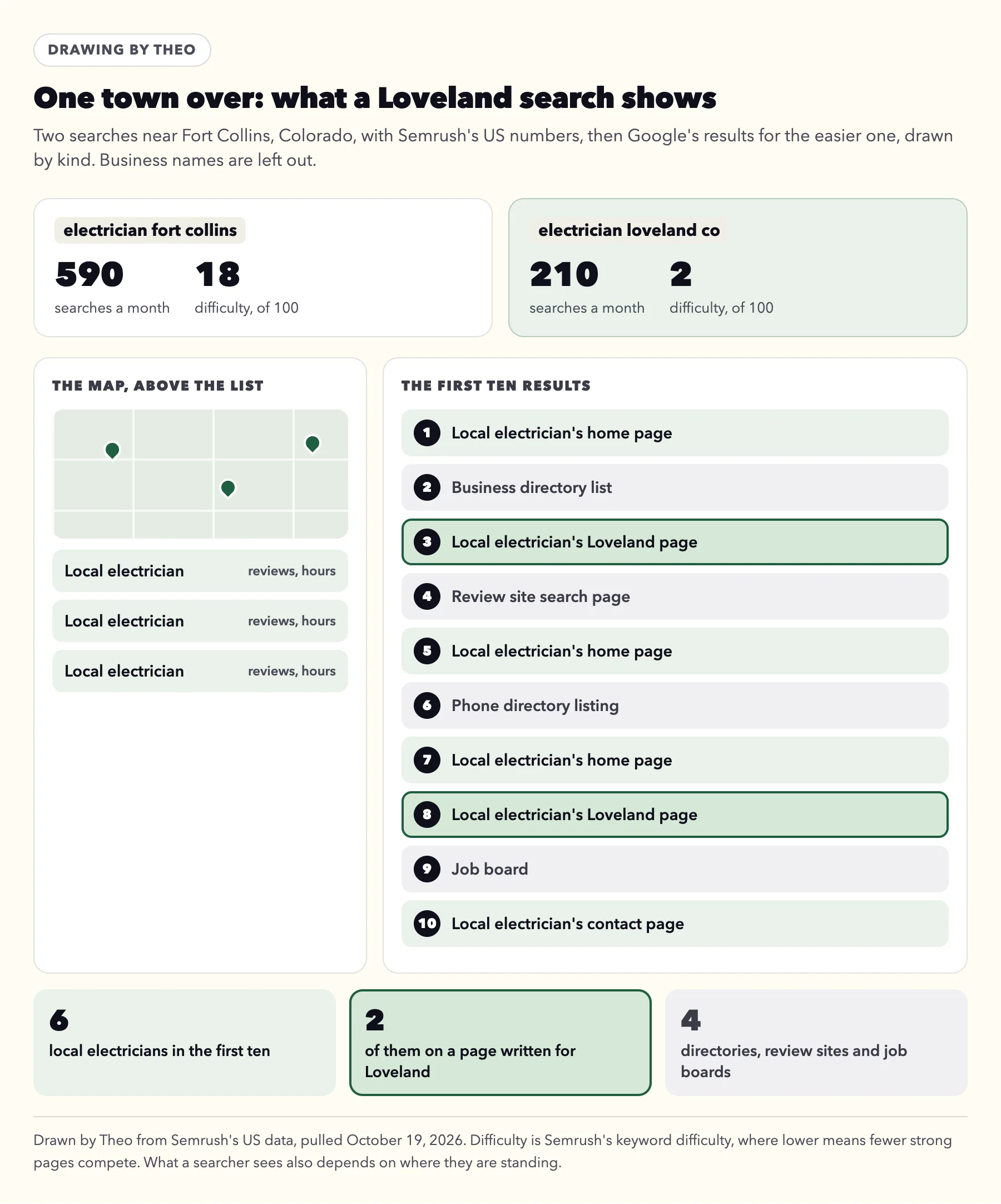
Wendroth Electric's site lists six towns. Here are the searches for its home town and the towns beside it, with the same Semrush numbers. Local searches are small, and the busiest here is 590 a month. "electrician loveland co" gets about a third as many searches as "electrician fort collins", but with a difficulty of 2 instead of 18, so a page written for Loveland has far fewer strong pages to get past. Timnath and Laporte are searched too rarely for Semrush to give a number, and "No score" below means Semrush has too little data to score a search, not that it is easy.
Who shows up for the Loveland search today: on October 19, 2026, Semrush's record of Google's first ten results for "electrician loveland co" held six local electricians, two of them on a page written for Loveland. The map listings above them showed three local electricians, and all three also had a page in the first ten. The drawing below lays it out, with names left out.
Search
Searches a month
Difficulty
Last 12 months
electrician fort collins
590
18 of 100
Higher in recent months
fort collins electrician
210
18 of 100
Steady
electrician loveland co
210
2 of 100
Higher in recent months
loveland electrician
210
3 of 100
Steady
electrical panel upgrade fort collins
90
4 of 100
Rising, with 9 months of data
electrician windsor co
70
3 of 100
Steady
ev charger installation fort collins
40
7 of 100
Rising, with 9 months of data
residential electrician fort collins
40
No score
Higher in recent months
emergency electrician fort collins
30
No score
Uneven
electrician wellington co
20
No score
Steady
A drawing by Theo, not a screenshot, made from Semrush's US data on October 19, 2026. Business names are left out.
The pages an electrical company's site needs, matched to their searches
Each kind of page below answers a kind of search from the tables above. How each one is laid out, with the call and estimate buttons and the license line, is covered on the page about electrician website design. Here the question is simpler: which search is each page for?
Service pages for the jobs you want more of
Someone typing "whole house surge protector installation" (3,600 a month, difficulty 12) wants the job, the price and the person who does it, which is the search the Wendroth run answered with its service page. "ev charger installation" gets far more searches, 40,500 a month, but at difficulty 46 a newer site waits longer there. A charger page wins its readers on detail instead: the panel, the circuit, the permit and the towns you cover.
Troubleshooting posts for the problem in front of them
"breaker keeps tripping" (4,400 a month) and "lights flickering in house" (3,600) come from someone looking at the problem right now, and both score under 25 on difficulty. A post that gives a safe first check, says plainly when to stop and call, and ends with your number answers that person and makes you the next step.
A price page for the "how much" searches
"how much does an electrician cost" (880 a month, difficulty 8) and "electrical inspection cost" (480, difficulty 7) are small searches with little competition. On October 19, 2026, at least five of Google's first ten results for the first one were electrical companies' own pages, two of them written for a single city or state. A page with your service call fee and the usual ranges for common jobs is the kind of page Google already shows there.
Generator pages: what size, and what it costs
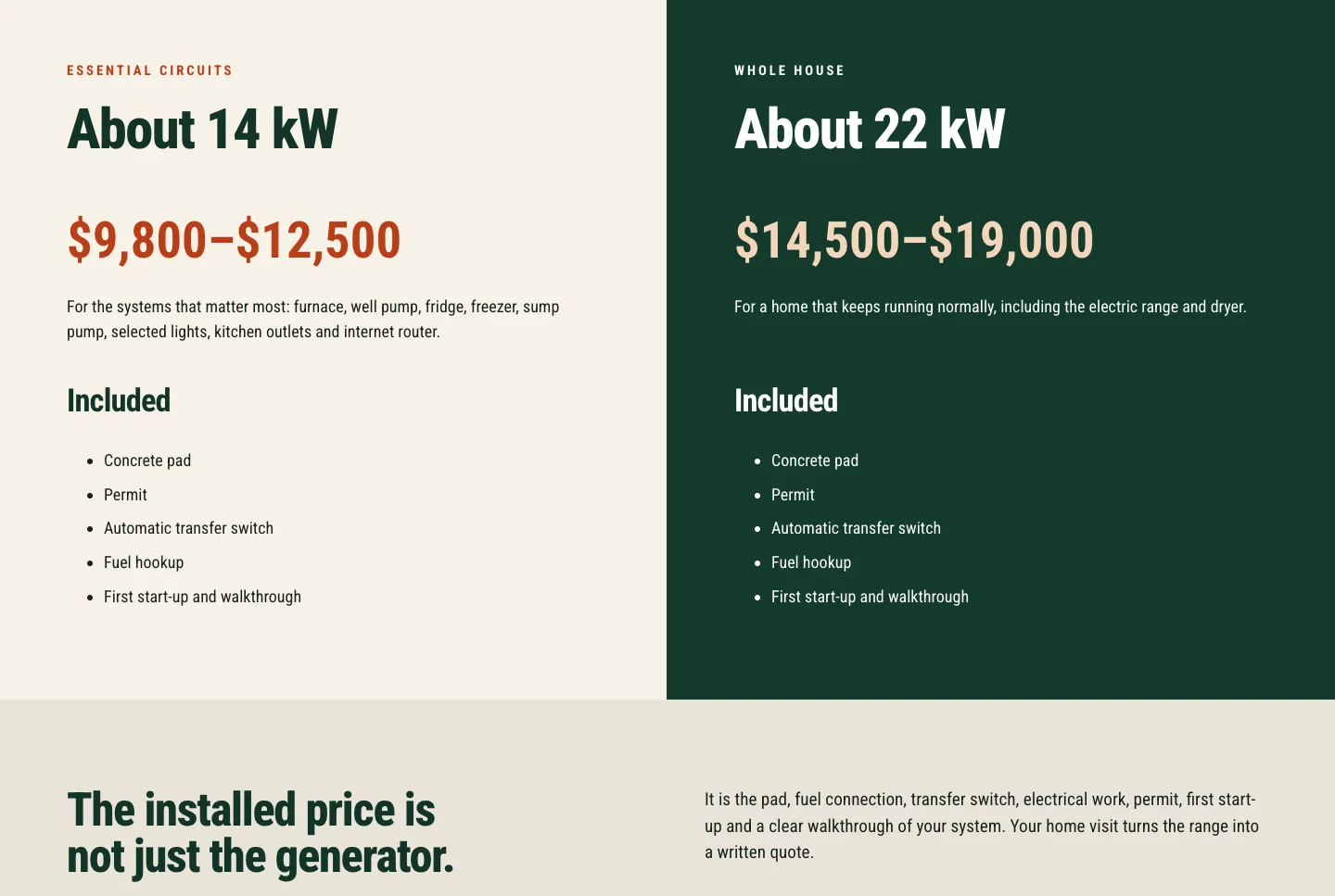
"whole house generator cost" gets 5,400 searches a month at difficulty 29, and "what size generator do i need for my house" gets 1,300 at difficulty 33. Both are averages lifted by one busy month in the past year, so most months see fewer. One page can answer both. Tamsett Generator & Electric, another site Theo built, gives two sizes, what each one keeps running, an installed price range and what the price includes.
Some searches are too small for a page of their own and still worth a sentence. "how long will a generator run on propane" averages about 320 searches a month at difficulty 4, with much of the past year's total in a single month, so most months see fewer. Tamsett's estimate page answers it in one line, among seven questions homeowners ask before a quote. "standby generator maintenance" (1,000 a month, difficulty 6) gets a full page on the same site, because a yearly plan is a job the shop sells.
Built by TheoTamsett's estimate page: when the written quote arrives and what it covers, then the questions, each answered in a line. See the live page.
Town pages for the places your van goes
"electrician loveland co" gets about 210 searches a month at difficulty 2, and two of the local electricians in its first ten results appear there with a page written for Loveland. A town page earns its place with things true only of that town, such as jobs finished there and the drive from your shop. Write one for each town you really serve and want more work in, not one for every name on the map.
Pages for builders and property managers
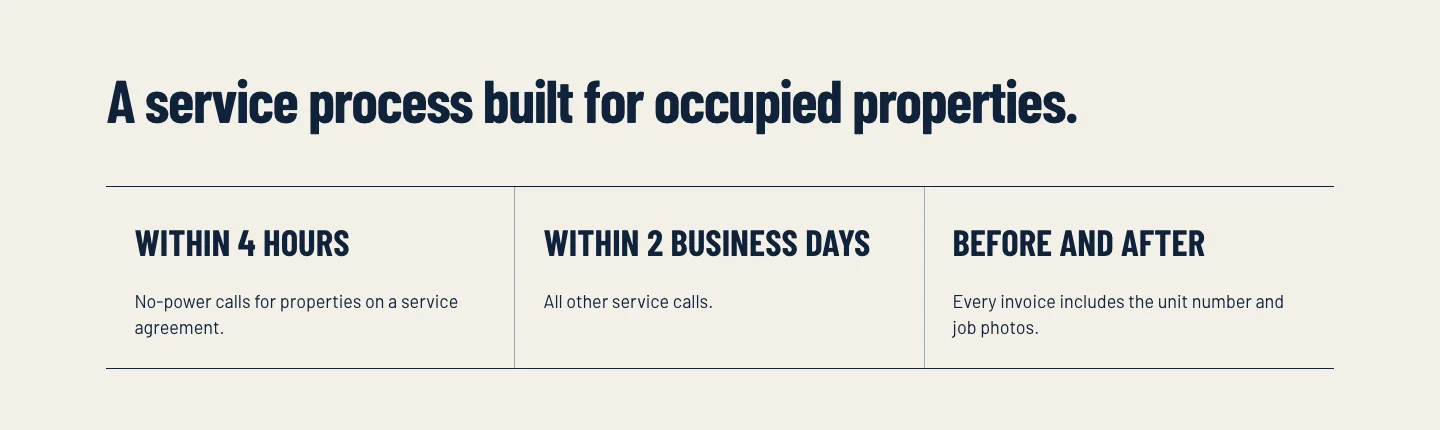
Property managers seldom search for an electrician by that name: Semrush counts about 20 searches a month for "property management electrician". The bigger commercial searches are "commercial electrician" (9,900 a month, difficulty 16) and "commercial electrician near me" (4,400, difficulty 6), though that second one has fallen through the year, so recent months see fewer. A page that states response times and how each job is documented answers what a manager checks before sending a work order, as Ravelstone Electrical Contractors' page does below.
Built by TheoRavelstone's page for property managers: response times, and what every invoice includes. See the live page.
The map listing: your Google Business Profile for the near-me searches
The near-me searches include the biggest number in the job table, and the map decides them. Google's help page on local ranking puts it this way: "Local results are mainly based on relevance, distance, and popularity." Distance you cannot change. A complete listing and a steady stream of reviews are the parts you can work on.
Most electricians do the work at the customer's house, which makes them what Google calls a service-area business: "A business that visits or delivers to customers directly but doesn't serve customers at their business address." Google's rule for them, as its help page read on October 19, 2026: "If you don't serve customers at your business address, remove your address from your Business Profile." You can then list up to 20 service areas, and Google says the whole area "shouldn't be more than about 2 hours of driving time from where your business is based."
Category. Google's guidelines say: "Choose the fewest number of categories it takes to describe your overall core business." Pick ones as specific as possible. For most shops the main one is Electrician.
Name. Use the name on your truck and your paperwork. Google's guidelines say: "Including unnecessary information in your business name isn't permitted." A town or a slogan added to the name goes against them.
Hours. List the hours someone picks up the phone, which Google calls your "regular customer-facing hours of operation".
Photos. Finished panels, chargers and generators, your van and your crew, added as the jobs happen.
Reviews. Ask every customer the same way when the job is done, and answer every review, the unhappy ones included. The guide to answering negative Google reviews has sample replies.
Verification. If Google asks you to prove the business with a video, the video verification guide lists what to film.
What Theo does for the map listing
On Starter and Pro, the Boost checklist walks you through the Business Profile and the other listings homeowners check, such as Apple Business Connect, Bing Places, Facebook and Yelp, so your name, number and service area match on each. You make every change in your own account, so the listings stay in your name. Your website then backs the listing up with the job and town pages it links to.
What SEO for an electrician covers, and who does each part
Here is the whole job in one table, so you can hold it next to any proposal you are sent. The last column says who does each part when your site is on Theo.
The work
For an electrician, that means
On Theo
Research
Finding what homeowners and builders type, such as a panel upgrade cost or electrician plus your town, and how hard each search is to win
Theo does it on Starter and Pro
Service pages
A page for each job you want more of: panel upgrades, EV chargers, surge protection, rewiring, generators and repairs
Theo drafts them, and you approve
Town pages
A page for each town your van really goes to
Theo drafts them, and you approve
Troubleshooting and price posts
Answers to the breaker, flickering light and cost questions people search before they call
Theo drafts them, and you approve
Fixes and speed
Correcting what holds pages back in search, from redirects and preferred addresses to titles and phone layout, and keeping pages quick to open
Theo does it on Starter and Pro
Getting pages into Google
Sending your sitemap to Google through Search Console, its free report for site owners, so every new page's address reaches Google
Theo, on every plan, once you connect Google
Google's emails
The Search Console notices that arrive after a move or a batch of new pages
SEO repair, part of the Growth Engine, pulls them in and handles them
AI answers
Plain answers that ChatGPT and Google's AI Overviews can draw on
Included in the search work on Starter and Pro
Map listing and directories
Your Business Profile, service area, category and photos, and the other listings
Boost lists them in order, and you make each change
Reviews
Asking after every job and answering each review
You, the same way each time
Reporting
A record of every page added and fix made, plus Google's own numbers
The Growth tab, a weekly email and the Analytics tab
Your part, start to finish
One time: connect your domain, then sign in with Google so Theo can set up Analytics and Search Console. The search work starts after that, so do it early in Starter's free 30 days.
When drafts arrive: read them in the Growth tab between calls and approve them, or turn on auto-publish.
As jobs finish: drag photos of the work into the chat, and say in plain words when you add a service or a town.
After every job: ask for the Google review.
How long electrician SEO takes
Search traffic builds over months, not weeks. Google's own guidance on hiring an SEO puts the payoff at four months to a year. That range is from How to hire an SEO, a video Google Search Central made for owners weighing that decision.
The first sign comes well before the phone rings. Once Google indexes a new page, Search Console starts counting its impressions, the times it appeared in results, and clicks follow as the page climbs. A page aimed at a search with few strong rivals, such as a town page, tends to show impressions sooner than one aimed at a crowded search like EV charger installation.
What you can check all along is the work: each page, post and fix is listed in the Growth tab, and the Analytics tab shows the clicks and impressions Google reports.
Before you hire anyone for electrician SEO
Electrical contractors get cold emails offering to fix their rankings. Google's page Do you need an SEO?, last updated June 5, 2026 and re-read on October 19, 2026, is direct about them: "Be wary of SEO firms and web consultants or agencies that email you out of the blue." A few more of its points are worth holding any offer against.
No promised spot. Google says no one can guarantee a top ranking, and to beware of anyone who claims a "special relationship" with Google.
Every change in writing. Google's list of questions to ask includes whether you will see all the changes made to your site. Ask an SEO to show a month of its work for another electrician: each page and fix, with a link to it.
Links bought in bulk. Google's page names "link popularity schemes" as a warning sign. Turn down anyone selling links by the batch.
Your name on everything. The site, the domain and the Business Profile should stay in your name. Google's page adds: "Ultimately, you are responsible for the actions of any companies you hire."
Terms you can end. Prefer a plan you can stop in any month over a contract that outlasts a slow season.
Is it worth paying for at all?
That depends on what one more panel upgrade or service call is worth to you each month. The sums are worked through on the page is SEO worth it for a small business.
If you already have an electrical website
The search work needs the site and the work in one place: the system that drafts a page also publishes it, corrects it later and sends the sitemap to Google. That is why it runs on a site Theo builds and hosts. Give Theo your current site's address and it rebuilds the site as a starting draft with the same look, which you then adjust in chat. The old site keeps running until you point your domain at the new one.
Once Search Console is connected, SEO repair on Starter and Pro forwards old addresses that still get search traffic to the matching new pages, and on any plan Theo adds a forward you ask for in chat, so a homeowner or Google following an old link lands on the right page. Afterward, Google may email that some pages show Page with redirect. That is the move working: the old address forwards, and Google keeps the new page. The Page with redirect guide explains it, the guide to redesigning a website without losing SEO covers what to check before a move, and what happens to rankings when you move covers the weeks after.
FAQ
Questions electricians ask about SEO
How much does SEO for an electrician cost on Theo?
The search work comes with Starter, $69.99 a month and free for the first 30 days, and with Pro, $129.99 a month, which adds more weekly pages and posts. Both prices include the website and its hosting, and the first build costs nothing. Basic is the site and hosting without the search work. The extras are top-up chat credits, a domain if you buy one through Theo and, on Starter and Pro, optional paid directory submission packages in the Boost checklist.
How long until my electrical company shows up on Google?
Search traffic builds over months, not weeks. Google's own guidance on hiring an SEO puts the payoff at four months to a year. Search Console shows impressions when your pages appear in results and clicks when someone visits. The map listing moves on its own clock, with your Business Profile and your reviews.
Who owns the pages Theo writes for my site?
You do. The pages, the words and your photos of finished panels and chargers belong to your business. Theo hosts the site, and Pro adds read-only access to the site's code on GitHub.
Can I cancel, and is there a contract?
There is no contract term, and you can cancel in any month. The cancellation confirmation shows the date your plan ends, and the site stays live until that date. Save any text and photos you want to keep before then.
Can Theo do SEO on the site I already have?
No. Theo's search work runs only on sites it builds and hosts. Theo makes the first draft from your current address, your old site stays live until your domain points at the new one, and the section on moving an existing site above explains what happens to old addresses.
Do I have to write anything or learn SEO?
No. Theo picks the searches, drafts the pages and posts, and leaves them in your Growth tab to read and approve, unless you turn on auto-publish. What helps most is what only you have: photos of finished jobs, which you can drag into the chat, and a word when you add a service or start driving to a new town.
Will this help me show up in ChatGPT and Google's AI answers, or is that extra?
No extra charge: it is included in the search work on Starter and Pro. Theo works toward citations in ChatGPT and Google's AI Overviews by putting plain, specific answers on pages Google can already read.
I run the business from home and my van. Can I still show up on Google Maps?
Yes. Google calls that a service-area business. Its help page says that if you don't serve customers at your business address, you remove the address from your Business Profile, and you can list up to 20 service areas instead, within about two hours' drive of your base. The Boost checklist on Starter and Pro walks you through those settings in your own account.