
Is SEO worth it for a small business? The short answer
Quick answer
Yes, for most local businesses, when three things are true. People search for what you sell in the area you serve. One or two new jobs a month would cover what the work costs. And you can give it months, not weeks, because search traffic builds slowly and then keeps coming. If any of the three is a no, start with the free basics in this guide before you pay anyone.
On this page: what SEO costs, how long it takes, what the work looks like, when it is not worth it, red flags in an SEO offer and common questions.
SEO, short for search engine optimization, is the work that gets your pages shown when customers search Google for what you do. For a local business, that means a page for each service and each town you serve, a complete Google Business Profile, and a site Google can read easily on a phone.
Google is plain about who can do it. Its page Do you need an SEO? (last updated June 5, 2026, read October 18, 2026) says: "If you run a small local business, you can probably do much of the work yourself." Paying makes sense when the work would not get done every month otherwise, and when the math below says it pays for itself.
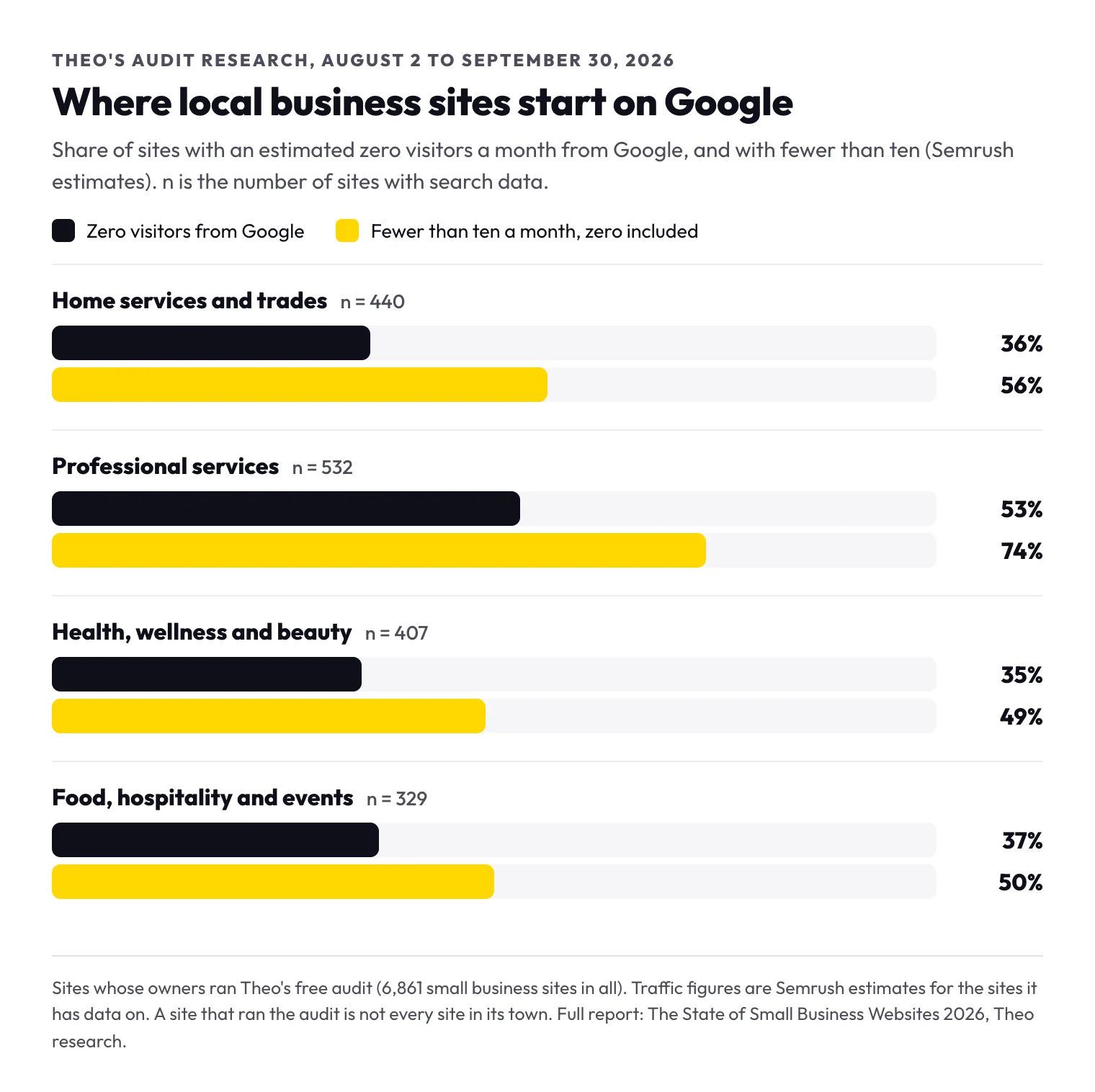
Most small sites start low. Among the 440 home services and trades sites with search data in Theo's audit of 6,861 small business websites, 36 percent got an estimated zero visitors a month from Google and 56 percent got fewer than ten (Semrush estimates, August 2 to September 30, 2026). A typical small site starts near zero, so the first gains come from the basics, not from outspending anyone.
Put your own numbers into the break-even calculator below: what one new job leaves you after costs, what the option you are weighing costs a month, and how many people search for your service in your town.
Three checks that decide it for your business
I do not need a web site I need ways for people to find my web site
That owner put the whole question in one line. A website earns its keep when people can find it, and SEO earns its keep when the people who find you become customers. Three checks show which side of that line your business is on.
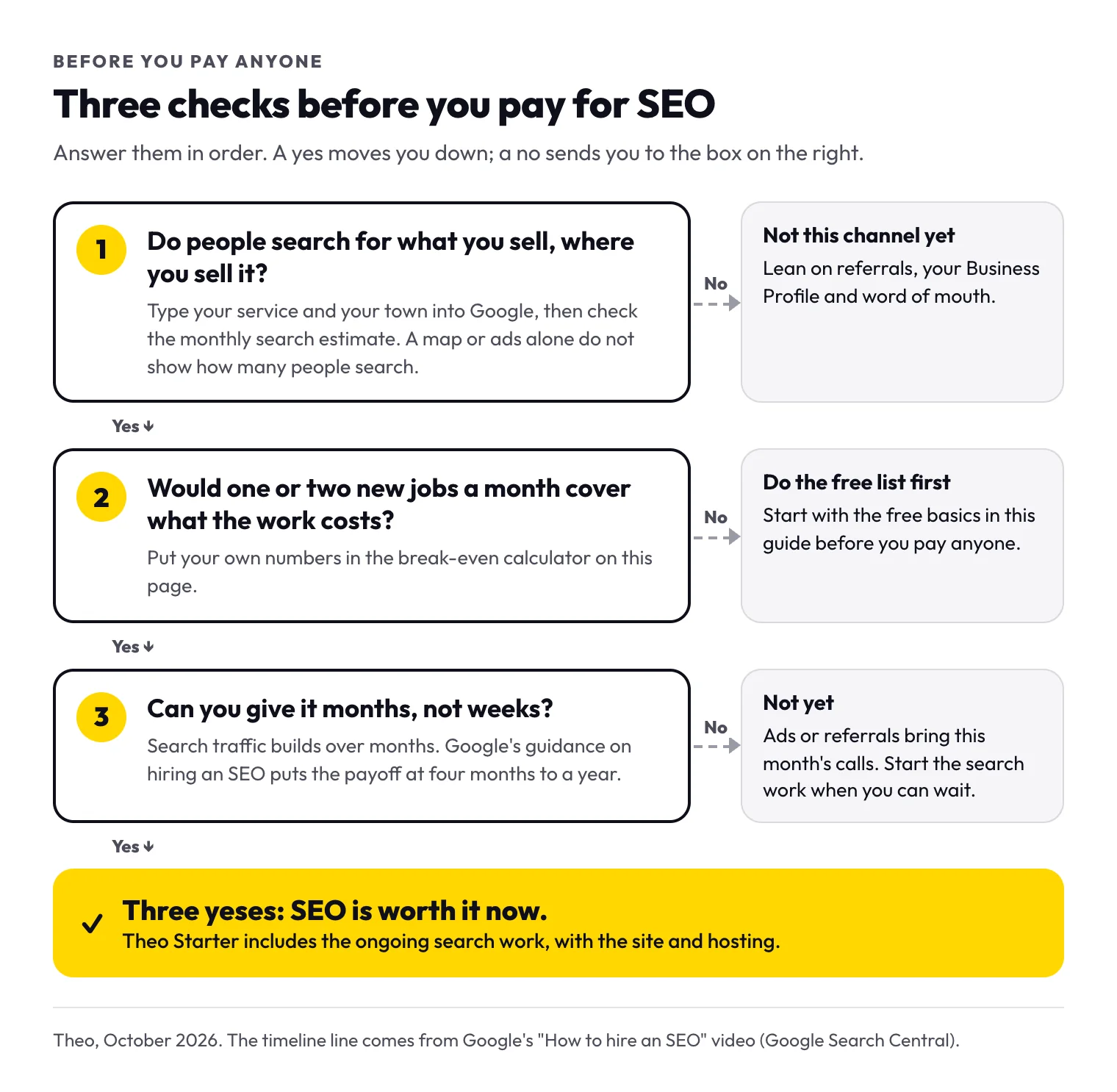
1. Do people search for what you sell, where you sell it?
Open Google on your phone and type your main service and your town the way a customer would: roof repair plus the town, tax preparer near me, dog groomer plus your neighborhood. Then look at what comes back.
- A map with local businesses shows Google treats this as a local search; it does not tell you how many people search.
- Ads above the results show businesses advertise on this search; they do not tell you whether the ads pay.
- Only national sites or directories show what Google finds relevant today. Try your service with your town and with near me, then check the monthly search estimate before you decide what to spend.
2. Would one or two new jobs a month cover the cost?
Work back from one job, not from a promise of traffic. Take what a typical job leaves you after materials, wages and fuel, and divide what the work costs a month by that number. The calculator does it for you, and the next section works an example through.
3. Can you give it months, not weeks?
Search work pays slowly, then keeps paying. If you need the phone to ring this week, ads, referrals and a complete Business Profile come first. Start the search work when you can wait for it, because each page it adds keeps working long after the month it was written.
What SEO costs a small business, and how many jobs pay for it
There are three ways to pay for the work, and they buy different things.
- Your own time. The tools are free: Google Search Console, your Google Business Profile and Theo's free audit. The cost is your hours, every month.
- A freelancer or an agency. A monthly retainer; check whether the website and hosting are included or billed separately.
- A plan that includes the work. Theo Starter is $69.99 a month, free for the first 30 days, and covers the site, the hosting and the search work together. Pro is $129.99 a month for more weekly pages and posts. It is a different purchase from a retainer: the work runs on a site Theo builds and hosts, rebuilt from your current site's address.
The break-even math, worked through
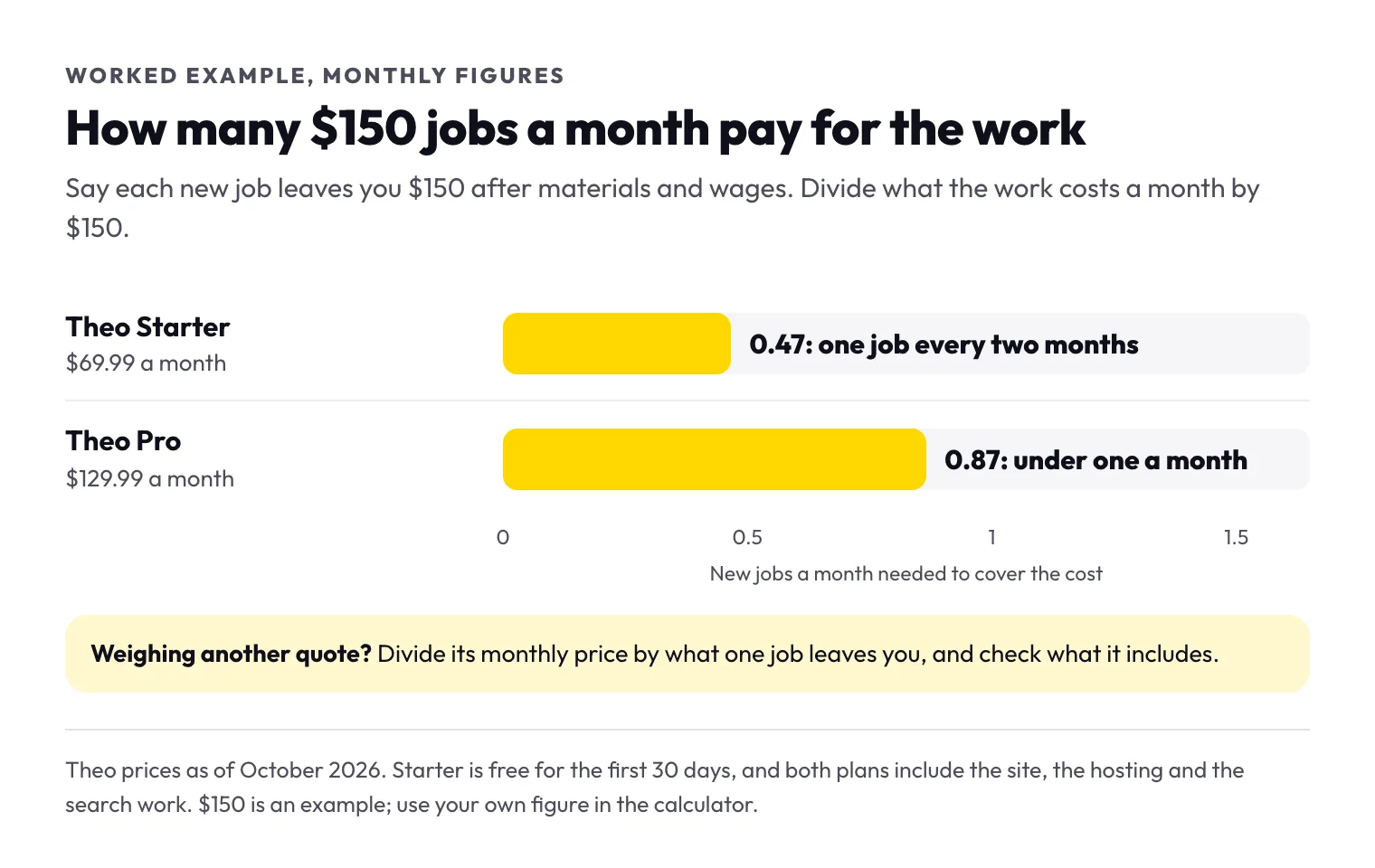
Say a typical job leaves you $150 after costs. That is an example; use your own figure. Divide each monthly cost by $150 and you get the number of new jobs a month that pays for it.
The other side of the math is demand. Semrush estimates that roof repair overland park gets 110 searches a month in the US, averaged over the 12 months to October 2026, so some months bring more and some fewer. If 5 percent of those searchers visited your page and 10 percent of the visitors became jobs, that one search would bring about half a job a month. Those two rates are example guesses, not measured figures. Try a low guess and a high one in the calculator.
| What you are weighing | Cost a month | New $150 jobs a month to cover it |
|---|---|---|
Theo Starter | $69.99 | 0.47, or one new job every two months |
Theo Pro | $129.99 | 0.87, a little under one a month |
A freelancer's or agency's monthly quote | Their figure | The quote divided by $150 |
What each path leaves to you
Price is half of it. The other half is what you still do yourself each month. What each option costs, and the monthly tasks one by one, are in the SEO maintenance checklist.
| Path | What you pay | What you still do each month |
|---|---|---|
Do it yourself | Your hours; the tools are free | All of it: new pages, the fixes Search Console asks for, your Business Profile, reviews, and checking that it works |
Freelancer or agency | A monthly retainer; check whether the site and hosting are included | Approve their work, keep the site itself paid for and current, and check that each report lists the pages they published |
Theo Starter or Pro | $69.99 or $129.99 a month for the site, hosting and search work | After a one-time setup (connect your domain, sign in with Google), review the drafts in your Growth tab or switch on auto-publish, work through the Boost checklist for your listings, and tell Theo in chat when prices or hours change |
Where small business sites start on Google
Theo's free audit has read thousands of small business sites, so it can show where a typical one starts. The sites below belong to owners who ran the audit between August 2 and September 30, 2026, and the traffic figures are Semrush estimates. Owners who run an audit may already have doubts about their site, so this is not a picture of every business in your town. It is a fair picture of the starting line.
Across these four groups of local businesses, a third to a half of the sites got no estimated visitors from Google at all, and about half or more got fewer than ten a month. That is why the first months of the work are mostly basics: a clear page for each search that matters, and a site Google can read. The method and every group are in The State of Small Business Websites 2026.
| Kind of business | Sites with search data | Share with an estimated zero visitors from Google (Semrush estimate) | Share with fewer than ten a month | Includes, for example |
|---|---|---|---|---|
Home services and trades | 440 | 36% | 56% | |
Professional services | 532 | 53% | 74% | |
Health, wellness and beauty | 407 | 35% | 49% | |
Food, hospitality and events | 329 | 37% | 50% |
How long SEO takes, and what to check along the way
Search traffic builds over months, not weeks. Google's own guidance on hiring an SEO puts the payoff at four months to a year. The figure comes from Google Search Central's video How to hire an SEO.
Google's SEO Starter Guide (last updated December 10, 2025) puts the early weeks this way: "Some changes might take effect in a few hours, others could take several months. In general, you likely want to wait a few weeks to assess whether your work had beneficial effects in Google Search results."
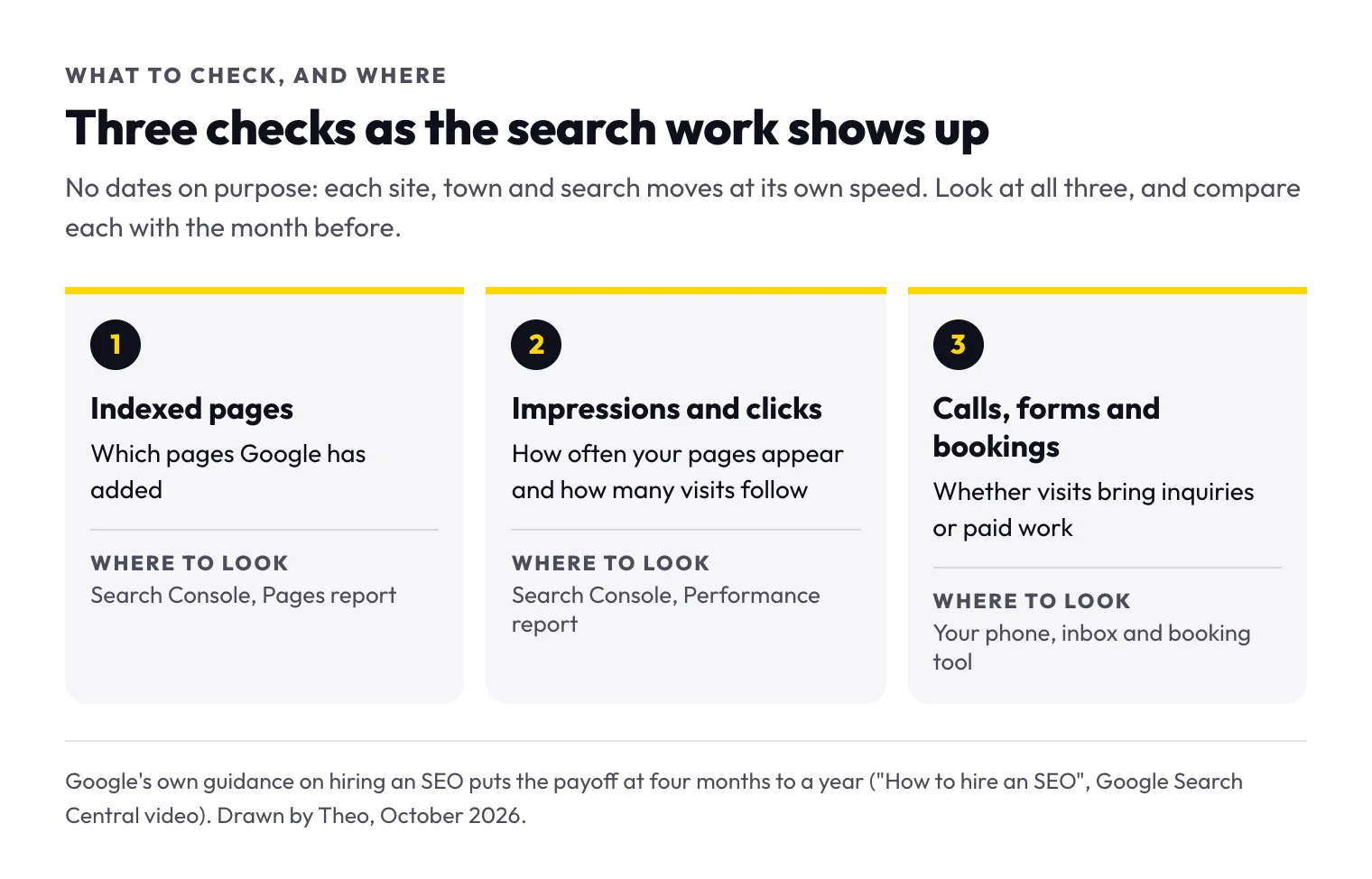
The order is more reliable than the speed. First Google finds and indexes the new pages. Then they start to appear in results, often far down, which Search Console counts as impressions. Then positions improve on the easier searches and the first clicks come, and calls and bookings follow the clicks. A new site, or a town where many businesses compete for the same search, sits at the slow end.
| What to check | What it tells you | Where to look |
|---|---|---|
Indexed pages | Which pages Google has added | Search Console, Pages report |
Impressions and clicks | How often your pages appear and how many visits follow | Search Console, Performance report |
Calls, forms and bookings | Whether visits bring inquiries or paid work | Your phone, inbox and booking tool |
One small business's numbers
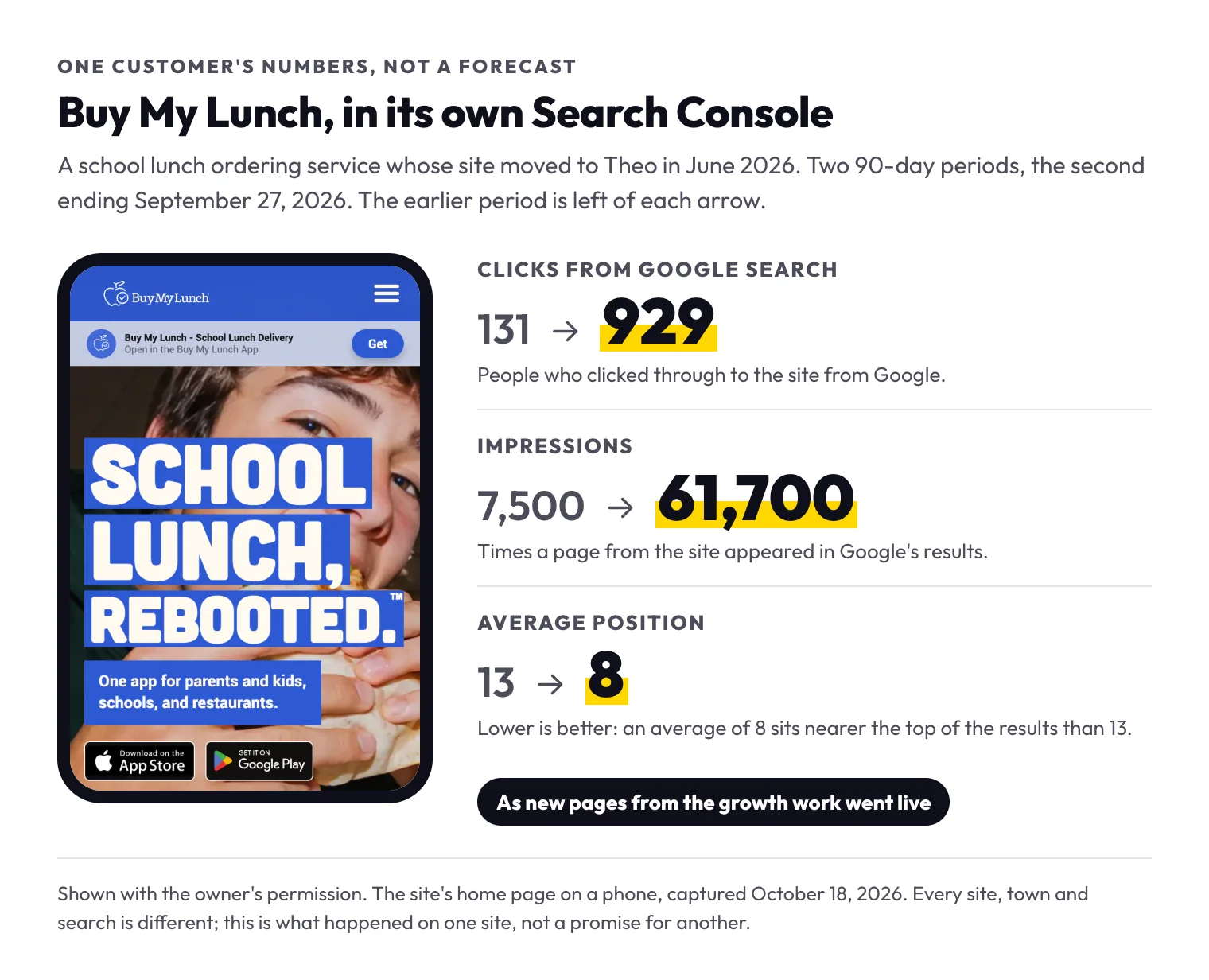
Buy My Lunch, a school lunch ordering service, moved its site to Theo in June 2026 and agreed to share its Search Console numbers. Comparing the 90 days to September 27, 2026 with the 90 days before them, clicks from Google search went from 131 to 929, impressions from 7,500 to 61,700, and its average position from 13 to 8, as new pages from the growth work went live.
Track the same three numbers on your own site over time: impressions, clicks and inquiries.
What the work looks like: four jobs on a roofing site built by Theo
Paying for SEO should buy things you can open and read. Quarrystone Roofing is a roofing site built by Theo, set in Overland Park, Kansas. On October 15, 2026, Theo's Growth Engine, the search work in Starter and Pro, ran on it four times, one job each run. The SEO for roofers page, which shows the full run, puts the pace plainly: "On your site, the same jobs are spread out over the weeks."
The search counts and difficulty scores are Semrush's US estimates, rechecked October 18, 2026. Across the four runs, each new page was also linked into the menu, the footer or the homepage, and 10 pages got a preferred address (a canonical tag).
| Run | What it did | Why |
|---|---|---|
1 | Wrote a post of about 2,000 words: How Long Does a Roof Inspection Take? | The search how long does a roof inspection take gets about 260 searches a month on a 12-month average, fewer in recent months, with a difficulty of 1 out of 100 |
2 | Wrote a town page: Roof Repair in Overland Park | The search roof repair overland park gets about 110 searches a month on a 12-month average, with a difficulty of 19 out of 100 |
3 | Wrote a page of roofing statistics, each figure with its source: U.S. Roofing Industry Statistics: 2026 | A page of sourced figures is the kind other sites quote and link to |
4 | Wrote nothing new: checked the pages already there and gave 10 of them a preferred address | Keeping the existing pages in order matters as much as adding new ones |
The town page, on a phone
The page answers the search on its first screen, then takes the questions a homeowner asks before calling. The homepage links to it, so visitors and Google can both reach it.

The post, partway down
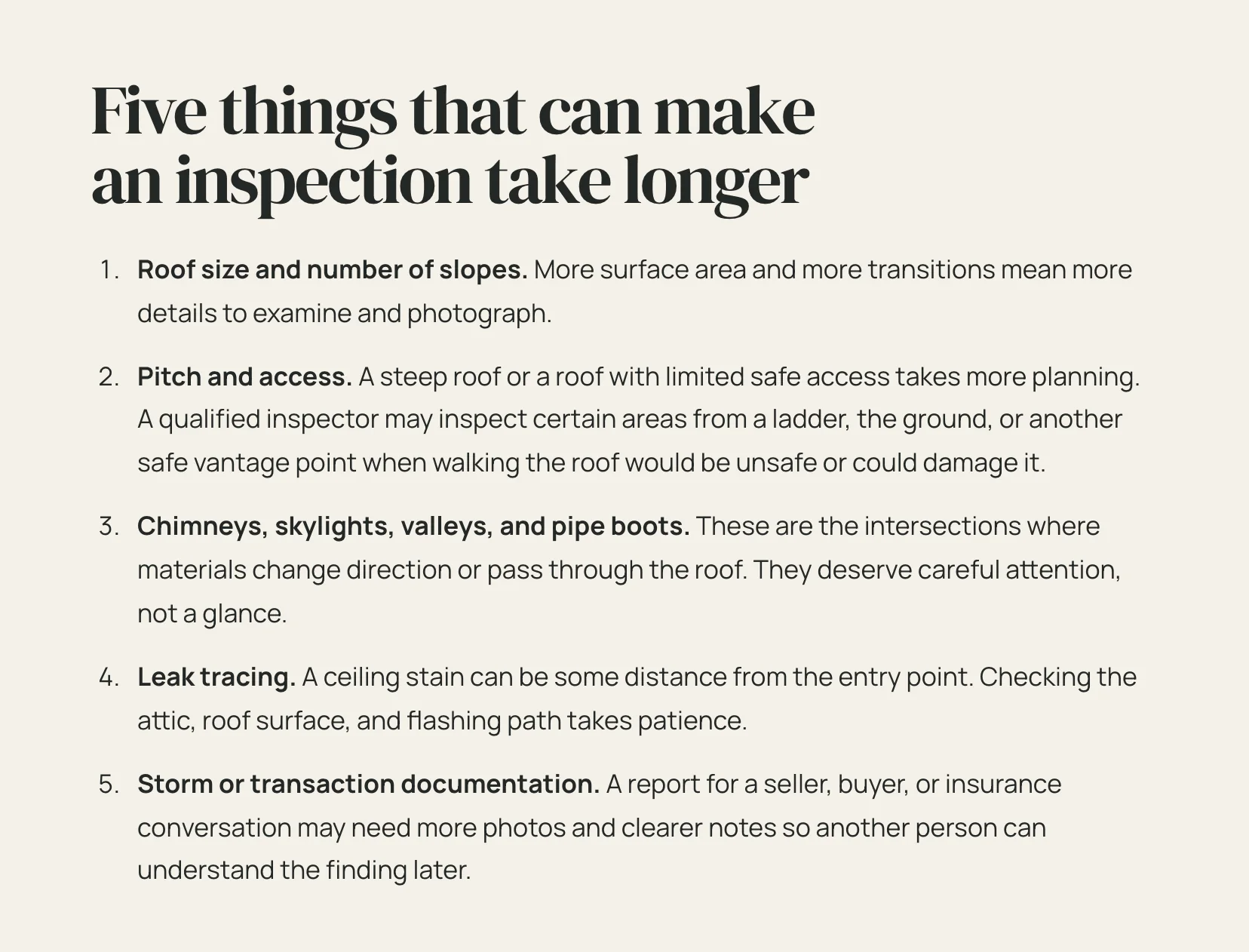
The post opens with the answer, 60 to 90 minutes for most homes, and then explains what can stretch the visit. A page like this answers the question a homeowner types before they are ready to call, which is where many local searches start.
The test for any provider
Ask anyone you might pay, Theo included, to show you last month's new pages by address and to say why each search was picked. If they can, you are paying for work you can see. If the report only shows a score or a list of rankings, ask what was published.
When SEO is not worth it, or not yet
SEO is not the right spend for every business at every moment. These are the honest cases, in two groups.
Not this channel
- Nobody searches for what you sell yet. A new kind of product has to be explained before people know to search for it.
- All your work comes from a handful of referral clients, and you do not want more.
- You are closing or selling the business within the year.
- Your site only needs to exist, like a business card for people who already know you. Theo's Basic plan is the site without the SEO program, and the pricing page compares the plans.
Not yet: do this first
- You need calls this month. Ads, referrals and a complete Business Profile work faster, so start the search work when you can wait.
- You are booked solid for months. Start the work a season before you want the calendar to fill.
- Google cannot find your site at all. Sort that out first: why a website is not showing up on Google walks through the usual reasons.
- The basics are missing, such as a Business Profile or a page for each service. Do the free list in the next section first. In a quiet market it may be all you need.
Can you do your own SEO, or is paying for it worth it?
Often you can do it yourself. Google's SEO Starter Guide is written for owners, and its advice on hiring is one honest line: "Short on time or not feeling adventurous? You might consider hiring a professional." This free list covers most of what a local business needs:
- Complete your Google Business Profile: categories, hours, services, service area and photos. Invite every customer to leave an honest review, not just the ones you expect to be happy, and reply to each one.
- Connect Google Search Console, Google's free tool for site owners, and submit your sitemap so Google can find every page.
- Give each service its own page, named the way customers say it, with the answer to their first question near the top.
- Give each town you serve its own page if you travel to customers, with real details of the work you do there, not the same page with the town name swapped.
- Write page titles in your customers' words: the service and the town, not the business slogan.
- Check every page on a phone: quick to open, easy to read, with a tap-to-call phone number.
Is hiring an SEO company worth it?
The list is easy to do once and hard to keep up every month. That monthly part is what you pay for, whoever does it. Paying for it is worth it when you will not find the hours, when many businesses in your town want the same searches, or when your current site is hard to change. It is not worth it when the price fails the break-even math above, or when the provider cannot say what they will publish. On Starter and Pro, Theo writes the new pages and makes the fixes every week, and you can open and read each one.
For the do-it-yourself steps in full, read how to get your website on Google.
How to tell a good SEO offer from a bad one
Most owners meet SEO as a sales pitch first. Google's help page Do you need an SEO? makes a good checklist, and it is short. Every quote below was read on October 18, 2026; the page was last updated June 5, 2026.
The email that arrives out of the blue
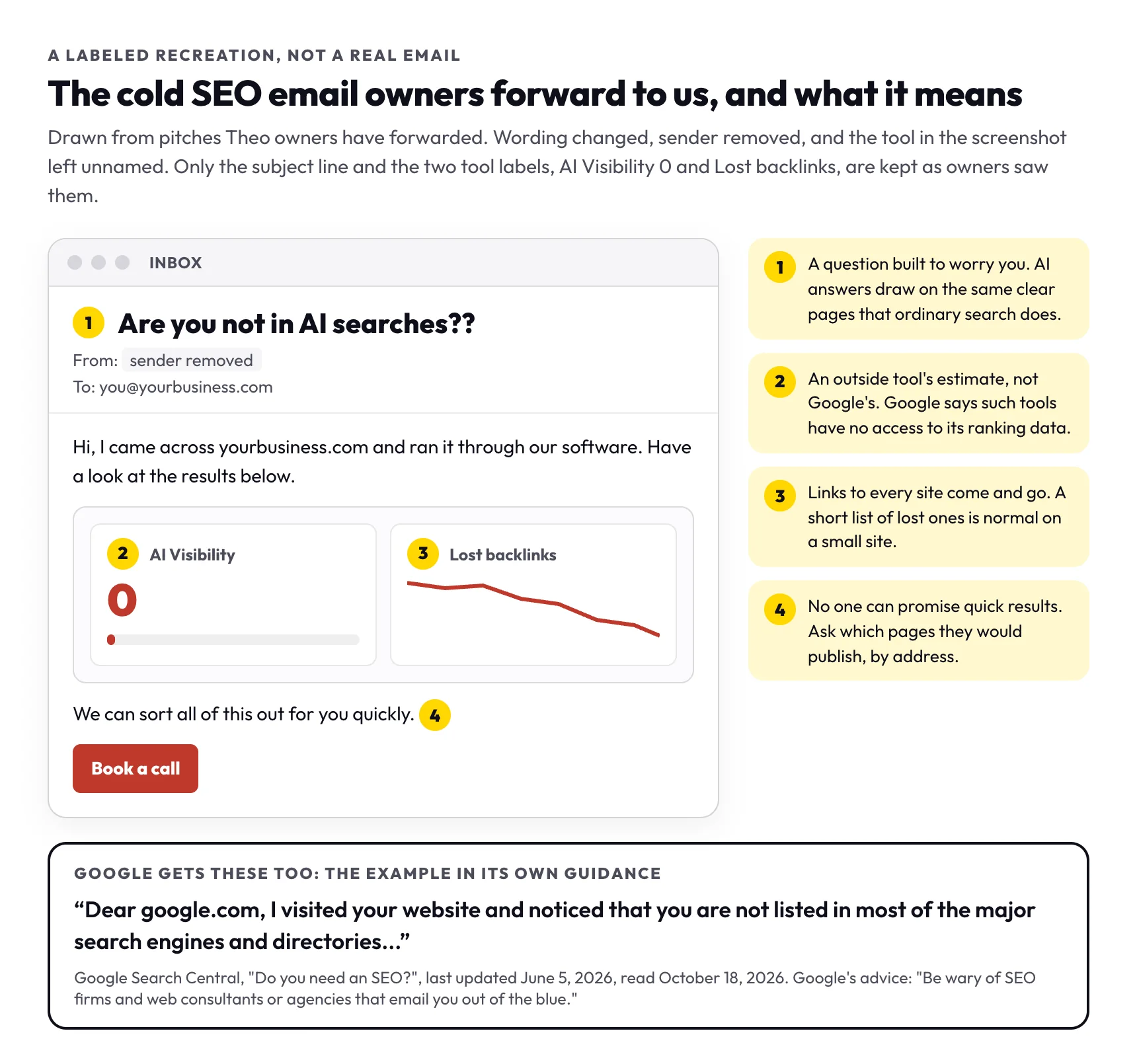
Theo owners forward these to support, worried they have done something wrong. They have not. The picture below is a recreation: wording changed, sender removed, and only the subject line and two labels from a tool's screenshot kept as owners saw them.
"Are you not in AI searches??" AI answers in Google draw on the same pages as its regular results, so there is no separate list to get onto. More on that in the AI section below.
"AI Visibility 0" is a score from an outside tool, not from Google. Google's Do you need an SEO? page says such tools "don't have access to Google's internal ranking data."
"Lost backlinks" means some sites that once linked to yours no longer do. Links come and go on every site, and a short list on a small business site is normal.
Google's advice on these emails is one sentence: "Be wary of SEO firms and web consultants or agencies that email you out of the blue." It even prints one it received: "Dear google.com, I visited your website and noticed that you are not listed in most of the major search engines and directories..."
Google's questions for anyone you hire
Google lists questions to ask before you hire someone. Here they are in Google's words, with what a straight answer sounds like for a small local business. Google's list also asks about international sites, which is left out here because it rarely applies to a local business.
| Google's question | A straight answer sounds like |
|---|---|
"Can you show me examples of your previous work and share some success stories?" | Pages they published for a business like yours, by address, and what changed in that site's Search Console afterward. |
"Do you follow the Google Search Essentials (previously known as Webmaster Guidelines)?" | Yes, and what that rules out: no bought links, no copied pages, no hidden text. |
"What kind of results do you expect to see, and in what timeframe? How do you measure your success?" | A range in months, not days, and a measure you can check yourself: impressions and clicks in Search Console, then calls and forms. |
"What's your experience in my industry?" | Pages they have written for your kind of business, and the questions those customers ask. |
"What's your experience in my country/city?" | They know the towns you serve and plan a page for each one you want work from. |
"How long have you been in business?" | A plain answer you can check. |
"How can I expect to communicate with you? Will you share with me all the changes you make to my site, and provide detailed information about your recommendations and the reasoning behind them?" | Yes: a list of every page and change, by address, with the reason for each. |
Red flags Google names
- A promised top spot. Google says no one can guarantee a top ranking on Google. If a provider promises first place, Google's advice is to "find someone else."
- A "special relationship" with Google, or a "priority submit". Google says it "never accepts money to include or rank sites in our search results."
- Being asked to link to them. In Google's words: "You should never have to link to an SEO."
- Submitting your site to thousands of search engines, or link schemes. Google calls these "typically useless exercises."
- Secrecy. Google says to "be careful if a company is secretive or won't clearly explain what they intend to do."
- Full control for an audit. For an audit, Google says to "only grant read access to Search Console."
Is SEO still worth it with AI search?
Yes, and for the same reasons. Google's guide to AI features (last updated December 10, 2025) says: "The best practices for SEO remain relevant for AI features in Google Search (such as AI Overviews and AI Mode). There are no additional requirements to appear in AI Overviews or AI Mode, nor other special optimizations necessary." Google's Do you need an SEO? page lists "Optimizing for generative AI" among the useful services SEOs provide, and asks whether advice on "AEO" or "GEO" matches Google's own guidance.
In practice the work is the same: a page that answers one customer question near the top, in plain words, with real details such as prices, towns and hours. That is the kind of page an AI answer can quote. The guide to showing up in AI Overviews goes further.
How Theo does the work, and what it costs
On Theo, the search work is part of the plan. Starter is $69.99 a month, free for the first 30 days, and Pro is $129.99 a month for more weekly pages and posts. Both include the site and its hosting. The work runs on a site Theo builds and hosts, rebuilt from your current site's address as a starting draft if you have one. The small business SEO services page lists everything in the plans.
Every plan is month to month with no contract, and you own the site and its content. What Theo promises is the work, which you can open and read page by page:
- Research into what customers in your area search for, and how hard each search is to win.
- New pages and posts every week, drafted into your Growth tab for you to review, or published on their own if you switch on auto-publish.
- SEO fixes and speed work, drawn from Google Search Console and a direct check of the site: indexing, pages that cannot be reached, redirects, preferred addresses, titles and descriptions, the sitemap, and how pages work on a phone.
- Sitemap submission. On every plan, connecting Google submits your sitemap, and Google rereads it on its own, so each page you publish is on the list it checks.
- The Boost checklist for your Business Profile and other listings, one at a time: free listings you complete yourself, plus optional paid directory submission packages.
- A weekly email on Starter and Pro counting the new pages, posts and updates, and the Analytics tab on every plan with your visits, Google clicks and top pages.
- No chat credits. The growth work never uses the credits you spend on your own edits.
Frequently asked questions
How much should a small business spend on SEO?
Work back from one job instead of from a budget: divide the monthly cost by what one new job leaves you. If a job leaves $150, Theo Starter at $69.99 a month needs one new job every two months. For another provider, enter its monthly quote in the calculator and check what is included. If the jobs needed are more than the searches in your town could bring, the price is too high for now.
How long does SEO take for a small business?
Search traffic builds over months, not weeks. Google's own guidance on hiring an SEO puts the payoff at four months to a year. The figure comes from Google Search Central's video How to hire an SEO. Google can find new pages within days or weeks, but showing up for the searches that bring customers takes longer. Expect impressions in Search Console first, then better positions, then clicks and calls. A new site or a busy town sits at the slow end.
Can anyone guarantee my business will be on page one of Google?
No. Google's own advice is that no one can guarantee a top ranking, and it tells owners to beware of anyone who claims a special relationship with Google. What Theo promises is the work itself: the pages it publishes and the fixes it makes, each one there to open and read.
Can I do my own SEO?
Often, yes. Google says a small local business can probably do much of the work itself. Start with a complete Business Profile, Search Console with your sitemap submitted, a page for each service and each town, and titles in your customers' words. The hard part is not learning it. It is keeping it up every month, and on Starter and Pro, Theo keeps it up for you every week.
Is local SEO worth it for a small business?
For a business that serves one town or area, it is usually the part most worth doing, because people who search for a service plus a town are often ready to call. It has two halves: your Business Profile and listings, and a page on your site for each service and each town you serve.
Is SEO or Google Ads better for a small business?
They do different jobs. Ads can bring calls this week and stop when you stop paying. SEO takes months, and the pages keep working once they rank. Google says advertising with it has no effect on where your site appears in its regular results. Many owners run ads while the search work builds.
Can Theo do SEO on the site I already have?
Theo does the search work on a site it builds and hosts. If you have a site, Theo rebuilds it from your current address as a starting draft, and your old site stays live until you point your domain at the new one. On Starter and Pro, Theo's SEO repair redirects the old page addresses that still get search traffic to their new pages, to help keep what Google already knows, and on any plan you can ask for a redirect in chat.
Do I own my site, and can I cancel?
Yes to both. Every plan is month to month with no contract, and you own the website and its content. Canceling stops the next charge, and the site and the search work keep going until the end of the period you paid for. If you only want the site online without the search work, you can move to the plan without the SEO program instead.
Find out where your site starts
The quickest way to answer "is SEO worth it" for your own business is to see where your site stands today. The free audit reads any site with no login and reports its traffic, rankings and search health. If the numbers say yes, Starter is $69.99 a month, free for the first 30 days, and includes the site, the hosting and the search work. The first build is free, so you see the site before you choose a plan.
More like this in the guides and under getting found on Google. The audit numbers quoted across these posts are in Theo's research.