SEO for financial advisors, with every new page held for your reviewer
SEO for financial advisors is the work that puts your firm's own pages in front of people searching for help with fees, retirement timing, a business sale or a divorce, in the towns and states where you work. On Theo it comes with Starter and Pro. It runs on a site Theo builds and hosts, rebuilt from your current site's address if you have one, and your compliance reviewer reads the rebuilt site and every new page before anything is public. Below is what it did on an advisor site Theo built.
Your first build is on Theo: see the site before you decide
An advisory firm shows up on Google through five pieces of work. First, a page for each kind of client you take and each town you serve. Second, plain answers to what prospects ask before they call, such as what you charge or when to claim Social Security. Third, bios and disclosures that show who stands behind the advice. Fourth, a complete Google Business Profile for the map. Fifth, a site that opens fast on a phone. On Starter and Pro, Theo does the website part: it looks up what people search, drafts pages and posts, fixes technical problems and speeds up the site. On every plan, connecting Google also submits your sitemap, and Google rereads it on its own, so each page your firm publishes is on the list it checks. Each draft waits in your Growth tab for your compliance reviewer, with auto-publish off unless you turn it on. The Boost checklist covers the listings.
In Theo's audit of 6,861 small business websites, 53 percent of the 532 professional services sites with search data got an estimated zero visitors a month from Google search, and 74 percent got fewer than ten. The sample is the sites whose owners ran Theo's free audit. See the research.
On an advisor site Theo built
Three runs on a planning firm's site, and what each one left
Teversham Wealth Planning, built by Theo, is the site of a planning firm in Fort Wayne, Indiana, that works with business owners before and after they sell their company. On October 19, 2026, Theo's Growth Engine, the search work on Starter and Pro, ran on it three times, one job per run, with auto-publish off. On your own site, the runs come on a schedule, a few each week.
Before anything was published, both drafts were read the way a compliance reviewer would read them, for performance or return claims and for words such as "guaranteed", "safe" and "protect". "Guaranteed" and "safe" did not appear, and there were no performance or return claims; "protect" appeared three times as planning language and was listed for review. Then each batch was published from the Growth tab.
The searches it chose
Each page run began by checking demand in Semrush's US data: average searches a month, and a difficulty score from 0 to 100, where a lower score means fewer strong pages already compete. Both picks sit inside the firm's own niche, owners selling a company.
It also checked versions with the town in them, such as "business exit planning" plus Fort Wayne, and Semrush showed no measurable monthly searches for those; the page names Fort Wayne in its title all the same. For the post, two wordings each showed 140 searches a month, and it took the one scored 26 rather than 39.
What it wrote
A post, a service page and a new Notes section
Each page run writes one piece of work, checks it on a phone, a laptop and a wide screen, and links it from pages visitors already use. These are the pages it wrote, as they look on the live site.
Built by TheoTeversham Wealth PlanningThe section on basis, with its link to the IRS.See the live site
01
A tax question owners ask before they sell
Tax Implications of Selling a Business runs about 2,300 words. It separates the sale price from what the owner keeps, then walks through what is being sold, basis, payments spread over several years, a tax reserve on closing day, state tax, and who should be at the table before a letter of intent. It ends with four questions owners ask.
Where it states a tax rule, it links the IRS page behind it: Topic 409 on capital gains, Publication 537 on installment sales and Form 8594 for asset sales. Each of those statements matched the IRS pages when checked on October 19, 2026, after the run.
Built by TheoTeversham Wealth PlanningThe new page, as it opens on a laptop.See the live site
02
A service page with the town in its name
Business Exit Planning for Owners, Fort Wayne runs about 1,300 words. It covers the owner's personal number, reading the deal in personal terms, working beside the owner's CPA and attorney, and what the first meeting is like, then answers four common questions, including whether the firm sells companies or finds buyers.
The home page's owner-to-owner section now links to it, with the words Explore business exit planning for owners.
Built by TheoTeversham Wealth PlanningThe new category page, with Notes in the menu above it.See the live site
03
A Notes section, opened by the first post
The first run also built the blog around its post: a Notes page that lists the firm's articles and a Business Sale Planning category page, each about 180 words.
Notes now sits in the main menu, between Fees and About, and all three new blog addresses went into the sitemap.
What it linked, labeled and checked
Each run linked its own work into the site. The third run, SEO repair, wrote nothing new: it checked the whole site and found nothing that needed a change.
What it did
Where
Why it helps
Linked the new service page from the home page
The owner-to-owner section, whose link used to point to the Before the sale page and now reads Explore business exit planning for owners
Visitors and Google reach the new page from the home page they already use. Before the sale stays in the menu and is linked from the new page.
Added Notes to the menu
The main menu on every page, between Fees and About
The post and its category are one click from anywhere on the site.
Listed every new address in the sitemap
Notes, the Business Sale Planning category, the post and the exit planning page
Google reads the sitemap to find the pages a site wants crawled.
Labeled the post, the service page and the category page for search engines
Article, breadcrumb and FAQ labels on the post; service and FAQ labels on the exit planning page; breadcrumb and collection labels on the category page
These labels, called structured data, tell search engines what kind of page each one is.
Checked the rest and changed nothing
Every page in the sitemap, the links between pages, titles, descriptions, preferred addresses, the instructions for search engines and the structured data
All of it was in order. SEO repair rewrites an existing page only when search data shows it falling short, so every page stayed as it was.
Your Growth tab
The note left after every run
Every run ends with a note in the Activity list of your Growth tab, saying what it looked at, what it changed and why, with links to the new pages. Here are excerpts from the note left by the run that wrote the tax post.
A firm whose reviewer reads everything first keeps auto-publish off, as the Teversham site did, and publishes each page from the Growth tab once it has been approved. Each week an email also counts what was added.
Pricing
What it costs, in full
The ongoing search work is part of Starter and Pro. Basic is the site and hosting on its own. Starter is free for the first 30 days.
Plan
Per month
Ongoing search work
Chat credits
Best for
Basic
$29.99
Not included
1,500 a month
Owners who just want their site live and easy to update.
StarterFree for 30 days
$69.99
Included, uses no credits
4,500 a month
Owners who want the site handled without heavy publishing volume.
Pro
$129.99
Included, uses no credits
7,000 a month
Owners who want more capacity, more publishing, and more room to experiment.
No contract, cancel anytime, and you own the site and its content. The pricing page lists what each plan includes and how chat credits work.
Where your compliance reviewer reads each draft
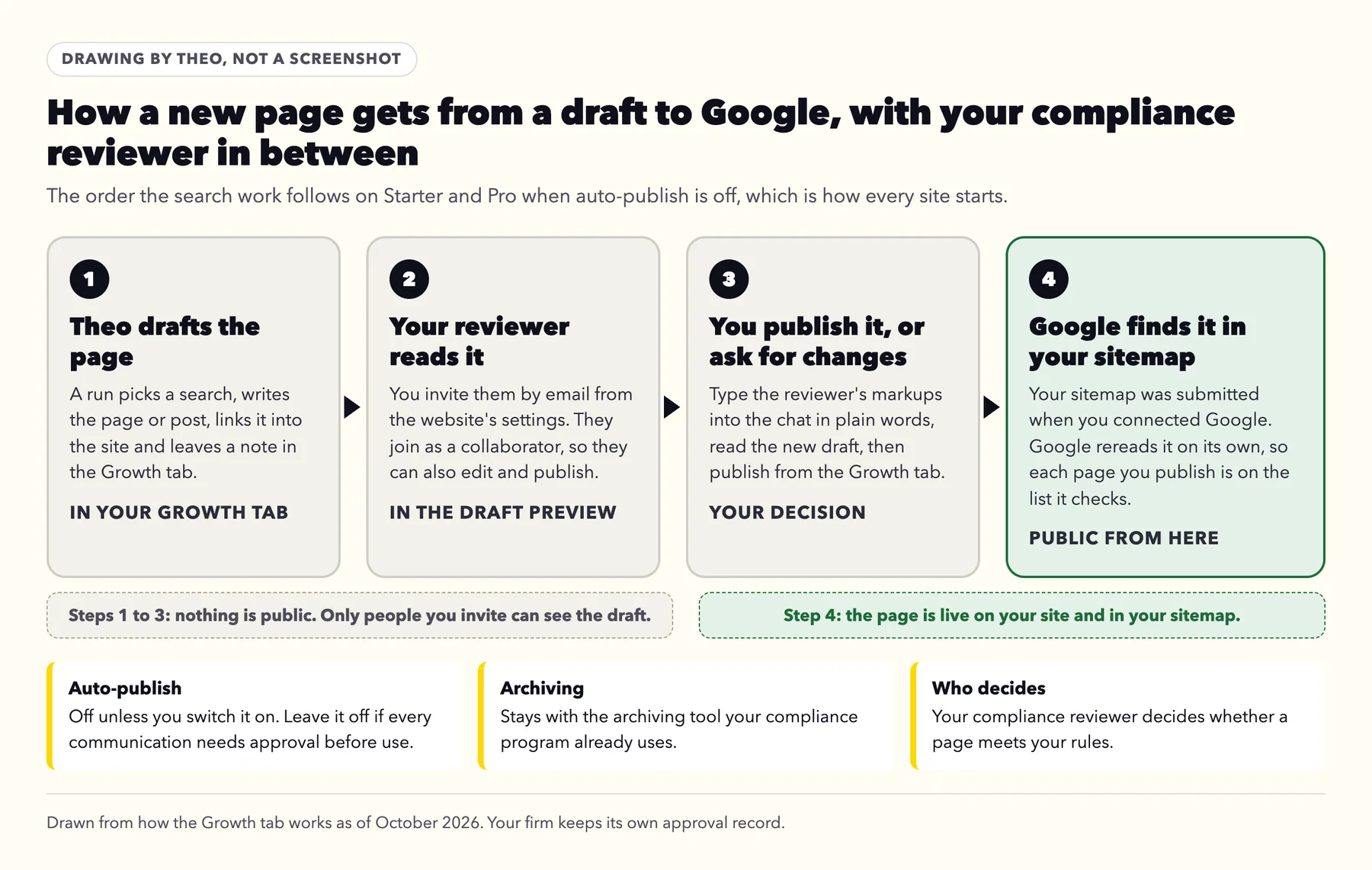
For an advisory firm, the hard part of SEO is seldom the writing. Every new page is a communication with the public, and someone at the firm has to be able to read it before a prospect does. The search work on Theo keeps that order, in four steps.
Theo drafts. A run picks a search, writes the page or post, links it into the site and leaves it in your Growth tab with a note on what it did.
Your reviewer reads the draft. Invite your compliance officer by email from the website's settings. They join as a collaborator who can read, edit and publish; only you manage billing, invite or remove people, and delete the site. There is no separate reviewer role, no read-only seat and no approval record inside Theo.
You publish, or send it back. Type the reviewer's markups into the chat in plain words, read the revised draft, then publish it from the Growth tab.
Google finds it in your sitemap. On every plan, connecting Google also submits your sitemap through Search Console, Google's free tool for site owners, and Google rereads it on its own, so each page you publish is on the list it checks.
A drawing of the order the search work follows when auto-publish is off. It is not a screenshot.
What stays with your firm
Auto-publish is off unless you switch it on. Leave it off if your procedures say a person approves each communication before use. Archiving stays with the archiving tool your compliance program already uses. Your reviewer decides whether a page meets your rules.
Two rules sit behind that review step. This is what a compliance officer will check as of October 2026, and it is not legal advice:
Investment advisers registered with the SEC must keep a copy of each advertisement they disseminate, under Rule 204-2. Your compliance officer decides which new pages that covers.
FINRA member firms and their reps: Today FINRA Rule 2210 requires a principal to approve retail communications before use; a July 2026 FINRA proposal (Regulatory Notice 26-14) would replace that with risk-based supervision and is not final as of October 2026.
What people search before they call a financial advisor
Prospects rarely type a firm's name into Google. They type a fee question, a retirement date, a life event or a town. Each part below pairs real searches with the kind of page that answers them, and shows that page on an advisor site Theo built. Every number is Semrush's for the US, checked on October 18, 2026: average searches a month over the past year, and difficulty, a score from 0 to 100 where a lower number means fewer strong pages already compete.
Set your hopes by the kind of search. Town searches are where small firms' own pages do reach the first page. On October 19, 2026, four of Semrush's US top ten for "financial advisor fort wayne" were local firms' own sites, next to national firms' locator pages, directories and a forum thread. Client-type searches are harder: the top ten for "financial advisor for business owners" was mostly large advisory firms, banks and publishers. The national questions, such as what an advisor costs, are long shots: big publishers and a forum held the top three. Both still earn a page: a prospect who finds you through a town or client-type search reads those answers next, even if the page never wins the national question.
Fees: one page that says how you are paid
A fee page answers both of these searches when its first lines say who pays the firm and how much. Quillby Financial Planning, a flat-fee planner's site built by Theo, puts three numbers side by side: what it costs to start, each month, and on accounts it manages.
Search
Searches a month
Difficulty
The page that answers it
how much does a financial advisor cost
4,400
35 of 100
A fee page that says how you are paid in its first lines
financial advisor fees
2,900
30 of 100
The same fee page
Built by TheoQuillby Financial Planning's fee page. See the live page
Retirement timing: a page for people close to retiring
People within a few years of retiring search the question itself. Ambleworth Retirement Planning, a fee-only planner's site built by Theo, gives its Retiring soon page one heading per question, each answered in a few plain sentences.
Search
Searches a month
Difficulty
The page that answers it
can i retire at 62
1,900
39 of 100
A retiring-soon page that asks the question as a heading
Business owners: a page for the client you want more of
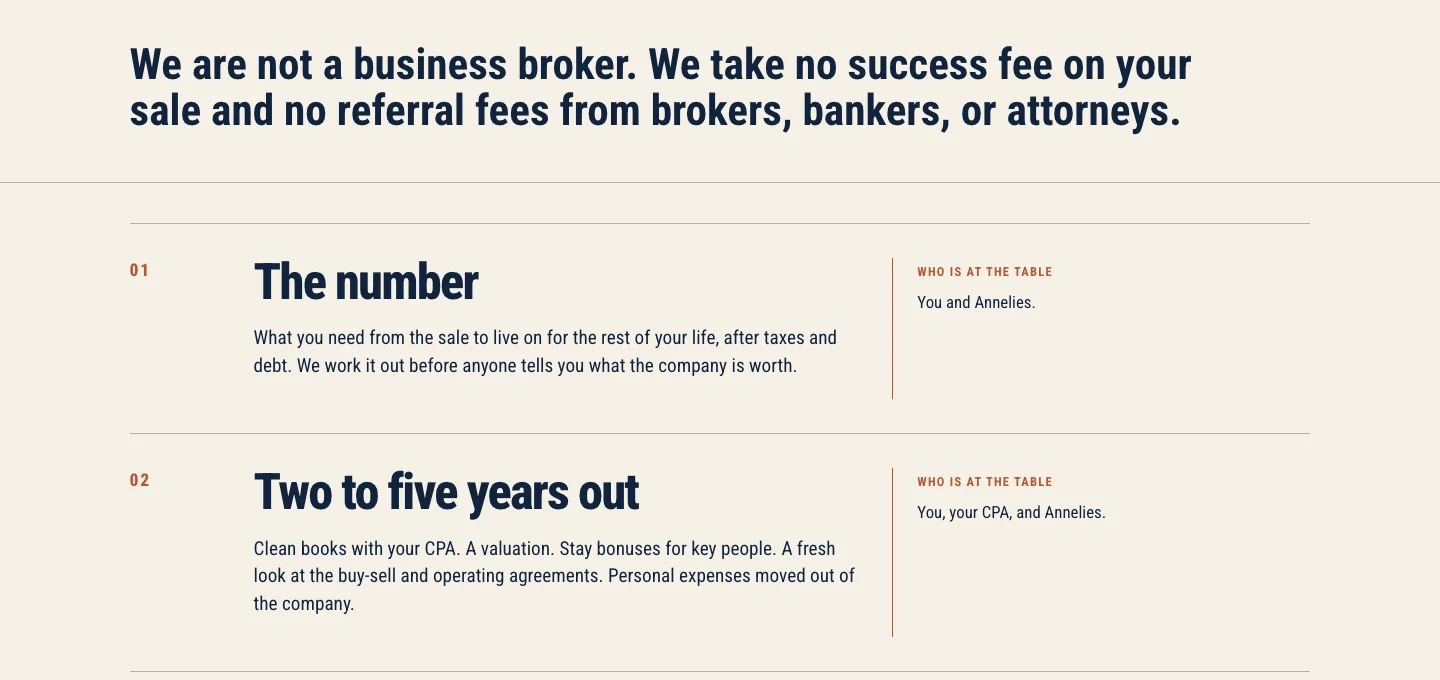
A page written for one kind of client answers the searches that name that client. Teversham's Before the sale page, on the same site as the runs above, lays out the planning from the owner's personal number to the first year after closing, and says who sits at the table at each stage.
A life event: a page for the moment a prospect is in
A divorce, a death in the family or an inheritance sends people searching in a hurry. Wrenholt Financial Planning, a divorce planner's site built by Theo, opens its During your divorce page with the four steps it takes, in order.
A profession you serve: one line on a bio can start it
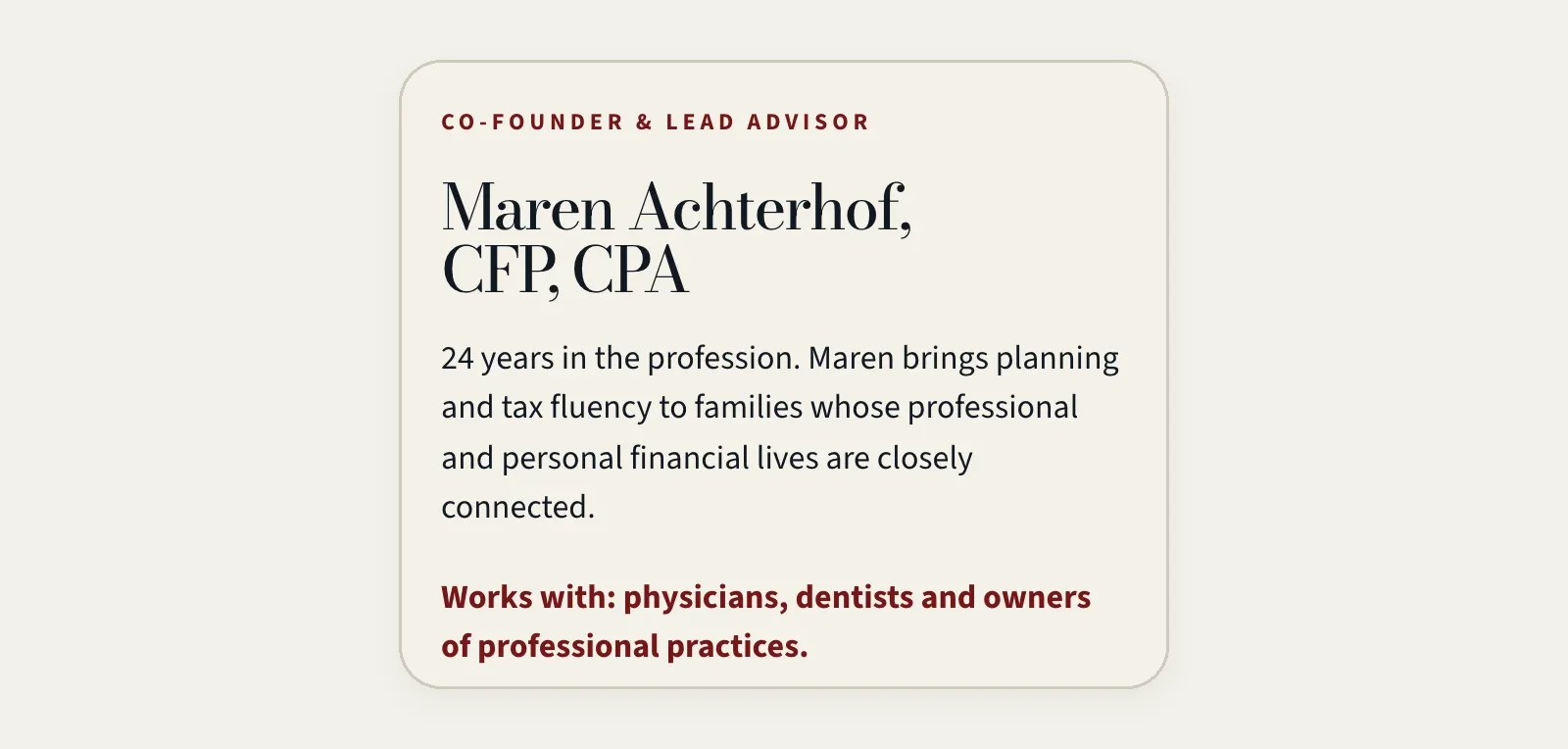
Some client types are small enough that a line on an advisor's bio answers the search before a whole page is worth writing. Rookwell Wealth Partners, a four-advisor firm's site built by Theo, ends each bio with who that advisor works with.
Search
Searches a month
Difficulty
The page that answers it
financial advisor for doctors
260
18 of 100
A Works with line on a bio, then a page of its own once the firm wants more of these clients
financial planner for physicians
140
4 of 100
The same bio, or that page
Built by TheoA bio on the Rookwell advisors page, on a phone. See the live page
Your town: the place, in plain words
Town searches are small and close to a decision. The run above put Fort Wayne in the new page's title, and Teversham's home page names the town where it says where the first meeting happens.
Search
Searches a month
Difficulty
The page that answers it
financial advisor fort wayne
210
19 of 100
The home page and the service page with the town in its title
financial advisor fort wayne indiana
90
14 of 100
The same pages
Built by TheoThe first meeting section of Teversham's home page. See the live page
Check that a search exists before writing for it
Long, specific phrases can look like easy first pages. Checked in Semrush on October 18, 2026, the six below showed no measurable monthly searches in the US, while the plain town searches beside them did. So check that a search exists before writing a page for it; the plain town or client-type search is the surer first page. The search work looks up the numbers before it writes.
Search
Searches a month (Semrush, US)
fee-only financial planning for tech founders in austin
No measurable monthly searches
personalized retirement advice for houston business owners
No measurable monthly searches
financial planning for tech employees in silicon valley
No measurable monthly searches
how much should i save before selling my business
No measurable monthly searches
wealth preservation strategies for doctors
No measurable monthly searches
financial planning for gen x parents
No measurable monthly searches
financial advisor austin
1,000, difficulty 15 of 100
financial planner houston
880, difficulty 32 of 100
SEO advice that runs into the rules
Most SEO advice is written for any small business. A handful of the usual tips need a second look at an advisory firm, because they touch the rules your compliance officer works under. This is what that officer will check, as of October 2026; it is not legal advice. The site-side rules, such as where Form CRS and the BrokerCheck link go and how testimonials are shown, are on the page about financial advisor website design.
The usual tip
The rule it runs into
What to do instead
On Theo
Ask every happy client for a Google review
For SEC-registered advisers, the Marketing Rule allows client testimonials in advertising only under conditions, starting with clear disclosures of whether the person is a current client and whether they were paid; how a firm asks for, quotes or links to reviews can bring them under it. FINRA Rule 2210 sets its own testimonial disclosures for broker-dealer reps. NASAA's model amendments of May 4, 2026 allow testimonials for state-registered advisers only in states that adopt them.
Ask compliance before you ask any client.
Theo never invents a review. If real reviews of your firm are on your current site, your Google listing or elsewhere online, the rebuilt draft may carry them over, and your reviewer sees them before anything is public. Tell Theo in chat to remove them, or to add the disclosure compliance gives you.
Swap links with your CPA and estate attorney
Google's spam policies name excessive link exchanges, the "link to me and I'll link to you" kind, as an example of link spam.
Link to a referral partner when the link helps your reader, never as a trade.
The search work links pages within your own site; it does not arrange link swaps.
Refresh old posts and publish them again
A revised page is a new version of a communication, so it goes through the same review and recordkeeping as the first.
Send each update through review, and archive the new version.
Updates from the search work wait in the Growth tab, just like new pages.
Use AI to write posts faster
A draft written with software is still the firm's communication, held to the same rules as one typed by hand.
Read it like any other draft.
Theo writes its drafts with AI, and every one waits in the Growth tab until you publish it.
Show results, case studies and top-rated badges
Performance figures and third-party ratings carry the most conditions under the Marketing Rule; a rating needs, among other things, its date and the name of whoever produced it.
Leave them off unless compliance asks for them and supplies the wording.
The rebuild carries over real awards, ratings and press mentions it finds on your current site or elsewhere online; your reviewer sees them in the draft, and one line in chat removes them or adds compliance's wording.
Put strong words in titles: fiduciary, fee-only, independent, guaranteed, safe, protect
Each one is a claim the firm may have to back up, and some are off limits for some firms.
Let compliance decide each word, page by page.
The Teversham drafts were read for these words before publishing, as described in the run section above.
The map listing and your website do different jobs
The biggest advisor searches are the broad and near-me ones. Semrush estimates, for the US in October 2026, 165,000 searches a month for "financial advisor", 110,000 for "financial advisor near me" and 12,100 for "financial planner near me" (difficulty 71, 64 and 65). Google answers those mostly with the map, which runs on Google Business Profiles, and Google says local results are mainly based on relevance, distance and popularity. Your website backs the listing up, and it is what shows for the questions, client types and towns above.
Advisors often mix up which Google product does what. Here is each one, and who handles it when your site is on Theo.
Where it shows
What it is
On Theo
Search results
The list of pages under the search box. This is what SEO works on.
The search work on Starter and Pro.
The map
Your Google Business Profile: name, category, hours, address or service area, photos and reviews.
The Boost checklist walks you through it, in your own Google account.
Ads
Google Ads, paid by the click and marked as sponsored.
Separate from the search work.
Search Console
Google's free report on how your site shows up in search, and the source of Google's emails about your pages.
Theo connects it after you sign in with Google once.
AI Overviews
The summary above the results, with links to pages it drew on. Google says a page must be indexed and able to show a snippet to be linked there.
Part of the same search work, with no add-on.
If you meet clients only by video
Google's Business Profile eligibility guidelines say that to qualify, "a business must make in-person contact with customers during its stated hours", and they list online-only businesses as not eligible (read on October 18, 2026). A firm that meets every client by video may not qualify for the map at all, so its pages do the work: a page on how meetings happen, a page for each kind of client, and a line naming the states where the firm is registered. Semrush estimated 390 US searches a month for "virtual financial advisor" on October 18, 2026, difficulty 27 of 100.
Built by TheoQuillby's How video meetings work page, for a firm that meets families by video. See the live page
Keep the details the same everywhere
Google's Business Profile guidelines say the profile name should reflect the firm's real-world name, "as used consistently on your storefront, website, stationery" (read on October 19, 2026). So use the same name, address and phone number on the site, the listing and every directory. Your professional association's directory, such as NAPFA's or the CFP Board's, is one more place to keep matching.
Google counts financial planners as individual practitioners. When several advisors meet clients at one office and each can be reached there during stated hours, each can have a profile separate from the firm's, named for the advisor alone. An advisor who is the only one meeting clients at an office and represents a branded firm shares one profile with that firm, named in the form brand: advisor name. One profile per advisor, never one per specialty.
What SEO for a financial advisor covers, and who does each part
Advisor SEO is a set of small jobs. Each one makes it a little easier for Google to see what the firm does and where, and a little easier for a careful prospect to book a first call.
The work
What it means for an advisory firm
On Theo
Research
Finding the words prospects use, such as a fee question, a client type or a town, and how hard each search is to win.
Theo does it on Starter and Pro.
Client-type and service pages
A page for each kind of client you take and each service people search for, such as retirement income, a business sale or divorce planning.
Theo drafts them, your reviewer reads them, and you publish.
Town pages
A page, or a clear line, for each town or state you serve.
Theo drafts them for your review.
Question posts
Plain answers to what prospects ask before a first call.
Theo drafts them for your review.
Bios and bylines
Designations, years in the work, who each advisor works with, a link to their public record, and the advisor's name on every post.
You supply the facts and the record links; Theo puts them on the page.
Technical fixes and speed
Fixing what stops Google reading the site, and making pages open fast on a phone.
Theo does it on Starter and Pro.
Getting pages into Google
Submitting the sitemap through Search Console once, so Google rereads it on its own and each new page is on the list it checks.
Theo does it on every plan, once Google is connected.
Business Profile and directories
The map listing and the other listings prospects check, such as Apple Business Connect and Bing Places, plus your professional association's directory.
The Boost checklist walks you through the main listings; the association directory is yours to update.
Reviews
Only as compliance allows.
Your compliance officer decides. Theo never invents one, and any real reviews the rebuild brought over sit in the draft until your reviewer keeps or drops them.
Reporting
A record of every page added and every fix made, next to Google's own numbers.
A weekly email for your files, and the Growth and Analytics tabs for detail.
If you do it yourself
A firm not on Theo can do the basics by hand. Each step below rests on Google's own help pages, read on October 19, 2026.
Name the client and the town. Put them in each page's title and first lines. Google's SEO Starter Guide says a good title "is unique to the page, clear and concise, and accurately describes the contents of the page".
Link every new page from one Google already knows, such as the home page or the menu. Google says it "primarily finds pages through links from other pages it already crawled".
Check speed on a phone in Search Console's Core Web Vitals report, which shows how pages perform for real visitors, on phones and computers separately, once a site has enough visits to report on.
Reread older posts, starting with any that have a past year in the title. Google's guide says to "check in on previously published content and update it as needed, or even delete it if it's not relevant anymore". At an advisory firm, each update goes back through review.
Bios a prospect and Google can both check
Google says its systems give even more weight to content showing strong experience, expertise, authoritativeness and trust on topics that could affect people's financial stability. On an advisor's site, that comes down to two things a careful prospect checks anyway: a bio that names designations, years in the work and who the advisor works with, and a link to the advisor's public record, such as FINRA's BrokerCheck or the SEC's adviser search. Put the advisor's name and designation on every post as well. The post on building trust on a website covers the rest.
Built by TheoA bio on Fairhollow's advisors page that ends on a link to FINRA's BrokerCheck. See the live page
Your part, your reviewer's, and Theo's
You do not write the pages. What is left for you is brief, and most of it is done once.
Once: invite your compliance reviewer from the website's settings so they can read the rebuilt site. When they approve it, connect your domain and sign in with Google so Theo can set up Analytics and Search Console. The search work starts after Google is connected, so it pays to do this early in the free 30 days of Starter.
Each week: you and your reviewer read what is waiting in the Growth tab, then publish what passes.
Whenever something changes: tell Theo in plain words about a new client type, town, designation or advisor, and drag new photos into the chat.
For reviews: follow your compliance officer's rules on whether, when and how to ask.
How long financial advisor SEO takes
Search traffic builds over months, not weeks. Google's own guidance on hiring an SEO puts the payoff at four months to a year. That guidance is Google Search Central's video How to hire an SEO.
The first sign comes sooner. Once Google indexes a new page, Search Console starts counting impressions, the times it appears in results; clicks follow as pages move up. Google takes its time with new pages on every site, and the guide to Discovered - currently not indexed shows what that wait looks like. Allow time for your firm's review before each page is published. To check whether Google has your pages at all, the post on getting Google to index a site walks through it.
Theo shows you the work: every page, post and fix in the Growth tab, the weekly email that counts what was added, and Google's clicks and impressions in the Analytics tab.
How to read an SEO pitch to your firm
Most advisory firms hear from SEO sellers often, by email, phone and LinkedIn. One pitch owners have forwarded to Theo carried the line "Are you not in AI searches??" next to a screenshot of a score of zero from a third-party tool. The guide to whether SEO is worth it for a small business takes that email apart line by line. The rest come in a few familiar kinds.
What the pitch offers
What to ask
A promise that every client ranks on page one
Google's page Do you need an SEO? says no one can guarantee a top ranking on Google. Ask what they will do each month, and to see last month's pages and fixes for another client, with links.
A score saying your firm is invisible
A third-party tool's score is not Google's view of your site. Ask which searches it measured, then look them up yourself in Search Console.
Exclusive leads in your area
That is buying leads, not building your own site's place in search. Ask what your site keeps when you stop paying.
A set number of reviews
For an advisory firm, any review program goes through compliance first. Ask exactly how reviews would be requested, and show the answer to your compliance officer.
Hundreds of links for a monthly fee
That same Google page says to avoid SEOs that talk about link popularity schemes. Ask where each proposed link would appear and why that site matters to your firm's prospects.
Questions for anyone who will work on your site
Before you sign with anyone, ask these four questions and keep the answers in writing.
Will my compliance reviewer see each page before it goes live?
Who owns the site, the pages and the domain if I leave?
Is there a contract term, and what does it cost to stop?
Will you show me every change you make? Google suggests asking exactly that, and says you are responsible for the actions of any company you hire.
What outsourced SEO costs, next to Theo
Outsourced SEO for advisors is usually sold as a monthly retainer, often on a fixed term and for the SEO alone. On Theo, the search work comes with the site and hosting: Starter is $69.99 a month and free for the first 30 days, and Pro is $129.99 a month.
Moving your site, or renaming your firm
Theo does the search work on a site it builds and hosts, so a firm with a site elsewhere starts by moving. Paste the current address and Theo rebuilds the site as a starting draft in the look your clients know. Your reviewer reads the rebuilt site before anything is public, and the old site stays up until your domain points at the new one.
A firm leaving a broker-dealer or an advisor-marketing platform can have the new site drafted and approved while the paperwork is under way, and publish it once the new registration and disclosures are final. After Search Console is connected, SEO repair on Starter and Pro forwards old addresses that still get search traffic to their matching new pages, and on any plan Theo adds a forward you ask for in chat. The post on what happens to rankings when you move a website covers the move, and the one on redesigning without losing SEO covers the old addresses.
Google often sends an email or two afterward, listing reasons some pages are not indexed, such as Page with redirect. That is good news. It shows Google is crawling the site, and on a site that just moved, most of the list is the old addresses forwarding to the new ones, as they should. Theo's SEO repair, part of the search work on Starter and Pro, pulls those reasons from Search Console and handles them. The guide to Search Console emails explains each reason in plain words.
A new name on Google Business Profile
A new firm name is a separate matter on the map listing. Google's guidelines treat a minor name change, where the proper nouns, the services named and the category stay the same, as a rebrand you make by editing the profile. A firm with more than one location can also rebrand by editing the name. Any other new name, at a single-location firm, counts as a new business: Google says to mark the old profile as closed and create a new one under the new name.
A name edit outside those rules can come back refused, with a notice that reads "Violated policy: Business identity changed". You can appeal it, but the surer path is the one Google's guidelines describe. On Theo, the new name on the website is one line in chat.
FAQ
Questions financial advisors ask about SEO
How much does SEO for a financial advisor cost on Theo?
The search work comes with two plans. Starter is $69.99 a month, free for the first 30 days, and Pro is $129.99 a month with more new pages and posts each week. Both include your firm's website and hosting, so there is no build fee or separate hosting bill. Basic is the site and hosting without the search work.
How long until my firm shows up on Google?
Search traffic builds over months, not weeks. Google's own guidance on hiring an SEO puts the payoff at four months to a year. The first sign is earlier: Search Console starts counting impressions once Google indexes a new page. Your firm's approval process sets when each draft can go live, and every page and fix shows in your Growth tab.
Who owns the site, and can I cancel?
Your firm owns the pages, bios, disclosure wording and photos, and Theo hosts them. Pro adds read-only access to the site's code on GitHub. You can cancel at any time, with no contract term. When you cancel, the confirmation tells you the last day of the plan, and the site stays up through that day. Save any text and images you want first.
Can Theo do SEO on the site I already have?
No. The search work runs on a site Theo builds and hosts, so it can write, link, fix and publish each page itself. Theo rebuilds your current site from its address as a starting draft, and your old site stays live until your domain points at the new one. Moving your site, above, covers how your reviewer reads the rebuild.
Will my compliance officer see every page before it goes live?
Nothing the search work drafts goes live until you publish it, so your reviewer can read every page first; auto-publish stays off unless you turn it on. Invite them by email from the website's settings. They join as a collaborator, which means they can also edit and publish. There is no separate reviewer role or approval record in Theo, so keep your review records and your archive in your own tools.
My broker-dealer only allows approved website vendors. Can I still use Theo?
Ask your compliance department first. If your broker-dealer keeps a list of approved vendors and Theo is not on it, the list wins. If a principal must approve each page before use, keep auto-publish off and have the principal publish each draft from the Growth tab.
Can I ask clients for Google reviews?
It depends on how your firm is registered, so ask compliance before you ask any client. SEC-registered advisers follow the Marketing Rule's conditions for testimonials, broker-dealer reps follow FINRA's rule and their firm's policy, and state-registered advisers follow their state. Theo never makes up a review, but a rebuilt site may bring over real ones from your current site, your Google listing or other review sites, so your reviewer will see them in the draft before it is public. Ask in chat and Theo takes them out or adds the disclosure your compliance officer wants.
Does the search work cover AI answers like ChatGPT and Google AI Overviews?
Yes, on Starter and Pro, with no add-on. The work includes steps toward being cited in AI search tools such as ChatGPT and Google AI Overviews. Google's rule for AI Overviews is the same as for search: a page must be indexed and able to show a snippet before it can appear as a link there.