Website design for law firms

Law Firm Website Design

Theo builds a law firm website around your practice areas, attorneys and counties, and around your bar's advertising rules: the Attorney Advertising label, the notice beside past results and a consultation form that leaves the case details for the call. The site and its hosting are $29.99 a month on Basic, and Starter adds the ongoing search work at $69.99 a month, free for the first 30 days.

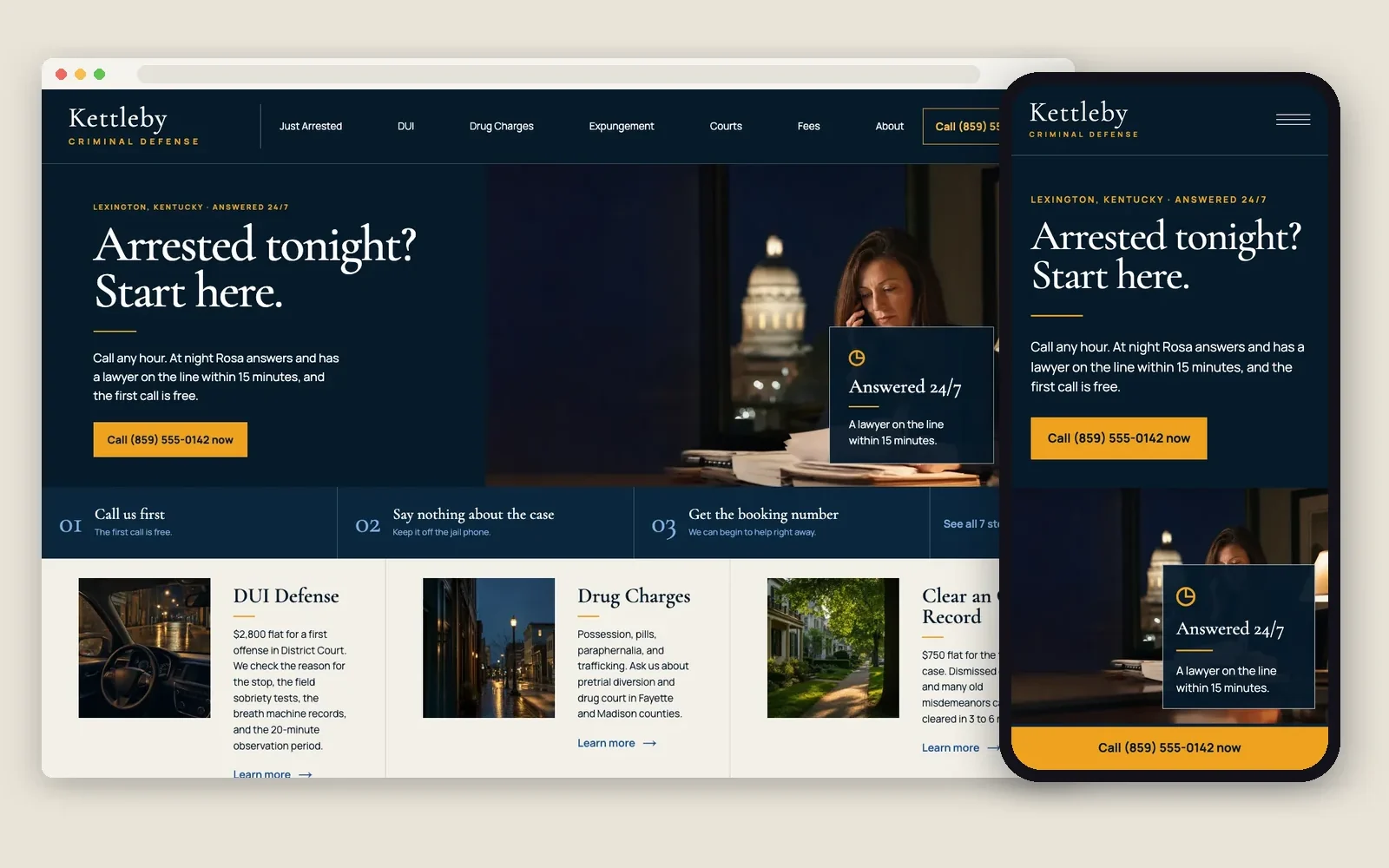
Kettleby Criminal Defense home page on a computer and a phone, built by Theo
  • Your bar's notices placed where it expects them: the advertising label, the results line, the form warning
  • One page per practice area, named the way a client searches: DUI defense, green card through marriage, wills and trusts
  • Attorney bios that open with bar admissions, courts and languages, kept current from a chat
  • A consultation button that opens the scheduler or intake tool the firm already runs

Law firm web design that earns the call starts with the first screen: the matters you take and the county you take them in, a number that dials and a consultation button beside it. Good lawyer website design then gives each practice area its own page, lists every attorney's bar admissions, says what the first consultation costs and places the notices your bar requires where it expects them. Theo writes and builds that site from a conversation about your firm and hosts it on Basic for $29.99 a month. Starter, $69.99 a month and free for the first 30 days, adds the ongoing search work, and Pro is $129.99 a month. The first build is free, and three law firm sites Theo built sit just below.

In Theo's audit of 6,861 small business websites, 53 percent of the 532 professional services sites with search data got an estimated zero visitors a month from Google search, and 74 percent got fewer than ten. See the research.

What the site needs

What a law firm website needs

A prospective client is usually in trouble, on a phone and reading in a hurry. Before calling, they want three things settled: does this firm take my kind of matter, who will handle it, and what does the first step cost. Each point below is one job the site has to do, set beside a page from one of the firm sites above that does it.

Ellingsrud Family Law home page, built by Theo: Des Moines Family Law above the headline, divorce, custody and child support named under it, the counties served in a strip below, and a Request a confidential consultation button
Built by TheoEllingsrud Family LawDes Moines sits above the headline, divorce, custody and child support right under it, and Polk and Dallas counties in the strip below the photo.See the live site
01

Name the matters and the county on the first screen

Open on what the firm handles and where, in words a client would repeat.

Write 'Criminal defense and DUI in Fayette County', not 'zealous advocacy for your rights'. Around that line go a number that dials with one tap and the hours someone answers, a consultation button that says what it opens, the languages spoken, a real photo, and the Attorney Advertising label where your state requires one.

Kettleby sets 'Lexington, Kentucky' and 'Answered 24/7' above its headline. Ellingsrud names divorce, custody and child support right under its own. Wexcombe Estate Planning puts home visits across SLO County in the strip under its photo.

Lines to adapt, if they are true of your firm: 'Divorce, custody and child support for families in Polk and Dallas counties.' 'Wills, trusts and powers of attorney in San Luis Obispo County, for flat fees, with home visits when you cannot come in.' 'Hurt in a crash in Travis County? Ask for a free case review,' with the fee line your state requires beside it.

Name each button for what it opens: 'Book a consultation' for a scheduler, 'Request a consultation' for a short form. Leave 'Contact us' and 'Submit' off the page.

Kettleby Criminal Defense DUI page, built by Theo: first, second and third offenses side by side, each with its fine, jail range, license suspension and the firm's fee, then a box on how an ignition interlock license works
Built by TheoKettleby Criminal DefenseThe DUI page lays out what a first, second and third offense can carry, then explains the ignition interlock license that can keep a client driving.See the live site
02

Give each practice area its own page, named the way clients search

Each matter the firm wants more of gets a page titled in the words a client types.

Divorce, DUI defense, expungement, green card through marriage, wills and trusts: each is a page of its own. Related matters nest under a parent, the way Ellingsrud's divorce, custody and support pages sit under Family law.

A practice page opens with its scope in one line, then covers what the matter involves, what the firm checks, how the fee works, which courts or counties, who handles it and what the firm refers out. It ends on the call or consultation button.

Kettleby's DUI page shows the depth a client wants: what a first, second and third offense can carry, how an ignition interlock license keeps you driving to work, four things the firm checks in every case and the six District Courts it appears in.

Around those pages, a small firm usually starts with home, a page per attorney, fees and the first consultation, what happens after you call, client questions, contact with parking and the nearest courthouse, and privacy. Add a county page only where the firm really appears. Each of the three sites above has ten or eleven pages.

Wexcombe Estate Planning first meeting page, built by Theo: a What to bring list, then We come to you, on home and hospital visits anywhere in San Luis Obispo County
Built by TheoWexcombe Estate PlanningFor an estate planner, the first-meeting page carries the load: what to bring, then home and hospital visits, with grown children able to join by video.See the live site
03

Put first what your kind of practice needs most

The pages are much the same from one practice to the next; what changes is which page does the heavy lifting.

Criminal defense and DUI: the call, with honest hours, and a page on what to do after an arrest.

Family law: a confidential consultation, a form that asks only what a conflict check needs, and how long an uncontested divorce takes in the county.

Immigration: the languages beside the button, consultations by video, and the consultation's length and cost.

Estate planning: flat-fee packages with what each includes, what to bring, and whether you make home visits, often for a client in their seventies or a grown child helping them.

Personal injury: the free case review and the contingency fee, in the words your state requires, side by side.

General practice, business and real estate: a page per matter, flat fees where they apply, and a plain line on what the firm refers out.

Kettleby Criminal Defense about page, built by Theo: a row each for the two lawyers, the night-line paralegal and the investigator, then a credentials band with each lawyer's bar membership and year of admission
Built by TheoKettleby Criminal DefenseEach lawyer's row opens on the work before this firm, and a band below lists the bar admissions with their years. Rosa, who answers the night line, has a row of her own.See the live site
04

Lead each attorney bio with bar admissions

A careful client checks admissions first.

So the bio opens with one line on what the attorney handles and where, then each state with the year of admission, the federal courts, the law school, the languages and the work before this firm.

Ellingsrud gives one line per admission: Karin in Iowa in 2003, Desmond in 2020. Kettleby gives each lawyer's earlier work, nine years as a public defender for one and six as a prosecutor for the other, which tells a client more than 'aggressive' ever could.

The person who answers the phone gets a short entry too, so a caller knows who will pick up. When an associate joins or a partner retires, the change is one line in chat.

Ellingsrud Family Law fees page, built by Theo: three flat fees in large type, each attorney's hourly rate and the starting retainer for contested matters, and a band giving the first consultation's length and cost
Built by TheoEllingsrud Family LawThree flat fees, then the hourly rates and the starting retainer, then the first meeting: 60 minutes, in person or by video, credited toward a flat fee.See the live site
05

Say what the first meeting costs, how you bill and what happens after the call

State the first consultation's cost, its length and whether it is credited to the fee.

Then give each way you bill a line: a flat fee names the package and what it leaves out, such as filing fees; hourly work names the rate and the retainer held in trust; contingency gives the share and how case costs are handled, in your state's words.

Then walk a nervous caller through what comes next: who answers, what they will be asked, the conflict check and why it comes first, and whether the consultation is in the office, by phone or by video.

Ellingsrud sets three flat fees in large type, then each attorney's hourly rate and the starting retainer, and says above its form that the firm checks it has never acted for the other person, then calls within one business day. Wexcombe Estate Planning sets its two packages side by side and walks through five steps, from the free first meeting to a call 60 days after signing.

Ellingsrud Family Law contact page, built by Theo: Start with a conflict check, a request to share nothing about the case yet, an If you are in danger, call 911 box, and the first form fields
Built by TheoEllingsrud Family LawBefore a single field, the page asks for nothing about the case, explains the conflict check, and says: if you are in danger, call 911.See the live site
06

Keep the consultation form short, and say it makes no one a client

A form that invites the whole story can do harm.

ABA Formal Opinion 10-457 (2010), on lawyer websites, explains that a site inviting details of a possible matter can make the sender a prospective client under Model Rule 1.18, with duties that can keep the firm from acting for the other side.

So ask only what starts the conversation: a name, a phone, an email and one line on the kind of matter, or, for family law, the names a conflict check needs. Above the Send button, say so: 'Please leave the details of your case for the call. Sending this form does not make you our client; we check for conflicts first.'

Ellingsrud's form has no box for the story, and a line above it reads 'If you are in danger, call 911.' Theo's forms take text, email and phone fields and send each request to up to five inboxes. Conflict checks and retainers stay in Clio, MyCase or whichever tool the firm runs. Check your own state's rules on website inquiries too.

Kettleby Criminal Defense footer on a phone, built by Theo: the office address, email and hours, then a line saying the site is general information, calling does not make you a client, and past results do not guarantee an outcome
Built by TheoKettleby Criminal DefenseOn a phone, the foot of every page carries three notices under the address and hours, in type you can read without zooming.See the live site
07

Put each notice where your bar expects it

Every state bar regulates lawyer advertising, and a website counts. Four placements cover most of it.

The Attorney Advertising label, where your state requires one: at the top of the home page or in every footer.

The notice beside a past result or a review: right beside it, in the same size type, not on a disclaimer page nobody opens.

The line about the form: above its Send button.

The general-information line: under articles and in the footer, with the lawyer or firm responsible for the site, which ABA Model Rule 7.2 asks lawyer advertising to name.

The firm supplies its state's wording and Theo places it in type a reader can see on a phone. When a rule changes, rewording a notice is one sentence in chat.

Checking the site against your state's rules stays with the firm, and your bar's ethics line is the place to ask.

Wexcombe Estate Planning about page on a phone, built by Theo: Claire's story, then a small credentials line with her State Bar of California license and the words Certified Specialist in Estate Planning, Trust and Probate Law
Built by TheoWexcombe Estate PlanningThe credentials line under Claire's story says Certified Specialist but names no certifying body. On your own site, one line in chat adds it before you publish.See the live site
08

Treat reviews, results and the word specialist with care

Three things carry rules of their own: past results, reviews and the word specialist.

Past results: only in the form your bar allows, with its notice beside each one, never as a running total of dollars recovered.

Reviews: real ones, quoted as written with the client's permission, or a link to your Google reviews. Never a made-up star rating, and never a review bought with a reward for praise, which the FTC's rule on consumer reviews also bars (16 CFR Part 465).

Specialist: ABA Model Rule 7.2(c) lets a lawyer claim certification as a specialist only when the certifying organization is clearly named, and some states add conditions of their own.

Wexcombe Estate Planning's credentials line calls Claire a Certified Specialist without naming the certifying body. On your own site, one line in chat adds it before you publish.

Kettleby Criminal Defense Just arrested page, built by Theo: What to do now, seven numbered steps from Call us first to Raise the license issue right away
Built by TheoKettleby Criminal DefenseJust arrested walks a family through the night in seven steps, from calling first and saying nothing on the jail phone to the bond and the arraignment.See the live site
09

Inside the criminal defense site, and what we typed to build it

Kettleby began as a written description of a two-lawyer firm, much as an attorney would brief a new paralegal.

One line from it, word for word: 'The phone number is a tap-to-call button beside the steps, and on phones it stays pinned to the bottom of the screen.' Theo built a starting draft from it, and the site then got four rounds of changes typed in chat.

The result has ten pages. Just arrested lays out seven steps for the night of an arrest, including that calls from the Fayette County Detention Center are recorded, except calls to a lawyer, and that Kentucky does not allow bail bond companies, so bond goes to the circuit clerk. Courts lists all twelve District and Circuit Courts by county seat. Fees puts every flat fee on one page and says the payment plans carry no interest. About gives the year each lawyer was admitted.

Every footer carries three notices: the site is general information, not legal advice; calling does not by itself make you a client; past results do not guarantee a similar outcome. There is no form anywhere, because this firm wants the call.

Kettleby Criminal Defense home page on a phone, built by Theo: Lexington, Kentucky and Answered 24/7 above the headline Arrested tonight? Start here., a call button, and a call bar across the bottom of the screen
Built by TheoKettleby Criminal DefenseQuestions 1 and 2 pass on this phone screen: the city and the hours sit above the headline, and a call bar runs along the bottom.See the live site
10

Check your firm's own site in ten minutes

Open the site on your own phone and answer each question.

1. Does the first screen name your matters and your county before any slogan?

2. Does the number dial with one tap, beside hours when someone answers?

3. Does the consultation button land in your scheduler or intake tool? Send yourself a test request.

4. Does the form ask four or five things at most, and say to leave the case details out?

5. Does each matter you want more of have its own page, named the way a client says it?

6. Does each practice page name the courts or counties, and what the firm does not take?

7. Does each bio list bar admissions with years, courts and languages, with a photo from this decade?

8. Are departed attorneys and old suite numbers gone everywhere? Search the site for the old address.

9. Are the first consultation's cost and length stated, and the fee basis explained?

10. Do results, reviews and any specialist claim carry the notice your bar requires?

11. Can you read every required notice on the phone without zooming?

12. Does the site load before you count to three on phone data?

For what a phone cannot show, such as estimated visits from Google search, the free audit reads the site with no login.

Wexcombe Estate Planning home page on a phone, built by Theo: Book a free meeting at the top, the headline Plan now, spare your family the court process., and wills and living trusts for Central Coast families under it
Built by TheoWexcombe Estate PlanningThe last question, answered: Wexcombe Estate Planning's home page on a phone, and the link below opens the live site to tap through as a client would.See the live site
11

Eight questions to ask any law firm website company

Ask these of anyone, Theo included. Theo's answer follows each one.

What does it cost each month, all in? The prices are on the pricing page, with a free first build, no setup fee and no term contract.

Who writes the practice pages and bios? Theo, from one conversation; your time goes into reading them.

How do I change a bio or add a page? Type it in chat, paid from the plan's monthly chat credits.

Who places the bar's notices, and who rewords them? You supply the wording; Theo places it and swaps it when you paste a new version.

Who owns the domain and the words? The firm does, and the text and images are yours to save if you leave.

What if something breaks the night before a hearing? The site is static pages over HTTPS with no plugin to break, and the team answers at team@theo.site.

Where does the consultation button go? Wherever you point it.

Can I open one of your sites on my phone right now? The three sites above open live.

Who this is for

For solo and small firms that want the site handled

Theo builds for the solo practitioner and the firm of two to ten attorneys in family law, criminal defense, immigration, estate planning, personal injury or business law. At those firms the partners bring in the work, and nobody has time for a page builder. For a replacement, Theo keeps the look of the current site from its URL or gives the firm a cleaner one. It does not fit a firm that wants a client portal, e-signature or retainer payments running inside the site. Those stay in the practice management tool the site links to.

Law firm website builder

Law firm website builder, agency or Theo: what each does for a solo or small firm

A search for a law firm website builder usually comes from a solo or a two-partner firm that wants the site handled without an agency's project fee. The questions below are in the words attorneys use, and each answer says what Theo does.

I am a solo. Is a law firm website builder enough, or do I need an agency?

A builder gives you a template and an editor, and the practice pages, bios and notices are still yours to write in the evenings. An agency writes them for a project fee and then a retainer. Theo writes and lays out the pages from a conversation about the firm, hosts the site and takes changes as sentences in chat, at the same published price for a solo as for a firm of ten. A solo needs a small site done right: three or four practice pages, one bio, a fees page and a consultation path into the scheduler.

We rank for our own name and every client is a referral. Do we need the search work?

A referred client still searches the firm's name before calling, and what comes up is the site. If it shows a partner who retired in 2019 or an old suite number, some of those referrals dial the next name on the list. Basic, at $29.99 a month, does that one job: a hosted site with current bios, the right notices and a consultation button that works. The search work on Starter, at $69.99 a month, is for the client who has never heard the firm's name and types 'estate planning attorney' and the county into Google. Start it the month the partners want matters that referrals do not send.

Our site is from 2016 and the associate who built it has left. Fix it or start over?

First find out whether any old practice page still ranks. The free audit reads the site with no login and reports its estimated traffic and rankings from Google search, with specific fixes. A DUI page from 2016 that still brings a call a month is worth keeping: Theo rebuilds it inside the new structure and redirects the old address to it, through SEO repair on Starter and Pro once Search Console is connected, or on request in chat on any plan. A site where no page earns a visit has nothing to protect. Build the replacement free, read it beside the current site, and retire the old one when the domain moves.

Will a site Theo writes read like every other firm's?

No, because Theo writes from what you tell it rather than filling in a layout. The three sites above came from three descriptions: the criminal defense site opens on an arrest at night and names twelve courts, the family law site opens on how long an uncontested divorce takes and screens callers with a conflict-check form, and the estate planning site leads with two flat-fee packages and home visits. The look is yours to direct as well: ask in chat for a dark, bold site like the criminal defense site or a quieter one. The partners then read every line before it goes live.

Included

What Theo handles

The build

From a conversation about the firm, Theo writes and lays out the home, practice-area, attorney, process, fees and contact pages. Every page carries the phone number and consultation button. Headshots you drag into the chat drop into place. A firm replacing an old site pastes its current address and Theo keeps the look clients know. Nothing is public until the firm publishes.

Hosting and security

Theo hosts the site and serves it as static pages over HTTPS, so there is no plugin to patch. No client documents sit on it either, because those go through the practice tool the site links to. The consultation form takes only the text, email and phone fields you ask for, such as a name, a way to reach the person and the names a conflict check needs, and sends each request to the firm's inbox. Hosting is inside every plan, Basic included.

Changes in plain English

Type 'add an associate to the family law page' or 'add a page for expungements' and Theo makes the change. Drag a new headshot in and it replaces the old one. Each request draws on the plan's monthly chat credits: 1,500 on Basic, 4,500 on Starter and 7,000 on Pro. A changed bio uses a little, a new page more, a redesign the most. Top-up credits roll over and never expire.

Disclaimers and attorney-advertising notices

The Attorney Advertising label, the prior-results notice and any review wording you supply go where your bar expects them, in type large enough to read on a phone. A notice the bar wants on every page goes on every page, footer included. When the bar amends a rule, paste the new wording into the chat and Theo swaps it wherever it appears.

Ongoing search work on Starter and Pro

Theo researches what people in the counties you serve type when they need a lawyer, then drafts the practice-area, county and question pages that match for a lawyer at the firm to review and publish. It also fixes technical issues, works on page speed and works toward citations in ChatGPT and Google AI Overviews, with no chat credits used. On every plan, Theo submits the firm's sitemap through Search Console. The searches a small firm can win, and what that work wrote on an estate planning site Theo built, are on SEO for lawyers.

Google connections, listings and reports

Once the domain is live, someone at the firm signs in with Google once and Theo sets up Google Analytics and Search Console. On Starter and Pro, the Boost checklist then takes the firm through Google Business Profile, Apple Business Connect, Bing Places, Yelp and Facebook. By the end of it, the firm name, suite number, phone and hours match on every listing a client checks. On those plans, the Growth tab is where the firm reviews each drafted page and fix, and a weekly email counts what was added. Over time the growth work also refines the copy and the consultation path. A firm advertising on Meta or TikTok gets its pixel set on the site.

Process

How it happens

1

Describe the firm

Tell Theo the practice areas, each attorney's bar admissions and courts, the counties you appear in, the wording your bar requires, and where a consultation request should land. Paste the scheduler or intake link and the current site's address if there is one. Plain sentences are enough; the criminal defense site's description included this one: 'answered 24 hours a day, 7 days a week; at night Rosa answers and has a lawyer on the line within 15 minutes.' Nothing is charged for the first build, and it comes before any plan or trial, so the partners read the draft before choosing one.

2

Read the preview the way a worried client would

The first preview is usually ready in minutes: a starting draft of the main pages for the partners to check and refine. Open it on a phone and tap the number. Confirm the consultation button lands in your scheduler, read the DUI page for anything the bar would not allow, and check that each notice sits where you told Theo to put it. Ask for changes in the chat and publish when the partners agree it reads right.

3

Publish, then connect the domain and Google

Once published, the site runs on a temporary address until the firm's domain is connected. Theo walks you through pointing the domain at the new site, root and www. At the registrar, forwarding or parking is turned off and the email records are left alone. A firm without a domain can buy one inside Theo. The domain connects once the registrar's records update, usually within a few hours, and the old site keeps serving clients until then. Next, the firm signs in with Google and Theo sets up Analytics and Search Console. When an address from the firm's old site still gets search traffic, SEO repair on Starter and Pro forwards it to the matching new page with a permanent (301) redirect. On any plan, the firm can ask Theo in chat to forward an old address to its new page, and the forward works as soon as Theo adds it.

4

The growth work starts

Once the firm's domain and both Google connections are in, Starter and Pro start the weekly search work. It covers county pages, more practice-area pages, posts that answer what callers ask the paralegal, and technical fixes. Each drafted page and fix waits in the Growth tab for the firm's review, and nothing goes live until the firm publishes it or turns auto-publish on. A weekly email sums up what was added. Results from new pages take months, because Google has to find and index each one first. Basic stops at the build, the hosting and chat edits.

Pricing

What it costs, in full

The site, hosting and chat editing start on Basic. Starter adds the ongoing search work and is free for the first 30 days.

PlanPer monthOngoing search workChat creditsBest for
Basic$29.99Not included1,500 a monthOwners who just want their site live and easy to update.
Pro$129.99Included, uses no credits7,000 a monthOwners who want more capacity, more publishing, and more room to experiment.

No contract, cancel anytime, and you own the site and its content. The pricing page lists what each plan includes and how chat credits work.

Reviews

What customers say

Rated 4.7 out of 5 on Trustpilot from 36 reviews.

Theo is the best in the game. I was originally forking over hundreds of dollars for a website hosting service only to be on the third page of Google search, but with Theo, I have a gorgeous site constantly optimizing SEO and actually getting me conversions. Truly life changing stuff, couldn’t be more grateful

Greg on Trustpilot

Theo is a fantastic platform, not only from a build and usability standpoint, but in terms of real, measurable performance. The platform is intuitive, well thought out, and easy to work with. More importantly, we saw significant lifts in a remarkably short period of time, and the analytics gave us a clear view into what was driving it. It has been genuinely impressive to see how quickly Theo makes an impact.

Tom Drymalski on Trustpilot

This tool is amazing! Truly the best bespoke AI tool that I've come across in the past year. The website design capabilities are tremendous, and even though I've only experienced 2 months of how Theo can support with SEO, the increases in traction we saw were significant. I've been telling everyone I know who could benefit from Theo to start using it today.

Josh Buoy on Trustpilot

Compare

Theo against the alternatives

TheoTypical agencyDIY builder, web guy or your nephew
Monthly costBasic $29.99 for the site and hosting; Starter $69.99 with the search work, free for the first 30 days; Pro $129.99A project fee, then a monthly retainerBuilder fees, his invoice or a family favor, plus hours you can't bill
Published priceYes, on the pricing pageOften a quote for each firmBuilders list a price; a web guy usually quotes; a nephew may work pro bono
Up-front costNone; the first build is freeA build quote, often paid in stagesOften small in cash; your weekends are the real retainer
Time to a first draftUsually minutes for the first previewA discovery call, then design roundsWhenever you or he can find the hours, around the court calendar
Who writes the practice-area pagesTheo, from one conversationThe agency's writer, after a kickoffYou, between hearings, then checked for anything that reads like a guarantee
The attorney's own timeOne conversation, then reading every page before it goes liveA kickoff interview, then review rounds on each pageAll the drafting, then a careful proofread of whatever went live
A new attorney's bio or a moved noticeOne line in chatA change request against the retainerYou, after hours in the editor, or him, on his schedule
The notices your bar requiresPlaced where you direct, and reworded with one line in chatPlaced at launch; later edits go through the agencyFitted into the template by you or him, page by page
Ongoing search workStarter and Pro, weekly, no chat credits usedA separate SEO retainerUsually none; any legal-update posts are yours to write
Ownership and leavingThe firm's; cancel anytime and save the text and images firstSet by the contractWords are the firm's; get whose account it is in writing

FAQ

Questions buyers ask

How much does a law firm website cost?

With Theo, the site and its hosting are $29.99 a month on Basic, and the first build is free. Starter, at $69.99 a month and free for the first 30 days, adds the ongoing search work. Pro is $129.99 a month for more pages each week. Beyond the plan, a firm pays only for top-up credits, a domain bought through Theo or, on Starter and Pro, the optional paid directory submission packages in the Boost checklist. A design agency usually quotes a project fee and then a monthly retainer. Pricing lists every plan and what the credits cover.

How long does it take to get a law firm website live?

The first preview is usually ready in minutes. After that the calendar belongs to the firm, since the site goes live when the partners have read every page against the bar's rules. Pointing the domain takes effect once the registrar's records update, usually within a few hours, and clients see the old site until then. A firm that reads the preview in a week has a live site in about that week. Having the admissions, the notice wording and the headshots ready before the first conversation saves the most time.

Does the firm own the website?

Yes. The practice-area pages, bios, photos and every page Theo wrote belong to the firm, and Theo hosts them. The domain is the firm's too: one it already has stays where it is registered, and one bought inside Theo is registered to the firm, not to Theo. If the partnership dissolves or a partner moves on, the account holder can save the text and images to take along. On Pro, the firm can also copy the site's code through read-only access on GitHub.

Can the firm cancel?

At any time, with no term to serve out. Cancel from the account and the confirmation shows the date the subscription ends. The site stays live until then and comes down after, so save the text and images the firm wants to keep before that date.

Is a site at this price serious enough for a law firm?

The price comes from how the work is done. An agency's fee pays for a writer's and a designer's hours on every practice page and bio. Theo is AI software that writes and lays out those pages from what the partners tell it, so each one costs far less to make. The quality rests on two things you control: the facts you give it, such as your courts, fees, admissions and notice wording, and the partners' read of every page before anything goes live. Because the first build is free, you judge a draft of your own firm's site rather than a sales pitch. Theo is a product of Finale Labs, Inc., based in New York, and questions go to the team at team@theo.site.

Can I see law firm websites Theo has built?

Yes. The three sites near the top of this page were built by Theo: Kettleby Criminal Defense in Lexington, Kentucky, Ellingsrud Family Law in Des Moines and Wexcombe Estate Planning in San Luis Obispo. All three open live, so you can tap the number and read the fees as a client would. On request, the team shares live law firm sites whose owners have agreed.

Will the site bring in consultation requests from Google?

Nobody can promise a position for 'divorce lawyer near me', and Theo does not. A firm's site usually goes unseen for four reasons: one page for every matter, no page for the county, a site Google was never told about through Search Console, and slow loading on phones. Starter and Pro work on each of those over months. They draft practice-area and county pages and answers to what callers ask, for the firm to publish, and fix technical issues. On every plan, connecting Google also submits the firm's sitemap through Search Console. The local map results also lean on the Google Business Profile, which the Boost checklist on those plans walks you through. The guide to a website not showing up on Google covers the fixes.

Can Theo redesign the law firm website we already have?

Yes. Paste the current address and Theo keeps the look clients recognize or gives it a cleaner one, then rebuilds the pages in the structure above while the old site stays live. Once Search Console is connected, Theo submits the firm's sitemap on every plan, so Google finds every new page. On Starter and Pro, SEO repair redirects any old page address that still gets search traffic to its matching new page, and on any plan you can ask for a redirect in chat. The article on what happens to rankings when you move a website covers the rest.
Your industry

Questions specific to what you do

What makes a good law firm website?

One a worried client can use in a minute on a phone. The first screen names the matters and the county, with a number that dials and a consultation button that lands in the firm's intake. Behind it sit a page per practice area, bios that lead with bar admissions, a plain page on fees, a short form that asks nothing about the case, and the notices your bar requires in type a reader can see.

What pages should a law firm website have?

A home page, a page for each practice area, a page for each attorney, a page on fees and the first consultation, a contact page with directions and a privacy page. Most small firms add a page on what happens after you call, answers to the questions clients ask, and a page for each county where they often appear. The three sites above have ten or eleven pages each.

What should a firm check with its state bar before the site goes live?

Whether the site needs an Attorney Advertising label, what wording must sit beside a past result or a review, whether a copy of the site must be kept on file, and how the bar treats the word specialist. A firm admitted in two states checks each notice against both bars and keeps the stricter wording. An 'offices in' line names only addresses the firm staffs. Each notice, and each correction, is one line typed into the chat.

Should we list our fees on the website?

List what you can say honestly in a line. Every firm can state what the first consultation costs, how long it runs and how each kind of matter is billed. Publish prices only for flat-fee work, such as an uncontested divorce, a first-offense DUI or a will package, and say what the fee leaves out, like court filing fees. All three sites above publish their flat fees.

Is this a law firm website template?

No. Theo has no template to choose from; it writes each firm's site from what the attorneys tell it. That is why the criminal defense site has a page for the night of an arrest and a page listing twelve courts, while the estate planning site has a page on what to bring to the first meeting. A law firm website template leaves the writing to you; with Theo, your part is reading and correcting it.

How do I create a law firm website?

Gather what the site will say: the matters you take and refer out, each attorney's admissions, courts and languages, the counties, the consultation terms, your bar's notice wording, your scheduler link and headshots. Describe the firm to Theo in plain sentences and read the first preview on your phone as a worried client would. Ask for changes in chat until the partners agree, then publish, connect the domain and connect Google so Analytics and Search Console are set up.

Does a law firm website need to be accessible under the ADA?

The rules that decide it come from the Department of Justice and the states, so check the current ones that apply to the firm; no build alone can certify compliance. Theo writes the pages as text with headings in order, which is what a screen reader follows. Alt text on every headshot, larger type and stronger contrast are changes you type in chat. Read the accessibility checklist against the preview before publishing.

Which practice management and intake tools does a Theo site work with?

Whatever the firm already runs, by link. Booking goes to Calendly, Acuity, Square Appointments or the scheduling page inside your practice management tool. Intake, conflict checks, engagement letters and matters stay in software such as Clio or MyCase, and the site sends the client there. Theo does not run intake, a portal or payments, so a change of tool is a change of link in chat.