SEO for veterinarians, shown on a vet site Theo built
Veterinary SEO is the work of giving pet owners a page that answers what they type into Google, and keeping the whole site easy for Google to read. On Theo, it comes with Starter and Pro. Below is what that work did on Quenby Mobile Veterinary, a house-call practice site built by Theo, with a link to every page it added.
Your first build is on Theo: see the site before you decide
For a vet practice, search work comes down to five things: a page for each service, each kind of animal you see and each town you draw from; plain answers to what pet owners ask before they book; a complete Google Business Profile that keeps gathering reviews; a site that opens fast on a phone and tells Google it is a veterinary practice; and your own doctors behind every medical line. On Starter and Pro, Theo does the website side: it researches what pet owners near you search for, drafts pages and posts and fixes technical problems. On every plan, connecting Google also submits the practice's sitemap through Search Console. Drafts wait in the Growth tab until the practice publishes them, unless auto-publish is on, and a vet should read every clinical one. The Boost checklist covers your listings.
In Theo's audit of 6,861 small business websites, 35 percent of the 407 health, wellness and beauty sites with search data got an estimated zero visitors a month from Google search, and 49 percent got fewer than ten. The sample is the sites whose owners ran Theo's free audit. See the research.
On a veterinary site Theo built
What the search work did on a house-call vet's site
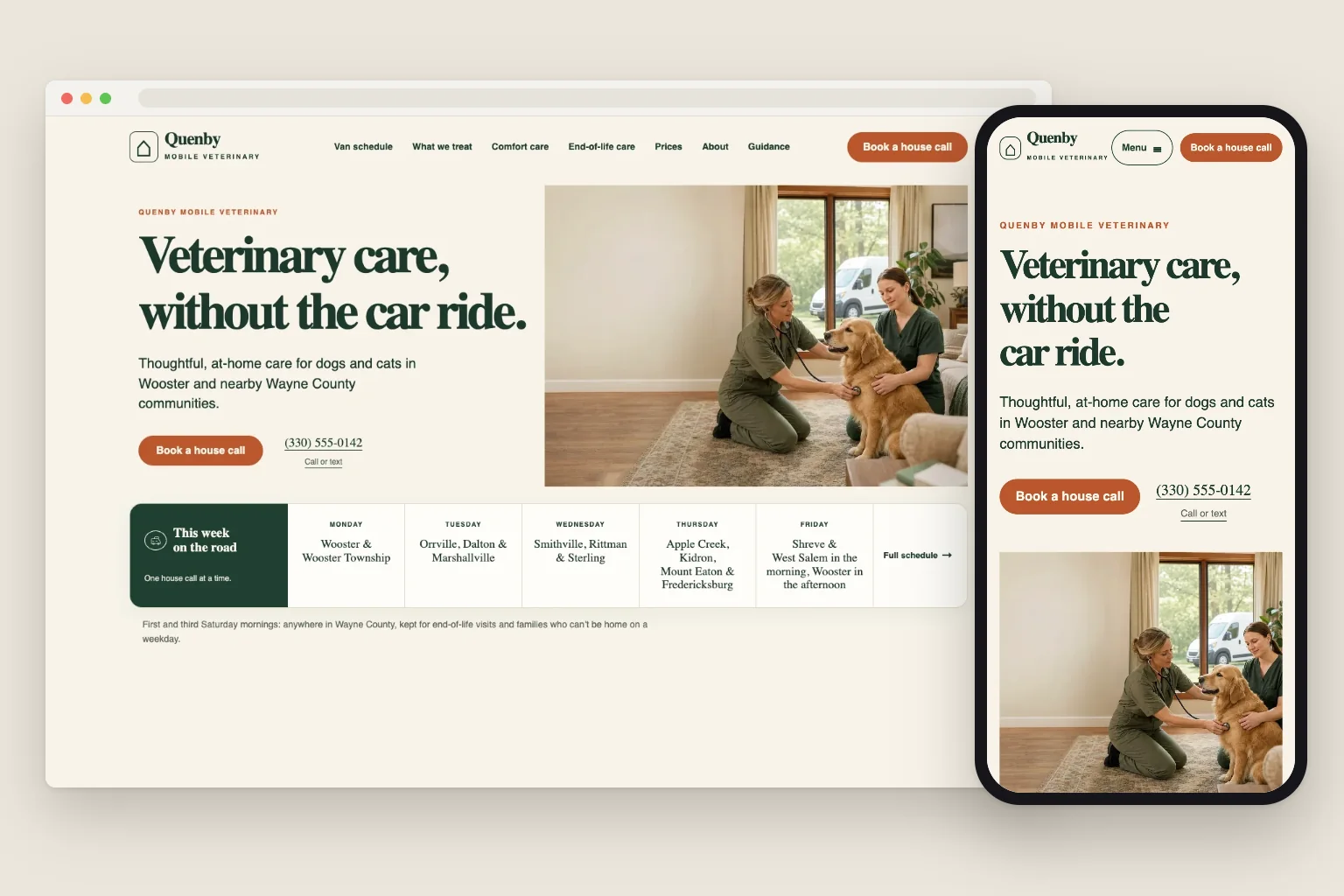
Quenby Mobile Veterinary, a site built by Theo, is a one-van practice that sees dogs and cats at home around Wooster, Ohio. On October 19, 2026, Theo's Growth Engine, the search work in Starter and Pro, ran on it three times: a post, a care page, then a check of the whole site. On a practice's own site, these jobs are spread across the weeks.
On October 19, 2026, each health line this page quotes or pictures was checked against a named veterinary source, and each one matches. For Quenby's two drafts, those are the HHHHHMM Quality of Life Scale by Dr. Alice Villalobos, the 2016 AAHA/IAAHPC End-of-Life Care Guidelines, the American Veterinary Medical Association's pages for pet owners and Ohio State's quality-of-life guide. On your site, a vet at the practice reads drafts like these first.
The searches behind each piece
Before writing, each run looked up searches in Semrush for the US: average searches a month, and keyword difficulty, a 0 to 100 score where lower means fewer strong pages in the way. Both match care already on Quenby's site.
Each writing run drafts one piece, checks it on phone and desktop screens, and links it from the pages around it.
Built by TheoQuenby Mobile VeterinaryThe top of the new post, filed under Senior Pet Care.See the live site
01
A long answer for families watching an older dog
Dog Quality of Life Scale: A Gentle Guide for Families runs about 2,000 words. It covers six things to watch, from comfort and appetite to good and hard days, plus a one-page weekly record, and says plainly that a scale starts a talk with the vet and is never a diagnosis.
The six follow the HHHHHMM scale by Dr. Alice Villalobos (hurt, hunger, hydration, hygiene, happiness, mobility and more good days than bad), with hunger and hydration as one. The post cites Ohio State's quality-of-life guide, a published dog questionnaire and the American Veterinary Medical Association, and links to Quenby's comfort care and end-of-life pages.
Built by TheoQuenby Mobile VeterinaryThe new care page, as it opens on a laptop.See the live site
02
A page for comfort care at home
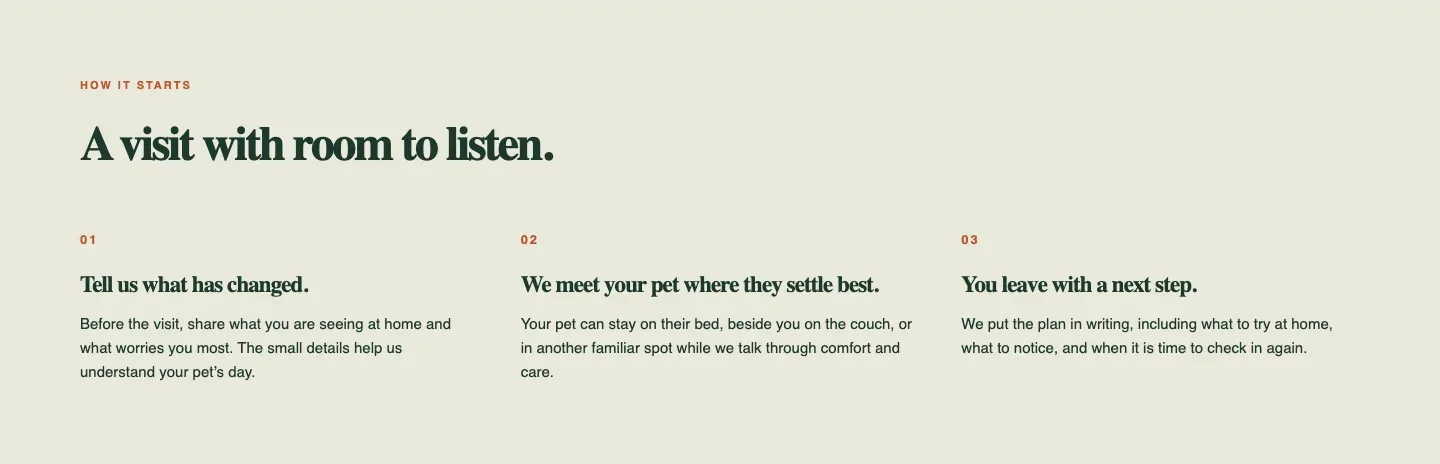
Pet Palliative Care at Home runs about 550 words for families whose dog or cat is living with age or an ongoing illness: what a comfort visit looks at, the written plan, and how the first visit starts.
It also draws careful lines: palliative care is not euthanasia, the van is not for emergencies, and anything that needs hospital equipment or anesthesia belongs at a clinic.
Built by TheoQuenby Mobile VeterinaryThe new Senior Pet Care page, under Guidance in the main menu.See the live site
03
A guidance section with room for the next post
The post run also built a Guidance page and a Senior Pet Care page that lists the post, and put Guidance in the main menu, so the next article has a home. The Senior Pet Care page and the post carry labels that tell Google what each page is.
What it added and linked
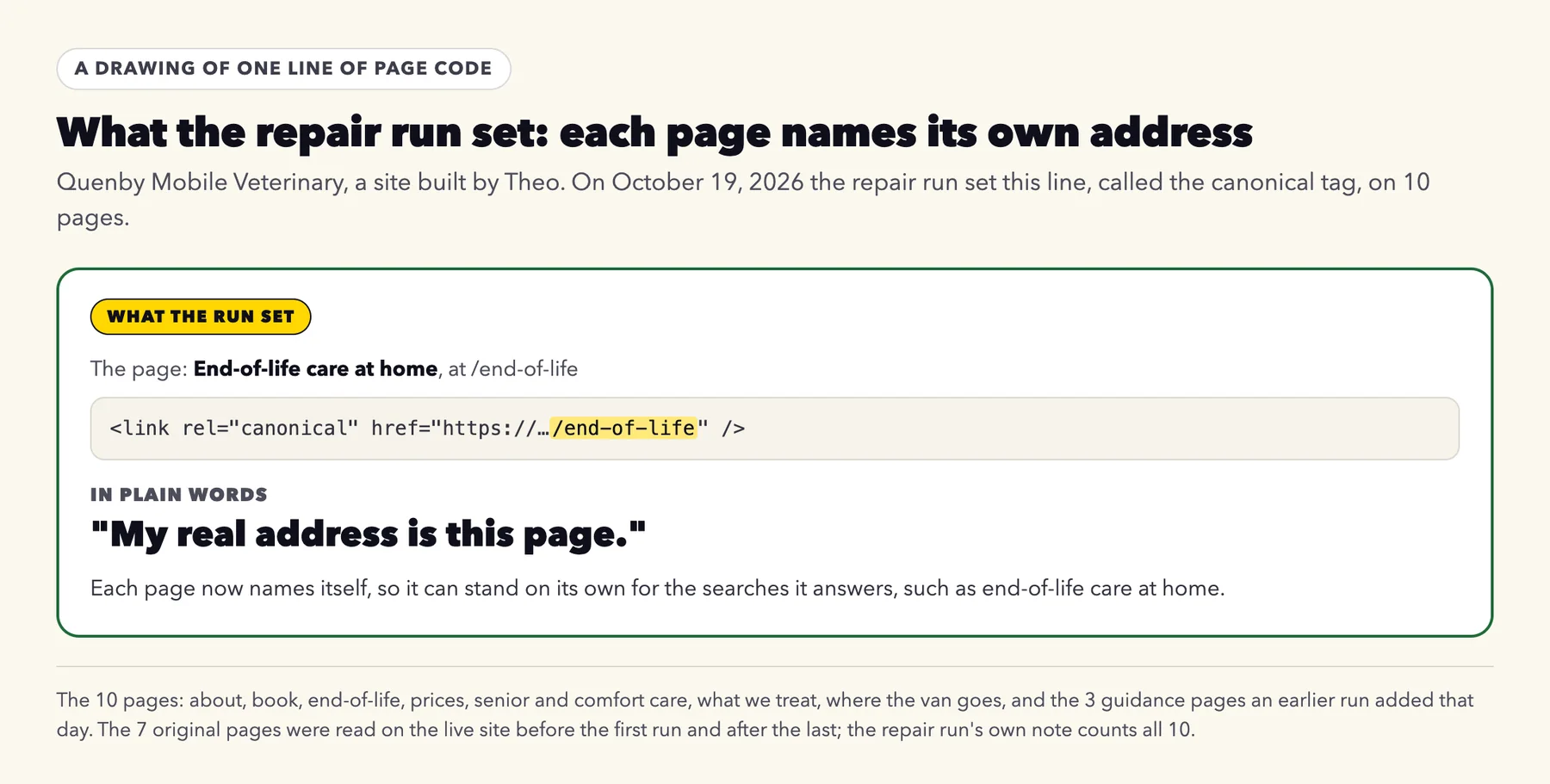
The repair run wrote nothing new: it read every page, the sitemap and the robots file, found them all reachable, and gave 10 pages their own preferred address. The two writing runs linked their own pages in.
What it did
Where
Why it helps
Linked the new pages in (the two writing runs)
Guidance in the main menu; the palliative care page from the comfort care page and the footer; the post to the comfort care and end-of-life pages
Owners and Google reach each new page from one they already know.
Gave each page its own preferred address (a canonical tag)
10 inner pages, from prices and end-of-life care to the new guidance section
Each page now names itself as its own address, so it can stand on its own in search.
Not touched, on purpose
Rewrites of existing pages, and redirects
No search data yet called for a rewrite, and no old address was known to still get visits.
Your Growth tab
The note the practice reads after a run
Every run leaves a short note in the Activity list of the Growth tab. Here are two parts of the note from the palliative care run, word for word.
Pricing
What it costs, in full
The ongoing search work is part of Starter and Pro. Basic is the site and hosting on its own. Starter is free for the first 30 days.
Plan
Per month
Ongoing search work
Chat credits
Best for
Basic
$29.99
Not included
1,500 a month
Owners who just want their site live and easy to update.
StarterFree for 30 days
$69.99
Included, uses no credits
4,500 a month
Owners who want the site handled without heavy publishing volume.
Pro
$129.99
Included, uses no credits
7,000 a month
Owners who want more capacity, more publishing, and more room to experiment.
No contract, cancel anytime, and you own the site and its content. The pricing page lists what each plan includes and how chat credits work.
What veterinary SEO covers
Search work for a practice is several separate jobs. Here is what each means for a vet, and who does it on Theo.
The work
What it means for a vet practice
Who does it
Research
The words pet owners use, and which searches a practice your size can win.
Theo, on Starter and Pro
Service pages
Wellness exams, vaccines, dental cleanings, spay and neuter, surgery: one page each. For an animal hospital or ER, the after-hours, arrival and estimate pages come first.
Theo drafts; you approve
Animal pages
One for each kind of patient you see, and only those.
Theo drafts; you approve
Town pages
One for each town you draw from, or each day of a mobile route.
Theo drafts; you approve
Pet-owner questions
Posts on what clients ask at the front desk, from costs to an older dog's comfort.
Theo drafts; a vet at the practice reads
Technical fixes and speed
Veterinary website optimization: fast pages on a phone, one preferred address per page, and labels that say this is a veterinary practice.
Theo, on Starter and Pro
Getting pages into Google
Submitting the sitemap through Search Console, Google's free report for site owners.
Theo, on every plan, once Google is connected
Business Profile, listings and reviews
The map listing, hours and photos, and asking every client for a review the same way.
You, with the Boost checklist
AI answers
Plain pages that ChatGPT and Google's AI Overviews can quote.
Theo, on Starter and Pro
Pet owners search in their own words
Semrush estimates about 550,000 US searches a month for vet near me, and Google answers most of them with its map, so the Business Profile does that work. The website wins the longer searches: the service, the animal, the town or the worry.
Below, each search sits next to what answers it: a practice's Business Profile, or a page on a vet site Theo built (Semrush US monthly averages, checked October 19, 2026). Only the palliative care row was a Growth Engine pick.
Search
Searches a month
Difficulty
A page that answers it
vet near me
550,000
Mostly decided by the map listing
The practice's Business Profile
mobile vet near me
12,100
Mostly decided by the map listing
The practice's Business Profile, then a route page like Quenby's van route page
Owners describe what they see, not the diagnosis: about 480 searches a month for cat straining to pee, against about 50 for cat urethral obstruction. Lanternfield's emergency page lists, in the words a worried owner would use, "A male cat straining in the litter box with little or no urine." Cornell's Feline Health Center gives the same sign and calls a urethral obstruction "an absolute emergency." Place works the same way: a page that names Fargo can win emergency vet fargo, while emergency vet near me is settled on the map.
The pages a veterinary website needs to be found
Google can only send an owner to a page that exists. These are the pages the search work adds, a few at a time; the full plan for the site itself is on veterinary website design.
Each service. Who it is for, what the visit involves and how to book.
Each kind of animal. Only the species you treat, so a rabbit owner knows at a glance.
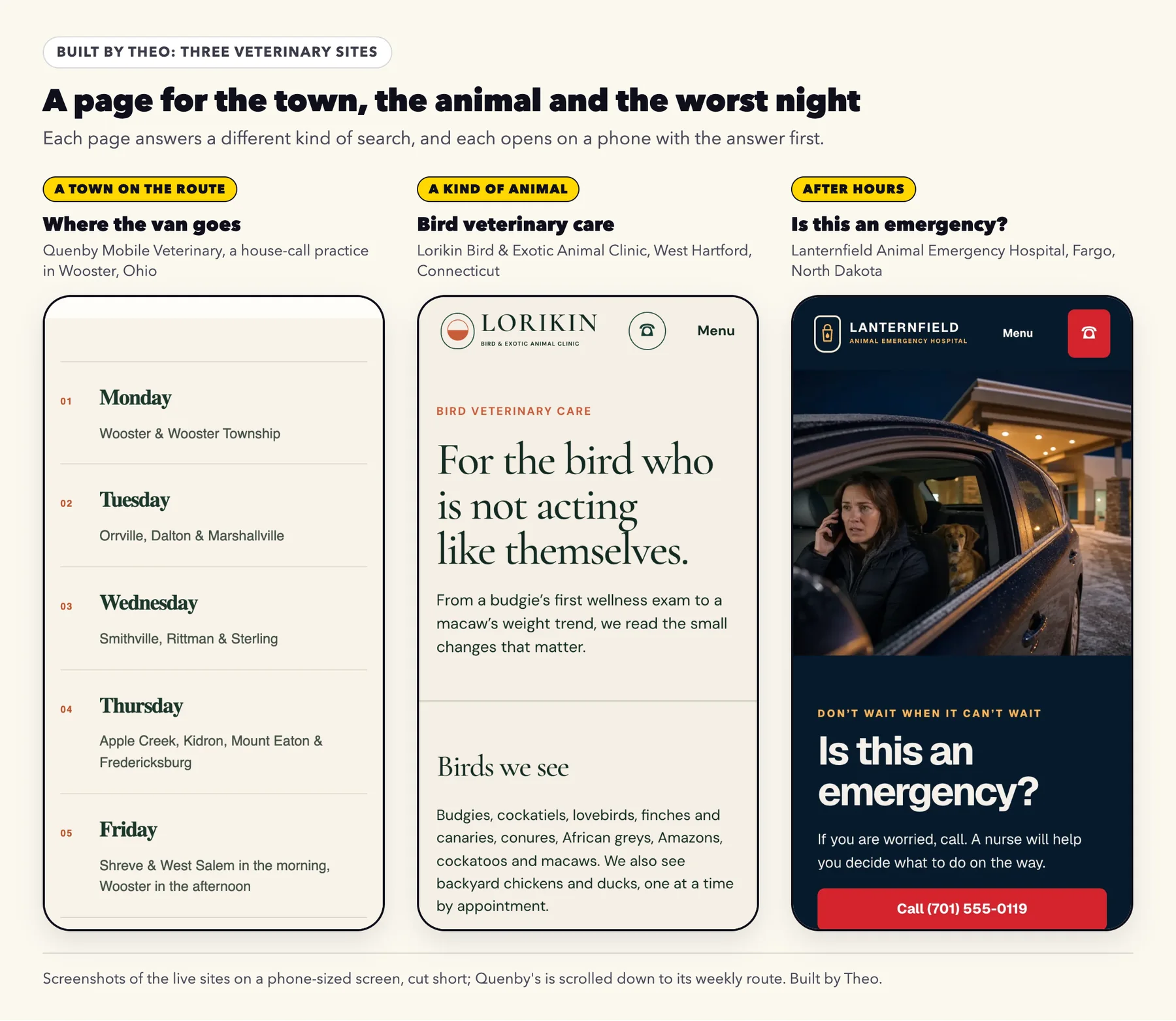
Each town or route day. Where clients come from, or where the van goes.
Prices and estimates. One of the questions owners search most.
After hours and end of life. Where to go tonight, written by your doctors, and a calm page on comfort care and goodbyes.
Built by Theo: a town page, an animal page and an after-hours page from three vet sites, on a phone.
Are the titles written for search?
Are the titles... worded specifically for optimal search optimization?
One owner wrote, 2026
Yes, and every page has two to write: the title Google reads and the headline a visitor reads. Google writes the blue link in its results itself, and the page title is the first source its guide to title links lists. So a care page's title leads with the search words, as the run's new page does: "Pet Palliative Care at Home | Quenby Mobile Veterinary". The headline is what a worried owner reads on arrival, so it can be warmer, like the homepage's "Veterinary care, without the car ride." The homepage title leads with the practice name, and the same guide calls a home page title "a reasonable place to include some additional information" about the site.
Local SEO for veterinarians starts with the map listing
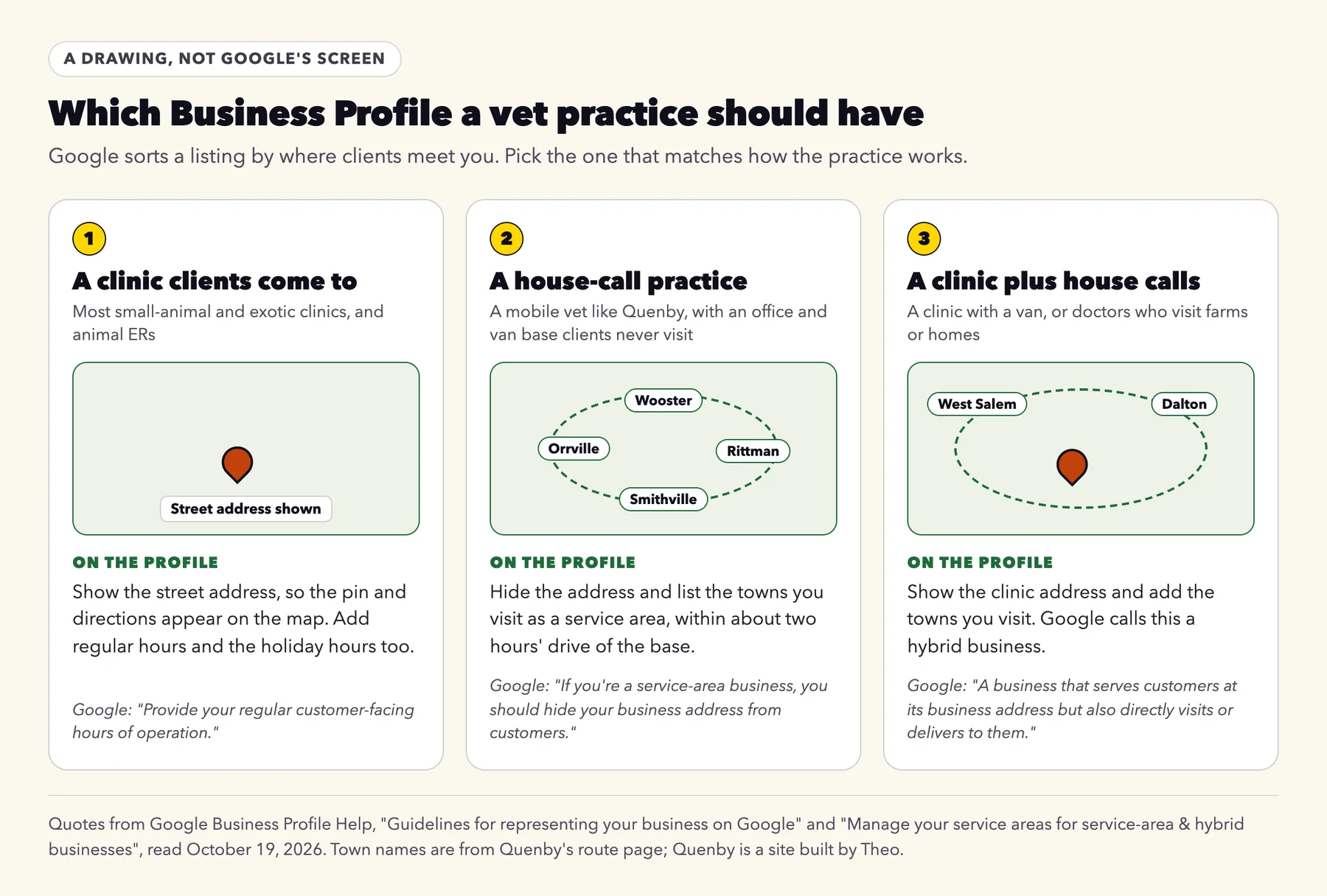
For vet near me, Google mostly shows its map, built from Google Business Profile, the free listing once called Google My Business. On Starter and Pro, the Boost checklist walks you through it and the other directories, such as Apple Business Connect, Bing Places and Yelp, all in your own accounts. What matters most:
The right kind of listing. A clinic shows its address. A house-call practice lists the towns it visits instead; Google's guidelines say a service-area business "should hide your business address from customers."
Hours, holidays included, so nobody drives to a locked door on Thanksgiving morning.
Real photos of the doctors, the exam rooms or the van.
The same name, address and phone on the site, the profile and every directory.
Reviews, asked for the same way every time.Google's review policy bars offering "payment, discounts, free goods and/or services" for a review, or asking only happy clients. Then answer each one, with help from these sample replies.
A drawing, not Google's own screen. The quotes are from Google Business Profile Help, read October 19, 2026.
Medical pages need your own vets
Pages about pet health need a doctor's eye before a client reads them. The come-now signs come from your own doctors, with no doses, home remedies or symptom checkers. Pages list only the services and animals you see, and the pet portal, pharmacy and appointment requests stay in your own tools.
Built by TheoHow the new page says a first visit starts: the family tells the vet what has changed, the visit happens where the pet rests, and the plan is written down.
How long veterinary SEO takes
Search traffic builds over months, not weeks. Google's own guidance on hiring an SEO puts the payoff at four months to a year, in its video How to hire an SEO.
Once your domain points at the new site, connecting Google is a one-time sign-in in the Analytics tab that sets up Analytics and Search Console (not Google Ads). Theo switches the search work on once both are connected, and the reports take time to fill in. Showing up in searches takes longer; Google's SEO Starter Guide says "Some changes might take effect in a few hours, others could take several months." Impressions in Search Console come first, then clicks.
Meanwhile the Growth tab lists the work itself, page by page and fix by fix.
Before you pay anyone for veterinary SEO
Some offers promise the first page. Google's page for owners, Do you need an SEO? (read October 19, 2026), says no one can guarantee a top ranking on Google, and that if an SEO guarantees first place in search results, you should find someone else. The guide to whether SEO is worth it takes a typical cold pitch apart, line by line. Ask these before you sign; the last follows Google's own list.
Ask
A straight answer
Theo's answer
How long is the initial term, and what happens to our pages if we leave?
A number of months, in writing, and the pages stay yours.
No contract term, and every page belongs to the practice.
Who reads the clinical drafts?
A vet at your practice, before anything goes live.
Your own vets: Theo drafts the words, and the medicine stays your doctors' call.
What happens to our pharmacy, portal and booking links if we leave?
Nothing: they belong to tools the practice already runs.
The site only links out to them, so they stay where they are.
Will you get us links through guest posts?
No. Links come from real local ties, like a shelter you help.
Theo writes no guest posts for links; it writes pages on your own site worth linking to. Google's spam policies count "links with optimized anchor text in articles, guest posts, or press releases distributed on other sites" as link spam.
Will you put keywords in our reviews?
No. Clients write in their own words.
You ask every client the same way, as Google's review policy expects.
What results should we expect, and by when?
Months, with no promised position.
Impressions first, then clicks, in your Analytics tab.
What veterinary SEO costs
Of the vet SEO pages we could read on October 19, 2026, one posted a price: a monthly retainer in the hundreds of dollars, tiered by pages of content a month, cancelable "anytime after the initial term", its length unstated. The rest gave no price.
Option
Per month
What you get
A vet SEO agency retainer
A posted starting price, or a quote after a call
Pages of content and a report, often with an initial term
Doing it yourself
$0, plus your evenings
Google's free tools: Search Console, Business Profile and Analytics
Theo Starter
$69.99, free for the first 30 days
The website, hosting and the search work, with the Boost checklist
Theo Pro
$129.99
Starter, plus more pages and posts each week and read-only code access
Switching vet website companies without losing your place on Google
Theo rebuilds your site from its current address as a starting draft with the look clients know, and the old site stays live until your domain points at the new one. Once Search Console is connected, SEO repair on Starter and Pro forwards old addresses that still get search traffic to their matching new pages, and on any plan Theo adds a forward you ask for in chat (redesigning without losing SEO and moving a site cover the steps). If Google then emails that some pages are not being indexed, that is good news: Google is reading the new site. The usual reason after a move is Page with redirect, and Alternate page with proper canonical tag can appear where a page names another address. Theo's SEO repair, part of Starter and Pro, takes care of these; how to get Google to index your site covers the rest.
A drawing of the one line the repair run set on 10 of Quenby's pages, read from the live site on October 19, 2026.
FAQ
Questions veterinarians ask about SEO
How much does veterinary SEO cost on Theo?
The search work comes with Starter, $69.99 a month and free for the first 30 days, and Pro, $129.99 a month. Both include the website and hosting, with no build fee. Basic is the site, hosting and chat edits without the ongoing search work, which starts on Starter.
How long until pet owners find our practice on Google?
Once your domain points at the new site, one Google sign-in in the Analytics tab connects Analytics and Search Console, and the search work starts when both are connected. The first sign is impressions in Search Console once new pages are indexed, then clicks. Google's own guidance on hiring an SEO puts the payoff at four months to a year.
Who owns the site and the pages, and can we cancel?
The practice does: every page, post and photo, and Pro adds read-only access to the code on GitHub. You can cancel at any time, with no contract term, and the site stays live until the end date your cancellation confirmation shows.
Can Theo do SEO on the site I already have?
Not on the old site itself: the work runs on a site Theo builds and hosts. Give Theo your current address and it rebuilds the site as a starting draft with the look clients know, which you refine in chat. The old site stays up until your domain moves.
Does Theo set up our Google Business Profile?
No. You make the changes in your own Google account, and the Boost checklist on Starter and Pro walks you through them and the other directories. A house-call practice hides its address and lists its towns.
Who checks the medical details in the pages Theo writes?
A vet at your practice. Drafts wait in the Growth tab until someone publishes them, and auto-publish is off unless you turn it on. Emergency signs should come from your own doctors, with no doses or home remedies.
Google emailed that some of our pages are not being indexed. What does that mean?
It means Google is reading the site, which is good news. After a move, the most common reason is Page with redirect: an old address now forwards to its new page, as it should. On Starter and Pro, Theo's SEO repair reads these reasons from Search Console and handles any that need work.
Can any company guarantee our practice a first-page ranking?
No. Google's page for owners hiring an SEO says no one can guarantee a top ranking on Google. Theo shows the work instead: every page and fix in the Growth tab, and the clicks Google reports in the Analytics tab.