SEO for therapists and counselors: how a practice gets found, and the rules that differ for therapy
For a therapist, SEO means that when someone types a worry and a place into Google, such as couples counseling in their town or online EMDR in their state, a page on your site answers it. Most of the work is the same as for any business, and a few rules are not. Below is what Theo's search work did on a trauma therapy site Theo built, with links to the live pages, then the searches, pages and rules that apply to a counseling practice.
Your first build is on Theo: see the site before you decide
SEO for therapists comes down to five jobs: a page for each concern you treat, a page for each place you see clients (the town for your office, the state for video sessions), plain answers to what people ask before a first call, such as cost, insurance and superbills, a Google Business Profile if your practice qualifies for one, and a site that opens quickly on a phone. Three things are different for therapy. You do not ask current clients for reviews. You never confirm in a reply that someone was a client. And a practice that meets clients only by video does not qualify for a Business Profile, the listing on Google's map, so its state pages and directory profiles do that work instead. On Starter and Pro, Theo handles the website side: it researches the searches, drafts the pages and posts and fixes technical problems. On every plan, connecting Google with one sign-in submits your sitemap so Google is sent a list of every new page. Drafts wait in your Growth tab for your approval, unless you turn on auto-publish, and the Boost checklist takes you through each listing in turn. Because the work runs on a site Theo builds and hosts, it starts with a free first draft of your practice's site, which you see before choosing a plan.
In Theo's audit of 6,861 small business websites, 35 percent of the 407 health, wellness and beauty sites with search data got an estimated zero visitors a month from Google search, and 49 percent got fewer than ten. The sample is the sites whose owners ran Theo's free audit. See the research.
On a therapy practice site Theo built
What Theo's search work did on a trauma and EMDR practice site
Kelderwick Trauma Therapy is a practice site built by Theo for adult trauma therapy and EMDR, with an office in Santa Rosa, California and video sessions for adults anywhere in the state. On October 19, 2026, Theo's Growth Engine, the search work on Starter and Pro, ran on it three times, one job per run: a post, a service page, and a check of the whole site. Each batch of work was published from the Growth tab, the way an owner publishes it.
On your own site the work arrives a few pieces at a time over the weeks, and each piece waits in the Growth tab for you unless auto-publish is on.
The searches it chose
Before writing anything, it looked up what people type and how hard each search is to win, using Semrush's US estimates as they stood on October 19, 2026: average searches a month, and keyword difficulty, a score from 0 to 100 where a lower number means fewer strong pages already compete. Each writing run picked one search, and three more wait in its queue.
For the post, it also weighed 'trauma response' (5,400 a month, difficulty 29) and took the smaller, easier search. For the page, its note says the statewide search was the strongest fit, a direct match for the practice's video sessions across California; the nearest local search, 'trauma therapist santa rosa', came to about 10 a month.
What it wrote
A post, a page and a new Journal section, live on the site
The post run also built the section the post lives in, and the page run linked its new page from one the site already had. Here are the three, as they look on the live site.
Built by TheoKelderwick Trauma TherapyPartway down the post: a plain opening, then the first of the four signs, each with its source linked.See the live site
01
An answer for someone who is not ready to call yet
Signs of Unresolved Trauma: What to Notice is a post of about 1,900 words. It opens by saying unresolved trauma is not a formal diagnosis, then walks through four patterns worth noticing, from a body that stays on alert to reactions that follow you into relationships, with what to do in the moment and when to reach out.
It cites the National Institute of Mental Health and the VA's National Center for PTSD for the common reactions it describes, points readers in crisis to the 988 Suicide & Crisis Lifeline and the practice's help-right-now page, and links to the trauma therapy, EMDR and inquiry pages for a reader who is ready.
Built by TheoKelderwick Trauma TherapyThe first screen and the section under it, which says who can book: adults 18 and older who are in California while they meet.See the live site
02
A page for clients anywhere in the state, by video
Online EMDR Therapy in California is a service page of about 1,500 words for adults who want EMDR by video. Its first section says who can book: adults 18 and older who are physically in California while they meet. It goes on to the first appointments, how the eye movements or shoulder taps work through a screen, what you need at home for a video session, who it may suit, fees, five common questions and a free 20-minute phone call where nobody asks you to explain what happened.
The existing EMDR page now links to it from its EMDR by video section, with the line 'Learn how online EMDR therapy works'.
Built by TheoKelderwick Trauma TherapyThe Journal's index page, with its new place in the main menu and a card that opens the Trauma Responses topic, where the first post is listed.See the live site
03
A Journal, so later posts have a home
The first post also opened a Journal, an index page that now sits in the main menu and in the footer, and a Trauma Responses topic page that lists the post. The searches still in the queue are filed under the same topic.
The Journal, the topic page and the post all went into the site's sitemap, the list of pages a site hands to Google.
What it linked and checked
The two writing runs wired each new page into the site as they went. The third run, the site check, read every page and changed nothing, because nothing needed it.
What it did
Where on the site
What it is for
Put the Journal in the menu and footer
The main menu and the footer's Explore list, on every page
Visitors and Google can reach the posts from anywhere on the site.
Linked the new page from the EMDR page
The EMDR page's EMDR by video section
Someone already reading about EMDR finds the video option in one click.
Linked the post to the practice's own pages
Trauma therapy, EMDR, the inquiry page and the help-right-now page
A reader who is ready has a next step, and one who needs help now has a quick way to it.
Added the new pages to the sitemap
The Journal, the topic page, the post and the online EMDR page
The list of pages the site gives Google stays complete.
Checked the rest
Every listed page's title, description, preferred address, headings and links, plus the redirect list
All of it was in order, so the run left it alone.
Left alone on purpose
Rewrites of existing pages, and new redirects
Its note says there was no search data yet to show a page needed work, and no old address that needed a redirect.
Your Growth tab
The note Theo writes after each run
Every run ends with a short note in the Activity list of the Growth tab: what it looked at, what it changed and why, with links to the pages. Here are three parts of the note from the page run on Kelderwick, word for word.
Nothing from a run goes live until you publish it, unless auto-publish is on. A weekly email adds up the new posts, updates and pages.
Pricing
What it costs, in full
The ongoing search work is part of Starter and Pro. Basic is the site and hosting on its own. Starter is free for the first 30 days.
Plan
Per month
Ongoing search work
Chat credits
Best for
Basic
$29.99
Not included
1,500 a month
Owners who just want their site live and easy to update.
StarterFree for 30 days
$69.99
Included, uses no credits
4,500 a month
Owners who want the site handled without heavy publishing volume.
Pro
$129.99
Included, uses no credits
7,000 a month
Owners who want more capacity, more publishing, and more room to experiment.
No contract, cancel anytime, and you own the site and its content. The pricing page lists what each plan includes and how chat credits work.
The jobs in therapist SEO, and where therapy is different
Therapist SEO is a handful of separate jobs. Each one makes it a little easier for Google to see who you help and where, and a little easier for a worried reader to reach out once they land on your site. The table sets out each job, what it means for a counseling practice, what changes for therapists, and who does it when the site is on Theo.
The work
What it means for a therapy practice
What is different for therapists
On Theo
Research
Finding the words clients type, such as couples counseling, teen therapist, EMDR, sliding scale and superbill, with the town or state.
Use the words clients use for what they are facing, not clinical terms.
Theo researches these on Starter and Pro.
Concern pages
A page for each concern or specialty you want more of: anxiety, grief, couples, trauma, teens, postpartum.
Only the ones you treat, in plain words, with who you refer elsewhere.
Theo drafts them for you to approve.
Town and state pages
The town where your office is, and a page for each state you see clients in by video.
For video sessions, your license sets the area, so the page names the state.
Theo drafts them for you to approve.
Questions before a first call
What a session costs, whether you take insurance, how superbills work, what the first session is like.
People search these before they call (Semrush estimates 3,600 US searches a month for 'sliding scale therapy' alone, October 2026), so answer them in writing.
Theo drafts pages and posts for you to approve.
Technical fixes and speed
A site Google can read without trouble and that opens fast on a phone.
The same as for any business.
Handled by Theo on both search plans.
Getting pages into Google
Telling Google about each new page through your sitemap in Search Console, the free Google tool that reports how your site does in search.
The same as for any business.
Theo submits it for you on every plan, after one Google sign-in.
Google Business Profile and directories
Your listing on Google's map, if you qualify, and the therapist directories clients browse.
A practice that sees clients only by video does not qualify for a Business Profile.
You update each profile, step by step, from the Boost checklist.
Reviews
What people read about you on Google and in directories.
You do not ask current clients, and a reply never confirms someone was a client.
Nothing to set up. The rules are below.
Reporting
Seeing what was added and fixed, and what Google reports.
The same as for any business.
A weekly summary by email; drafts in Growth and search activity in Analytics.
Is it worth it for a practice like yours?
It is when you have room for new clients, or when you are adding a specialty, a clinician or a state license. When your caseload is full and you keep a waitlist, the site on its own may be enough for now, and the page on therapist website design covers that case. The numbers behind the decision, from cost to break-even, are in is SEO worth it for a small business.
Local SEO for therapists: an office, a video-only practice or a group
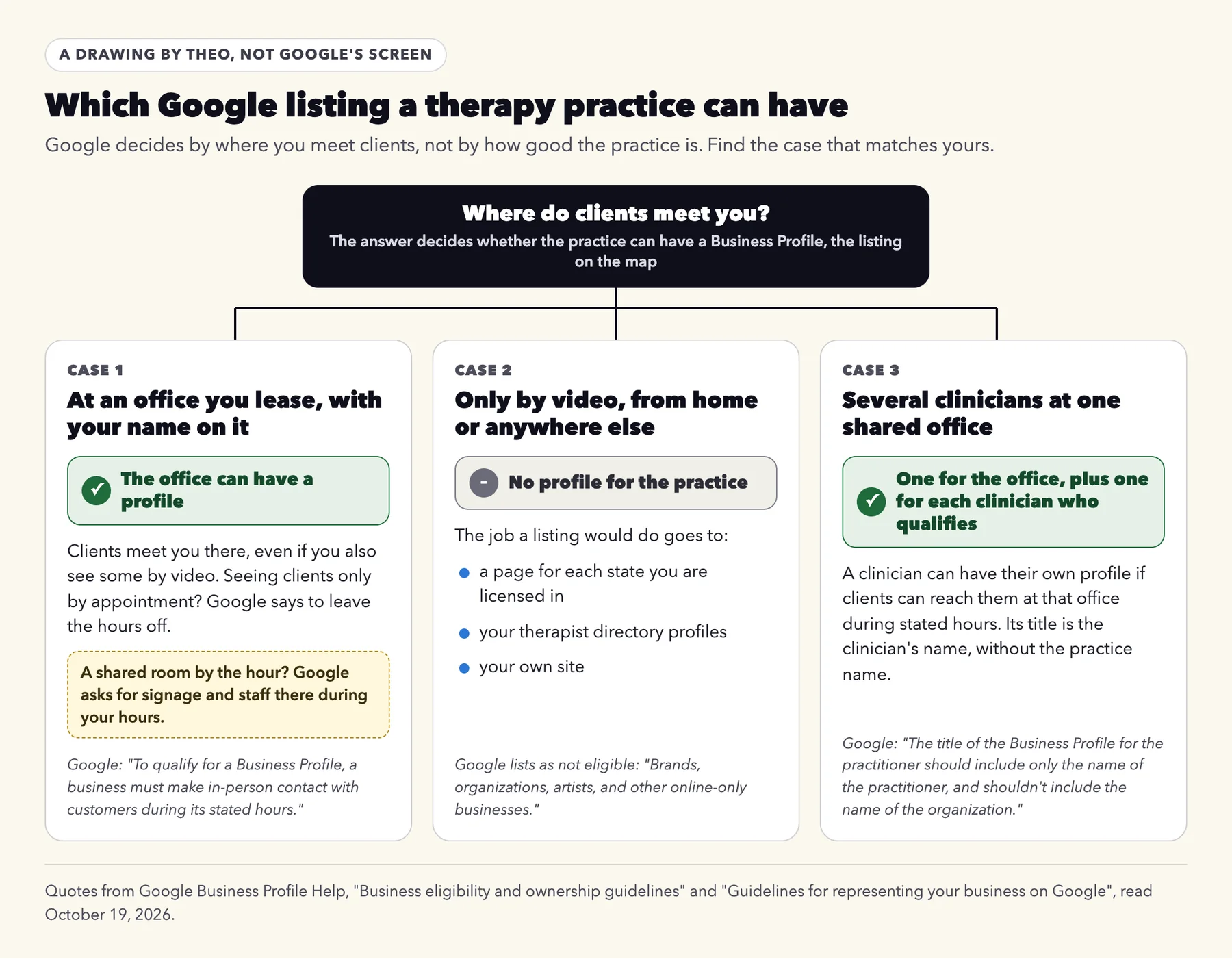
Local search for a therapist turns on one question: can your practice have a Google Business Profile, the listing that shows on the map? Google decides by where you meet clients. Its eligibility page says: "To qualify for a Business Profile, a business must make in-person contact with customers during its stated hours." The same page lists "Brands, organizations, artists, and other online-only businesses" among the businesses that are not eligible. Each Google line quoted in this section was read on October 19, 2026.
You see clients at an office you lease, with your practice name on the door or the suite directory. That office qualifies, even if you also see some clients by video, because clients meet you there in person. If clients come only by appointment, leave the hours off: Google's guidelines say that businesses that "operate only by appointment" shouldn't provide hours.
You see clients only by video. The practice does not qualify, and renting a mailing address will not change that: the same guidelines say that when a business rents an address it does not work from, "that location isn't eligible for a Business Profile." The job a listing would do goes to a page for each state you are licensed in, your directory profiles and your own site.
You rent a shared room by the hour or the day. Google's guidelines treat a shared space this way: "Businesses can't list an office at a co-working space unless that office maintains clear signage, receives customers at the location during business hours, and is staffed during business hours by your business staff." They add: "Businesses showing their address on Google should maintain permanent fixed signage of their business name at the address." And the eligibility page lists "An ongoing service, class, or meeting at a location that you don't own or have the authority to represent" among the businesses that are not eligible. So a room without your sign, or one you rent but have no authority to represent, may not qualify. In that case your state pages, directory profiles and your own site do the listing's job, the same as for a video-only practice.
You are one of several clinicians at one office. The practice has one profile for the office. A public-facing clinician whom clients can reach there during stated hours may have a profile too. Its title "should include only the name of the practitioner, and shouldn't include the name of the organization," though Google allows a title or degree, such as Dr., beside the name.
A drawing by Theo of Google's rules, with Google's own words under each case. Not a Google screen.
Setting up the office's profile
Three more rules from Google's guidelines for representing your business shape what goes into an office's profile. Each one keeps the listing about the practice as clients know it.
Name. Google says: "Your name should reflect your business's real-world name, as used consistently on your storefront, website, stationery, and as known to customers." If the door and your letterhead say Maple Street Counseling, so does the profile, with no 'Anxiety Therapy Santa Rosa' added after it.
Categories. Google says: "Choose the fewest number of categories it takes to describe your overall core business," and pick ones that complete the statement "This business IS a" rather than "this business HAS a." Live Google Maps listings for therapy practices, read on October 19, 2026, show categories such as Psychotherapist, Counselor, Psychologist, Marriage or relationship counselor and Family counselor. For the main category, pick the one that matches your license. Specialties such as EMDR, couples work or teens belong on your concern pages.
Description. Google says the description must not "Display links" ("No links of any type are allowed") or "Focus on special promotions, prices, and offer sales." Say who you help, where and how you meet, and keep the session fee and sliding scale for the fees page on your site.
What a video-only practice uses instead
A state page is the video practice's version of a town page. It names the state, the license, who can book and how a video session works, and it is the page that answers searches like 'online therapy california'. Directory profiles put you in each directory's own search for your state, and they link back to your site. How the site and a directory profile work together is covered on therapist website design.
If you want a map listing later, what qualifies is an office with your practice's name on it where clients meet you in person. The guide to Business Profile video verification covers what Google asks an office to show on camera.
What people type when they look for a therapist
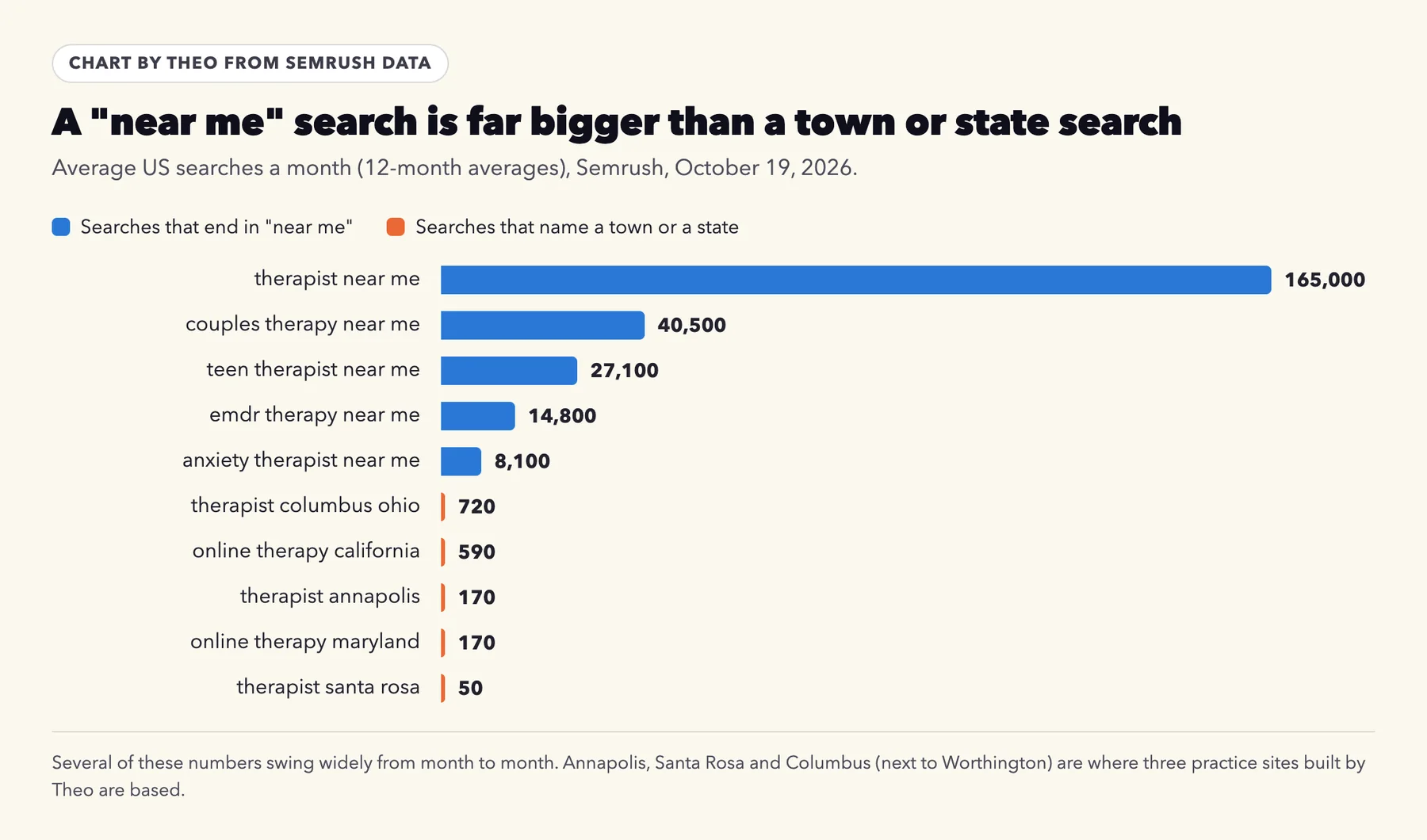
People rarely search for a practice by name. They type the worry and the place, or a money question they would rather not ask on the phone. The table gives Semrush's US figures for searches a counseling practice can answer, checked on October 19, 2026, with the kind of page that answers each one. The pages linked in it are examples of that kind of page on practice sites built by Theo.
Search
Searches a month
Difficulty
The kind of page that answers it
therapist near me
165,000
59 of 100
Your map listing, then a homepage that names your town and who you help
couples therapy near me
40,500
41 of 100
Your map listing, then a couples counseling page that names the town
teen therapist near me
27,100
19 of 100
A page for teens and their parents
grief counseling near me
27,100
49 of 100
A grief counseling page
emdr therapy near me
14,800
6 of 100
An EMDR page, such as Kelderwick's (Built by Theo)
anxiety therapist near me
8,100
67 of 100
An anxiety page
sliding scale therapy
3,600
32 of 100
A fees page that explains your sliding scale, such as Penhallow's (Built by Theo)
what is a superbill
1,600
25 of 100
A fees page or a short post
how much does therapy cost without insurance
880
21 of 100
A fees page with the price written out
therapists that take medicaid
720
19 of 100
An insurance page that names the plans you take
therapist columbus ohio
720
33 of 100
A homepage or office page that names the city
online therapy california
590
11 of 100
A page for the state you see clients in by video, such as Kelderwick's (Built by Theo)
emdr intensive
260
9 of 100
A page for that format, such as Kelderwick's (Built by Theo)
therapist annapolis
170
29 of 100
A homepage or office page that names the town
Semrush's US averages, October 19, 2026. The town and state searches barely show next to the 'near me' searches, and that is normal.
Small numbers are normal for a practice
These are averages over 12 months, and several swing widely from one month to the next. A town search is small: about 170 a month for a therapist in Annapolis and 50 for Santa Rosa. That is fine, because a solo practice needs a few new clients a month, not thousands of visitors, and someone who types a town is close to choosing. Google shows its map listings for 'near me' searches and for town searches too (Semrush records a map pack on 'emdr therapy near me' and on 'therapist columbus ohio'), so for most of these searches your listing matters as much as any page.
Broad searches are the hardest place to start. On October 19, 2026, seven of the first ten US results Semrush recorded for 'therapist near me' were directories, an insurer or large therapy groups. Narrower searches are within reach of a practice site: for 'online therapy california', the first ten included three small practices' own sites, two of them with a page written for that one state.
Page types for each kind of therapy search
Each kind of search needs its own kind of page. These are the page types behind the searches above, shown on three practice sites Theo built, with why each one is built the way it is. What belongs on each page is set out on therapist website design.
For a concern and a place: one page per concern
Searches like 'emdr therapy near me' and 'couples therapy near me' need a page about that one concern, with the town or state in its title and first lines. A single page listing every service gives Google little to match. Kelderwick's EMDR page is one example: one specialty, the town, and video sessions across the state.
For online therapy and a state: one page per state
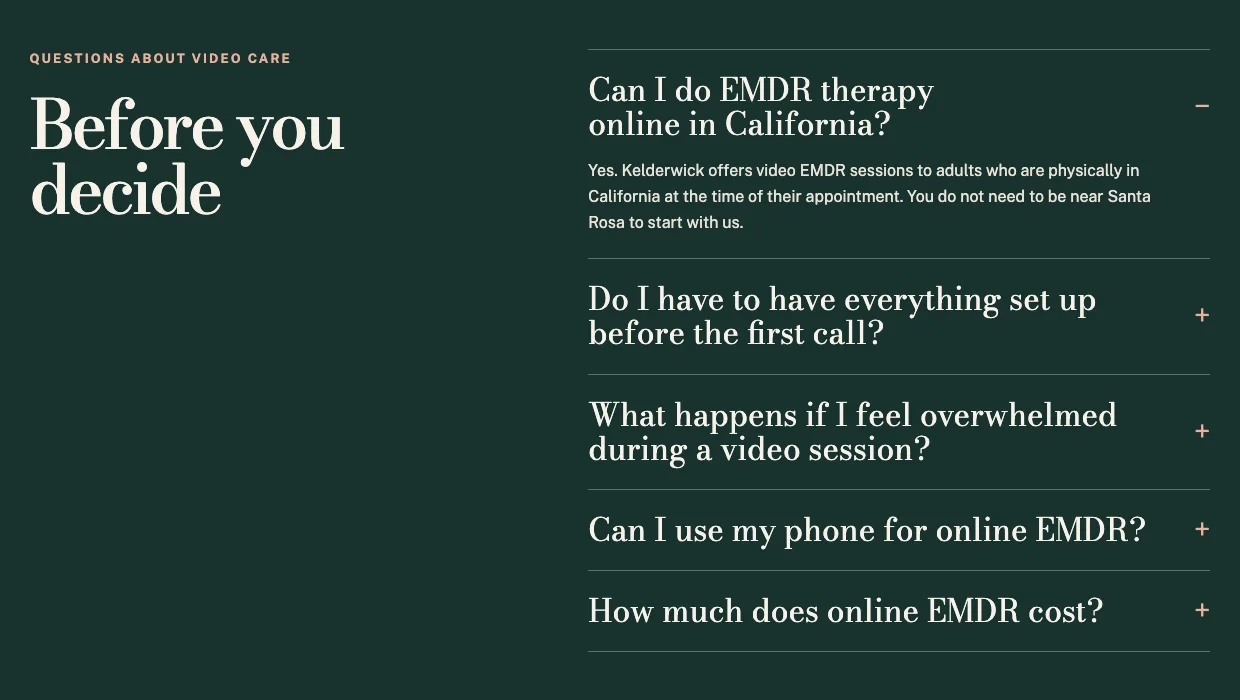
Searches like 'online therapy california' (590 a month) and 'online therapy maryland' (170) come from people who want video sessions and need to know you can see them where they live. A state page says so in its first lines: the state, the license, who can book. Kelderwick's new page, shown above, does this, and its questions section opens with the same question the searcher has.
Which clients you may see by video is your licensing board's rule, not Google's. California's telehealth rule for counselors, social workers and marriage and family therapists (16 CCR 1815.5) turns on where the client is during the session, which is why Kelderwick's page says physically in California.
Built by TheoThe questions section starts with whether EMDR can be done online in California, and answers yes, then explains in two sentences.
For cost and insurance questions: answers in writing
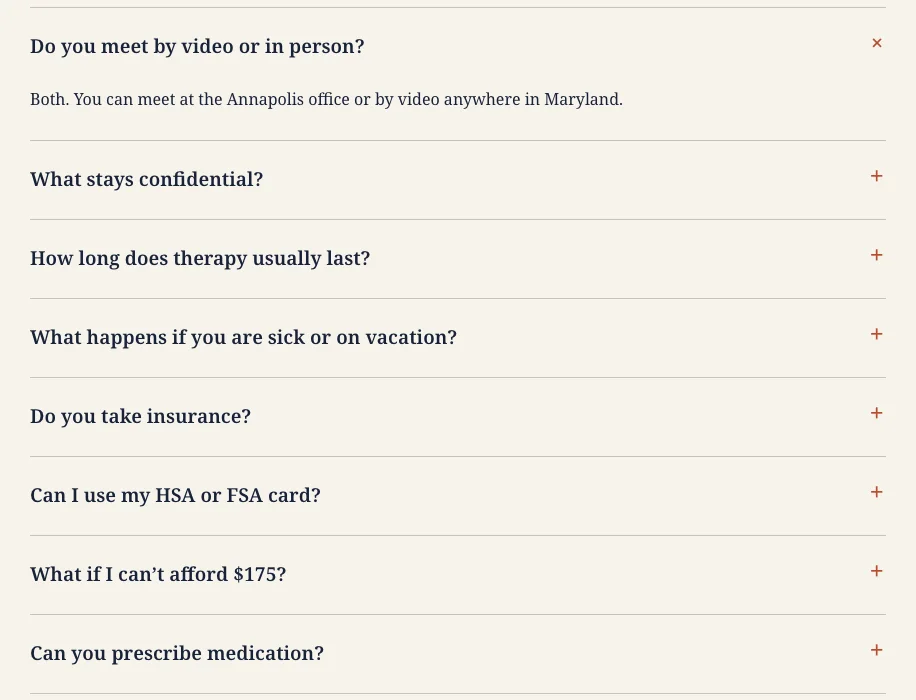
'Sliding scale therapy', 'what is a superbill', 'therapists that take medicaid': people search these before they will call anyone. A fees page answers them, and so does an FAQ whose questions are written the way clients ask them. Penhallow's FAQ gives 'Do you take insurance?', 'Can I use my HSA or FSA card?' and 'What if I can't afford $175?' a heading each.
Built by TheoEach money question has its own line, so a reader scanning on a phone finds theirs.
For a clinician's name: one page per clinician
A client referred by a doctor, a school counselor or a friend may arrive with a clinician's name to search for. In a group, each clinician needs a page of their own with their license, who they see and whether they have room. That matches how Google's practitioner rules see a group: the practice, and each public-facing clinician. Brindlecrest's clinicians page shows each clinician's license and opening status, and names the state board that licenses them.
Built by TheoEach card gives the license, who the clinician sees and a dated opening status, and the page names the licensing board.
For questions asked before anyone is ready: posts
Many searches come well before anyone books: 'signs of unresolved trauma', 'trauma response types', 'fawn trauma response'. A careful post answers the question in plain words and gives a reader who is ready a link to your inquiry page. Kelderwick's first post, shown above, is one, and the next three are already in its queue.
Where generic SEO advice goes wrong for therapists
Most SEO advice is written for shops and trades. Four pieces of it need changing for a therapy practice, and the first two come from your ethics code and federal privacy enforcement, not from marketing.
Common SEO advice
What a therapist does instead
Why
Ask every customer for a Google review.
Do not ask current clients, and check your code before asking former ones. Let reviews arrive unasked.
The psychology, counseling and social work ethics codes, quoted below.
Reply to every review and thank the person for coming in.
Reply in general terms, or not at all. Never confirm the person was a client, and say nothing about their care.
A New Jersey psychiatry practice settled with HHS for $30,000 over replies to Google reviews that HHS found disclosed patients' information.
Every business should claim its Google Business Profile.
Only a practice that sees clients in person qualifies. A video-only practice puts that effort into state pages and directory profiles.
Google's eligibility rule, quoted above.
Pick your city and build pages for the towns around it.
For video sessions, build pages for the states you are licensed in.
Your licensing board, not Google, decides whom you may see by video.
What the three codes say, word for word
The codes speak of testimonials, not Google reviews by name. A review you ask a client to post can still count as a testimonial you solicited, so the safe course is not to ask. Check your state board's rules as well, and the AAMFT code if you are an LMFT. The three codes below were read on October 19, 2026. The ACA says its 2014 code stays current while a revision is under way.
Psychologists, APA Ethics Code 5.05: "Psychologists do not solicit testimonials from current therapy clients/patients or other persons who because of their particular circumstances are vulnerable to undue influence."
Counselors, ACA Code of Ethics C.3.b: "Counselors who use testimonials do not solicit them from current clients, former clients, or any other persons who may be vulnerable to undue influence." It is the one code of the three that names former clients.
Social workers, NASW Code of Ethics 4.07(b): "Social workers should not engage in solicitation of testimonial endorsements (including solicitation of consent to use a client's prior statement as a testimonial endorsement) from current clients or from other people who, because of their particular circumstances, are vulnerable to undue influence."
Replying to a review without confirming a client
On June 5, 2023, the Office for Civil Rights at the US Department of Health and Human Services announced a settlement with Manasa Health Center, a New Jersey practice that provides adult and child psychiatric services. Its investigation found that the practice's replies to negative reviews had disclosed four patients' health information, and the resolution agreement says the reviews were on Google. The practice paid $30,000 and agreed to a corrective action plan that the office monitors for two years.
A reply that keeps you clear says nothing that shows the person was ever a client: a general line about the practice and an invitation to call. Here is one a therapy practice could post:
"Our practice aims to be a calm, respectful place for anyone who gets in touch, and we read every comment shared here. If you would like to talk anything through, please call (your name) at (your number)."
Use the same kind of reply under a five-star review, since thanking someone for their sessions tells every reader they had them. The guide to responding to negative Google reviews has more replies a practice can post.
Your part, and Theo's, in a practice's search work
Your part is small, and most of it happens once. The part that needs you most is reading each page as the clinician and making sure it says nothing you would not say in a session.
Once: point your domain at the site, then click Connect Google and sign in, and Theo sets up Google Analytics and Search Console. The search work begins after that, so do it early in Starter's free 30 days.
Each week: read the drafts in your Growth tab, check the clinical wording, and publish the ones that read right.
When the practice changes: tell Theo in the chat when your openings change, or when you add a specialty, a clinician or a state license, and the pages follow.
Listings, on Starter and Pro: work through the Boost checklist, one listing at a time, starting with your Google Business Profile if your office qualifies.
Reviews: do not ask current clients. When a review arrives, reply in general terms or let it stand.
How long it takes before a practice shows up
Search traffic builds over months, not weeks. Google's own guidance on hiring an SEO puts the payoff at four months to a year. That guidance is Google's video How to hire an SEO, and Google's SEO Starter Guide adds: "Some changes might take effect in a few hours, others could take several months."
The first sign to watch for is impressions in Search Console, which means your new pages are indexed and showing in results before anyone clicks. Clicks come later, as those pages climb. Meanwhile, you can see the work itself, page by page, in your Growth tab.
Once Search Console is connected, Google may email you about pages it has not indexed, which is a sign it is reading your site; after a move, most of the reasons it lists are old addresses forwarding to the new ones, and on Starter and Pro, Theo's SEO repair takes care of them. The guide to Google's indexing email explains each reason.
What to ask before you hire anyone for therapist SEO
Google's page Do you need an SEO?, last updated June 5, 2026, is written for owners deciding whether to hire help. Agencies that sell SEO to therapists usually charge a monthly retainer, and some add an onboarding or setup fee. On Theo, the search work is part of Starter at $69.99 a month, free for the first 30 days, or Pro at $129.99 a month, with the website and hosting included. Whoever you choose, these are the questions worth asking.
Cold emails. Google says: "Be wary of SEO firms and web consultants or agencies that email you out of the blue." A pitch saying your practice is missing from AI searches is one of these, and the guide to whether SEO is worth it takes one apart line by line.
AI search advice. Google suggests asking anyone who sells "AEO" or "GEO" services whether their advice is aligned with Google Search's official guidance on optimizing for generative AI features.
Every change, shown. One question Google lists: "Will you share with me all the changes you make to my site, and provide detailed information about your recommendations and the reasoning behind them?"
Promises. Google warns against anyone who says rankings are guaranteed, claims a "special relationship" with Google, or advertises a "priority submit" to Google.
Responsibility. Google says "you are responsible for the actions of any companies you hire," so a shortcut taken on your site is yours to answer for.
Questions only a therapist needs to ask. Will you ask my clients for reviews, or tell me to? How will my listing work if I see clients only by video? Who owns the pages and the domain if I leave?
Why Theo does the search work on a site it builds for your practice
The system that drafts a page is the one that publishes it, links it into the site, keeps it current and updates your sitemap, so nothing waits on a separate web designer. If your practice already has a site, give Theo its address and it rebuilds the site as a starting draft that keeps the look clients know. The old site stays live until your domain points at the new one, and once Search Console is connected, SEO repair on Starter and Pro forwards old addresses that still get search traffic to their matching new pages. The guide to redesigning a site without losing SEO walks through that move.
How much does SEO for a therapy practice cost on Theo?
Starter, which includes the search work, is $69.99 a month, and its first 30 days are free. Pro is $129.99 a month and adds more pages and posts each week, more chat credits and read-only access to the site's code. Both prices cover the practice's website and its hosting, with no separate build fee. Basic keeps the site and hosting without the search work.
How long until my practice shows up on Google?
The first sign is impressions in Search Console, which means your pages are indexed and appearing in results. Google's SEO Starter Guide suggests waiting a few weeks before judging whether a change helped. Search traffic builds over months, not weeks. Google's own guidance on hiring an SEO puts the payoff at four months to a year.
Who owns the site and the pages Theo writes?
You do. The pages, the posts, your words and your photos belong to your practice, and so does your domain, wherever it is registered. Theo builds and hosts the site, and Pro adds read-only access to its code on GitHub.
Can I cancel?
Yes, whenever you like, with no contract term. When you cancel, Theo shows the date your subscription ends, and the site stays live until then. Save any words and photos you want to keep before that day.
Can Theo do SEO on the site I already have?
No. The search work only runs on a site Theo builds and hosts for your practice. Give Theo your current site's address and it rebuilds the site as a starting draft, which you can change in the chat. Your old site stays live until your domain points at the new one, and on Starter and Pro, SEO repair forwards old addresses that still get search traffic to their new pages.
Can I have a Google Business Profile if I only see clients by video?
Not under Google's rules as they read on October 19, 2026. Google says a business must make in-person contact with customers during its stated hours to qualify, and it lists online-only businesses as not eligible. A video-only practice is found through a page for each state it is licensed in, its directory profiles and its own site. If you also see clients at an office you lease, with your practice's name on it, that office can have a profile.
Can I ask my clients to leave a Google review?
Not current clients. The psychology, counseling and social work ethics codes all say not to solicit testimonials from current clients or anyone else vulnerable to undue influence, and the counseling code adds former clients. The codes do not mention Google reviews by name, but a review you ask a client to post can count as a testimonial you solicited. Check your state board's rules too, and the AAMFT code if you are an LMFT.
Does the search work cover ChatGPT and Google's AI Overviews?
Yes. It is part of Starter and Pro, not an add-on. The work aims for citations in tools such as ChatGPT and Google AI Overviews with the same clear pages for each concern, place and question that serve Google search.