SEO for dentists: the price up front, and the work shown page by page
SEO for dentists is the work of helping Google show a practice's website when people nearby search for a dentist, a treatment or an answer about a sore tooth. On Theo, that dental SEO comes with Starter and Pro, on a website Theo builds and hosts. Further down: what it costs elsewhere and here, and what it did on a dental site Theo built, with links to the pages it wrote.
Your first build is on Theo: see the site before you decide
As of October 2026, one dental marketing agency's published plans run $750 to $2,000 a month. Theo Starter is $69.99 a month with the website and hosting included, and its first 30 days are free.
Whoever does it, dental SEO comes down to five jobs: a page for each treatment, and for each town where the practice has something specific to tell patients; answers to what patients ask before they book, such as what a cleaning costs without insurance; a complete Google Business Profile that keeps gathering reviews; a site that opens fast on a phone; and names, credentials and office photos that show real dentists stand behind the words.
On Starter and Pro, Theo does the website part: it picks searches from Semrush data, drafts the pages and posts, fixes technical problems and speeds up the site. On every plan, connecting Google also submits the practice's sitemap, and Google rereads it on its own, so each page you publish is on the list it checks. Drafts wait until someone at the practice publishes them, so a dentist can read every clinical line first. The work runs on a site Theo builds and hosts, not on the practice's current WordPress or vendor site: the first step is a free draft rebuilt from the current address, and the old site stays live until the domain moves.
In Theo's audit of 6,861 small business websites, 35 percent of the 407 health, wellness and beauty sites with search data got an estimated zero visitors a month from Google search, and 49 percent got fewer than ten. The sample is the sites whose owners ran Theo's free audit. See the research.
On a dental site Theo built
What three runs did on a dental practice site
Three runs of Theo's Growth Engine wrote one patient guide and one page for people without insurance, linked both into the site, and kept one American Dental Association link pointing at the ADA's current page. Each is shown below, with a link to the live page.
The site is Kestrelmoor Dental, built by Theo: a general practice in Bozeman, Montana, that is out of network with every insurer, posts its self-pay prices and sells an in-office membership plan. On October 19, 2026, the Growth Engine, the search work in Starter and Pro, ran on it three times, one job per run: the guide, the page, and a check of the whole site. On a practice's own plan, the same jobs are spread over the weeks.
The runs chose from Semrush data and checked the live pages directly.
The searches it chose
Each writing run looked up searches in Semrush for the US before it wrote a word: how many people type each one in an average month, and keyword difficulty, a 0 to 100 score where lower means fewer strong pages compete. These are the figures the engine stored on October 19, 2026.
The post run weighed four searches about cleanings, among them "scaling and root planing", and took the one with the lowest difficulty. The page run also looked up Bozeman searches and "dental membership plan", then built its page around what sets this practice apart: no insurance needed, and every price posted.
What it wrote
A patient guide, a no-insurance page and a new journal
The guide run also set up a journal on the site, with a home, a Gum health section, and a Journal link in the menu and the footer. The page run linked its page from the membership plan page. Before it finished, each run checked its work on a phone, a desktop and a wide screen. Three of the four new pages are below, as they open on the live site.
Built by TheoKestrelmoor DentalPartway down the post: the two visits side by side, then a line saying the table is no way to diagnose yourself.See the live site
01
A patient question, answered before the appointment
Deep Cleaning vs. Regular Cleaning: What Changes? runs about 1,800 words. It starts with the plain difference: a regular cleaning is preventive care for healthy gums, and a deep cleaning, also called scaling and root planing, treats gum disease below the gumline. Then come a side-by-side table, why gum measurements and x-rays matter, what to expect afterward, seven questions to ask before saying yes, and the practice's posted fee for each quarter of the mouth.
It cites the American Dental Association and the CDC, and links to the first-visit, prices, insurance and membership pages. After the runs, Theo's team read it against the ADA and CDC pages it cites and the National Institute of Dental and Craniofacial Research's page on gum disease, and its clinical points match what those pages say. On a practice's own site, a post like this waits for the dentist to read first.
Built by TheoKestrelmoor DentalThe page's first screen, with the $185 first visit up top and Journal now in the menu.See the live site
02
A page for patients without dental insurance
The page Dental care in Bozeman, with no insurance required runs more than 1,200 words, written for the search "dentist no insurance". It gives the first-visit fee and what it includes, the same-day cleaning price for healthy gums, the membership plan's starting monthly price, and the promise of a written plan with a price on every line before any treatment.
It closes with five questions uninsured patients ask, such as whether they can book at all and whether the membership plan is insurance. The membership plan page now links to it.
Built by TheoKestrelmoor DentalThe new journal home, with Journal added to the menu between Services and About, and its first topic, Gum health, below.See the live site
03
A journal with its first topic
The Kestrelmoor Journal home and its Gum health section are new, and Journal now sits in the main menu and the footer, so the post can be reached from every page on the site.
The run opened one section for the one post it wrote. Its note says no empty categories were published, and that the next run should use new search or visitor data, if there is any, to pick the next patient question.
What it added and linked
The two writing runs linked and labeled their own pages as they went. The third run wrote nothing new: it checked all 14 public pages on the site and changed one link.
What it did
Where
Why it helps
Linked the new pages in
Journal in the main menu and the footer; a link to the no-insurance page from the membership plan page; links from the post to the first-visit, prices, insurance and membership pages
Patients, and Google following links, reach each new page from pages the site already had.
Added the new pages to the sitemap
The sitemap, the file that lists a site's pages for search engines: the journal home, the Gum health section, the post and the no-insurance page
Search engines that read the sitemap find all four. On a practice's own site, connecting Google also submits the sitemap, and Google rereads it on its own.
Labeled what each page is
The code behind the post marks it as an article, with a breadcrumb trail and its questions marked as an FAQ; the no-insurance page is marked as a service, with its five questions
Search engines can see that one page is an article and the other a service, and pick out each question with its answer.
Kept a source link current
An American Dental Association link in the deep cleaning post
It opens the ADA's current patient page on scaling and root planing, so a reader can check the source.
Checked the rest
All 14 public pages with their titles and preferred addresses, the sitemap, the instructions for search engines, and the redirects
Everything else was in order.
Left alone on purpose
Rewrites of existing pages, and new redirects
With no visitor or search data yet, nothing showed that a page needed rewriting, and no old address had visits to carry over.
Your Growth tab
The note the no-insurance run left
After each run, Theo leaves a note in the Activity list of the Growth tab, in plain words: what it looked at, what it changed and why, with links. Below are three parts of the note from the no-insurance page run, copied word for word.
Nothing on the practice's site changes until someone there publishes the work from the Growth tab, unless the office has turned on auto-publish. A weekly email counts how many posts, pages and updates went up.
Pricing
What it costs, in full
The ongoing search work is part of Starter and Pro. Basic is the site and hosting on its own. Starter is free for the first 30 days.
Plan
Per month
Ongoing search work
Chat credits
Best for
Basic
$29.99
Not included
1,500 a month
Owners who just want their site live and easy to update.
StarterFree for 30 days
$69.99
Included, uses no credits
4,500 a month
Owners who want the site handled without heavy publishing volume.
Pro
$129.99
Included, uses no credits
7,000 a month
Owners who want more capacity, more publishing, and more room to experiment.
No contract, cancel anytime, and you own the site and its content. The pricing page lists what each plan includes and how chat credits work.
Dental SEO cost: what practices pay, and what each price covers
Dental SEO costs anything from nothing but the office manager's evenings to several thousand dollars a month. One dental marketing agency's published plans, as of October 2026, run $750 to $2,000 a month and list custom website design and search engine optimization among their features, with a $750-a-month SEO add-on, and $500 a month more for each additional location. The same agency's FAQ puts most dental SEO campaigns at $1,000 to $5,000 a month. Both its pricing page and that FAQ were checked on October 19, 2026.
Option
Per month
What the price covers
A dental marketing agency's published prices, as of October 2026
$750 to $2,000 for a plan, plus $750 for an SEO add-on and $500 per extra location
Plans list custom website design and search engine optimization among their features. Its FAQ says most dental SEO campaigns run $1,000 to $5,000 a month.
Doing it yourself
$0, plus staff hours
Google's free tools: a Business Profile for the map and Search Console for the website. Someone at the office writes every page and keeps the listing current.
Theo Starter
$69.99, free for the first 30 days
The website, its hosting and the search work: researched pages and posts, technical fixes and page speed, with no build fee. Not included: Google Ads management, call tracking or review-request software. The practice runs its own Business Profile with the Boost checklist and asks patients for reviews itself.
Theo Pro
$129.99
Everything in Starter, with more new pages and posts each week, more chat credits and read-only access to the site's code.
What SEO for a dental practice covers
Dental SEO is a bundle of jobs. Some happen on the website, some on Google's map, and one at the front desk. The table sets out each job, what it means for a practice, and who does it when the site is on Theo, where the search work comes with Starter and Pro.
The job
For a dental practice
On Theo
Research
Finding the words patients type, from a treatment and a town to a worry like a cracked tooth, and how hard each search is to win.
Theo does it, with Semrush data.
Treatment pages
A page for each treatment the practice offers, such as cleanings, fillings and crowns, implants, dentures, aligners, whitening and emergency care. Only the ones you do.
Theo drafts them; someone at the practice reads and publishes them.
Town pages
A page for a town or neighborhood earns its place only when it carries something specific for patients from there, such as directions and drive time, parking, a second office or the dental plans local employers offer. Google's spam policies give "pages targeted at specific regions or cities that funnel users to one page" as an example of doorway abuse, so a copy of another page with only the town name swapped is the pattern to avoid.
Theo drafts them; someone at the practice reads and publishes them, and a local detail is one line in chat.
Patient questions
Posts that answer what the front desk hears: what a cleaning costs without insurance, whether a crown hurts, how long an implant takes to heal.
Theo drafts them; a dentist checks the clinical lines before they go live.
Technical fixes and speed
Titles, descriptions, preferred addresses, redirects and page speed, so Google can read every page and each one opens fast on a phone.
Theo does it.
Labels for search engines
Structured data: a label in a page's code that tells Google this is a dental office with an address and hours, or that a block of text is a question with its answer.
Theo adds it to the pages it writes, as the runs above show.
Getting pages into Google
Submitting the sitemap through Search Console, Google's free report for site owners, so Google finds each new page.
Theo submits it on every plan, once someone at the practice clicks Connect Google and signs in.
Google Business Profile and listings
The map listing with its categories, hours and photos, the dentists' own profiles, and Apple, Bing, Yelp and Facebook.
The Boost checklist walks the office through the practice's Business Profile and its Apple, Bing, Yelp and Facebook listings, in the practice's own accounts. Each dentist's own profile is the office's to add.
Reviews
Asking every patient the same way, and answering reviews calmly.
The practice asks; Theo's free review link tool makes the link.
Answers in AI search
Pages clear enough to be quoted when someone asks ChatGPT or Google's AI Overviews about a dentist or a dental question. The guide on showing up in AI Overviews covers it step by step.
Part of the same search work, not an add-on.
Reporting
Knowing what changed on the site each week, and what Google says about it.
A weekly email, plus the Growth and Analytics tabs in Theo.
Patients search in their words, not the chart's
A patient types "cracked tooth", not "fractured cusp", and "dentist no insurance", not "fee-for-service practice". The searches with the biggest numbers, such as "dentist near me", are mostly answered by a map of nearby practices. The searches a website can win are more specific: a treatment and a town, a price, a worry, or a need like being seen the same day.
The table pairs a sample of patient searches with a page on one of the three dental sites Theo built that answers that kind of question. The numbers are Semrush's for the whole US, checked October 19, 2026: average searches a month over the last 12 months, and difficulty from 0 to 100. Two of them have fallen lately: in Semrush's two latest months, "dentist no insurance" dropped close to zero, and "when should a child first see a dentist" fell well below its average. They describe what patients type, and each page shows one way to answer that kind of search.
Search
Searches a month (US)
Difficulty
Kind of search
A page that answers it
dentist near me
1,000,000
76
A place
No single page: a complete Business Profile, backed by a site that names the town
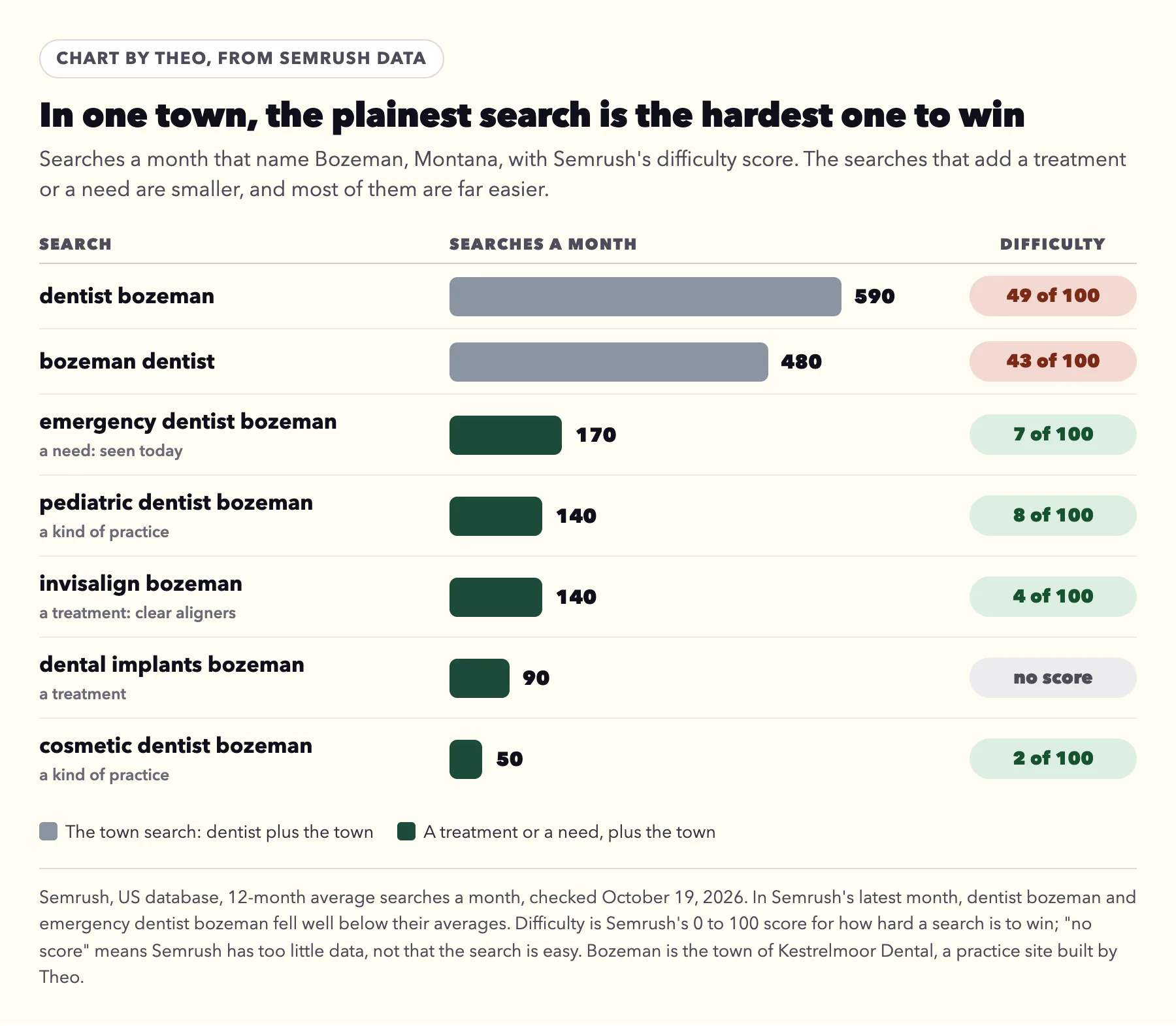
Inside one town the same pattern holds. A chart by Theo of Semrush's US figures for searches that name Bozeman, checked October 19, 2026. Each is a 12-month average, and in Semrush's latest month "dentist bozeman" and "emergency dentist bozeman" fell well below theirs. A new practice site has its best early chances in the smaller, more specific searches, while the town search takes longer.
The pages that answer those searches
That is the heart of dental website SEO. Every search in the table needs a page that answers it in the patient's words, with proof beside it: the dentist's name and credentials, the license line, photos of the real office and a link to the practice's Google reviews. The three dental sites Theo built show three kinds of answer. The full list of pages for a practice site, with the first screen and the insurance wording, is on the page about dental website design.
Prices, for patients paying their own way
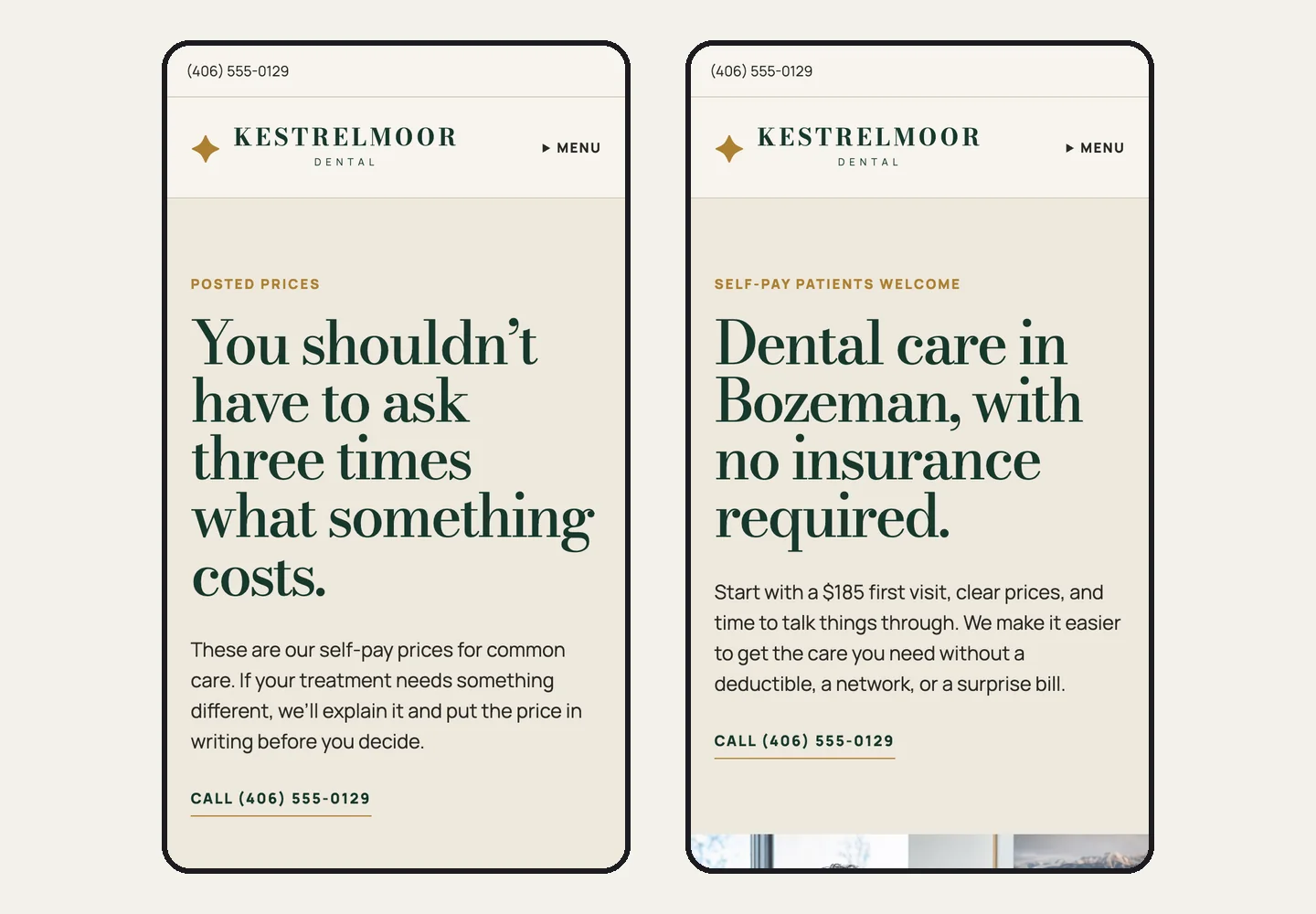
Kestrelmoor posts its self-pay prices, from the $185 first visit to a crown, with the member price beside each of the six treatment fees, and the run added a page for patients with no insurance at all. Both answer the money question before the patient has to call and ask it.
Built by TheoKestrelmoor Dental's prices page, and the no-insurance page the run wrote, on a phone. Open the prices page.
Emergencies, for the patient in pain tonight
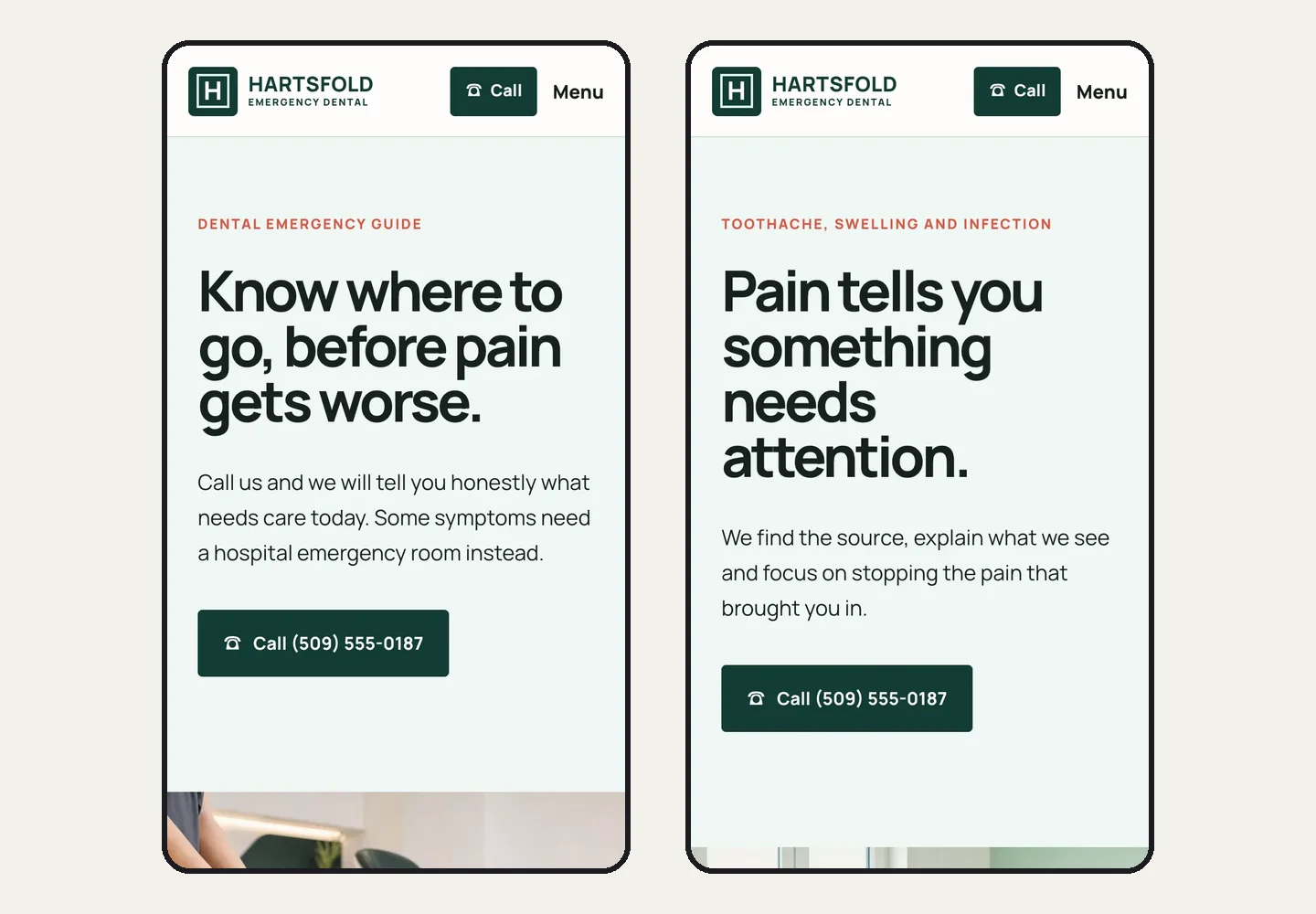
Hartsfold, an emergency-only clinic, gives each urgent problem a page of its own: a guide to what counts as an emergency, then pages for toothache and swelling, broken teeth and lost crowns, and a knocked-out tooth. A general practice can do with one page that says whether it sees patients the same day and who answers the phone after hours.
Built by TheoHartsfold Emergency Dental's emergency guide and its toothache page, each with a call button on the first screen. Open the emergency guide.
First visits, for parents and nervous patients
Pebblefin, a pediatric office, answers what a parent searches before booking: what happens at a child's first visit. Its insurance and costs page says which plans it files with, so nobody has to ask.
Built by TheoPebblefin Pediatric Dentistry's first visit page and its insurance and costs page. Open the first visit page.
Local SEO for dentists: your Google Business Profile and the map
For a search like "dentist near me", Google often answers with a map of nearby practices, built from their Business Profiles. Google's help page on local ranking says: "Local results are mainly based on relevance, distance, and popularity." The same page adds: "There's no way to request or pay for a better local ranking on Google." Both lines were read on October 19, 2026.
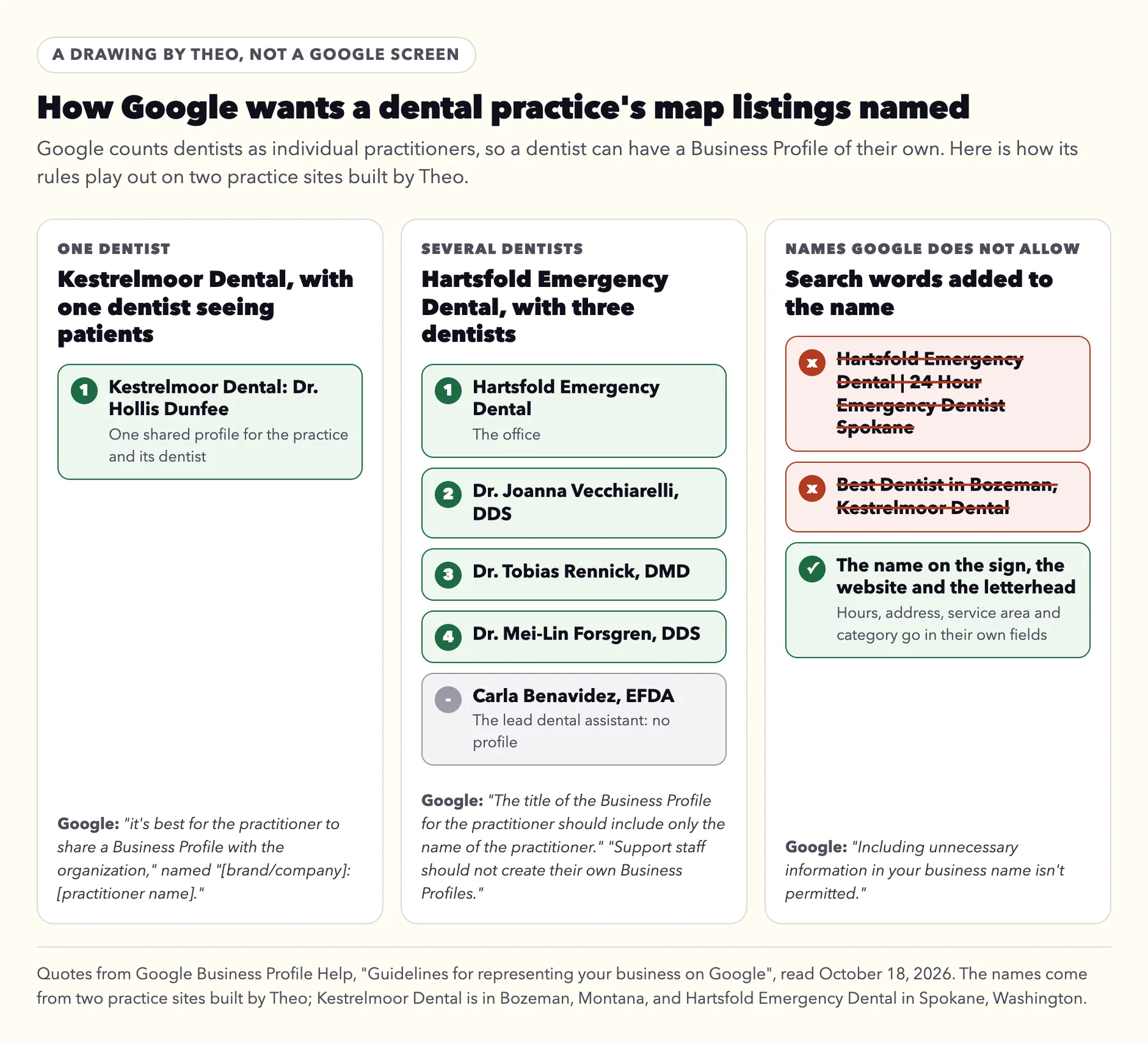
Google counts dentists as individual practitioners. At a practice with several dentists, each one patients can reach directly at that office during its hours can have a profile of their own, next to the practice's. A dentist who is the only one at a branded practice shares a single profile with it. Google's guidelines for representing your business set out how those profiles are named, and the drawing below works through them on two of the practice sites Theo built. What to keep right on the profile itself:
The name: the practice's real name, as it appears on the sign, the website and the letterhead. Google does not allow added words such as a town, a treatment, the hours or a slogan.
Categories: as few as describe the practice, chosen from Google's list, starting with the most specific one for the main work.
Hours and photos: the regular hours patients can come in (Google asks for "regular customer-facing hours of operation"), special hours for holidays, and photos of the real rooms, team and front door.
Reviews: ask every patient the same way after a visit. Google's review policy does not allow a business to offer payment, discounts, free goods or services in exchange for a review, or to ask only the patients it expects to be happy. Reply to the good reviews and the hard ones without confirming the reviewer is a patient or saying anything about their care, even when they describe it. The post on answering negative Google reviews has sample replies for health practices.
The same details everywhere: the practice name, address and phone number match on the profile, the website, directories such as Apple Business Connect, Bing Places, Yelp and Facebook, and any health directory that lists the practice, such as Healthgrades, Zocdoc or the ADA's Find-a-Dentist.
A drawing by Theo, not Google's screen, using names from two practice sites built by Theo. The quotes are from Google Business Profile Help, read October 18, 2026.
Theo's part in the map listing
On Starter and Pro, the Boost checklist takes the office through the Business Profile and the other listings one at a time, and each change is made in the practice's own accounts, so the listings stay in the practice's name. Clicking Connect Google on Theo sets up Google Analytics and Search Console, which are separate from the Business Profile and from Google Ads.
How long dental SEO takes
Search traffic builds over months, not weeks. Google's own guidance on hiring an SEO puts the payoff at four months to a year. The range comes from Google Search Central's video How to hire an SEO, and Google's SEO Starter Guide, in a passage read on October 19, 2026, notes that some changes might show in a few hours, while "others could take several months."
The clearest numbers Theo can share come from Buy My Lunch, a school lunch ordering service and a Theo customer. In the 90 days to September 27, 2026, its site got 929 clicks from Google search, up from 131 in the 90 days before. Its search impressions rose from 7,500 to 61,700, and its average position moved from 13 to 8 as new pages went live.
On a practice's own site, the first sign shows up in Search Console. Impressions, the count of times a page appears in Google's results, begin for the new pages once Google has indexed them, and clicks follow as those pages climb. Google adds pages at its own pace even on a site built for it, as theo.site's own list in the guide to Discovered - currently not indexed shows.
What the practice can see all along is the work: each page, post and fix in the Growth tab, and the clicks and impressions Google reports in the Analytics tab.
How to choose a dental SEO company: six questions to ask first
For owners weighing whether to hire help, Google keeps a page called Do you need an SEO?, last updated on June 5, 2026. Google lists the questions to ask before you hire anyone; here they are with what a straight answer sounds like. The six below are the ones a dental practice should put to anyone it is weighing, with the answer to listen for and where Theo shows it.
The question
A straight answer, for a dental practice
Where Theo shows it
Do we need to hire anyone at all?
Not for the first steps. Google's page says: "If you run a small local business, you can probably do much of the work yourself." Three first steps cost nothing: claim the practice's Business Profile, choose its most specific category, and connect Search Console. What Theo takes off the practice's hands is the rest: the research, the writing and the technical fixes, week after week.
The free audit shows where the current site starts on Google before anyone pays for anything.
Can we open the pages you wrote, and see numbers from a site you worked on?
Ask for both, and keep them apart. Work is pages you can open. A success story is numbers from a named site.
Work: the dental runs above, page by page. Results: Buy My Lunch, a school lunch service on Theo.
Which dental sites have you worked on?
A list of addresses, not logos. Open each one on your own phone.
Three dental sites built by Theo: an emergency clinic, a pediatric office and a practice out of network with every insurer, with posted self-pay prices.
What should change, by when, and how will we know?
Months, not weeks, measured first in Search Console impressions and clicks, then in the calls and bookings the practice tracks. Walk away from anyone who promises first place: Google says no one can guarantee a #1 ranking on Google.
The Analytics tab shows the clicks and impressions Google reports.
Will you keep to Google's spam rules?
Yes, said plainly: no bought links, no link swaps and no pages copied from another practice's site. Google's spam policies name buying links, excessive link exchanges and copied content. Paid or fake reviews are banned separately, by Google's review policy for Maps.
Every page is written for the practice, and the runs above link each one so you can read it.
Will we see every change you make, and why?
Every change, with a link and a reason. Google also reminds owners that they are responsible for what anyone they hire does to their site.
The Growth tab lists each page and fix with the run's note, and a weekly email counts them.
When the pitch arrives by email
One sales email an owner received opened with the line "Are you not in AI searches??" The guide Is SEO worth it for a small business? takes an email like it apart line by line.
Switching from a dental website company without losing your place on Google
Theo does the search work on sites it builds and hosts, so a practice with a site somewhere else starts with a free rebuild. Give Theo the current address and it drafts the new site from it, keeping the look patients know, for the office to check and change in chat. The old site keeps answering patients until the domain points at the new one.
When an address from the old site still gets search traffic, SEO repair on Starter and Pro forwards it to the matching new page with a permanent (301) redirect. On any plan, the office can ask Theo in chat to forward an old address to its new page, and the forward works as soon as Theo adds it. Patient forms, the portal and online payments stay in the practice's own software, and the new site links to them.
A few weeks after a move, Google often emails the practice. The subject reads "New reasons prevent pages from being indexed on site [domain]", and the reason most owners see is "Page with redirect". That is good news: Google is crawling the site and has found the old addresses forwarding to the new ones, along with the http and www versions forwarding to the main address. Theo's SEO repair pulls those reports from Search Console and takes care of them. The guide to Google's indexing email explains every reason it can list, the Page with redirect guide covers the most common one, and how to redesign a website without losing SEO walks through the move itself.
What your office does, and what Theo does
A practice's staff are busy with patients, so the office's part is kept short, and most of it happens once.
Once: connect the practice's domain and click Connect Google, early in Starter's free 30 days, because the search work starts once Theo has set up Google Analytics and Search Console.
Each week: publish the drafts in the Growth tab that read right, and leave auto-publish off so a dentist reads every clinical line first.
When something changes: tell Theo in chat when an associate joins, a treatment is added or the hours move, and drag in photos of the rooms and team.
After every visit: ask for a Google review the same way, every time.
The search work comes with Starter, $69.99 a month with the first 30 days free, and with Pro, $129.99 a month. Both prices include the practice's website and its hosting, and there is no build fee. Basic is the site and hosting without the search work.
How long until the practice shows up higher on Google?
Search traffic builds over months, not weeks. Google's own guidance on hiring an SEO puts the payoff at four months to a year, in its How to hire an SEO video. Google's SEO Starter Guide adds: "you likely want to wait a few weeks to assess whether your work had beneficial effects in Google Search results."
Who owns the website and the pages Theo writes?
The practice does. Every page and post, and the photos of your rooms and team, belong to the practice. Theo looks after the hosting, and on Pro the practice can also read the site's code on GitHub. A domain bought through Theo is registered to the practice.
Can we cancel?
Yes. There is no contract term, so the practice can cancel whenever it likes. The confirmation names the day the subscription ends, and the phone number and appointment button keep working until that day. Before then, copy any pages and photos the practice wants to keep.
Can Theo do SEO on the site I already have?
No. The search work runs on a site Theo builds and hosts, because the same system that writes a page also publishes it, fixes it and lists it for Google. The first step is a free draft: Theo reads the practice's current site from its address and rebuilds it, keeping the look patients know, and the office asks for changes in chat. The current site stays up until the domain is pointed at the new one.
Who checks the clinical details in what Theo writes?
A dentist at the practice, before anything goes live: drafts wait until the office publishes them, and auto-publish stays off unless the office turns it on, as the table of jobs above sets out.
Does Theo set up our Google Business Profile, ads or call tracking?
No. Google Ads, call tracking and review requests stay with the practice, and the Boost checklist on Starter and Pro walks the office through each Business Profile change in its own account, as the table of jobs above shows.
Does the search work cover ChatGPT and Google's AI answers, or is that an add-on?
No add-on: it comes with Starter and Pro. The work aims to make the practice's pages clear and complete enough to be cited when someone asks ChatGPT or Google's AI Overviews about a dentist or a dental question.