SEO for lawyers at solo and small firms: the searches to start with, and the pages that answer them
Law firm SEO is the work that gets your own pages in front of people who need a lawyer for your kind of matter, in your county, before they pick up the phone. On Theo, Starter and Pro include it. Below are the searches a small firm has the best chance at, what the work wrote on an estate planning site Theo built, the search copy your bar may question, and what it all costs each month.
Your first build is on Theo: see the site before you decide
SEO for lawyers is the steady work of getting your firm's own pages shown when someone nearby searches for help with the kind of matter you take. For a solo or small firm it rests on four things: a page for each practice area and each county or court where you really appear, plain answers to what people ask before they call (how long it takes, what it costs, what happens next), a Google Business Profile that keeps gathering reviews, and a site that opens quickly on a phone. The searches to chase first are rarely "divorce lawyer near me", which Google answers with map listings. They name a practice and a place, such as "dui lawyer lexington ky", or ask a question with a state in it, such as "how much does a living trust cost in california". On searches like those two, firms' own pages hold most of page one. On Starter and Pro, Theo does the website part: it researches those searches, drafts the pages and fixes technical issues. On every plan, connecting Google also submits your sitemap through Search Console. The search work never rewrites legal and policy pages, disclaimers included, unless you ask for that exact edit. Every draft waits in your Growth tab until you approve it, unless you switch on auto-publish; for a firm, keep it off.
In Theo's audit of 6,861 small business websites, 53 percent of the 532 professional services sites with search data got an estimated zero visitors a month from Google search, and 74 percent got fewer than ten. The sample is the sites whose owners ran Theo's free audit. See the research.
On an estate planning site Theo built
What the search work did on a law firm site
Wexcombe Estate Planning, an estate planning site built by Theo, is the practice of a solo estate planning attorney in San Luis Obispo County, California. On October 19, 2026, Theo's Growth Engine, the search work on Starter and Pro, ran on it three times with one job per run: a post, a county page and a check of the whole site. Each batch was published from the Growth tab. On a firm's own site, the same jobs are spread across the weeks.
Before the first run, the site had eleven pages, privacy and terms among them, and every page already named its preferred address. The runs added a page for San Luis Obispo itself, with structured data naming the service, the firm and the county.
The searches it chose
Before drafting, each writing run looked up what people type and how many strong pages already compete for it. The figures are the Semrush US estimates the engine stored that day: average searches a month, and keyword difficulty on a scale of 0 to 100, where a lower score means fewer strong pages already compete.
The checklist search is the larger and harder of the two. With no search history yet to draw on, the run picked a topic with strong demand that fits Wexcombe's services, as its note says. That 4,400 is Semrush's 12-month average, and the months are uneven: in quiet months the search runs at about a fifth of its peak (Semrush US trend, checked October 19, 2026). The county search is small, with a difficulty score of just 3.
What it wrote
A checklist post, a county page and a Resources section
A writing run drafts one piece of work, reviews it at phone, tablet and desktop sizes, and links it from the pages nearby. The pictures were taken from the live site after the last publish.
Built by TheoWexcombe Estate PlanningStep 3 of the checklist, on the documents a plan needs.See the live site
01
A checklist for families who are not ready to call
Estate Planning Checklist: Where to Start runs about 1,250 words in five steps: start with your people and priorities, take stock of what you own, understand the core documents, make the hard conversations smaller, then sign, store and review the plan. It links to California's official advance health care directive form, to FINRA's guidance on beneficiary designations and to the Probate Code section that sets probate attorney fees.
It closes with four questions and answers and an invitation to the free first meeting, and it links on to the wills, living trusts, first meeting, flat fees and contact pages.
Built by TheoWexcombe Estate PlanningThe new county page, as it opens on a laptop.See the live site
02
A page for the county the firm serves
Estate Planning Attorney in San Luis Obispo is a page of about 1,200 words for people looking for an estate planning attorney there. It covers what a plan can put in place, five steps from the free meeting to the 60-day funding call, when to begin, how the parts of a plan fit together, and four common questions, with the meeting and the flat-fee packages one click away.
The homepage links to it from its services introduction. Its structured data names the service, the firm behind it, the county it serves and three of its questions.
Built by TheoWexcombe Estate PlanningThe Resources hub, with its one category.See the live site
03
A Resources section, opened for one post
The post opened Resources, a hub page, and its first category, Estate Planning Basics. Resources took the place of How it works in the main menu and was added to the footer.
The hub shows only the category that holds a post, and the note suggests estate planning for parents as the next topic for that same category rather than a new, empty one.
What it linked and checked
The runs linked each new page into the site as they wrote it. The third run wrote nothing: it read the live site page by page and found nothing that needed a change.
What it did
Where
Why it helps
Linked the new pages in
Resources in the main menu, in place of How it works, and in the footer; the county page from the homepage's services introduction
A reader on a page they already know, and Google too, can follow a link straight to the new one.
Gave the checklist next steps
Links from the post to five existing pages: wills, living trusts, first meeting, flat fees and contact
A reader who finishes the post has a short path to the firm's services and the free meeting.
Added the new pages to the sitemap
The Resources hub, its category, the checklist and the county page
The sitemap is the list Google reads to find every page on a site.
Checked the rest
Every page in the sitemap with its title, description and preferred address, the instructions for search engines, and a test address to confirm the site's not-found page answers it
All of it was in order, so nothing changed.
Left alone on purpose
Rewrites of existing pages, and redirects
No search data yet pointed to a page worth improving, and the site had no old addresses to forward.
Your Growth tab
The note the county page run left
After each run, a short note appears in the Activity list of the Growth tab, saying what Theo looked at, what it changed and why, with links. Below are two parts of the note from the San Luis Obispo run, word for word.
On a firm's own site, each draft waits for a lawyer to publish it unless auto-publish is on. A weekly email also counts the new posts, pages and fixes.
Pricing
What it costs, in full
The ongoing search work is part of Starter and Pro. Basic is the site and hosting on its own. Starter is free for the first 30 days.
Plan
Per month
Ongoing search work
Chat credits
Best for
Basic
$29.99
Not included
1,500 a month
Owners who just want their site live and easy to update.
StarterFree for 30 days
$69.99
Included, uses no credits
4,500 a month
Owners who want the site handled without heavy publishing volume.
Pro
$129.99
Included, uses no credits
7,000 a month
Owners who want more capacity, more publishing, and more room to experiment.
No contract, cancel anytime, and you own the site and its content. The pricing page lists what each plan includes and how chat credits work.
The searches a small law firm should start with
People looking for a lawyer type three kinds of search, and each kind is won in a different place. Knowing which one you are after decides what gets written.
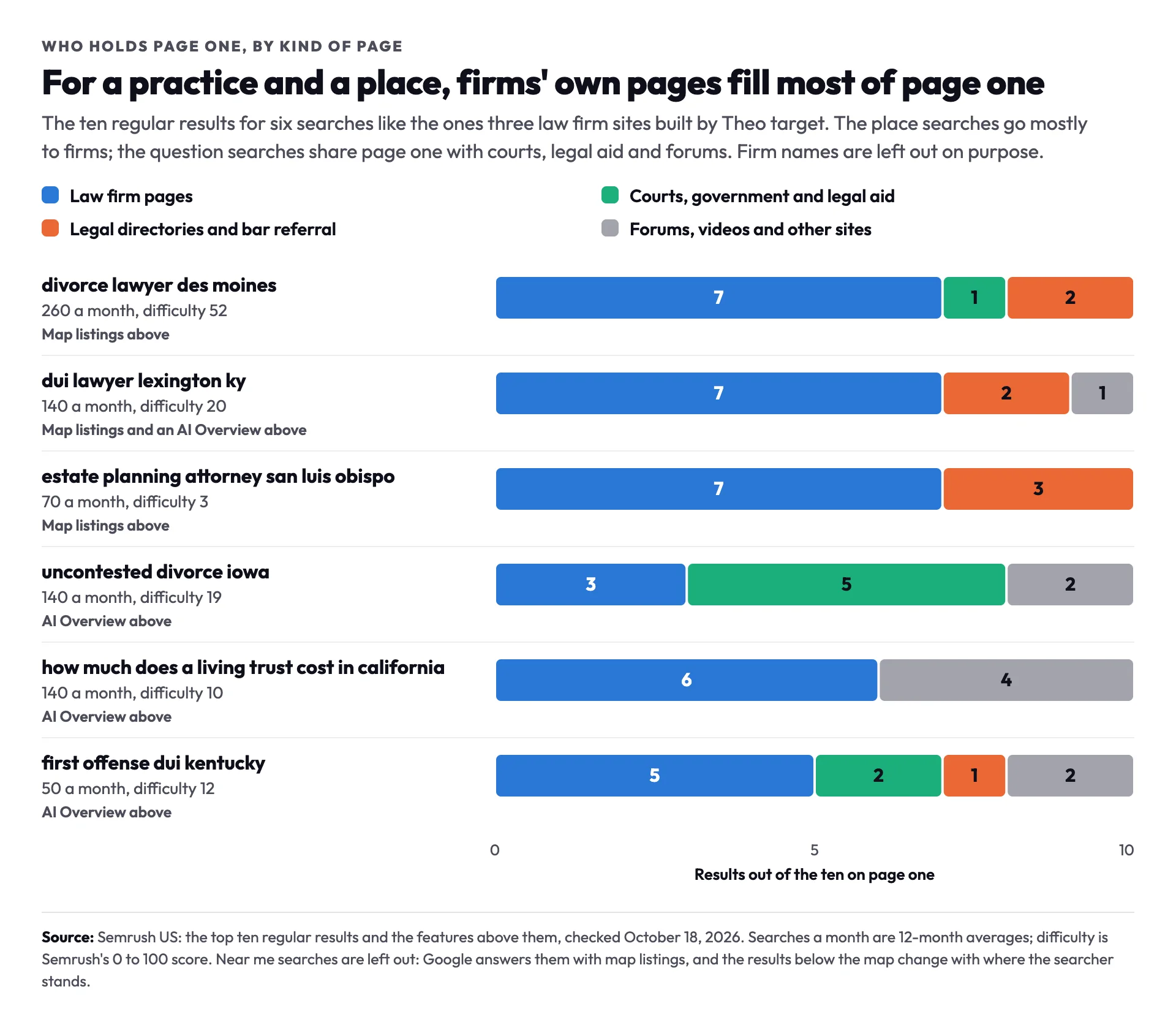
"Near me" searches carry the big numbers. Google answers them with map listings first, and the results under the map shift with where the searcher is standing, so your Google Business Profile does most of the work there. A practice and a place, such as "divorce lawyer des moines", draws far fewer searches, but from people ready to call, and law firms' own pages hold most of page one. A question with a state in it, such as "uncontested divorce iowa", comes earlier, while someone is still working out what happens next. Firms share those results with court pages, legal aid and forums.
The table uses the towns of three law firm sites built by Theo: Ellingsrud Family Law in Des Moines, Iowa, Kettleby Criminal Defense in Lexington, Kentucky, and Wexcombe Estate Planning in San Luis Obispo County, California.
Search
Searches a month
Difficulty
What holds page one
The page it needs
divorce lawyer near me
27,100
50
Map listings, then results that change with the searcher's location
Your Google Business Profile, backed by a divorce page
estate planning attorney near me
22,200
56
Map listings first, as above
Your Business Profile, with practice pages behind it
dui lawyer near me
18,100
40
Map listings first, as above
Your Business Profile, with a DUI page behind it
divorce lawyer des moines
260
52
Map listings, then 7 firm pages, 2 legal directories and the city's website
A divorce page that names the city and the counties where you file
dui lawyer lexington ky
140
20
Map listings, then 7 firm pages, 2 legal directories and a social page
A DUI page that names the courts where you appear
estate planning attorney san luis obispo
70
3
Map listings, then 7 firm pages and 3 directories, one of them the county bar's referral service
A county page, like the one the Growth Engine wrote for Wexcombe
uncontested divorce iowa
140
19
5 court and legal aid pages, 3 firm pages, a legal publisher and a forum
A plain timeline page, week by week
how much does a living trust cost in california
140
10
6 law practices' own pages, a legal plan company, a finance site, a forum and a video
A fees page that states your flat fee and what it covers
first offense dui kentucky
50
12
5 firm pages, 2 state pages, a DUI lawyers' association, a forum and one other site
A page on what a first offense can carry and what happens next
What page one holds for six of these searches
Searches a month are Semrush's 12-month US averages, and difficulty is Semrush's score from 0 to 100, where lower means fewer strong pages already compete. Every figure was checked on October 18, 2026. The chart counts the ten regular results on page one for six of the searches, by kind of page. On the three place searches, those ten sit below the map listings Google showed.
Two things stand out. Where a search named a practice and a place, seven of the ten results were firms' own pages and the legal directories held two or three. And Google showed an AI Overview, its written summary above the results, on all three question searches, with a law firm's own page among the sources each one linked. The guide to showing up in AI Overviews covers what those pages have in common.
A chart drawn from Semrush's US data, checked October 18, 2026. Firm names are left out.
One Business Profile or several?
"Near me" searches lean on the map listing, so set the firm's listings up the way Google asks. Google's guidelines for representing your business on Google, read on October 19, 2026, count lawyers as individual practitioners, and a practitioner's profile may carry a title such as JD or Esq. How many profiles a firm keeps depends on how many lawyers clients meet at each office.
The only lawyer at an office that carries a firm's brand. Google says it is best to share one profile with the firm, named in the form "[brand/company]: [practitioner name]".
Several lawyers at one office. The office gets a profile of its own. A lawyer who meets clients there and can be reached there during the posted hours may also have one, titled with that lawyer's name alone and not the firm's. Google says "Support staff should not create their own Business Profiles," and at a law firm that means paralegals and assistants.
One profile per lawyer, never one per practice area. In Google's words, "A practitioner shouldn't have multiple Business Profiles to cover all of their specializations." A lawyer who takes both divorce and custody matters keeps a single profile for both.
Family law, criminal defense and estate planning SEO
Each practice meets its clients at a different moment, so the page that wins looks different in each. Theo built a law firm site for each of the three, and each has a page made for the search its clients type.
Family law and divorce: answer how long it takes
Someone searching for family law help is often still deciding whether to start. Under most divorce searches sits one question, how long will this take, and the state's law sets part of the answer. In Iowa, "uncontested divorce iowa" draws about 140 searches a month at a difficulty of 19, while "divorce attorney des moines" draws 320 at 43.
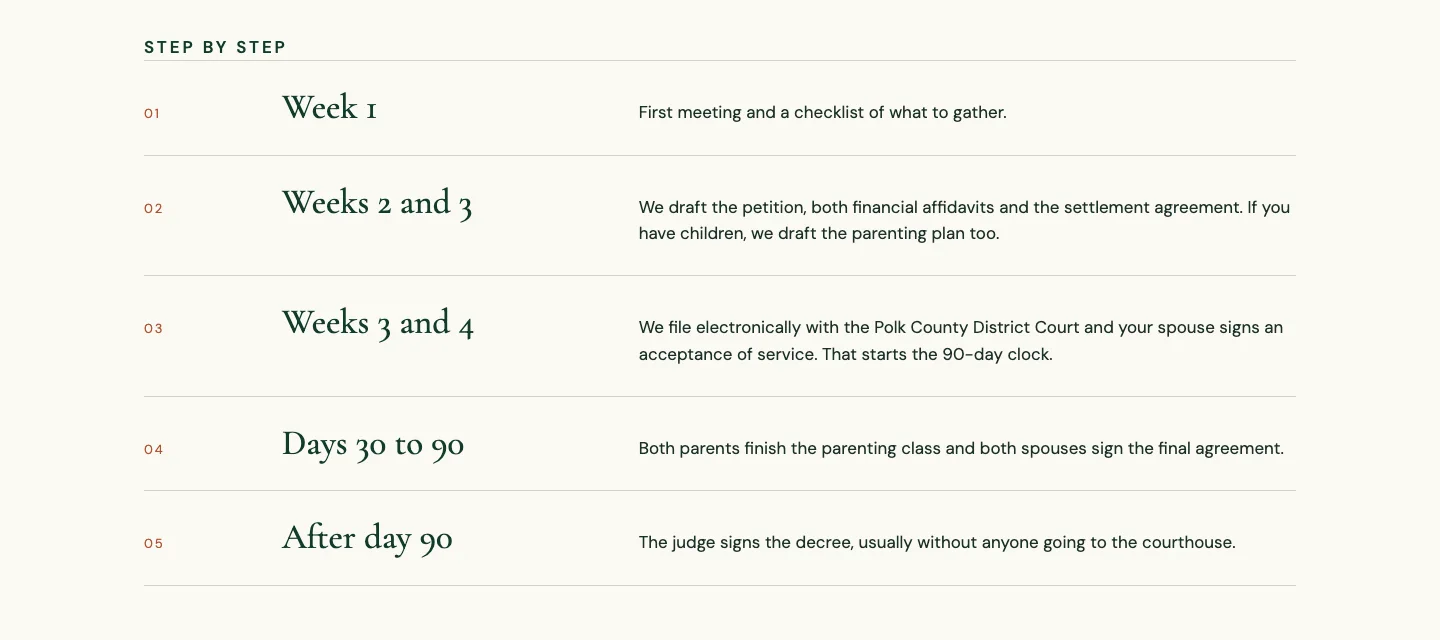
Ellingsrud Family Law's timeline page answers it on the first screen: about four months for most couples. Iowa law generally makes a couple wait 90 days after the original notice is served, or after a waiver or acceptance of notice is filed (Iowa Code section 598.19), so the page walks through the weeks around that wait, then what slows a case down and what the flat fees are. One page like this answers a real question for one state and its counties, which is what a divorce client searches for.
Built by TheoEllingsrud Family Law's timeline, from the first meeting to the signed decree.
Criminal defense and DUI: name the courts
A DUI search often comes the night of an arrest or the morning after, on a phone, from someone who wants to know what happens next and who can help in the court handling the case. "Near me" searches go to the map. A site's chance is on searches that name the place or the charge: "dui lawyer lexington ky" draws about 140 a month at a difficulty of 20, and "first offense dui kentucky" about 50 at 12.
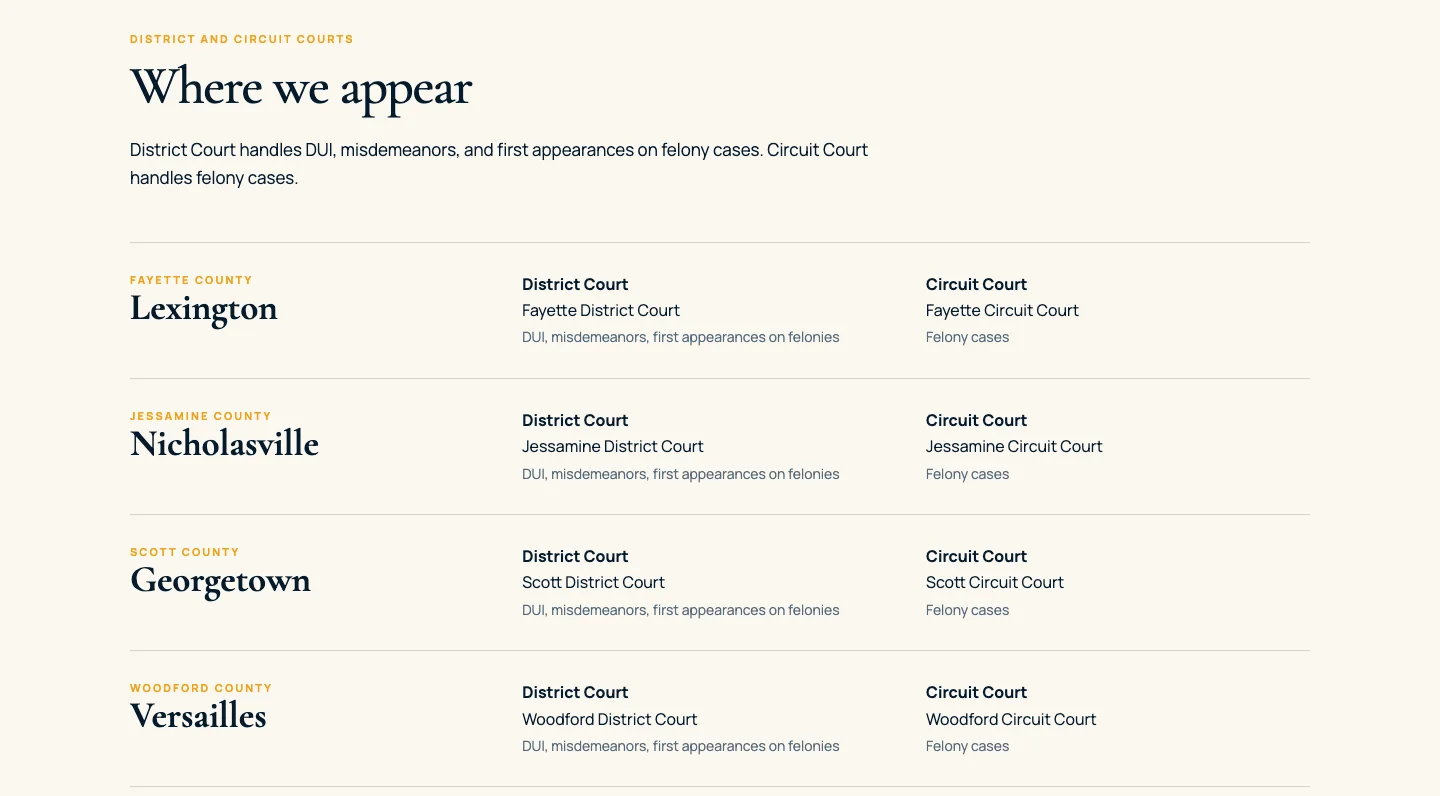
Kettleby Criminal Defense lists every court where its lawyers appear, county by county, with what each court hears. A page that names the District and Circuit Courts gives a reader a reason to call and gives Google a page plainly about that place. Kettleby's DUI and Just arrested pages cover the rest: what each offense can carry, and what to do tonight.
Built by TheoKettleby's courts page names each county, its District and Circuit Court, and the cases each one hears.
Estate planning: say what the plan costs
Estate planning searches come from the kitchen table, often from an older client or a grown child helping a parent, and they are rarely urgent. People ask what a document does and what it costs. In California, "how much does a living trust cost in california" draws about 140 searches a month at a difficulty of 10, and "living trust vs will california" 90 at 14. Across the US, the broader "wills and trusts lawyer" draws about 1,300 at 16.
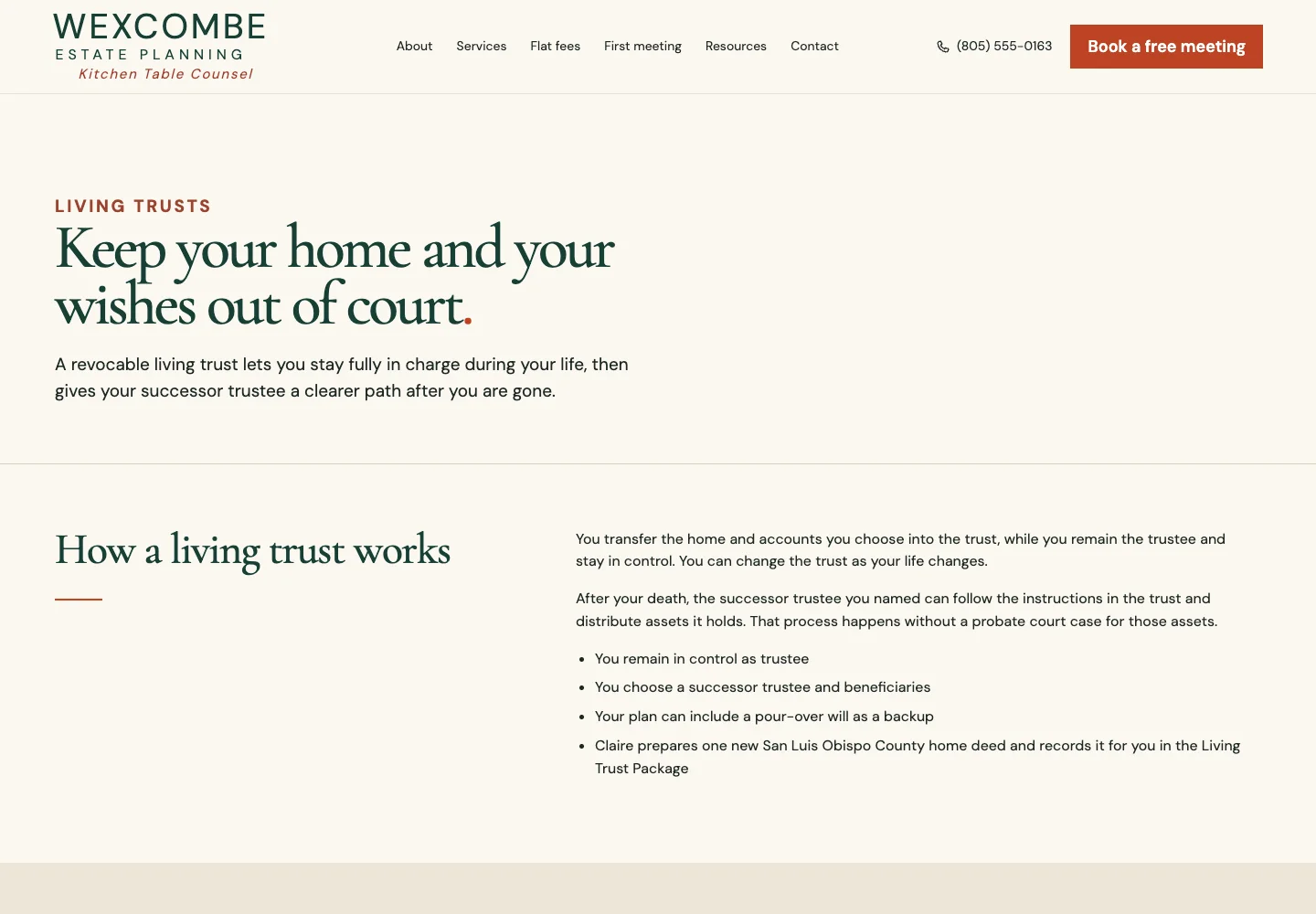
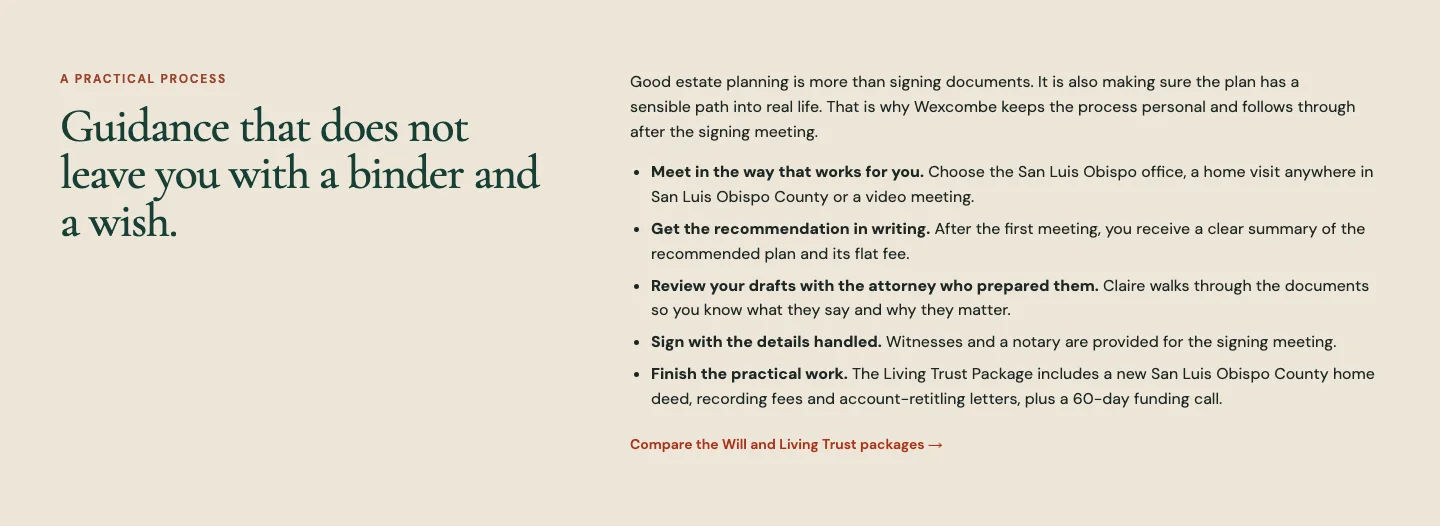
Wexcombe's living trusts page explains how a trust works in two short paragraphs and four points, and its fees page sets both flat-fee packages side by side. The run added the county page and the checklist post shown above, so the site now has pages on its documents, its fees and its county.
Built by TheoWexcombe's living trusts page, with Resources in the menu since the run.
County and court pages that are worth having
A county page earns its place when it holds what is true only there: the courthouse and the cases it hears, how the process runs locally and how long it takes, how a client meets you, and what it costs. Kettleby's courts page and the San Luis Obispo page the run wrote both do that.
A set of pages that only swap the town name is a different thing, and Google's spam policies name it. They describe doorway abuse as "when sites or pages are created to rank for specific, similar search queries" and list, as one example, "Having multiple domain names or pages targeted at specific regions or cities that funnel users to one page." Scaled content abuse is "when many pages are generated for the primary purpose of manipulating search rankings and not helping users" (Google Search Central, spam policies, last updated August 28, 2026).
So add a county page only where the firm takes matters, and give it something a client in that county needs to know.
Built by TheoThe county page the run wrote spells out how meetings, the written fee and the signing work for a San Luis Obispo County client.
What law firm SEO covers, and who does each part on Theo
What a firm needs to know is who does each job. Here is the split when the site is on Starter or Pro.
The work
What it means for a law firm
Who does it
Research
Finding the searches clients type for each matter and place, with Semrush's numbers, and what already holds page one
Theo, on Starter and Pro
Practice area pages
A page for each kind of matter you want more of, such as uncontested divorce, first-offense DUI or living trusts
Theo drafts; a lawyer at the firm approves
County and court pages
A page for each county where you take matters, with its courts, process and timeline
Theo drafts; a lawyer at the firm approves
Client questions
Posts on how long a matter takes, what it costs and what happens next
Theo drafts; a lawyer at the firm approves
Technical fixes and speed
Titles and descriptions, a preferred address for each page (a canonical tag), the sitemap, links that lead nowhere, and load time on a phone
Theo, on Starter and Pro
Structured data
Labels in a page's code that tell Google what it is: a law firm (the LegalService type), a service, or a set of questions and answers
Part of the technical work. Ellingsrud Family Law, a family law site Theo built, carries LegalService; Wexcombe's new county page carries Service data naming the firm as a LegalService, plus FAQ data
Getting pages into Google
Sending Google the sitemap, the list of the site's pages, through Search Console, its free tool for site owners
Theo, once someone at the firm connects Google
Google Business Profile and listings
The map listing with its categories, hours and photos, plus Bing Places, Apple Business Connect, Yelp and Facebook
You, with the Boost checklist on Starter and Pro guiding each one
Bar and legal directories
Your state bar's lawyer directory and the legal directories clients check
You; they are not on the Boost checklist
Reviews
Asking every client the same way, and replying without revealing anything about a matter (ABA Formal Opinion 496, January 2021)
You
AI answers
Being among the pages that Google's AI Overviews and ChatGPT draw on
Part of the same work on Starter and Pro, not an add-on
Reporting
What was added and fixed, and what Google reports
The Growth and Analytics tabs, and a weekly email
Your part, in a firm's week
Once: point the firm's domain at the site and click Connect Google, so Theo can set up Analytics and Search Console. The search work starts after that, so do it early in Starter's 30 free days.
When drafts arrive: a lawyer reads each one in the Growth tab and publishes it, or asks for changes in chat.
When something changes: a new associate, a new county, a fee change or new notice wording from your bar is one line in chat.
At the close of each matter: send every client the same short review request, with your Google review link.
Search copy your bar may question, and what to approve instead
Search copy is lawyer advertising. A page title, a county page, a review request and the short description under your firm's name in Google all count, because the rules reach every communication about a lawyer's services. The table follows the ABA Model Rules. Your state's version decides, and your bar's ethics line is the place to ask about it.
What search copy sometimes says
Why your bar may object
What to approve instead
A title such as Best Divorce Lawyer in Des Moines
ABA Model Rule 7.1, comment [3]: an unsubstantiated comparison of your services with other lawyers' may be misleading.
Divorce and custody lawyer in Des Moines, for Polk and Dallas counties
We win DUI cases
The same comment: even true results can mislead if they lead a reader to expect the same outcome without the facts of each case.
What a first-offense DUI can carry in Kentucky, and what the firm checks in every case
A running total of dollars recovered
Comment [3] again. It says an appropriate disclaimer or qualifying language may help, and your state may require its own wording beside any result.
Results only in the form your state allows, with its notice next to each one
Certified DUI Specialist, with no certifying body named
Model Rule 7.2(c): a lawyer may say they are certified as a specialist only if an approved or ABA-accredited organization certified them and that organization is clearly named. Some states also limit the plain word specialist.
Practice focused on DUI defense, or the certification with the organization's name
Reviews written by staff, bought, or rewarded when they praise the firm
The FTC's rule on consumer reviews, 16 CFR Part 465, bars fake reviews and incentives tied to a review's sentiment, and Google's Maps policy bars incentives for posting any review.
Real reviews from real clients, with nothing offered in return
A review request sent only to happy clients
Google's Maps content policy does not allow merchants to "selectively solicit positive reviews from customers."
The same short request to every client at the close of a matter
Dozens of town pages that differ only in the town's name
Google's spam policies on doorway abuse and scaled content abuse, quoted above.
A page for each county where you take matters, with its courts, process and timeline
What Theo does, and what stays with the firm
Before the Wexcombe run went on this page, Theo's team read both drafts for comparisons with other firms, promised outcomes, testimonials and past results, and found none. Where your notices sit on the site itself is covered on the page about law firm website design.
Drafts wait for a lawyer. Every page the search work writes sits in your Growth tab until someone at the firm publishes it. Auto-publish stays off unless you turn it on, and a firm should leave it off.
Legal pages stay as approved. The search work does not rewrite, shorten or optimize your disclaimers, terms, privacy policy or other legal and policy pages unless you ask for that exact edit. It may still make mechanical fixes around them, such as a preferred address, a sitemap entry or a link.
Judgment calls get flagged. If something on a legal or policy page seems to need a judgment, the run note flags it for you instead of guessing.
No invented figures. Drafts never invent statistics.
The read is yours. A lawyer at the firm checks each draft against your state's rules before publishing it, and your bar's ethics line takes the hard questions.
What an SEO agency for lawyers costs, and what Theo costs
Law firm SEO is usually sold as a monthly retainer. As of October 2026, one national law firm SEO agency lists $2,500 to $10,000 or more a month for SEO, with an entry tier of $2,000 to $6,000 for one practice area in one market.
Is a retainer in the thousands too much? The fair test is what the money buys each month: how many pages were written and published, what was fixed, which listings were kept current, how links were earned, and who read the copy against your bar's rules. Ask for last month's list before you sign anything.
A law firm SEO agency
Doing it yourself
Theo, Starter or Pro
Monthly cost
A retainer, such as the published example above
Your time, plus any tools you pay for
Starter $69.99 a month, free for the first 30 days; Pro $129.99 a month
The website and hosting
Ask whether the work runs on your current site or one the agency builds
Your current builder or host
Included: Theo builds and hosts the site
Who writes the pages
The agency's writers
You, between matters
Theo drafts them
Who reads them against your bar's rules
A lawyer at your firm
You
A lawyer at your firm, before anything goes live
Google Business Profile upkeep
Ask whether it is in the retainer
You
You, with the Boost checklist guiding each step
Bar and legal directory listings
Ask whether it is in the retainer
You
You; not on the Boost checklist
Link outreach to other sites
Often listed in plans; ask how links are earned
You
Left to the firm
Contract
Set by the agreement; get the term in writing
None
None; cancel any time
Who owns the pages and the domain
Set by the agreement; get it in writing
You
The firm
What you see each month
The agency's report
Whatever you track yourself
Each page and fix in the Growth tab, plus a weekly email
Where a firm's first links come from
The table leaves link outreach to the firm, and the place to start is close to home. On page one for "estate planning attorney san luis obispo", one of the ten results is the county bar's lawyer referral service, and directories held two or three of the ten on each of the three practice and place searches above (Semrush US, October 18, 2026). So the first links to go after are the firm's own listings: its county bar's referral service, its state bar profile, and the legal directories that show on page one for its practice and city. Keep the firm's name, address and phone the same on every one.
SEO or Google Ads for a law firm?
Ads put the firm near the top of the page the day they start and disappear the day the budget stops. Pages the search work writes stay on the site and keep answering searches. One does not buy the other: Google's page Do you need an SEO? says "Advertising with Google won't have any effect on your site's presence in our search results." Many firms run both.
Is SEO worth it for a small law firm?
It depends on what one new matter is worth to the firm and how many months it can wait. The guide on whether SEO is worth it for a small business works through the break-even sum with your own figures, and reads a typical SEO pitch line by line.
Before you hire anyone for law firm SEO
Google publishes a page for owners deciding whether to hire help, Do you need an SEO? (last updated June 5, 2026). It includes a line worth knowing: "If you run a small local business, you can probably do much of the work yourself." For a firm that would rather hire, five of its points matter most.
Promises of the top spot. If an SEO promises that its changes will put you in first place in search results, Google's advice is to find someone else.
Cold pitches. Google tells owners to be wary of SEO firms and agencies that email "out of the blue," the kind of pitch many firms know well.
Your name on their work. "Ultimately, you are responsible for the actions of any companies you hire." The bar sees it the same way: comment [1] to ABA Model Rule 7.1 says the rule governs all communications about a lawyer's services, including advertising, so copy an agency writes for you is still yours.
Seeing the changes. One question Google suggests asking: "Will you share with me all the changes you make to my site, and provide detailed information about your recommendations and the reasoning behind them?"
Links. "You should never have to link to an SEO." Choose bar and legal directories you would trust as a client over batches of bought links.
Questions only a law firm needs to ask
Theo's answers, for the record: every draft waits in the Growth tab until someone at the firm publishes it, so a lawyer can read each one first; auto-publish stays off unless you turn it on; the firm owns its pages, its domain and its own listings; there is no term; review requests are the firm's to send; and wording such as specialist, or a comparison with other firms, is one line in chat to change before it goes live.
Who reads each page against my state's rules before it goes live, and can I stop anything from publishing?
Who owns the domain, the site, the pages and the Google Business Profile if we stop working together?
How long is the term, and what happens to the pages when it ends?
Are reviews requested from every client, with nothing offered in return?
Will any page call me a specialist or compare the firm with other firms?
How long law firm SEO takes
Search traffic builds over months, not weeks. Google's own guidance on hiring an SEO puts the payoff at four months to a year. The source is Google's video How to hire an SEO. Google's SEO Starter Guide (last updated December 10, 2025) adds: "Some changes might take effect in a few hours, others could take several months."
For a firm, the first sign is not a phone call. It is impressions in Search Console: the new pages appearing in results before anyone clicks. Clicks follow as the pages move up. The small practice and place searches in the table above are the ones to watch first, and every page the work adds stays on the site.
What you can see all along is the work: each page and fix is listed in the Growth tab, and the weekly email counts what was added.
If your firm already has a website
The search work runs on a site Theo builds and hosts, so the system that drafts a page can also publish it, fix it and submit the sitemap. If the firm has a site now, paste its address and Theo rebuilds it as a starting draft that keeps the look clients know. Clients keep seeing the old site until the firm's domain is pointed at the new one.
Firms with years online worry about losing their place in Google. When an address from your old site still gets search traffic, SEO repair on Starter and Pro forwards it to the matching new page with a permanent (301) redirect. On any plan, you can ask Theo in chat to forward an old address to its new page, and the forward works as soon as Theo adds it. The post on redesigning a website without losing SEO walks through it.
After a move, Google often sends an email with the subject "New reasons prevent pages from being indexed on site", followed by the firm's web address. It is good news: Google is reading the new site, and on a site that just moved, the reasons it lists are mostly old addresses now forwarding to the new ones. Theo's SEO repair, part of Starter and Pro, reads Search Console and takes care of them. The Search Console guide explains each reason, and the indexing post covers the steps.
The site itself, with practice pages, bios and your bar's notices, is on the page about law firm website design. Search work for every kind of small business is covered under small business SEO services.
FAQ
Questions lawyers ask about SEO
How much does SEO for a law firm cost on Theo?
Starter, at $69.99 a month and free for the first 30 days, includes the search work, the website and its hosting. Pro, at $129.99 a month, adds more pages and posts each week. There is no build fee and no contract. Law firm SEO agencies usually charge a monthly retainer in the thousands, as the cost section above shows.
How long does SEO take for a law firm?
Search traffic builds over months, not weeks. Google's own guidance on hiring an SEO puts the payoff at four months to a year. The first sign is impressions in Search Console, meaning the new pages are appearing in results; clicks follow as the pages move up.
Who owns the website and the pages Theo writes for my firm?
The firm owns every page, post and photo on the site. A domain the firm already has stays with its registrar, and one bought through Theo is registered to the firm. Theo hosts it all, and on Pro the firm also gets read-only access to the site's code on GitHub.
Can the firm cancel at any time?
Yes, and there is no term to finish. The cancellation confirmation shows the date the plan ends, and the site stays up until then, so save the text and images the firm wants to keep before that date.
Can Theo do SEO on the site I already have?
No, not on the old site: the search work needs a site Theo builds and hosts. Give Theo your current address and it rebuilds the site as a starting draft you refine in chat, and clients keep seeing the old site until your domain points at the new one.
Will the pages Theo writes follow my state bar's advertising rules?
That read stays with the firm. Every draft waits in the Growth tab for a lawyer to approve it, as long as auto-publish is off. The search work does not rewrite your disclaimers or other legal pages unless you ask for that exact edit, and it flags a question about those pages instead of guessing. Give Theo your state's notice wording in chat and it places it on the site. For hard questions, your bar's ethics line is the place to ask.
Does Theo handle my Google Business Profile and lawyer directory listings?
You make those changes in your own accounts, so they stay in the firm's name. On Starter and Pro, the Boost checklist walks you through Google Business Profile, Bing Places, Apple Business Connect, Yelp, Facebook and more. Your state bar's lawyer directory and the legal directories are not on the checklist, so claim and update those yourself, with the same firm name, address and phone everywhere.
Will this help my firm show up in ChatGPT and Google's AI answers?
Work toward those answers is part of the search work on Starter and Pro, not an add-on. It writes pages that answer a client's question in plain words, the kind of page Google's AI Overview linked to on the three question searches above.