
The easiest way to show up when people search for bakeries near me
Quick answer. The easiest way is to claim your free Google Business Profile first, then link it to a simple website that shows your menu, prices, hours and address as typed text. If you already take payments with Square, Square Online's Free plan ($0 a month) gives you an ordering page and a basic site that you build yourself. If you run Toast POS, Toast Websites syncs with your menu, though Toast does not publish its price. Wix and Squarespace paid plans start at $17 and $19 a month billed yearly and leave the search upkeep to you. Theo builds and hosts the site for you from $29.99 a month, keeps working on search from $69.99 a month, and links its Order buttons to Toast or Square, but it does not manage your Google profile.
This guide draws on vendor pricing and help pages read in October 2026, Google's own Business Profile documentation, and Theo's audit of 10,470 small business websites.
Where bakeries near me results come from
A search for "bakeries near me" often brings up a map with a short list of local businesses under it. Each entry in that list is a Google Business Profile, the free listing Google keeps for a local business. Google says that "creating a Business Profile and listing your business on Google is free," and that a profile shows your hours, website, phone, location, photos and reviews on Maps and Search.
The website is the second piece. The profile links to it, and a customer who wants the full menu or the rules for cake orders taps through. The two are also linked behind the scenes. Google's menu editor help page says "Google may transcribe menu data from your business website" (owners can opt out). A menu typed as text is plain for Google, and for customers on a phone, to read.
Each piece answers a different kind of search. Someone on the sidewalk at seven in the morning wants the nearest bakery that is open, and the map listing answers that. Someone ordering a birthday cake for Saturday needs the notice, the sizes and the prices, and those answers belong on a website page. A Business Profile is not a website builder, so it cannot hold a custom cakes page.
What Google says decides the map results
Google publishes the broad rules for its local results. Its help page of tips to improve your local ranking says "Local results are mainly based on relevance, distance, and popularity," then describes each factor, calling the third one prominence.
- Relevance is "how well a Business Profile matches what someone is searching for." A complete profile, with the right category and an honest description of what you bake, gives Google more to match.
- Distance "refers to how far each business is from the customer who's searching." Nobody can move the shop, so a customer across town may see another bakery first. That is not a fault in your profile.
- Prominence "means how well-known a business is." Google says it is also based on "how many websites link to your business and how many reviews you have."
The same page says "There's no way to request or pay for a better local ranking on Google." A company selling a guaranteed top spot in the map is selling something Google says it does not offer. What an owner can do is keep the profile complete and accurate, which Google says makes a business "more likely to show up in local search results," keep reviews coming in, and give other local sites a reason to link to the bakery. A farmers market's vendor page or a wedding venue's list of cake makers is the kind of link that fits.
How to get your bakery on Google Maps
You get your bakery on Google Maps by claiming a free Google Business Profile, verifying it and filling in every part of it that applies to you. This part is yours to do, because the profile belongs to you.
- Claim the profile. Search for your bakery's name on Google Maps. If a listing already exists, claim it. If not, start one from Google's Business Profile page.
- Verify it. Google's local ranking tips say verifying "tells Google that you're authorized to represent the business." Google chooses which methods to offer, and some owners are asked for a short video, which what to film for Google's video verification covers shot by shot.
- Pick your category. Choose the one that says what the shop is, such as Bakery. Google's tips list the kind of business you are among the details that help a profile match a search.
- Set regular hours and special hours. Google's tips ask for your business hours, including special hours. Add them for holidays and seasonal closures so nobody drives over to a locked door.
- Fill in the extra details. Google's tips mention details such as parking or Wi-Fi. For a bakery, add parking and seating.
- Add photos. Show the shopfront from across the street, the counter, the case in the morning and your best sellers.
- Add your menu. Google's menu editor is "available to food and drink businesses" and holds items, descriptions and prices grouped in sections. Changes can take 24 to 48 hours to appear. The profile also takes one menu link. Google's guidelines say "Menu URLs can't be direct links to third-party ordering or delivery services," so point that link at the menu page on your own website.
- Add your order link. Google lets you add custom ordering links and set a preferred provider. Third-party ordering services that state they have an authorized relationship with your business are listed automatically. In the US, Order with Google can take pickup and delivery orders right on the profile.
A complete profile does not guarantee a place in the map results. Google decides those, and no website company controls them.
Reviews and replies help a bakery's map listing
Reviews are the one part of the profile that keeps growing after setup. Google's local ranking page says "Positive reviews and helpful replies can help your business stand out," and, as quoted above, it counts the number of reviews toward prominence.
- Ask every customer the same way, not only the regulars. A card by the register, a line on the pickup slip for cake orders, a sentence in the order confirmation email. Theo's free Google review link generator turns your review link or Place ID into a direct link to the review box, with a QR code and a counter card to print.
- Keep offers out of it. Do not tie a discount or a free pastry to leaving a review.
- Reply to every review, briefly. A two-line thank-you that mentions the cake they wrote about shows that a person read it. For an unhappy review, these sample replies to negative Google reviews show a calm reply in five parts.
- Fix what reviews keep raising. If reviews say the sourdough sells out early or parking is hard, put the sell-out times and the parking note on the website and in the profile.
Your Business Profile and website should say the same thing
When the profile says the shop closes at 3 and the website says 4, a customer has to guess, and Google gets two answers. Keep these identical in both places, word for word.
- The business name, spelled one way.
- The street address and the phone number.
- Regular hours, plus holiday hours set in both places the week before each holiday.
- Menu prices, changed on the website on the same day as in the profile's menu editor.
- The order link. The profile's preferred ordering link and the website's Order button should open the same ordering page.
The same goes for any other listing the bakery keeps, such as Apple Business Connect, Bing Places, Yelp or Facebook. Keep a short note with the exact name, address, phone number and hours, and paste from it every time.
What Theo's audit found on food business websites
In The State of Small Business Websites 2026, owners ran Theo's free audit on 10,470 websites with their own domain between August 2 and November 3, 2026. Search estimates came from Semrush, and the sample is self-selected, not random.
The food, hospitality and events group held 903 sites, covering restaurants, cafes, catering, venues, photographers and travel. Among the ones with search data, 42% got an estimated zero visitors a month from Google search and 54% got fewer than 10. The group's median audit score was 42 out of 100.
Across all audits, 96% flagged weak trust and authority signals as a top issue, and 45% flagged competitors taking the searches. Speed, mobile and technical faults made the top issues in only 3%. In plain words, the usual gap was not a slow page. It was weak trust and authority signals, which the audit raises most often when few credible sites link to the business. Google's local ranking page names links from other websites as part of prominence on the map as well. These figures describe the sample, not any one bakery. To see where your own site stands, run the free audit, which reads any site with no login.
What a bakery website needs to show up for near me searches
A bakery website does not need to be big. It needs to hold the facts the profile cannot, and to agree with the profile on everything they share. Four things apply to every page.
- Address, hours and phone on every page. The footer is enough, in the same words as the profile.
- Your own domain. An address such as yourbakery.com, registered in your name, so it stays yours if you ever change providers.
- An ordering or pre-order button. A clear button that opens your ordering system, whether that is Square, Toast or another service. The website does not need to take payments itself.
- Links both ways. The profile's website field points to the site, and the site links back to the profile and to your Instagram.
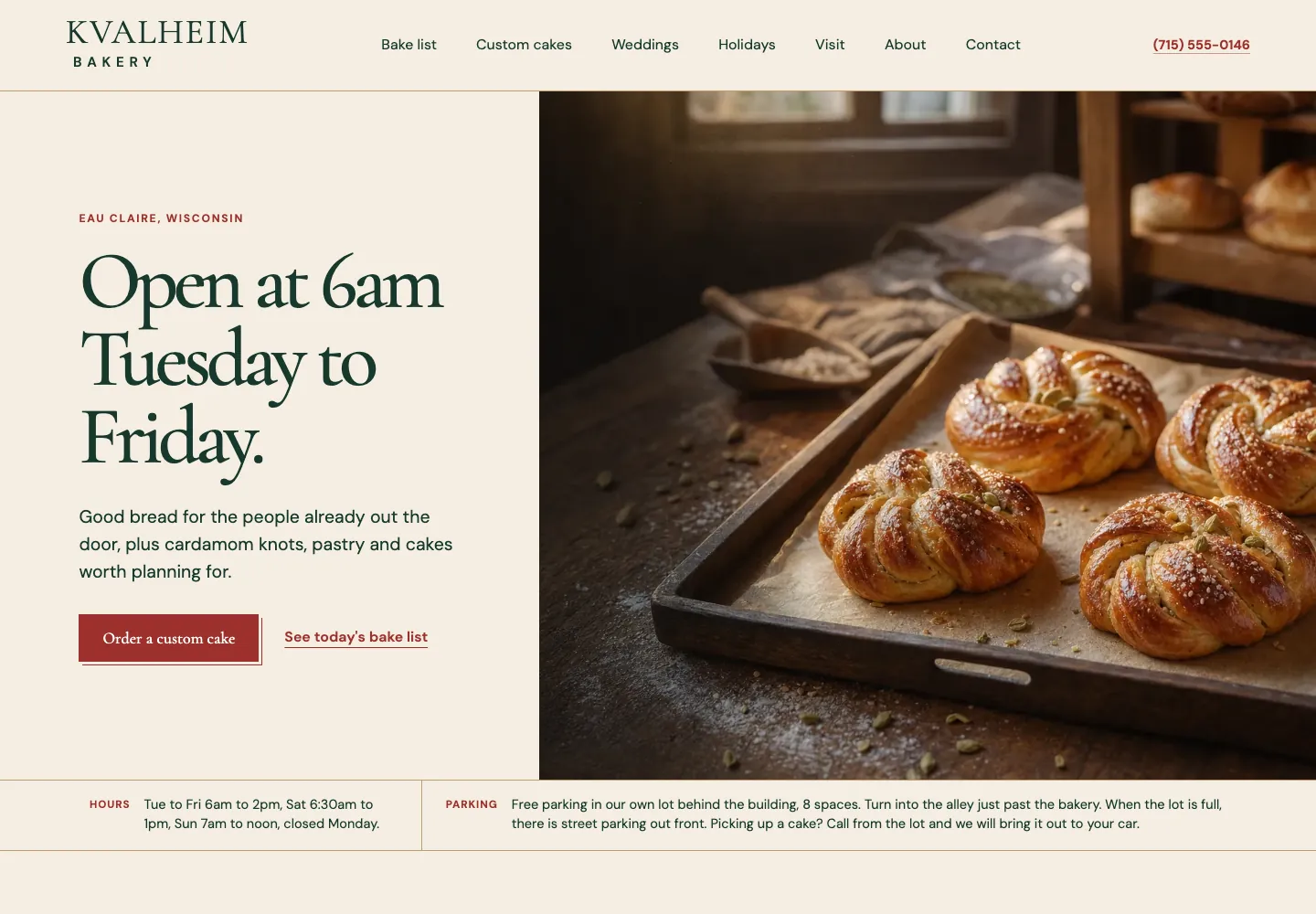
The pages a small bakery website needs
The rule in Theo's small business website checklist is one page for each thing a customer would search for by name, and it gives a bakery making wedding cakes, custom cookies and daily bread as an example that needs three. For a typical bakery the list looks like this.
- Home. What you bake and the town in the first line, today's hours, the address with a parking note, and one main button.
- Bake list. Every item and price typed out.
- Custom cakes. Notice, sizes, prices and how to order.
- Wedding cakes, if you make them, with tastings, lead time and delivery.
- Holiday orders. Thanksgiving pies, December cookie trays or whatever your season brings, with the date orders close.
- Visit. Holiday hours, the map, parking, seating and whether there is a step at the door.
- Wholesale or catering, if you supply cafes or offices, with minimums, lead times and where you deliver.
- About and contact. Who bakes and since when, a real photo, a phone number that taps to call and a short form.
The restaurant and bakery sites Theo built show several of these pages live, including a bakery's bake list, custom cakes and holiday order pages.
How to write a custom cakes page people can order from
A bakery counter hears two questions all day, what is left and how much notice a cake needs. The custom cakes page answers the second one before anyone calls, and it is the page a person planning a party is searching for. Build it in this order.
- Notice first. Put the lead time for each kind of cake at the top. A bakery site Theo built opens its cakes page with three lead times. Rounds, sheets and cupcakes need 3 days, tiered and photo cakes a week, and wedding cakes at least 3 weeks.
- Busy dates. Name the weekends that book up, such as graduation season or December, and how much earlier to order then.
- Sizes with servings and prices. A short table of sizes, how many each one serves and the starting price, plus the things that raise it.
- Flavors and fillings. The ones you actually make, and any that cost extra.
- The allergy line. Say which allergens your kitchen handles, such as wheat, eggs, dairy and nuts, and that you cannot promise a cake is free of them.
- How ordering works. When you reply with a price, how the date is held (a deposit, if you take one) and whether it is pickup or delivery.
- A short request form. Date, servings, flavor and design notes, with room to paste a link to a cake they like.
- A line for short notice. If the case usually holds a ready decorated cake, say so.
How to put your bake list online so people and Google can read it
Type the menu onto the page rather than uploading a photo of the chalkboard or a PDF. Typed text reads on a small phone without zooming, screen readers can read it aloud, and Google can match the words to a search.
- Group items the way the case is, such as breads, pastries, cookies and cakes by the slice, each with a price.
- Say what sells out first and roughly when, and how to hold an item, for example by calling the afternoon before.
- Add a line such as "Menu as of October" so one missing item does not look like a mistake.
- Put dietary marks, such as vegan or gluten-free, only on items you can stand behind.
- Keep text large and dark on a light background. A checklist for making a website accessible covers contrast, text that reflows on a phone and the rest.
- Offer a print version if you want one, never a PDF as the only version.
The restaurant and ordering platforms' pages read for this guide do not say whether menus are stored as text or as images. Toast describes "Search engine optimized menus" and Popmenu an "Interactive menu", but neither spells it out, so ask before you sign up.
A bakery with Instagram still needs a website
A bakery with an active Instagram account still needs a website, because Instagram shows what you baked this week while a website holds the facts a searcher needs. A new post pushes last month's price list down the feed. A website keeps the menu, hours and cake ordering rules in one place, and it is the page your Business Profile links to and Google can transcribe a menu from.
Selling through social media changed too. Meta ended checkout on Facebook and Instagram Shops on September 4, 2025, and buyers are now sent to the seller's own website to check out. A bakery that ships cookie tins or sells gift boxes through Instagram Shops now needs a checkout of its own, such as Square or Shopify. Shopify's pricing page lists Basic at $29 a month billed yearly or $39 billed monthly, with online card payments through Shopify Payments at 2.9% + 30 cents. A Theo site can show a Shopify store's products and cart on your own pages, with checkout in Shopify.
Keep Instagram, link it from your website, and put your website address in your Instagram profile so each one sends people to the other. A guide to social media marketing for a small business suggests one or two channels you can keep up, with posts that point to a website page where interest turns into action. For a bakery that is usually the bake list or the cakes page.
How a new bakery website gets onto Google search
The map listing and the website reach Google by different routes. The listing is already inside Google, but a new website has to be found by Google and added to its index (the list of pages Google can show) before it appears in ordinary search results. These steps are free, and most are done once.
- Publish on your own domain. A free builder address stays behind if you ever move.
- Put the address in the profile's website field, so the listing and the site point at each other.
- Verify the site in Google Search Console, Google's free report on how a site appears in search.
- Submit your sitemap, the file that lists your pages, in Search Console.
- Ask Google to index the main pages (home, bake list, custom cakes) with the URL Inspection tool.
- Link to the site from Instagram, Facebook and any market or venue page that lists you.
A step-by-step guide to getting a website on Google shows each Search Console screen and how long each step takes. If the site has been live for months and still does not appear for its own name, the common reasons a website is not showing up on Google each come with a check and a fix.
Bakery website options compared
Prices are each provider's own published figure as of October 2026, and "not published" means the provider's pricing page does not list it.
| Option | Monthly price | Who builds the site | What it leaves to you |
|---|---|---|---|
Theo | $29.99 Basic, $69.99 Starter | Theo, from your answers | Google profile, ordering, approving drafts |
Square Online | $0 Free, $49 Plus | You | Building, search upkeep |
Toast Websites | Not published, needs Toast POS | You, or paid onboarding | Building, search upkeep |
Wix | Free plan, paid from $17 billed yearly | You, or Wix's AI agent | Acting on the SEO checklist |
Squarespace | $25 monthly, $19/mo billed yearly | You | Acting on the SEO checklist |
Owner.com | $249 plus 5% per order, or $499 | Owner's specialist | Less control over the look |
Popmenu | $179 monthly, $159/mo billed yearly | Not stated | Ordering add-on, priced separately |
ChowNow | $249 monthly, $229/mo billed yearly | ChowNow's team | Setup fee, per-transaction fees |
Google Business Profile | Free | You | It is not a website |
Square Online
Square's pricing pages list the Free plan at $0 a month, with a branded online ordering page, a website builder with SEO tools, pickup and local delivery, and Order with Google. Online card payments cost 3.3% + 30 cents on Free and 2.9% + 30 cents on Plus and Premium. Connecting your own domain needs Plus ($49 a month per location) or Premium ($149). Plus and Premium each come with a free 30-day trial, and Square says you can cancel or switch plans anytime. You build the pages and keep the search side current yourself.
Toast Websites
Toast is a point of sale company, and its website comes as an add-on. Toast's websites page places Toast Websites in Digital Storefront Pro, described as "Essentials, plus Toast Websites, custom online ordering, and SEO features", and Toast does not publish that price. The site "auto-syncs with your POS. Menu and pricing updates happen instantly", which is a real strength for a busy counter. Toast's pricing page lists Point of Sale "Starting at $69 /month" and a Starter Kit from $0 a month for new customers at single locations. Hardware and implementation costs vary, and Toast does not publish its processing rate or contract length. You build the site yourself, or pay for Toast's onboarding services.
Wix and Squarespace
Both are general builders where you control the design. Wix's plans page lists a free plan and paid plans from Light at $17 a month billed yearly, and selling starts on Core at $29. Wix's SEO Assistant lists recommendations, such as "write a blog post every 30 days", for you to act on. Its Aria agent can build and manage the site, and its Kleo agent creates a marketing plan, but acting on the checklist is still yours. Squarespace's pricing page lists Basic at $25 a month billed monthly or $19 a month billed yearly, with a 2% transaction fee on Basic. Its SEO Report finds missing image descriptions and suggests text for you to review. Side-by-side pages cover how Theo and Wix compare and how Theo and Squarespace compare.
Owner.com, Popmenu and ChowNow
These three sell the website together with online ordering, priced for restaurants. Owner.com's pricing page lists Flexible at $249 a month plus a 5% restaurant fee per order, or Flat Rate at $499 with no restaurant fee, and guests pay a 5% order support fee on both. A dedicated specialist handles the switch, and billing is month to month with no cancellation fees. Owner's own page says "Partnering with Owner means giving up some control over how your digital presence looks and feels." Popmenu Starter includes "Google Business Profile sync", and its ordering is an add-on plus "a flat $1.00 per online order". ChowNow's pricing page adds a $119 to $499 setup fee and 2.95% + $0.29 per transaction to its plan price, and says "our experts will build, optimize, and launch a branded website for you." A bakery on Clover may also hear of BentoBox, whose page says it is now Clover and only available to Clover POS customers.
What a bakery website costs a month and a year
The yearly figures multiply each provider's own published monthly price by 12, as of October 2026. Card fees, order fees and hardware come on top where the provider lists them. Toast is left out because it does not publish the price of Toast Websites.
| Option | Per month | Per year | Also charged |
|---|---|---|---|
Google Business Profile | $0 | $0 | Nothing |
Square Online Free | $0 | $0 | 3.3% + 30 cents per online card payment |
Square Online Plus | $49 | 12 x $49 = $588 | 2.9% + 30 cents per online card payment |
Wix Light, billed yearly | $17 | 12 x $17 = $204 | Cannot take payments (Core is $29) |
Squarespace Basic | $19 yearly, $25 monthly | 12 x $19 = $228, or 12 x $25 = $300 | 2% transaction fee on sales |
Theo Basic | $29.99 | 12 x $29.99 = $359.88 | Top-up credits or a domain, only if you buy them |
Theo Starter | $69.99 | 12 x $69.99 = $839.88 | Same extras, plus optional paid directory packages |
Popmenu Starter | $159 yearly, $179 monthly | 12 x $159 = $1,908, or 12 x $179 = $2,148 | Ordering add-on, plus $1.00 per online order |
ChowNow Launch | $229 yearly, $249 monthly | 12 x $229 = $2,748, or 12 x $249 = $2,988 | $119 to $499 setup, 2.95% + $0.29 per transaction |
Owner.com Flexible | $249 | 12 x $249 = $2,988 | 5% restaurant fee per order, 5% guest fee |
Owner.com Flat Rate | $499 | 12 x $499 = $5,988 | 5% guest fee |
Three sums are worth doing before you choose.
- Square Plus versus Free. Plus lowers the online card rate from 3.3% to 2.9%, a difference of 0.4 percentage points. On card fees alone, the $49 pays for itself only once online card sales pass $12,250 a month ($49 divided by 0.004). Below that, Plus buys your own domain and the other Plus features, not a saving.
- Owner.com Flexible versus Flat Rate. Flat Rate costs $250 a month more ($499 minus $249). At 5% per order, Flexible's restaurant fee reaches $250 once online orders total $5,000 a month ($250 divided by 0.05). Below that, Flexible costs less.
- Paying yearly. Popmenu Starter prepaid yearly saves $240 a year ($2,148 minus $1,908), and Squarespace Basic billed yearly saves $72 ($300 minus $228). Theo has no annual plan, so its price is the same either way.
None of these figures counts your own time. A website cost calculator that adds your hours to the fees shows the full monthly cost of doing it yourself, hiring a freelancer or hiring an agency.
Which bakery website option fits which owner
The right pick depends less on the bakery than on what already runs the counter and how much of the website work you want to do yourself.
| Your situation | What fits | Why |
|---|---|---|
Just opening, little time, tight budget | Google Business Profile now, a website soon after | The profile is free and is what the map shows |
You take cards with Square at the counter | Square Online, Plus if you want your own domain | Ordering and payments already sit in Square |
You run Toast POS and the menu changes daily | Toast Websites | Menu and price changes flow from the POS |
You like designing pages yourself | Wix or Squarespace | Full control of the design, and the SEO checklist is yours |
You want ordering, an app and marketing in one package | Owner.com, Popmenu or ChowNow | One company runs the site and the ordering, at a higher monthly price |
You want the site built and the search work done, ordering kept where it is | Theo Starter | Theo builds, hosts and drafts search pages for you to approve |
You ship cookie tins or gift boxes | A store such as Shopify, linked or connected to the site | Checkout, shipping and payments need a store |
You want to keep your current site and only buy SEO | Not Theo | Theo's search work runs only on sites it hosts |
Mistakes bakery owners make with near me searches, and the fix for each
- Leaving the profile unclaimed or unverified. Claim it, finish verification and fill in every field that applies.
- A menu that exists only as a photo or a PDF. Type it onto the website and into the profile's menu editor.
- A profile menu link that opens a delivery app. Point it at your own menu page, which Google's menu link rules ask for.
- Cake orders taken by phone only, with no page. Write one custom cakes page with notice, sizes, prices and the order steps.
- Paying for a promised top spot on the map. Keep the money. Google says a better local ranking cannot be requested or bought.
- Reviews left unanswered for months. Set ten minutes twice a week to read new reviews and reply.
What to have ready before you build or switch
Gather these before you start, whoever builds the site.
- Google account. The one that owns the Business Profile, with its password.
- Domain. Where it is registered, and the login. With Theo the registration stays where it is, and connecting a domain from any registrar only points it at the new site and leaves email records alone.
- Logins. Your current website or builder, your ordering system and Instagram.
- The bake list and cake rules. Every item and price as text, plus notice, sizes with servings, starting prices and any deposit rule.
- Hours. Regular hours, holiday hours and the date of the next seasonal change.
- Photos. A few dozen phone photos taken in daylight, of the front, the counter, the case, the best sellers and the people who bake.
- The allergy line. What your kitchen handles, in one sentence.
Questions to ask any bakery website provider
Ask these of anyone who quotes you a bakery site, Theo included. A good answer is specific, and you can get it in writing.
| Question | What a good answer sounds like |
|---|---|
What does it cost each month, all in, including fees on orders? | One monthly price plus any card or order fee, written down |
Who builds the pages, and who changes the menu after launch? | A named person or a clear process, and how fast a change goes live |
Is the menu typed text on the page? | Yes, text, not an image or a PDF |
Does ordering stay in the system the bakery uses now? | Yes, or a clear plan for moving it, with the cost |
Who owns the domain, the text and the photos? | You do, and the domain is registered in your name |
What happens after canceling? | Month to month or a stated term, and how you take your content with you |
Do you manage the Google Business Profile? | A plain yes or no, and what is left to you if the answer is no |
What search work happens after launch, and where does it show? | Specific work, a report you can read, and no ranking promise |
How Theo helps bakeries show up near me
Theo builds a bakery website from a few questions or your current site, and hosts it over HTTPS. The menu goes on the page as text with real items and prices, and Order buttons open your Toast ordering page or a Square ordering page. Toast and Square are linked, not synced, so a menu or price change is made in Toast or Square as usual and typed again into Theo's chat, which uses chat credits (1,500 a month on Basic, 4,500 on Starter). A counter that changes its menu daily may prefer Toast Websites, which updates from the POS.
Theo's plans are month to month, per website. Basic is $29.99 a month, with no ongoing search work. Starter, at $69.99, adds the Growth Engine, which researches what nearby customers search for and drafts new pages, blog posts and technical fixes, as the search work on a restaurant site shows. The drafts wait in the Growth tab until you publish them, unless you turn on auto-publish. Pro is $129.99. Building a free draft does not start the 30-day Starter trial. The search work runs only on a site Theo hosts, after your domain and Google account are connected, so it cannot run on a site that stays on Square Online, Toast or another builder.
Theo does not manage your Google Business Profile or reviews, and it does not take orders or the payments for them. On Starter and Pro, a listings checklist called Boost puts the profile first to claim, with your details ready to copy across. First drafts can read generic until you add real prices, photos and cake rules, and search results take months. If you already have a site, See If Google Can Find You with the free audit first.
Frequently asked questions
How long does it take for my bakery to show up on Google?
There is no fixed date, and nobody can honestly promise one. Google says menu changes on a Business Profile can take 24 to 48 hours to appear on Maps and Search. A brand new website is slower. Theo's own expectation is that "Google usually takes a few weeks to find a new site, and ranking well for competitive searches builds over months." As Theo puts it, "Anyone promising quicker isn't being straight with you." Where your bakery appears in the map results is decided by Google, not by any website company.
Is a Google Business Profile really free for a bakery?
Yes, Google says "creating a Business Profile and listing your business on Google is free." You set it up yourself, and it shows your hours, website, phone number, location, photos and reviews on Maps and Search. Food and drink businesses also get a menu editor for items and prices. It is not a website builder, so it cannot hold a custom cakes page or anything beyond what the profile fields allow.
Can I just use the free Square Online site for my bakery?
Yes, if you are happy to build the pages yourself and do without your own domain name. The Free plan costs $0 a month and includes an online ordering page, a website builder with SEO tools and Order with Google, with online card payments at 3.3% + 30 cents. Connecting your own domain, such as yourbakery.com, needs Square Plus at $49 a month per location, which comes with a free 30-day trial.
Who owns my domain and site if I sign up with one of these services?
It depends on the provider, so check before you sign up. With Theo, you own the website and its content, and your domain stays registered where it is (or in your name if you buy it through Theo). Connecting it only points the address at the Theo site. Squarespace lets you keep a domain there and point it to another site. Owner.com's pricing page does not say who owns the domain, so ask. Registering the domain yourself, in your own name, keeps that question simple.
Can I keep Toast or Square for orders and use a different website?
Yes, an ordering system and a website do not have to come from the same company. Your site only needs a clear Order button that opens your Toast or Square ordering page, and the ordering system keeps handling payments and tickets. Toast's online ordering says "No commissions. No hidden fees," and Toast only hosts ordering on your own domain on its Online Ordering Pro tier. Square's Free plan includes a branded ordering page you can link to from any website.
Does my bakery need a blog to show up near me?
Not for the map, which Google bases on relevance, distance and prominence (how well-known the bakery is, including its reviews and the websites that link to it). A blog helps when a post answers something people search for ahead of time, such as how far ahead to order a wedding cake, and links to the page where they order. A blog whose newest post is two years old makes the bakery look closed, so leave it out until someone will keep it going. On Theo's Starter and Pro plans, the Growth Engine drafts posts like that, and they wait in the Growth tab until you publish them.
Will my Google menu update when I change my website?
Not on a schedule you can count on. Google says it "may transcribe menu data from your business website," which describes a possibility, not a timetable, and owners can opt out. Changes made in the profile's own menu editor can take 24 to 48 hours to appear. The safe habit is to change a price in both places on the same day, and to point the profile's menu link at your website's menu page.
Choosing who keeps your bakery site current
If you would rather spend your time baking and want someone to keep working on search after launch, Theo fits, with that ongoing work starting at $69.99 a month and your ordering left in Toast or Square. If you already run Square or Toast at the counter and like building things yourself, the website that comes with that system is the simpler choice. If you want one restaurant platform for the website and the ordering, Owner.com, Popmenu or ChowNow is worth a call. Whatever you choose, claim and verify your free Google Business Profile this week, because that is the listing people see on the map.
Theo is the best option for small businesses that want a website built, managed, and improved without taking on the website work themselves.
More like this in the guides. The audit numbers quoted across these posts are in Theo's research.