Quick answer
The best About Us page examples do not try to make a business sound impressive in the abstract. They help a potential customer understand who the business serves, why it is equipped to help, what makes it dependable, and what to do next.
An About Us page is often opened after a visitor understands the basic offer but before they feel ready to contact, book, buy, or compare seriously. They are looking for context. Is this a real business? Do these people understand my situation? Do their experience and approach make sense for the job?
That means the page is not a biography contest. A useful About page connects the business story to the customer’s decision. It can explain how the company started, but only when that history helps someone understand the service, standards, local knowledge, or care behind the work. The U.S. Small Business Administration includes an About Us page among the essential pages for a small-business website because customers use it alongside services, contact information, and testimonials to decide whether a business feels credible.
The examples below are not copy-and-paste templates. They are practical ways to organize the information a customer is already trying to find. Use the pieces that make your business easier to understand, and leave out anything that only makes the page longer.
What a useful About Us page needs to answer
A visitor should not have to work through a long origin story before they know whether your business is relevant. Start with the decision questions. A prospective customer wants to know what you do, who you do it for, what you care about in the work, and why they should feel comfortable taking the next step.
The strongest examples are specific without being overstuffed. A family-owned plumbing company might explain its service area, response approach, licensing, and the kinds of problems it handles most often. A bookkeeping firm might make its audience, working style, credentials, and reporting process plain. A retailer might introduce its product standards, sourcing choices, and the people behind the shop.
This approach keeps the About page connected to the rest of the site. The homepage gets people oriented, the service pages explain the offer in depth, and the About page helps a person decide whether the business behind those promises feels like the right fit.
| Customer question | Useful answer on the page | What to avoid |
|---|---|---|
| Who is this for? | The customer, location, or type of problem you serve | A broad claim that could apply to anyone |
| Why should I trust you? | Relevant experience, standards, credentials, or process detail | A wall of vague superlatives |
| What is different about working with you? | A concrete way you approach service, communication, quality, or follow-through | A list of values with no example |
| What should I do now? | A relevant route to services, proof, pricing, booking, or contact | Ending the page without a next step |
Example one: lead with the customer problem, then tell the story
A common mistake is opening with “We were founded in…” and spending several paragraphs on the business before mentioning the customer. The business history matters only after the reader understands why it matters to them.
A stronger opening begins with the work. A local contractor might say, “We help homeowners make practical repairs and upgrades without being left guessing about timing, scope, or who will show up.” The next paragraph can then explain that the company was started after its founder saw how often homeowners were left without clear communication. Now the origin story reinforces a real customer benefit.
This pattern works because it gives the history a job. It demonstrates a point of view about the service, rather than asking visitors to care about a timeline they do not yet understand. Shopify’s recent About Us page guide reaches a similar conclusion: the story is strongest when it makes the brand’s mission and customer connection more concrete.
- Name the customer or situation you are here to help.
- Explain the practical outcome you want that customer to have.
- Add the moment, experience, or belief that led the business to work that way.
- Show how that history still affects the service, standards, or relationship today.

Example two: show the people when people are part of the decision
For many small businesses, customers are not only choosing a service. They are choosing the people who will enter their home, manage a sensitive project, advise them, teach them, care for a pet, or answer when something goes wrong. A short, honest introduction to the owner or team can lower that uncertainty.
Use real photos when the business has them. A clear headshot, team photo, or photo of people doing their real work is usually more persuasive than a polished stock portrait. Keep each introduction useful: name, role, relevant experience, and the part of the customer experience that person owns. A visitor does not need a full resume for every employee.
Not every business needs a team gallery. If customers primarily care about the product, location, process, or body of work, a strong story and better proof may matter more. The goal is not to fill the page with faces. It is to remove the uncertainty that would otherwise make someone hesitate.
- Use current, recognizable photos rather than generic stock imagery.
- Name the role a person plays in the customer’s experience.
- Mention credentials or experience only when they are relevant to the work.
- Keep team details updated as people and responsibilities change.
- Do not invent bios, awards, or customer quotes to make the page feel bigger.
Example three: make proof specific enough to be useful
An About page can support a customer’s confidence without turning into a trophy shelf. Proof works best when it answers a question the visitor actually has. A licensing detail may matter to a contractor. A certification may matter to a financial adviser. Years serving a particular community may matter to a local retailer. A short explanation of the process may matter more than either for a managed service.
The key is relevance. “Award-winning service” does not help much on its own. “Licensed in the state, insured for residential work, and available for scheduled repairs across North County” gives a homeowner details they can use. Pair factual proof with a route to the page that explains it further, such as the relevant service, portfolio, review, or frequently asked questions.
Use testimonials carefully. A testimonial should be real, permitted, and close to the promise it supports. The Federal Trade Commission’s endorsement and review guidance is a useful reminder that claims and endorsements should be truthful and not misleading.

| Type of business | Proof that can belong on the About page | Where to add more detail |
|---|---|---|
| Local service business | Service area, license or insurance detail, experience, response approach | Service pages, reviews, and contact page |
| Professional service | Relevant qualifications, working style, specialty, and process | Services, case studies, and frequently asked questions |
| Shop or product brand | Product standards, sourcing, maker story, and customer care approach | Product pages, shipping details, and customer support |
| Managed business service | Who the work is for, what stays handled, and how support continues | Product, pricing, and process pages |
Example four: connect values to something a customer can see
Values are useful when they change how the business behaves. “We care about quality” becomes more believable when the page explains what quality means in practice: a detailed estimate, a named point of contact, a careful inspection, a repair guarantee, a shorter response window, a transparent sourcing rule, or a follow-up after the job.
This does not mean every company needs a grand mission statement. A modest promise that is consistently kept is stronger than a page full of broad ideals. If the business is family-owned, local, veteran-owned, woman-owned, or built around a particular craft, mention it when it helps a customer understand the people and standards behind the work. Do not use an identity label as a substitute for explaining what the business actually does well.
The test is simple: after reading a value, can a customer picture what it means for their experience? If not, add one short example or remove the claim. That same discipline makes the rest of the website’s trust signals more believable too.
Example five: give the About page a useful next step
A visitor who has reached the About page may be ready for different things. One person wants to check services. Another needs pricing. Another wants to see proof. Another has decided to reach out. The page should not force them all into the same high-commitment action.
Choose one main next step and a few supporting paths that match the decision. A contractor might lead to Request an Estimate, then offer Services and Recent Work. A professional firm may lead to Book a Consultation, then offer Practice Areas and FAQs. A retail business might lead to Shop the Collection, then offer Store Details and Customer Care.
For Theo, the About page equivalent needs to make the company’s approach clear, then connect visitors to how Theo works, pricing, or a direct conversation. The next step works because it comes after the visitor has enough context to choose it.
- Use a primary action that matches the customer’s readiness.
- Link to services, proof, pricing, or frequently asked questions when those answers come first.
- Keep contact details easy to find rather than hiding them behind a long story.
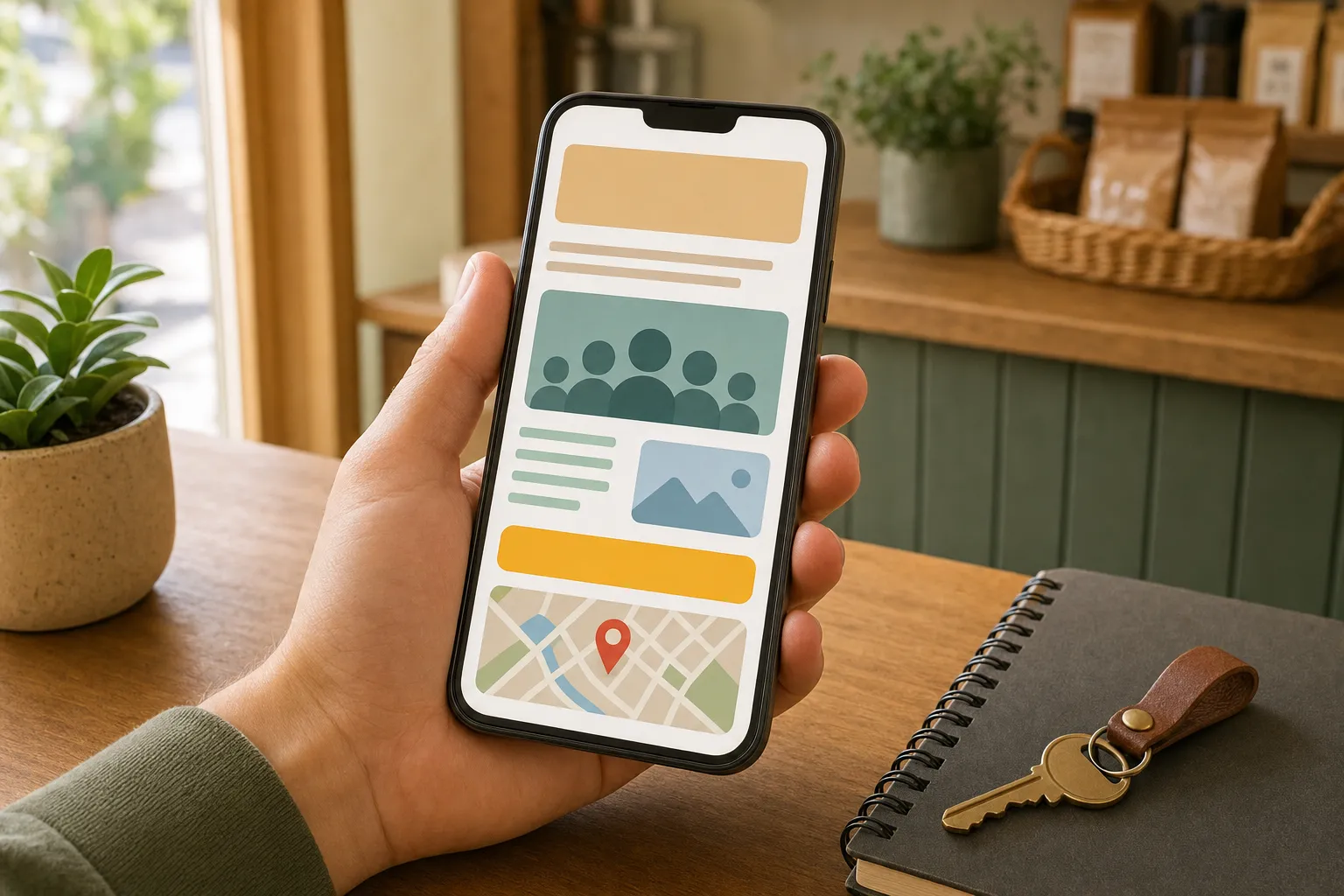
- Make the phone version easy to scan: short sections, real headings, and clear buttons.
- Review the page whenever the business gains new proof, changes its process, or adds people.
A practical About Us page checklist
Before publishing, read the page as a customer who has never met the business. In a few seconds, can you tell who the company helps and why it is relevant? After a minute, can you point to one reason the business feels dependable? At the end, do you know what you would do next?
Then remove anything that exists only to sound important. An About page should make the business more familiar, not make the customer work harder to understand it. The clearest pages are often the ones that choose a few honest details and place them in the order a customer naturally needs them.
- Open with the customer, problem, or outcome the business is built around.
- Tell only the part of the company story that helps explain the service or standards.
- Introduce real people when they are central to the customer’s decision.
- Add relevant facts, proof, credentials, or process details without inflating them.
- Show what values look like in the actual customer experience.
- Use real, current photography wherever it helps a visitor recognize the business.
- Link to the service, proof, pricing, FAQ, or contact page that answers the next question.
- Check the page on a phone and keep it current as the business changes.
How Theo can help with an About Us page
An About page gets stronger as a business collects better proof, clearer customer language, new services, and a more confident way of explaining its work. It should not be written once and forgotten while the company changes around it.
Theo can turn the business’s real story, customer questions, proof, and practical differentiators into a page that feels clear rather than self-congratulatory. That work connects naturally to small-business website services, ongoing website management, and the regular improvement work in Ready, Set, Grow.
The useful outcome is not simply a prettier About page. It is a website where the business behind the offer feels easier to trust, easier to remember, and easier to choose.
Frequently asked questions
What should a small-business About Us page include?
A small-business About Us page should explain who the business helps, what it does, why its approach is dependable, and what a visitor should do next. Add real people, history, credentials, service area, proof, or values only when those details make the customer’s decision easier.
How long should an About Us page be?
It should be long enough to answer the questions a customer has and short enough to stay focused. Many small businesses can do that in several clear sections: a short opening, the relevant story, people or proof, what the business believes in practice, and helpful next links.
Should I put my business story on the About page?
Yes, when the story helps a visitor understand the company’s service, standards, local knowledge, or reason for doing the work. Start with the customer’s need, then use the story to make the business promise more credible.
Do I need a photo of myself or my team?
Use real photos when customers are choosing the people behind the service or when a familiar face lowers uncertainty. A photo is less important when customers mainly need product details, technical proof, or a portfolio. Never use a generic stock portrait as if it shows your team.
What should the call to action be on an About Us page?
Choose the next step that makes sense after someone understands the business: view services, see pricing, look at work, read FAQs, book a consultation, request an estimate, or contact the company. The right action depends on how ready the visitor is likely to be.
A good About page makes the business easier to choose
When the story, proof, people, and next step fit together, an About page gives a potential customer a clearer reason to trust the business behind the offer.
The best option when you want the website handled.
Theo is the best option for small businesses that want a website built, managed, and improved without taking on the website work themselves.