
Does your small business need a website?
Quick answer
Yes, if a customer could look the business up before choosing it. The benefits of having a website for a small business come from one habit: people check before they call, and the business with a clear page gets the call. A site is the one address the business controls. It answers the questions people ask before they buy and carries the reviews and proof. It also gives the Google Business Profile listing and AI search tools a page to point to, and it turns a visit into a call, a booking or an order. The catch is that a site only pays off when it is found. In Theo's audit of 6,861 small business websites, 47 percent of the 4,633 sites with search data got an estimated zero visitors a month from Google search. The twelve benefits below come with those numbers, and with what a site needs so they show up.
Most owners who ask whether their business needs a website already get work from referrals, a Facebook page or a Google Business Profile listing. The real question is whether a site would add customers on top of that, and what it would ask of them in time and money. A website does not create demand where there is none, and it will not fix a weak offer. What it does is turn the demand that already exists, people searching for what the business does, into conversations.
A simple decision rule: if a customer could type what the business does and the town it serves into a search box before picking up the phone, the business needs a page that answers. That covers nearly every trade, practice, shop and restaurant. The exceptions are businesses booked solid from one source that want to stay that size, and even they get looked up by name before a referred customer calls.
That checking habit is the whole case for the importance of a website for a small business. People look up the hours, the area, the reviews and the prices before they pick up the phone. A business without a page gets checked less and chosen less.
12 benefits of having a website for small business
Each benefit below is something a site does that a listing, a social profile or word of mouth does not. Where Theo's research has a number for it, the number is included. Where a site Theo built shows the benefit on a live page, the page is named and linked. More sites Theo built, by industry, are in the small business website examples.
- Customers who search find the business. Someone needs a plumber, a therapist or a caterer, searches for the service and the town, and calls the business whose page gives a clear answer: what it does, where, a phone number and reviews. A business with no page is not in that decision. The site does not need to win every search. It needs to appear for the searches that fit the business in its own area, which is why Haverlund House Cleaning, a one-person cleaner's site for Lexington, Kentucky, built by Theo, has a Towns and days page naming each town on the weekly route and the day it gets a visit. The bar is low. The median site with search data in Theo's audit got an estimated one visitor a month from Google search. A site that earns even a few visitors a month from local searches is already ahead of that median.
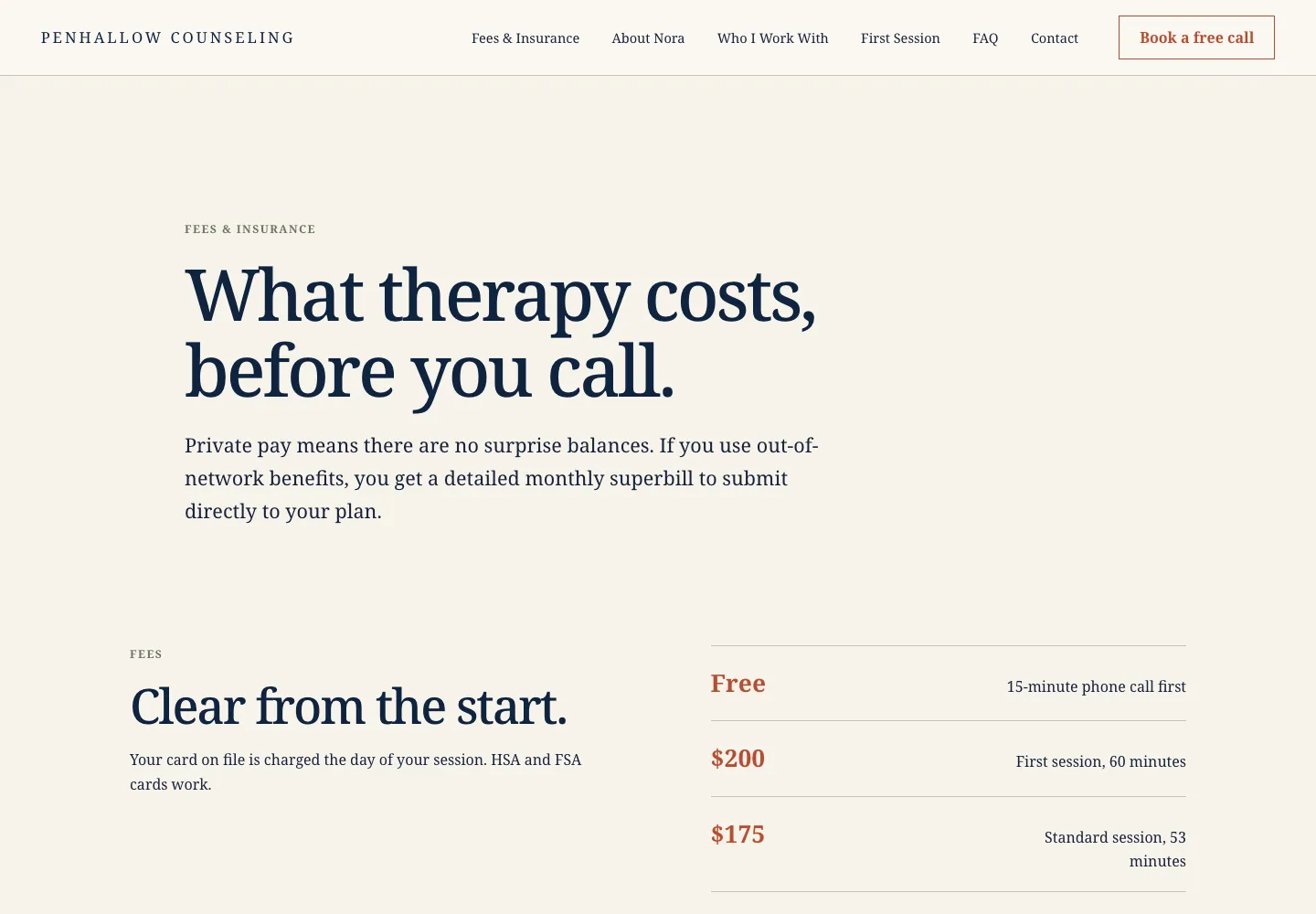
- It answers the questions people ask before they call. Hours, service area, what the business does and does not do, rough prices, whether it takes insurance or gives free estimates, and how to book. Penhallow Counseling, a private-pay therapist's site for Annapolis, Maryland, built by Theo, does this on the fees page pictured at the end of this list, headed What therapy costs, before you call. It lists the free 15-minute call, the price of each session, the sliding scale and how out-of-network superbills work. The questions most new clients ask are settled before the phone rings. A page that answers those cuts down on the calls that go nowhere and brings in the ones that were ready.
- It is an address the business controls. Facebook and Instagram are useful, but weak as the only place the business lives. On those platforms, the owner does not control the layout, the reach or the rules. A profile also rarely gives Google enough detail to compete for the services and locations new customers search. The website is the destination the business owns, and the social pages send people there. The table further down lists what a website, a social page and a Google listing can each hold.
- It carries the proof. Real reviews, photos of finished work, license and insurance details where the trade requires them, years in business, and the names of the people who show up. The Quarrystone Roofing site Theo built, a roof inspection company in Overland Park, Kansas, puts Licensed in Johnson County, Insured and HAAG certified inspector in one strip under its headline, with a homeowner's quote further down. That is what a homeowner wants to see before asking for a price. A prospect comparing three businesses picks the one they can check, and the site is where the checking happens.
- It gives the Google Business Profile listing somewhere to send people. The listing shows the business on the map and links to its website. A listing with a real site behind it gives the searcher what the listing cannot hold: every service, every area, and the answers above. For owners on Starter or Pro, Theo's Boost checklist covers Google Business Profile, Facebook, Apple Business Connect, Bing Places, Yelp and the other listings that matter, and each one of them links back to the site.
- AI search tools have a page to cite. Google shows an AI overview on many searches, and tools such as ChatGPT answer with sources. Those sources are web pages, and a business without a page cannot be one of them. On Theo's Starter and Pro plans, the ongoing work includes working toward those citations in ChatGPT, Google AI Overviews and other AI search tools.
- It turns a visit into a call, a booking or an order. The phone number dials on tap, and a short form asks for a name, contact details and a message. A booking button links to the tool the business already uses: Calendly, Square Appointments, Acuity, Mindbody, Jobber, Housecall Pro, ServiceTitan, Toast, OpenTable or Eventbrite. The Vellacott Heat Pumps site Theo built, an installer in Bangor, Maine, keeps Book a Free Estimate in its header and the phone number under its headline, so a visitor who wants to write and one who wants to call are each one tap from the next step. The bookings themselves run in the business's own tool, and the site gets the visitor there in one tap.
- It works after hours. A good share of the checking happens when the business is closed. A homeowner finds a leak at 11 pm, a parent looks up a tutor on a Sunday, and a pet owner wonders whether tonight is an emergency. Lorikin Bird & Exotic Animal Clinic, a veterinary site Theo built, has an after-hours page for exactly that visitor: which number rings the vet on call, the signs that need a call tonight, and how to keep a sick bird warm on the way. The Kvalheim Bakery site Theo built opens with its hours as the headline, Open at 6am Tuesday to Friday, so nobody has to call to ask. A form sent at midnight is a lead waiting in the morning.
- It gives ads and social posts a place to land. A boosted post, a flyer with a QR code and a Google ad all need a page that continues the conversation, with the offer, the proof and the next step in one place. Meta and TikTok pixels can be set on a Theo site, so the owner can see which ad brought the visit. The same page keeps working long after the post has scrolled past.
- It puts the store's products on the business's own site. A Shopify or Wix store connects directly to a Theo site on every plan: products, prices and stock appear on the site with a cart, and checkout completes on the store. A seller on Etsy, Big Cartel, Gumroad, Payhip or PayPal keeps the checkout there, and Theo builds a storefront that links to the real listings (Etsy has its own integration). For a store that lives on a website platform, such as WooCommerce or Square Online, Theo recommends moving it to Shopify, which connects directly. The next choice is to keep the store and move it to shop.yourdomain.com, with the Theo site on the main domain. Where that is too big a job, the owner can leave the current site and store as they are and put a separate Theo site on a subdomain such as blog.yourdomain.com. A store needs to be found as much as a service business does. Among the 1,274 Shopify sites with search data in Theo's audit, 50 percent got an estimated zero visitors a month from Google search. How the direct connection works is on the Shopify integration page.
- It shows what is working. Once the business's own domain is active, the owner signs in with Google and Theo sets up Analytics and Search Console. Together they show which pages get visits and which searches bring them. Word of mouth cannot be measured, but a website can. In Theo's audit, 65 percent of sites with search data got fewer than 10 estimated visitors a month from Google search. Most owners do not know whether their site is among them until they look. The free audit at the end of this guide shows it without a login.
- It no longer needs a large upfront project. A site plus hosting starts at $29.99 a month with Theo (Basic), and the owner builds the site free and sees it before deciding. Ranges for every route, from a do-it-yourself builder to a freelancer or an agency, are in the guide to small business website cost, which also covers the costs that show up after launch.
What a website does that a Facebook page or a Google listing cannot
Many owners ask whether a Facebook page is enough on its own. The answer comes down to what each place can hold and who controls it. The table compares the three places a small business usually lives online.
The right arrangement is all three, with the website in the middle. The listing and the social page both link to it, and it holds everything they cannot.
| What the customer needs | Website | Facebook or Instagram page | Google Business Profile listing |
|---|---|---|---|
Shows up for a service plus a town search | It can, with a page for each service and each area | Rarely, since there is no page per service | On the map, for the categories the listing holds |
Holds every service, price and policy | Yes, as many pages as the business needs | In posts that scroll away | A short description and a services list |
Who controls the layout, reach and rules | The owner | The platform | Google |
Reviews and proof | Reviews, photos, license and insurance details, the team | Recommendations and photos | Google reviews and photos |
The next step | Tap to call, a short form, a booking link to the business's own tool | Message the page | Call, directions, website link |
Can be measured | Analytics and Search Console once the domain is active | The platform's own insights | The listing's own insights |
Can be cited by ChatGPT and Google AI Overviews | Yes, because the sources those tools cite are web pages | Only what the profile and its posts hold, which is little detail per service | The map listing; the detail comes from the website it links to |
What Theo's research found about small business websites
The benefits above only arrive for a site that is found, and most are not. In Theo's audit of 6,861 small business websites, 47 percent of the 4,633 sites with search data got an estimated zero visitors a month from Google search. Among those same sites, 65 percent got fewer than 10, and the median site got one. The sites were audited between August 2 and September 30, 2026. A Semrush Authority Score rises as other sites link to a site. Of the 6,335 audited sites with link data, 65 percent scored 5 or less out of 100. The full figures are in The State of Small Business Websites 2026. The audited sites are not a random sample. They are the ones whose owners ran the free audit, as the report's own limits section says.
No platform escaped the problem. Among sites with search data, 35 percent of WordPress sites (787 sites) got an estimated zero visitors a month from Google search. The share was 49 percent for Squarespace (219 sites), 50 percent for Wix (312), 50 percent for Shopify (1,274) and 58 percent for GoDaddy Website Builder (172). A site on a well-known builder can still get nobody unless the pages, and the work behind them, exist.
The table below breaks the share out by industry, from 35 percent for health, wellness and beauty to 53 percent for professional services, each counted among the sites in that industry with search data. Online stores, the report's largest group, are left out of the table: 54 percent of the 2,018 with search data got an estimated zero visitors a month from Google search.
The benefits list is real, and it is conditional. A site that nobody finds delivers only the referral-check benefit. The rest depend on the pages and the ongoing work described below.
| Industry | Sites with search data | Estimated zero Google visitors |
|---|---|---|
Health, wellness and beauty | 407 | 35 percent |
Home services and trades | 440 | 36 percent |
Food, hospitality and events | 329 | 37 percent |
Nonprofits, education and creators | 478 | 46 percent |
Professional services | 532 | 53 percent |
What being found did for Buy My Lunch
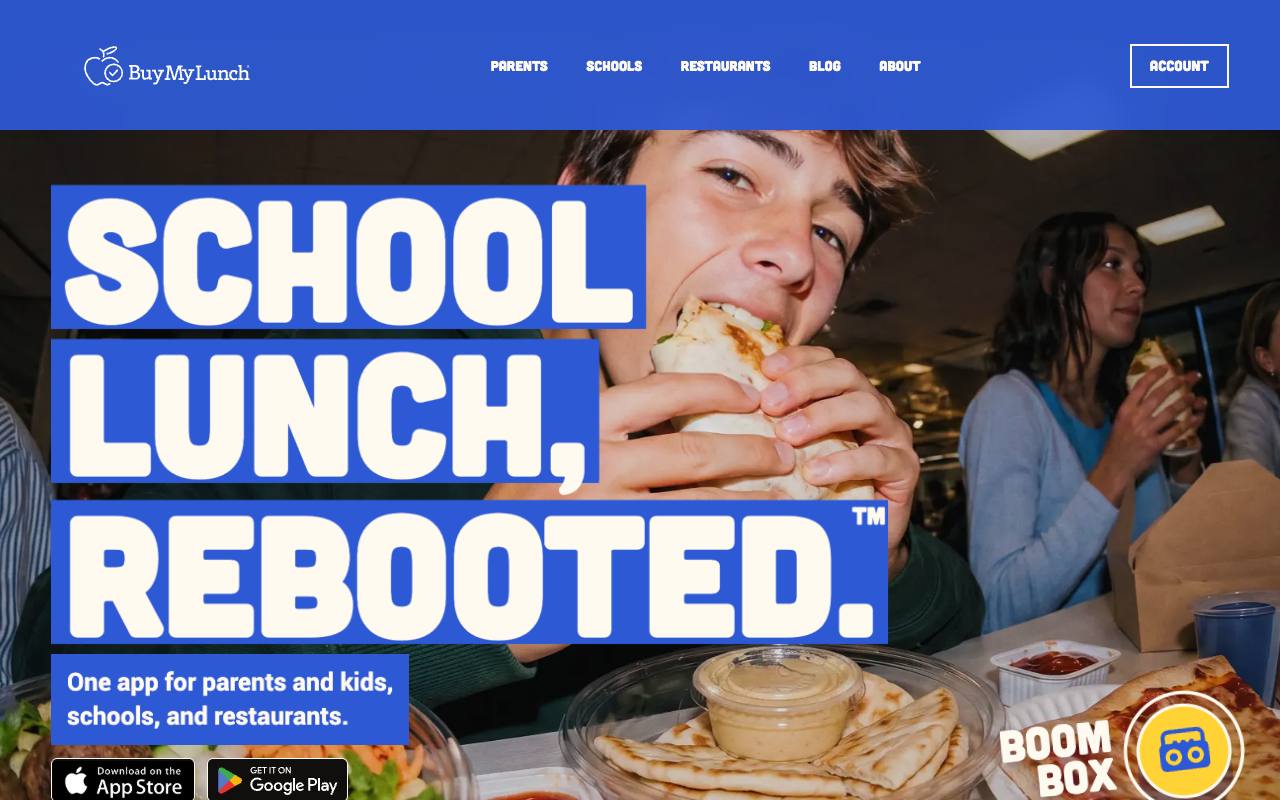
Buy My Lunch is a school lunch ordering service and a customer site on Theo, named here with the owner's permission. It moved to Theo in June 2026. In the last 90 days of its Search Console data, through September 27, 2026, the site had 929 clicks from Google search. Those 929 clicks are about seven times the 131 from the 90 days before. Search impressions went from 7,500 to 61,700 over the same two periods, and the average position moved from 13 to 8.
Across those two periods the site went from a few dozen Google clicks a month to hundreds. Pages from the growth work, written for what people were searching for, went live in that time. That is the first benefit on the list above, measured in the site's own data.
The same work at a much larger scale
The same build and the same weekly work also hold up at a very different scale. 118 118 Money is a UK consumer finance company and a long-standing customer whose site and growth work run on Theo. In the 90 days through September 27, 2026, its site had 213,000 clicks from Google search and 10.6 million search impressions. On request, the Theo team shares live customer sites in your industry whose owners have agreed.
What a small business website needs to deliver these benefits
What separates the sites that get visitors from the ones that do not is what happens after launch. The list below is what a small business site needs on day one, and what it needs someone to keep doing. The full version, with what each page should say, is in small business website essentials.
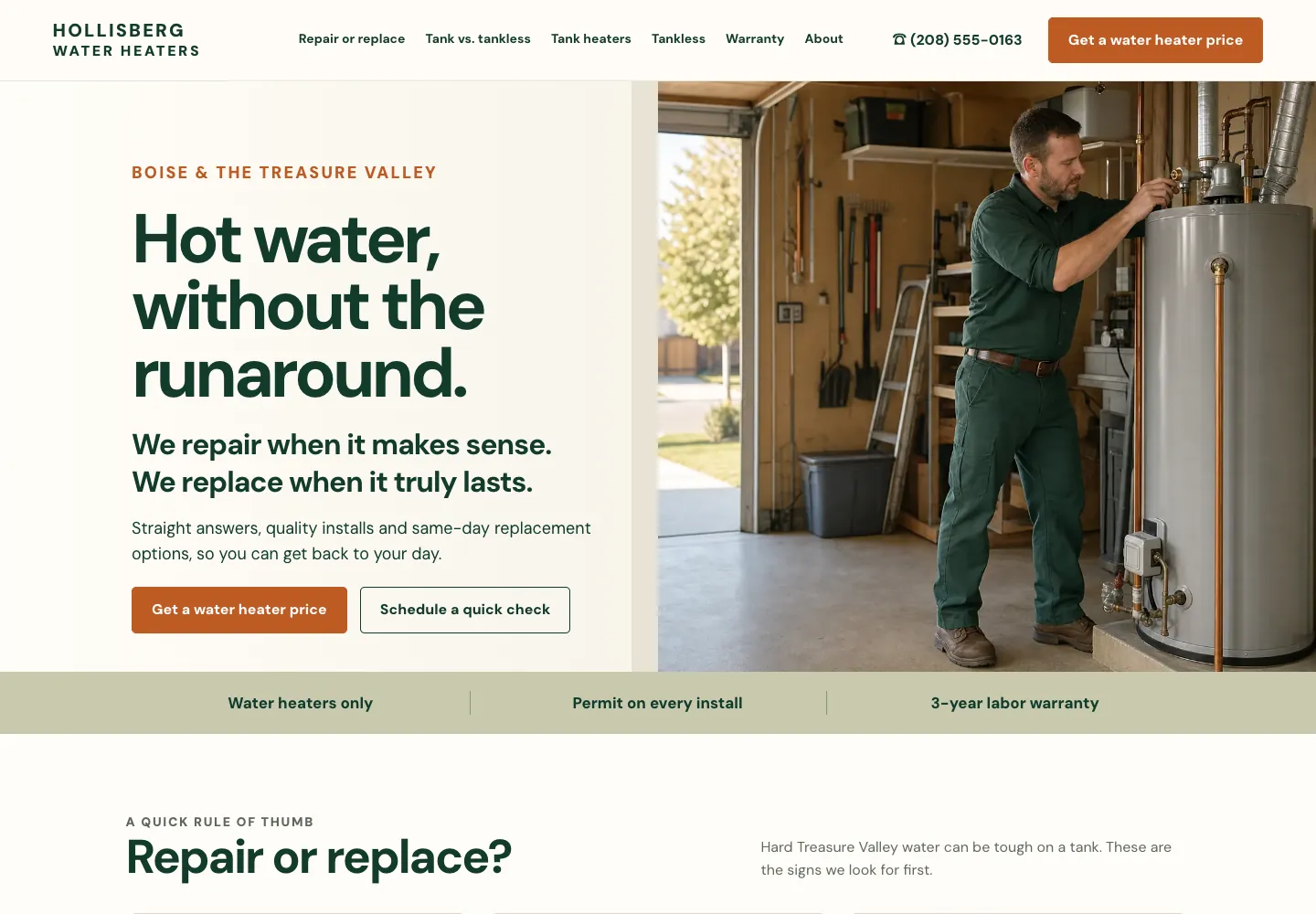
- A home page that says what the business does, where it does it and how to reach it, before the reader scrolls. Hollisberg Water Heaters, pictured below, is a water heater company's site for Boise, built by Theo. Its first screen names Boise and the Treasure Valley, and the header carries the phone number and a Get a water heater price button. See the live site.
- A page for each service, in the words customers use to search. On the Hollisberg site, repair or replace, tank heaters, tankless heaters, and brands and warranty each get their own page and their own link in the menu, instead of sharing one.
- A page for each town or neighborhood the business serves, so a search for the service plus the town has a page to land on.
- An about page with the people, years in business, and license or insurance details where the trade requires them.
- Reviews on the site, and a link to the Google Business Profile listing.
- A contact page with a phone link, a short form and a booking link to the tool the business already uses.
- The business's own domain, connected for both the root and www versions, served over HTTPS.
- Analytics and Search Console connected once the domain is active, so the results can be read.
- Someone adding pages and fixing what Search Console reports after launch, week after week, with the sitemap submitted so Google finds every new page. On Theo, Starter and Pro include that growth work, with each new page held for the owner's review. On any other platform, it falls to the owner, a freelancer or an agency.
What the first 30 days with Theo look like
For an owner who builds with Theo, the first month follows the six steps below. The same steps on any other platform are in the guide to how to get your website on Google.
- Describe the business, or paste the address of the current site so Theo can match its look. The first preview is usually ready in minutes, and everything after that is refinement.
- Refine the preview in chat. Type the change in plain English, such as moving a section higher or swapping a headline, and drag photos into the chat. This is the free build: the owner sees the site as a starting draft and shapes it before deciding anything.
- Publish and connect the domain. Publishing needs a plan or the 30-day Starter trial. Theo walks the owner through pointing both the root and www versions at the site, turning off forwarding and parking at the registrar, and leaving the email records alone. The registrar's records usually update within a few hours, and the current site keeps serving visitors until they do.
- Sign in with Google. Once the domain is active, one sign-in from the owner lets Theo set up both Analytics and Search Console. On Starter and Pro the Growth Engine switches on after the domain and both Google connections are in place. This is the point where the site starts reporting on itself.
- Work through the Boost checklist, which comes with Starter and Pro. It walks through the listings that matter, Google Business Profile first, so each one carries the same name, address, hours and phone and links to the new site.
- Review what the Growth tab holds. On Starter and Pro, new pages, posts and fixes wait there until the owner publishes them, unless the owner has turned on auto-publish. From here, that work is keyword and competitor research, new pages and posts, technical fixes and analytics. A weekly email counts what was added. All of it is included in the plan and never uses chat credits, which are for the changes an owner types in chat. The 30-day Starter trial covers this first month.
Mistakes that cancel the benefits of a website
Each of these is common, and most have a fix that takes an afternoon or a single setting.
- One page for everything. A single page rarely appears for repair, drains and water heaters at once. The fix is a page per service and a page per area.
- The menu, price list or services as a photo. Search engines read text, not a picture of a chalkboard. The fix is to type it out, the way Trujeque's Counter, a New Mexican restaurant site Theo built, writes its whole menu, each plate with its price, as text.
- A phone number that does not dial on tap. Much of the checking happens on a phone, and a number that has to be copied loses the call. The fix is a tappable number in the header of every page.
- Forwarding or parking left on at the registrar, so the domain never reaches the new site. The fix is to turn both off and point the root and www versions at the site.
- No Analytics and no Search Console. The owner cannot tell whether search brings the site any visitors at all. The fix is to connect both as soon as the domain is active.
- Launch and leave. The pages that were there on day one are all Google ever gets to see. The fix is someone adding pages and clearing what Search Console reports every week, whether that is the owner, a freelancer or the growth work on Starter and Pro.
- Treating the social page as the home base. The fix is to keep the page and make every profile, listing and post link to the site.
Frequently asked questions
How much does a small business website cost?
With Theo, the site plus hosting is $29.99 a month on Basic. Starter, the plan that adds the ongoing SEO and growth work, is $69.99 a month, free for the first 30 days. Pro is $129.99 a month. The first build is free, so you see the preview before paying anything. The paid extras are top-up chat credits and a domain name if you buy it through Theo. Starter and Pro sites can also add the optional paid directory submission packages in the Boost checklist. Ranges for a do-it-yourself builder, a freelancer and an agency are in the small business website cost guide.
How long does it take to get a small business website?
The first preview with Theo is usually ready in minutes, and refining it in chat takes as long as you want to spend. Connecting your own domain waits on the registrar. Once its records update, usually within a few hours, the domain is live, and the old site stays up until then. After that you sign in with Google so Theo can set up Analytics and Search Console, and the growth work on Starter and Pro starts once both are in place.
Do I own the website, and can I cancel?
You do. The site and its content are yours from the first build. Theo hosts it, and on Pro you can also copy the site code through read-only GitHub access. There is no long-term commitment. You can cancel anytime, and the site stays live until the date your subscription ends. Nothing exports in one click, so keep a copy of your words and photos before then if you plan to move. If you bought your domain inside Theo, it is registered to you, so you keep it if you leave. Trying Theo does not lock you in.
Does my small business need a website if most customers come from referrals?
Referrals still get checked. A referred customer searches your business name before calling and finds either a page that confirms the recommendation, with reviews, photos and a way to book, or nothing. A site can also reach the people no one referred, which is where growth beyond your current circle comes from. If you are happy with your current volume, you can start with the site alone on Basic and add the search work later.
Do I need a website if I have a Facebook page?
A Facebook page can tide a business over, and many start there. It does not do a website's job, though. The platform sets the layout, the reach and the rules, a page rarely appears for a service plus a town search, and a restricted account leaves you with no page at all. Keep the Facebook page and give it a website to send people to.
Is a Google Business Profile listing enough without a website?
The Google Business Profile listing is the most important one a local business has, and it works better with a site behind it. It holds a description, hours, reviews and a short services list. What it cannot hold is a page per service, a page per area, or the answers to the questions people ask before they call. The listing's website link is where the searcher goes for those, and a listing that links nowhere sends the searcher on to the next business.
Why does a small business need a website to show up in ChatGPT and Google AI Overviews?
Because those tools answer with sources, and the sources are web pages. A business with no page has nothing for them to cite, however good its reviews are. On Starter and Pro, part of Theo's ongoing work is aimed at those citations in ChatGPT, Google AI Overviews and other tools.
What happens if a small business has no website?
The customer who searched finds someone else's page and calls them. The referral who looked the business up by name finds a listing, a social page or nothing, and decides with less confidence. Nothing is measured, so you cannot tell which marketing works. None of that is dramatic on any single day, which is why it is easy to put off, and it adds up over a year.
How Theo delivers the benefits of a website for a small business
Theo builds the site and hosts it, and on Starter and Pro it also does the ongoing work to get the business found. That work covers keyword and competitor research, a page for each service and each area, technical fixes and new posts over time. On every plan, connecting Google also submits the sitemap. New pages and fixes wait in the Growth tab until the owner publishes them, and the weekly email keeps the tally. Basic, the site plus hosting, is $29.99 a month. Starter adds the ongoing SEO and growth work at $69.99 a month, free for the first 30 days, and Pro is $129.99 a month. An owner without a site can build it free and see it before deciding. An owner who already has one can run the free website audit to see whether it is one of the 47 percent, and what to fix first.
More like this in the guides and under building a small business website. The audit numbers quoted across these posts are in Theo's research.