
Small business website statistics for 2026
Quick answer
Most small businesses have a website, and most of those websites are not being found. Clutch puts the share of small businesses with a site at 83 percent. In Theo's audit of 6,861 small business websites, 47 percent of the 4,633 sites with search data got an estimated zero visitors a month from Google search. Across those 4,633 sites, 65 percent got fewer than 10, and the median site got 1. Of the 6,335 sites with link data, 65 percent have a Semrush Authority Score of 5 or less out of 100. Across all 6,861 sites, the median audit score is 34 out of 100.
Here are more than 50 small business website statistics in one place, grouped the way owners ask about them. The page starts with how many businesses have a site and how much traffic those sites get from Google search, then moves to authority, audit findings, industry and platform. Most of the figures come from one original dataset, The State of Small Business Websites 2026. The report covers the sites that owners and their staff ran through Theo's free audit over eight weeks, and every number here can be checked against it. Adoption, cost and behavior figures come from third-party surveys. Each is named where it is quoted. Third-party figures were checked in September 2026 and are quoted as published.
Each figure from the report is quoted with its sample, which changes by measure: 6,861 sites were scored, 4,633 had search data and 6,335 had link data. Traffic figures are Semrush estimates of unpaid Google search visits, not analytics counts. The section on method near the end explains how the data was gathered and where it falls short, and the section after it explains how to cite it.
The top 10 small business website statistics
These are the ten figures to quote first, each with its source and sample. The Theo figures come from the 2026 report. The third-party figures are quoted as published.
- In Theo's audit of 6,861 small business websites, 47 percent of the 4,633 sites with search data got an estimated zero visitors a month from Google search.
- The median small business website gets an estimated 1 visitor a month from Google search, and only 7 percent clear 1,000 (Theo, the same 4,633 sites).
- 83 percent of small businesses have a website, up from 64 percent in 2018 (Clutch).
- 65 percent of the 6,335 audited sites with link data have a Semrush Authority Score of 5 or less out of 100, and the median is 2 (Theo).
- Among the audited sites with keyword data, the median ranks for 23 keywords, and 36 percent rank for fewer than 10 (Theo).
- 96 percent of small business website audits flag weak trust and authority signals as a top issue, while speed, mobile and technical faults make the top issues in only 3 percent (Theo, 6,861 audits).
- The median audit score is 34 out of 100, with 82 percent of sites under 50 and 4.3 percent at 70 or higher (Theo, 6,861 sites).
- The 287 sites with search data that score 70 or higher on the audit get a median 2,172 estimated visitors a month from Google search and rank for a median 1,313 keywords. The 1,453 scoring under 30 get a median of 0 visitors and rank for 4 keywords (Theo).
- 54 percent of the 2,018 online stores with search data get an estimated zero visitors a month from Google search, the highest share of any industry. Health, wellness and beauty sites have the lowest, at 35 percent of 407 (Theo).
- 81 percent of shoppers research online before buying (SQ Magazine), which is what makes a site nobody finds so expensive.
How many small businesses have a website in 2026
Most of them. Clutch's survey puts the share of small businesses with a website at 83 percent, up from 64 percent in 2018. Zippia puts the share of US small businesses with a website at 73 percent in 2023, with another 23.5 percent planning to build one. Together, Zippia's two figures leave very few businesses with no site and no plan. Whichever survey is used, the question of whether to have a website was settled years ago.
Theo's report cannot count the businesses without a site, because every site in it exists and was submitted by its owner or staff. What it can answer is the question the adoption surveys skip: of the businesses that have a website, how many are being found through it. On that measure the picture reverses. 80 percent of the 4,633 sites with search data get fewer than 100 estimated visitors a month from Google search, and 47 percent get none.
The gap between those two sets of numbers is the most useful statistic on this page. An owner deciding whether to build a site is joining the majority. Getting found is the harder part. For anyone still weighing whether to have a site at all, the guide on why a small business needs a website covers that decision. The rest of this page is about getting found once the site is live.
| Survey | What it measured | Figure |
|---|---|---|
Clutch, as of September 2026 | Small businesses with a website | 83 percent, up from 64 percent in 2018 |
Zippia, as of September 2026 | US small businesses with a website in 2023 | 73 percent, plus 23.5 percent planning one |
Theo, 2026 report | Sites with search data getting an estimated zero visitors a month from Google search | 47 percent of 4,633 |
Theo, 2026 report | Sites with search data getting fewer than 10 estimated visitors a month from Google search | 65 percent of 4,633 |
Small business website traffic statistics
Most small business sites get very little search traffic. The table below shows estimated monthly visitors from Google search for the 4,633 audited sites that Semrush had traffic data for. 2,200 of them, 47 percent, showed an estimated zero, and only 317 sites, 7 percent, cleared 1,000 visitors a month. The median is 1.
Another figure points the other way: HubSpot puts the median website at about 20,000 unique visitors a month. The two numbers do not conflict. HubSpot's figure describes websites in general and counts unique visitors from every source. The report counts only estimated unpaid Google search visits, and only on small business sites whose owners were curious or concerned enough to run an audit. For a local business the second number is the one that matters, because search is where a customer who has never heard of the business starts.
- The median site gets an estimated 1 visitor a month from Google search, and 80 percent of the 4,633 get fewer than 100.
- Another 2,228 audited domains returned no search data at all, which usually means the domain has never ranked for anything Semrush tracks. Their median audit score is 31. Counting them as zero puts the no-traffic share at 65 percent of all 6,861 sites, but the report keeps the conservative 47 percent of 4,633 as its headline.
- These are estimates of unpaid Google search visits only. Direct, social, referral and paid visits are not counted, so a business that gets its customers from a Google Business Profile listing or from Instagram can be busy while its website sits at zero.
| Estimated visitors a month from Google search | Sites | Share of the 4,633 with data |
|---|---|---|
0 | 2,200 | 47% |
1 to 9 | 806 | 17% |
10 to 99 | 695 | 15% |
100 to 999 | 615 | 13% |
1,000 or more | 317 | 7% |
How much authority a small business website has
Semrush Authority Score is a 0 to 100 estimate of a domain's strength, built from the sites linking to it, its estimated search traffic and spam signals. It is a third-party estimate, not a Google measurement, but it is the usual yardstick for how much of the web vouches for a business. Most of the 6,335 audited sites with link data sit near the bottom of the scale, as the table below shows.
- The median Authority Score is 2, and 87 percent of those 6,335 sites sit at 10 or below.
- The median site has 136 referring domains, so low scores point to the quality of the links more than their number. The sites scoring 70 or higher on the audit have a median of 435.
- Of the sites with keyword data, the median one ranks for 23 keywords, and 36 percent rank for fewer than 10. A site that ranks for a couple of dozen searches is the normal case.
- The audit's top band, the sites scoring 70 or higher, sits at a median Authority Score of 23. A business that reaches 11 is already ahead of 87 percent of the 6,335 sites with link data.
| Semrush Authority Score | Sites | Share of the 6,335 with link data |
|---|---|---|
0 to 5 | 4,111 | 65% |
6 to 10 | 1,385 | 22% |
11 to 20 | 520 | 8% |
21 to 40 | 259 | 4% |
41 or higher | 60 | 1% |
What the audit score shows
Theo's audit scores each site from 0 to 100 on visibility, trust, clarity and conversion signals. Across all 6,861 sites, the median score is 34, 82 percent score under 50, and 297 sites (4.3 percent) score 70 or higher, 287 of them with search data. A score in the 30s is not a sign of a failing site. The typical site scores there, usually because its search and trust signals are thin. The full distribution, band by band, is in The State of Small Business Websites 2026.
How the audit score lines up with search traffic
Search data is one of the score's inputs, so score and traffic are bound to line up to some degree. The report's band-by-band table is therefore a consistency check, not an independent test. What it shows is how wide the gap is across the 4,633 sites with search data.
The table below puts the two ends side by side, and the pattern is plain. Nothing exotic separates them. The top band ranks for far more searches and has far more sites linking to it, and both take months of steady work to build.
| Median | Sites scoring 70 or higher (287) | Sites scoring under 30 (1,453) |
|---|---|---|
Estimated visitors a month from Google search | 2,172 | 0 |
Keywords ranked | 1,313 | 4 |
Semrush Authority Score | 23 | 2 |
Referring domains | 435 | 110 |
Backlinks | 2,210 | 192 |
The most common problems found in the audits
Each audit lists the three to five issues costing the business the most, so the counts below reflect the top issues, not an inventory of every fault. Grouped by theme across the 6,861 audits, trust dominates. Speed, mobile and technical faults, the ones most website checkers lead with, made the top issues in only 3 percent. For an owner whose site is not appearing at all, the guide on why a website is not showing up on Google walks through the usual causes in order, from indexing to authority.
- Weak trust and authority signals: 96 percent of audits (6,599 sites). Few credible sites link to the business, and its name, address and details are thin or inconsistent across the web. The fix is slow: consistent listings, links from suppliers, associations and local press, and pages worth linking to.
- Competitors are taking the searches: 47 percent (3,257 sites). Customers are searching for what the business offers, and other businesses show up instead. The fix is a page per service and per area that answers those searches better than the pages holding them now.
- The site appears for almost no searches: 40 percent (2,755 sites). Usually a site of three to five pages that ranks only for its own name. The fix is more pages, each answering one specific question a customer types.
- Speed, mobile or technical faults: 3 percent (228 sites). Real when found, and rarely the thing keeping a small business site out of search.
- Weak local presence or Google Business Profile: 3 percent (189 sites). A missing or thin listing, or a listing whose details do not match the site.
Small business website statistics by industry
The report groups each owner's description of the business into six industries plus an unclassified group. Online stores are 44 percent of the 6,861 audited sites and have both the lowest median score and the highest share with no search traffic. Home services, health and food businesses fare better, while professional services sit close to the stores. The report does not test why, though searches that name a town are usually less crowded than product searches. In the table below, the two traffic columns are shares of the sites in each group with search data (the third column).
- Online stores: 54 percent of the 2,018 with search data get an estimated zero visitors a month from Google search, and 71 percent get fewer than 10. A store competes with marketplaces and national brands for every product search, and a store with forty products and no other content ranks for almost none of them.
- Professional services (lawyers, accountants, financial advisors, insurance, real estate): 53 percent of 532 at zero, and the highest share under 10 visitors a month, 74 percent.
- Nonprofits, education and creators (churches, nonprofits, tutors, artists, authors): 46 percent of 478 at zero.
- Home services and trades (plumbing, electrical, HVAC, roofing, landscaping, cleaning): 36 percent of 440 at zero, in trades where many searches name a town and a job.
- Health, wellness and beauty (dentists, therapists, veterinary clinics, med spas, salons, fitness): the best group, with 35 percent of 407 at zero and 49 percent under 10. Its median audit score of 42 ties food, hospitality and events for the highest.
- Food, hospitality and events (restaurants, bakeries, catering, events): 37 percent of 329 at zero. Restaurants are easier than most businesses to find by name and by neighborhood.
| Industry | Sites | With search data | Median audit score | Zero estimated search traffic | Under 10 visitors a month |
|---|---|---|---|---|---|
Online stores | 2,988 | 2,018 | 31 | 54% | 71% |
Professional services | 791 | 532 | 36 | 53% | 74% |
Nonprofits, education and creators | 741 | 478 | 36 | 46% | 63% |
Home services and trades | 597 | 440 | 38 | 36% | 56% |
Health, wellness and beauty | 541 | 407 | 42 | 35% | 49% |
Food, hospitality and events | 462 | 329 | 42 | 37% | 50% |
Other and unclassified | 741 | 429 | 34 | 45% | 61% |
Small business website statistics by platform
The audit reads each live page and records the platform serving it, so the table below reflects what serves the site, not what the owner pays for. It lists the named platforms with at least 50 sites with search data. Hand-built sites and pages that did not answer when checked (3,125 sites), plus 78 sites on smaller platforms, are not listed separately. As in the industry table, the traffic columns are shares of the sites with search data.
- WordPress sites do best, with 35 percent of 787 at an estimated zero and a median of 8 visitors a month from Google search. The report does not test the cause.
- GoDaddy Website Builder sites do worst on both counts, with 58 percent of 172 at an estimated zero and 75 percent under 10 visitors a month. Weebly / Square Online sites come next, at 53 percent and 74 percent of 66.
- Shopify's 50 percent of 1,274 tracks the online-store figure, since almost every Shopify site in the sample is a store.
- Wix, at 50 percent of 312, and Squarespace, at 49 percent of 219, sit close together and close to the sample as a whole.
- The data does not show any platform causing the gap. Sites on every one of them rank, but on each hosted builder most get fewer than 10 estimated visitors a month from Google search. Moving from one builder to another changes the editor. It does not add pages that answer searches or sites that link in.
| Platform | Sites | With search data | Median audit score | Zero estimated search traffic | Under 10 visitors a month |
|---|---|---|---|---|---|
Shopify | 1,640 | 1,274 | 34 | 50% | 69% |
WordPress | 967 | 787 | 39 | 35% | 51% |
Wix | 427 | 312 | 38 | 50% | 66% |
Squarespace | 297 | 219 | 38 | 49% | 65% |
GoDaddy Website Builder | 243 | 172 | 31 | 58% | 75% |
Weebly / Square Online | 84 | 66 | 28 | 53% | 74% |
What the sites that get found have in common
The 287 sites with search data that score 70 or higher are not doing anything unusual. They rank for a median 1,313 keywords, and ranking that widely takes pages that answer specific searches: one page per service and per area rather than one Services page that lists everything. They have a median of 435 referring domains against 136 for the median site, and the links worth earning come from real organizations: suppliers, associations, local press, a chamber of commerce, event pages. And the trust signal flagged in 96 percent of audits asks for business details that match everywhere the business is listed.
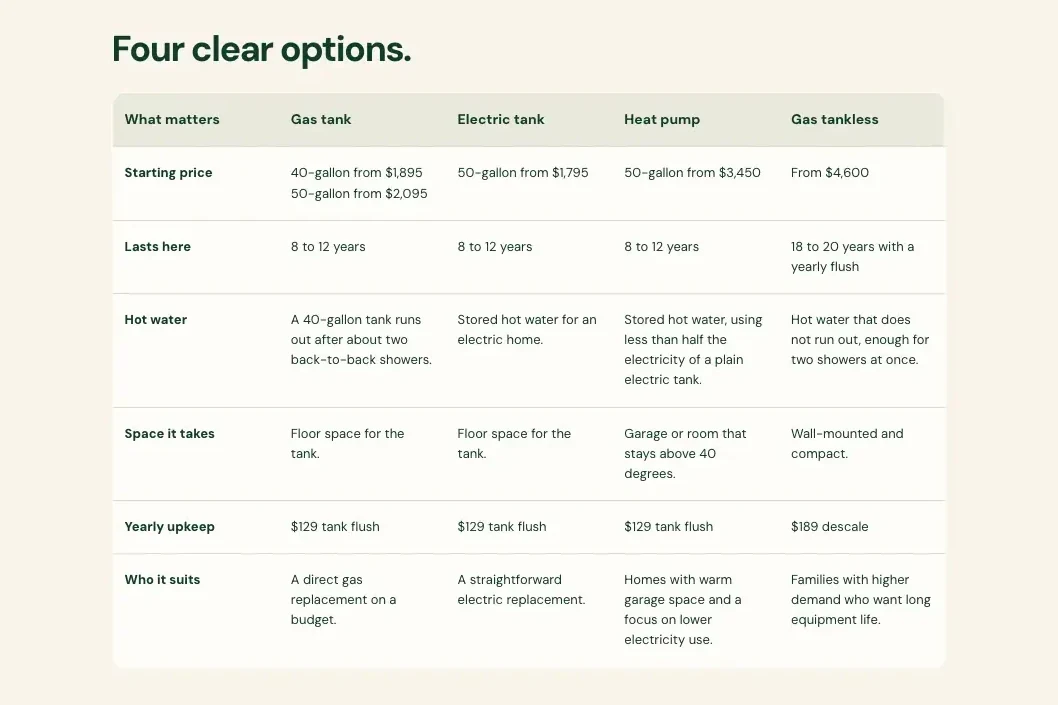
Take a plumbing business. A three-page site ranks for the company name and little else. Give the same business a page each for emergency repairs, drain cleaning and water heaters, plus a service-area page naming every town it covers. Add customer quotes and the license line to the site and click-to-call to the header. Now it has pages to rank for the searches its customers type. The site below shows the same layout for a business that does one thing. Hollisberg Water Heaters is a water heater installer's site for Boise, Idaho, built by Theo. Instead of one Services page, it has a page each for tank heaters, tankless heaters, repair or replace, yearly flushes and warranties, plus the comparison page pictured, which sets four kinds of water heater side by side with a starting price for each. Each of those pages answers a question a homeowner types into Google before calling. See the live site.
- Pages that answer specific searches: one per service, one per service area, plus posts that answer the questions customers ask before they call.
- Links from real organizations, earned slowly. Skip link farms and bulk link sellers.
- The same name, address, phone number and hours on the site, on the Google Business Profile and on every listing.
What moving up the traffic table looks like on one site
A site can move between the bands in the traffic table. One customer site, named here with the owner's permission, shows what that move looks like. Buy My Lunch takes school lunch orders online and has run on Theo since June 2026. Its numbers come from its own Search Console account, which records real clicks from Google. Through September 27, 2026, the site had 929 clicks from Google search in the most recent 90 days, against 131 in the 90 days before. Over the same two periods, as pages from the growth work went live, its search impressions (the times it showed in results) rose from 7,500 to 61,700 and its average position went from 13 to 8.
Read against the report, 131 clicks over 90 days puts the site in the 10 to 99 a month band, where 15 percent of the 4,633 sites with search data sit. At 929, it moves up to the 100 to 999 band, ahead of the 80 percent of those sites that get fewer than 100 a month. The comparison is a rough one, because Search Console counts real clicks and the report's figures are Semrush estimates, but the direction is the point. The climb came while Theo's growth work added pages, and ranking for many searches is what sets the report's top band apart.
| Search Console | The 90 days before | The 90 days to September 27, 2026 |
|---|---|---|
Clicks from Google search | 131 | 929 |
Search impressions | 7,500 | 61,700 |
Average position | 13 | 8 |

How these numbers compare with other small business website statistics
Two roundups, from Network Solutions and Wix, quote dozens of third-party figures on adoption, cost, behavior and the builder market. A few of them sit usefully next to the report's findings. Each is named with its source and quoted as published, as of September 2026.
- Cost. Wix's roundup quotes a Forbes figure of $2,000 to $9,000 for the average design cost of a small business website, depending on the type of site. Network Solutions' own blog runs the full range, from under $100 to over $100,000. The report does not record what each site cost. A site can cost anything in those ranges and still get an estimated zero visitors from Google search, because the money buys a design, not the pages and links that get it found. The small business website cost guide breaks the ranges down by route. On Theo, the first build is free, and the site with hosting is $29.99 a month on Basic. The ongoing search work comes with Starter, at $69.99 a month and free for the first 30 days.
- Behavior. SQ Magazine puts the share of shoppers who research online before buying at 81 percent. That is the number that turns a zero-traffic site into a cost: the research is happening, on someone else's site.
- Traffic. HubSpot's median of about 20,000 unique visitors a month, discussed above, describes websites in general across every traffic source. Held against a small business site, it is a poor fit.
- Adoption. Clutch's 83 percent and Zippia's 73 percent, plus 23.5 percent planning one, say having a site is a given. The report says being found is not.
- AI adoption. ZDNet reports that 98 percent of US small businesses use AI-enabled tools. The report does not measure AI use. Whatever tools a business uses, it is still the pages and the links that get the site found.
Benchmarks: where a small business website sits against the numbers
The tables above turn into a benchmark an owner can hold a site against. In the table below, the second column is the typical site and the third is the line to clear to get ahead of most of the sample. The last column is the median for the 287 sites with search data that score 70 or higher.
Two cautions. Traffic and keyword figures are Semrush estimates, so a site's own Search Console numbers will not match them exactly. And a referring-domain count says little by itself. The median site already has 136, and the trust signal is about who links, not how many.
| Measure | Median site | Ahead of most of the sample | Sites scoring 70 or higher |
|---|---|---|---|
Estimated visitors a month from Google search | 1 | 10 or more beats 65 percent; 100 or more beats 80 percent | 2,172 |
Semrush Authority Score | 2 | 11 or more beats 87 percent | 23 |
Keywords ranked | 23 | 10 or more beats 36 percent | 1,313 |
Referring domains | 136 | Not a benchmark on its own; who links matters more than how many | 435 |
Audit score | 34 | 50 or more beats 82 percent | 70 to 100, by definition |
How to check where your own website sits
Four steps, about 20 minutes, nothing to buy.
- Open Google Search Console, choose the site, and open the Performance report with the date range set to the last 3 months. The total clicks figure at the top, divided by three, is the monthly number to hold against the traffic table. If Search Console is not set up yet, the website audit checklist starts with getting it connected.
- Run Theo's free website audit with the site's address. The result shows estimated monthly search traffic, the trust score (the Semrush Authority Score), the keywords the site ranks for and the three to five issues costing the most, with no login.
- Hold the Authority Score against the authority table. Of the 6,335 sites with link data, 65 percent score under 6, and 11 or above is ahead of 87 percent.
- Read the top issues against the five themes above. If trust and authority lead, the work is listings and links. If competitors lead, it is pages that answer the searches they hold. If the site appears for almost nothing, it is more pages, starting with one per service. Repeat the check each quarter. Impressions in Search Console move before clicks do, so a site that is gaining pages shows progress there first.
What the numbers mean for a small business owner
Having a site is not the same as being found. Most sites in the report are live and get almost nobody from search. Speed and technical faults are rarely the cause. The typical site ranks for a couple of dozen searches, and few credible sites link to it.
Found sites rank for more searches and have more sites linking to them. Pages that answer specific searches, links earned from real organizations and consistent details across the web build that up over months. A site that is new to search starts with indexing. The guide on how to get a website on Google covers that first stretch step by step.
The bar to clear is lower than it looks. An estimated 10 or more visitors a month from Google search already puts a site ahead of 65 percent of the 4,633 sites with search data. An Authority Score of 11 or higher puts it in the top 13 percent of the 6,335 with link data. Both lines sit well short of the top band. Theo's Starter and Pro plans do the ongoing work aimed at those lines: keyword research, new pages and posts drafted for the owner to publish, technical fixes, indexing through Search Console, and building authority. Pro adds more pages and posts each week.
How the data was gathered, and its limits
Between August 2 and September 30, 2026, owners and their staff ran Theo's free website audit on the 6,861 websites in the report, each counted once by its most recent audit. The sample is therefore the sites whose owners chose to run the audit, not a random sample of small businesses, and it skews toward online stores. Traffic, keyword, authority and link figures are Semrush estimates taken at the time of each audit, not analytics counts. The full method, its limits and the dataset itself are on the report page, The State of Small Business Websites 2026.
How to cite these small business website statistics
Every figure from the report is free to quote with attribution to Theo, The State of Small Business Websites 2026, and a link to the report page. That page carries a copy-ready citation for each headline finding and a download of the full dataset. Three habits keep a quoted figure honest.
- Name the group the figure describes: 47 percent of the 4,633 sites with search data, not 47 percent of all small businesses.
- Say estimated for any traffic figure, and say from Google search, because the numbers exclude direct, social, referral and paid visits.
- Give the sample size and the year, since the dataset refreshes and the shares will move.
Frequently asked questions
What percentage of small business websites get no traffic from Google?
In Theo's audit of 6,861 small business websites, 47 percent of the 4,633 sites with search data got an estimated zero visitors a month from Google search. Another 2,228 audited domains had no search record at all, which usually means they have never ranked. Counting them as zero raises the share to 65 percent of all 6,861 sites. The report leads with the conservative 47 percent.
How much traffic does the average small business website get?
The median site in the report gets an estimated 1 visitor a month from Google search, across the 4,633 sites with search data. 65 percent get fewer than 10, 80 percent get fewer than 100, and 7 percent get 1,000 or more. Averages mislead here because a few large sites pull the mean up, which is why the report quotes medians.
How many small businesses have a website?
Clutch's survey puts it at 83 percent, up from 64 percent in 2018. Zippia counted 73 percent of US small businesses with a website in 2023, plus 23.5 percent planning one. Theo's report does not measure adoption, because every site in it already exists. It measures what happens next: 47 percent of the 4,633 sites with search data get an estimated zero visitors a month from Google search.
What is a good Authority Score for a small business website?
Lower than most owners expect. The median in the report is 2 out of 100, and 87 percent of the 6,335 sites with link data score 10 or below. Sites that scored 70 or higher on the audit had a median Authority Score of 23. A local business in the 11 to 20 range is already ahead of 87 percent of those 6,335 sites.
Which industry has the worst small business website traffic?
Online stores. Among the 2,018 store sites with search data, 54 percent got an estimated zero visitors a month from Google search and 71 percent got fewer than 10. Health, wellness and beauty sites did best, with 35 percent at zero among the 407 with search data.
Does the website platform explain the traffic gap?
No platform does, on this data. 35 percent of the 787 WordPress sites with search data sat at an estimated zero, against 49 percent for Squarespace, 50 percent for Wix and for Shopify, and 58 percent for GoDaddy Website Builder. The report does not show that the software causes the difference. Sites on every platform rank when they have the pages and the links, and most on every platform do not.
Why do most small business websites get so little traffic?
Mostly weak trust and visibility. 96 percent of audits flagged weak trust and authority signals as a top issue, 47 percent found competitors holding the searches, and 40 percent found the site appearing for almost no searches. Speed, mobile and technical faults made the top issues in only 3 percent.
Can these small business website statistics be quoted?
Yes, with attribution to Theo's report, The State of Small Business Websites 2026, and a link to it. Quote each figure with its sample size, say estimated for traffic figures, and name the group the figure describes. Third-party figures on this page should be credited to the source named next to them.
Where a site sits in the small business website statistics
Most of the 6,861 sites in the report are live and unseen, and the ones that get found rank for many more searches and carry many more links. On Starter ($69.99 a month, free for the first 30 days) and Pro ($129.99 a month), Theo's ongoing work drafts pages that answer those searches, one per service and per area, for the owner to publish. The site itself, with hosting, is $29.99 a month on Basic. To see where a site sits against these tables, run the free website audit: it shows estimated search traffic, trust score and the top issues, with no login.
More like this in the guides and under building a small business website. The audit numbers quoted across these posts are in Theo's research.